
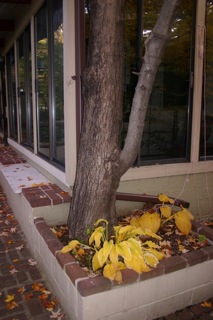
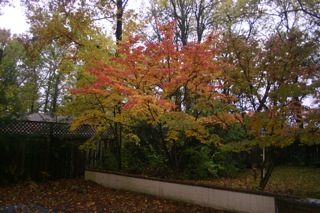
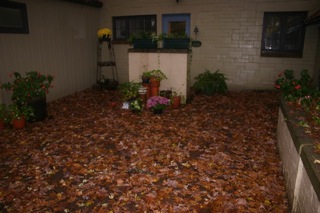
We had to take down a beautiful maple tree at the back of the house that was way too close to the foundation. Still, there are other maples nearby. And look at the dogwoods. Burning bush, pruned by the deer up to nose height. And leaves from yesterday’s storms. We still have plenty of trees. –Susan Bruce





Boys and tables: Asking may not be enough
In my last post, I talked about the parable of the blind men and the elephant, concluding that if we want to know how others see the world, “we need to ask.”
But often, simple asking is not enough. John Dewey includes the following story (from Ogden and Richards, quoting J. H. Weeks) in his Essays in Experimental Logic. He obviously liked the story as I do, because he repeats it in his Logic: The theory of inquiry:
I remember on one occasion wanting the word for Table. There were five or six boys standing around, and tapping the table with my forefinger, I asked, ‘What is this?’ One boy said it was a dodela, another that it was an etanda, another stated that it was bokali, a fourth that it was elamba, and the fifth said it was meza.
[It turned out afterwards that] one boy thought we wanted the word for tapping; another understood that we were seeking the word for the material of which the table was made; another had the idea that we required the word for hardness; another thought we wished for a name for that which covered the table; and the last, not being able, perhaps, to think of anything else, gave us the word, meza, table—the very word we were seeking.
References
Ogden, C. K., & Richards, I. A. (1949). The meaning of meaning: A study of the influence of language upon thought and of the science of symbolism, 10th ed. With supplementary essays by Bronislaw Malinowski and F. G. Crookshank (orig. pub. 1923). Routledge & Kegan Paul.
Philosophy reading group
Here are the readings for our philosophy reading group this year (2009-2010). There’s a general emphasis on practice-based theories:
- Bruno Latour, Why Has Critique Run out of Steam? From Matters of Fact to Matters of Concern
- Stephen Toulmin, Return to Reason
- Eddie S. Glaude, jr., In a Shade of Blue: Pragmatism and the Politics of Black America
- Optional: Frank Margonis, “John Dewey’s Racialized Visions of the Student and the Classroom Community,” Educational Theory 59, no. 1 (2009): 17-39.
- John Dewey, Logic: The Theory of Inquiry
- Victor Turner, From Ritual to Theater: The Human Seriousness of Play
- Jane Addams, Democracy and Social Ethics; there is a cheaper edition but it lacks the Haddock Siegfried intro
- Alasdair MacIntyre, “Idea of an Educated Public”
- Optional: Latour review of Dewey’s Public and its Problems
Other possibilities:
Bernstein, Beyond Objectivism and Subjectivism
Michel de Certeau, Practice of Everyday Life
Joe Dunne, Back to the Rough Ground
Bent Flyvbjerg, Making Social Science Matter
Ian Hacking, The Social Construction of What?
Bruno Latour, Reassembling the Social (or one of his others)
Jonathan Lear, Therapeutic Action
Alasdair MacIntyre, Dependent Rational Animals
Theodore Schatski, Social Practices
Richard Sennett, The Craftsman
Charles Taylor, Modern Social Imaginaries
Leslie Paul Thiele, The Heart of Judgment
Stephen Turner, The Social Theory of Practices
Victor Turner, The Ritual Process (or From Ritual to Theater)
and/or modern classics such as Arendt, Collingwood, Gadamer, Goodman, Oakeshott, Wittgenstein.
Apples and apples
 There’s more than corn and beans in the farmland here. Last Sunday, we visited an apple farm/orchard in Monticello, Illinois, which had 17 varieties.
Appropriately (for Monticello), one was Thomas Jefferson’s favorite, Spitzenberg. We got a little carried away and bought five half-pecks for $20.
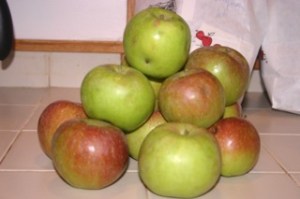 Fortunately, one is a long-keeper, Buff, which is supposed to last until late winter if it stays cold.
 If we don’t eat them all, we can feed them to our deer. See this backyard scene, where we played boule at the potluck in honor of John Dewey’s 150th birthday on Tuesday.
Blind people and elephants: We need to ask
 [These comments grew out of a discussion in our Community Engagement class.]
The parable of the blind men and the elephant (see also the Wikipedia entry) has been told and retold many times. In that story, blind men feel different parts of the elephant, each concluding that the elephant is only what they directly feel.
For example, as John Godfrey Saxe’s poem re-telling would have it, different men saw the elephant as a wall, a snake, a spear, a tree, a fan, or a rope. E.g.,
The Second, feeling of the tusk,
Cried, “Ho! what have we here
So very round and smooth and sharp?
To me ’tis mighty clear
This wonder of an Elephant
Is very like a spear!”
The story reminds us that reality may be viewed differently depending upon one’s perspective. But our fascination with it reveals that we, too, see only part of reality, making judgments about blindness based on not seeing actual blind people encountering actual elephants.
In Letter on the Blind for the Use of Those Who See, Javier Téllez takes the story in a new direction, by asking blind people to interact with a real elephant. (interview with Téllez and curator Mark Beasley)
As quoted in Greg Cook’s review in The Boston Phoenix, participants said things such as:
“It felt like a tire, a car tire, except it was warm. It wasn’t a good feeling.” “When I first went to touch it, I bumped into it, and I thought it was the wall. It felt like thick lizard skin.” “I felt an ear that felt like a hat and a trunk that felt like a hand.” “You feel the ridges and the bumps. And you can feel the life pulsing through it. You can’t hide it.” “It felt like I was touching some curtains.” “I imagined it to be quite large, but I couldn’t really sense how wide or tall it was. . . . And then I couldn’t tell if the damn thing was breathing or not breathing.”
Despite all the many tellings and re-tellings of that story, the actual blind people saw the elephant in ways not included in the standard versions of the parable. They helped me to see both blindness and elephants in new ways.
It’s good to recognize that people see the world differently, but to know what those different ways really are, we need to ask.
Dreaming in Hindi, by Katherine Russell Rich

Recently, I listened to an interesting Afternoon Magazine (WILL AM 580) radio interview with Katherine Russell Rich, related to her book, Dreaming in Hindi: Coming Awake in Another Language.
It’s her own story of learning language. When Rich lost her job at a New York magazine, she didn’t just file for unemployment compensation, she decided to immerse herself in Hindi and in India, as she says on her website;
I’d recently lost a job, I was watching the business I’d been in and loved, magazines, begin to crumble. My world had been turned upside down. Compounding that was the fact that in the decade before, I’d gotten smacked around twice by breast cancer. I barely recognized my own life anymore. Or the way that I put it in the book was, “I no longer had the language to describe my own life, so I decided to borrow someone else’s.”
There are many examples revealing about Hindi, English, language in general, culture, and Rich herself, e.g.,
…the word for yesterday and tomorrow is the same: kal, from Kali, the goddess of death and destruction. There’s a philosophy embedded in there—it’s only when you’re in today, aaj, that you’re here; if you’re in yesterday or tomorrow, you’re in blackness.
Preserving the $ by invading Iraq
This is old news, but I was reminded of it by a discussion on this weekend. It’s worth thinking about again in these parlous economic times.
Sharma, Tracy, and Kumar (2004) talk about one of the major, but little-discussed reasons for invading Iraq. Is militarism the best way to boost our economy?
What prompted the U.S. attack on Iraq, a country under sanctions for 12 years (1991-2003), struggling to obtain clean water and basic medicines? A little discussed factor responsible for the invasion was the desire to preserve “dollar imperialism” as this hegemony began to be challenged by the euro.
References
Caryl, Christian (2009, October 16). Decline of the dollar. Foreign Policy.
Sharma, Sohan; Tracy, Sue; & Kumar, Surinder (2004, February). The Invasion of Iraq: Dollar vs Euro Re-denominating Iraqi oil in U. S. dollars, instead of the euro. Z magazine.
Your very own barcode
Tech-Ex talks about the Google doodle becoming a barcode, and then, how to make your own. That article also includes a little history of the barcode:
The first item scanned was a pack of chewing gum scanned at an Ohio supermarket in 1974. On June 26, 1974, Clyde Dawson pulled a 10-pack of Wrigley’s Juicy Fruit gum out of his basket and it was scanned by Sharon Buchanan at 8:01 AM. The pack of gum and the receipt are now on display in the Smithsonian Institution.
Click here to create your own, and you too could be scanned!:  by Barcodes Inc



Is it good to synchronize traffic signals?
The Champaign County Regional Planning Commission hopes to apply for a $1.94 million federal grant to coordinate the traffic signals at dozens of intersections in the community, covering major corridors such as Neil Street and Prospect, University, Bradley, Mattis and Florida/Kirby avenues.
Champaign-Urbana Urbanized Area Transportation Study…says the proposed “traffic signal energy efficiency and conservation strategy” could reduce the typical motorist’s annual travel times by 20 to 50 percent, cut fuel consumption by 14 percent and reduce carbon dioxide, methane and nitrogen dioxide emissions by 13.3 percent.
via The News-Gazette.com: Re-timing of traffic signals could be first stage in overhaul.
 Saving energy, reducing pollution, reducing travel time, all sound good. But synchronized signals along University Avenue may have an insidious consequence.
It’s already the case that University Avenue marks and maintains racial divisions in the cities of Champaign and Urbana. Some people south of University, especially whites, view “north of University” as an area they don’t want to be in. And some blacks north of University may view south of University as an unwelcoming place. The busy traffic corridor with miserable access for pedestrians reinforces the view that these two domains are separate, and necessarily so.
As an already busy traffic corridor, University Avenue makes it difficult for alert, athletic adults to cross from one area of town to another on foot or bicycle. It’s positively unsafe for children or anyone without well-honed defensive faculties. Drivers already go too fast and are inattentive to pedestrians and cyclists. This could become worse with synchronization.
Could the street become safer with synchronization? Maybe. But I doubt that will happen if the only concerns considered are overall vehicular traffic flow.
I’m not sure in the final analysis whether the proposed changes should be done or not, but I do believe that we’d be better off if we were to understand better the symbolic and material consequences of slashing through our community.
Dewey’s logic
 John Dewey is not even mentioned in the Wikipedia article on Logic. That’s an oversight that I’m tempted to remedy, but it also reflects the fact that the 20th century development of logic in the tradition of Frege, (early) Wittgenstein, Russell, Gödel, and Tarski has largely ignored Dewey’s work, conceiving it in various ways, but above all, as not part of Logic. His idea that logic is the theory of inquiry is deemed to be a non-starter.
Dewey’s new logic
Bertrand Russell, in particular, took pains to explain why Dewey’s logic (1938) was not real logic, how it failed to address the fundamental questions of truth conditions or the relation between propositions and meaning, an idea that Tarksi had already developed in his model theory. Logicians should focus on concepts such as truth conditions, consistency of logical systems (that not all statements are provable), and completeness (that true statements are provable).
The development of model theory as a basis for semantics meant that the direct connection with the world was severed; logicians could now focus on the structure and operation of logical systems per se, without concern for real world consequences. In the terms of academic logic, it’s clear that Russell won the battle; Dewey’s “new logic” as Russell demeaned it, especially with its insistence on connection to lived experience, is now judged irrelevant by virtually all mathematical logicians, and most philosophical logicians.
 However, despite the great achievements of Tarski and others to follow, the standard account of logic has encountered obstacles. Kurt Gödel proved that any effectively generated theory capable of expressing elementary arithmetic cannot be both consistent and complete. For most systems of greater complexity, it’s not possible to say what consistency and completeness even mean.
Logicians began to see that formal logic was inadequate for the goals that David Hilbert, Russell and Whitehead, and others had proposed. Moreover, it was completely inadequate for that part of the universe that isn’t elementary arithmetic, i.e., social relations, history, culture, language, art, learning, nature, and all the other things that most people care about.
 In recent years, these inadequacies of the formal semantics approach have led to a reconsideration of Dewey’s theories. Thomas Burke, among others, has called for a critical, re-examination of logic as the theory of inquiry. In Dewey’s new logic: A reply to Russell, he analyzes the debate between Russell and Dewey that followed the publication of Dewey’s Logic: a theory of inquiry in 1938. He concludes that although Russell won the battle, Dewey won the war, in the sense that his logic holds more promise for the future, especially as a a logic for work in the social sciences and humanities, or for practical concerns.
Dewey’s unread book
In the preface to his 1938 book on logic, Dewey says,
This book is a development of ideas regarding the nature of logical theory that were first presented, some forty years ago, in Studies in Logical Theory; that were somewhat expanded in Essays in Experimental Logic and were briefly summarized with special reference to education in How We Think.
There are many proposed encapsulations of Dewey’s vast body of work. If I had to choose one, it might be logic, which Dewey himself saw as a 40-year project. His early training, an academic context that sought a logical basis for knowing and life, and the ways in which his logic integrates across his ideas in art, education, political theory, morality, and other areas, suggests to me that logic could be the strongest connective thread.
 As he develops his logic, one can see the core behind many of Dewey’s major ideas, such as warranted assertions, situation, ends-in-view, habits, the continuum of inquiry, facts and meanings, and the relation between natural and social science. He also confronts major issues in logic as they are conceived by Russell et al., but always with a twist, which not surprisingly, makes his views unacceptable to that community. Nevertheless, I agree with Burke et al. that Dewey offers us the best option for a usable logic for the problems of today.
Reading Dewey’s Logic: A theory of inquiry
 Some of Dewey’s Logic: a theory of inquiry can be a slow read. Published 71 years ago, the style is often pedantic. Dewey’s characteristic lack of references, diagrams, compelling metaphors, and good examples doesn’t help. His attempts to speak to the world of Russell and Tarski often get in the way. Nevertheless, the ideas are powerful, and deserve the reconsideration mentioned above.
Much of the book can seen as explaining one of the few definitions Dewey ever provides:
Inquiry is the controlled or directed transformation of an indeterminate situation into one that is so determinate in its constituent distinctions and relations as to convert the elements of the original situation into a unified whole.
The book is 556 pp. (my copy), divided into four parts. Part I is probably the most useful for most readers. It’s here that he provides the rationale for conceiving logic as inquiry, and discusses topics such as common sense in relation to scientific inquiry.
Part II defines inquiry and explores the construction of judgments. Part III on propositions and terms is a shorter section, and probably the most technical in the book. It’s also the one that speaks most to Tarski, although in a way that I suspect he rejects. Part IV focuses on mathematics and science. I found it to be the most interesting, especially as it deals with scientific methods, scientific laws, theories of knowledge, and social inquiry.
My recommendation on reading is to slow-read Part I, in order to understand what Dewey is trying to do. Use Part II as a way to see how the theory plays out, but devoting effort to chapters differentially, e.g., I find chapter 8 on understanding and inference to be especially good. Part III could be left for a more advanced read. Part IV is very good, especially the last three chapters.
Table of Contents
Here is the TOC for Logic: a theory of inquiry. The links are to the Past Masters collection at the University of Illinois (login required).
|
preface
|
 |
|
|
|
References
- Burke, F. Thomas (1994). Dewey’s new logic: A reply to Russell. Chicago: University of Chicago Press.
- Burke, F. Thomas; Hester, D. Micah; Talisse, Robert B. (Eds.) (2002). Dewey’s logical theory: New studies and interpretations. Nashville: Vanderbilt University Press.
- Dewey, John (1938). Logic: a theory of inquiry. New York: Henry Holt.
- Talisse, Robert T. (2002). Two concepts of inquiry. Philosophical Writings, 20, 69-81.
- Tarski, Alfred (1983). Logic, semantics, metamathematics: Papers from 1923 to 1938 (2nd ed.). Hackett, Indianapolis: Hackett.
 Chip's journey