People often talk of the Internet as a venue for open learning. But this openness often means simply that students can explore a vast array of resources, perhaps coming across sources that neither they nor their teacher expected.
It’s useful to think about the various ways that new information and communication technologies (ICTs) create additional possibilities for open learning, including both its benefits and costs. Several years ago, Umesh Thakkar, Eric Jakobsson, and I along with others developed such an analysis for the case of Biology Workbench (see Molecular Science Student workbench and Swami). The general idea is that Biology Workbench could facilitate open world learning.
Biology Workbench is a suite of computational tools and data sources, which is used by scientists across a wide range of disciplines to explore and analyze protein and nucleic acid sequence databases. There is a wide variety of analysis and modeling tools, within a point and click interface that ensures file format compatibility.
Thus, Biology Workbench is not an alternative tool for teaching biological concepts, although students who work within it can expand their understanding of biology significantly. Rather, it is an exemplar of a venue for learning, one in which students explore genetics, protein structure and function, physics, chemistry, and other domains of inquiry, invoking processes of pattern-matching, probabilistic reasoning, and both inductive and deductive analysis. Its potential significance for learning relates to three major ways in which it is an open system.
Open Data and Problems
The Workbench architecture provides the potential for using information technology to provide an open world of learning and exploration. Previous approaches to using computers in education have focused on the creation of closed worlds in which students could navigate and explore. Many of these computational environments are excellent and useful, but they are limited. Students are not encouraged to investigate the unknown. In general, students cannot investigate phenomena that the creators of the environment themselves do not know.
The open environment of the Biology Workbench is fundamentally different. By providing access to essentially all that is known about biomolecular sequences and structures, together with powerful analysis and visualization tools, the Workbench makes it possible for students to learn more than what their mentors and teachers know, and even to generate new basic knowledge. The key idea here is not only that there is a large amount of material, but that the data are constantly changing as a result of scientific work. This is true of course for the Web in general, but appears more striking in the case of rapidly changing molecular data (see point #2 below).
This aspect of the Workbench was exemplified by one instructor who was using the Workbench in a university class. She commented that once the students went beyond working through specified exercises, they were essentially doing original biological research, doing analyses that perhaps had not been done before, and she was hard pressed to know how to grade their work.
Open Computational Environment
In addition to providing a window to the entire world of molecular biology, the Biology Workbench is open in a second sense. It is continually growing, adding new features that extend its capabilities and domain of applicability. New domains of applicability include the ability to reconstruct metabolic pathways by utilizing data from newly developed microarrays (gene chips and metabolic flux chips) and the ability to do molecular simulations. The Workbench continues to grow as the whole field of computational molecular biology grows, because it is more than a computer program. It is a computational environment that integrates tools for exploring and learning about all aspects of molecular biology. This dynamic growth is both a plus and a challenge for teachers or curriculum designers who might reasonably seek consistency in their curricula.
Open Community
The Biology Workbench exists within a community of investigators working across a variety of areas within molecular biology. These investigators are not only users, but creators of the system, as they add their research results to the available corpus of articles or their findings result in additions or other modifications of the databases. This community is a powerful resource for education, but it does not exist to meet educational needs per se.
Students who attempt to learn through the Workbench are able to enter into that community of investigators. In so doing, they have stepped outside of the protected world of the classroom. Their learning becomes much less structured, even potentially hazardous without the assurance of carefully vetted curricula, but it can also be far more engaging and applicable to learning beyond the classroom.

 I wrote most of my last post while flying from San Francisco to Chicago. Flipping through the airline magazine, the essay by Gerard J. Arpey, “The world is a book” caught my eye. It’s from St. Augustine: “The World is a book, and those who do not travel read only a page.” That seemed to be the message of Stilgoe’s Outside lies magic.
 Gesa Kirsch recently pointed me to John R. Stilgoe’s, Outside lies magic: Regaining history and awareness in everyday places. It’s a refreshing call for becoming more aware of the ordinary world around us. Stilgoe urges us not only to walk or cycle more, but also to use the advantages of those modes of transport to see the world that we usually ignore.
 The chapters—Beginnings, Lines, Mall, Strips, Interstate, Enclosures, Main Street, Stops, Endings—lie somewhere between prose poems, history lessons, and sermons about the everyday. They remind me of John McDermott’s summary that John Dewey “believed that ordinary experience is seeded with possibilities for surprises and possibilities for enhancement if we but allow it to bathe over us in its own terms” (1973/1981, p. x).
 He shows the value of a camera, despite the lament that “ordinary American landscape strikes almost no one as photogenic” (p. 179). He recognizes the dread of causal photography (‘why are you photographing that vacant lot?’), but ties it to “deepening ignorance” (p. 181). This ignorance makes asking directions dangerous: People question us back, ‘Why do you want to know?’
 I was fortunate to have a visit with youth planners at the
  What I saw is part of
 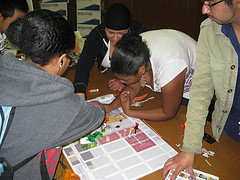 Sarah Van Wart from the UC Berkeley I School was my guide. She and two undergrads, Arturo and Sarir had been leading the high school students in a community planning exercise. They first examined their current situation, using dialogue, photos, and data. They then considered alternatives and how those might apply to a planned urban development project.
 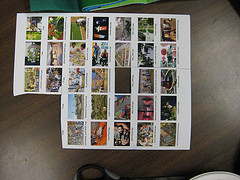 The development will include schools, housing, a park, and community center, but the questions for city planners, include “How should these be designed?” “How can they be connected?” “How can they be made safe, useful, and aesthetically pleasing?”
 On the day I visited, the youth had already developed general ideas on what they’d like to see in the development. Now they were to make these ideas more concrete through 3-D modeling. Using clay, toothpicks, construction paper, dried algae, stickers, variously colored small rocks, and other objects, they constructed scale models of the 30 square block development. One resource they had was contact sheets of photos of other urban environments. They could select from those to include as examples to emulate or to avoid.
 I was impressed with the dedication and skill of the leaders of the project, including also the teacher, Mr. G. But the most striking thing was how engaged the young people were. I heard some healthy arguing about design, but I didn’t see the disaffection that is so common some high schools today.
 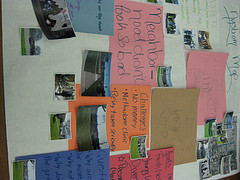 My only regret is that I wasn’t able to follow the process from beginning to end. But from the rich, albeit limited, glimpse I had, the project is an excellent way to engage young people in their own communities, to use multimedia for learning and action in the world, and to learn how to work together on meaningful tasks. It’s a good example of
 I just saw a reference to a New Scientist article,
 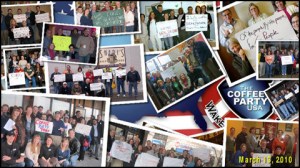 I met recently with someone who’s played a major role in starting
 Happy Pi day! It’s March 14, or 3/14, the first three digits in the decimal expansion of Pi.
