Photo opportunity

I was recently invited to appear in a book for the Fort Worth Museum of Science and History. They’re featuring people who played an important role in creating the museum, famous people who enjoyed the museum, and for some reason, me.

This project involved making photos of the people in scenes with museum artifacts. In my case, that was to be antique telescopes. It’s not hard to find antiques, since even the new ones from my day are now over half a century old. The photography was to take place in Austin.

My photo shoot went OK in the end, but was a near disaster in many ways. Skipping over several minor problems, which made me a few minutes late, I arrived at what I thought was the site, the J. J. Pickle Research Campus, only to be told that I had come to the wrong place. Michael O’Brien, the photographer, did not have any office there, but could definitely be found at CMA (?) on the main University of Texas (UT) campus. *All* I had to do was drive down Burnet Rd to 183, take IH 35, get off at 24th St, and find my way to his office. That was a white knuckles drive in the Austin traffic, in an unfamiliar car, especially when I don’t see well while I’m waiting for new contact lenses.

Anyway, I eventually got to the main campus, but at the opposite corner from CMA. I was given a map, but it didn’t show construction. So, I’d drive ten blocks down a narrow street, with cars on both sides, people on bicycles, pedestrians walking haphazardly, while searching for a street sign I could read. Then I’d come to a construction barrier, which meant I had to back up and go a different way. I eventually reached what I thought was CMA.

There were of course no parking spaces, save for one with large signs declaring how your car would be towed within seconds and crushed to a pinpoint of dense matter for use in a cosmology department experiment if you even thought of using it. It was my mother’s car, but she wasn’t there, so, deciding for her, I took the chance. Inside CMA, which by now I’d decided was a top secret agency, known only to a few others with three-letter acronyms, I asked for Michael O’Brien. No one would admit knowing him, and he wasn’t in the directory.

I kept pressing on, meeting people in the special needs communications department (obviously some kind of intelligence agency function), radio-television-film (propaganda department), and eventually journalism. Under relentless pressure, I finally got someone to claim him.

Unidentified But Helpful Person: Would you like his phone number?
Me: Thanks, no, I have that and already called it, leaving a message.
UBHP: He has a cell number.
Me: Oh, can you give me that?
UBHP: No, but I could call it for you.
Me: Please do.

To my surprise, we reached Michael. Almost immediately another call came in, undoubtedly from some little-known war region, so we went on hold, I had to move to another room, needed to, but couldn’t find the other phone, had trouble reconnecting, and so on. Eventually, we were able to talk, most certainly being recorded by CMA operatives. I apologized; he apologized.

Then, I learned where he was, at the J. J. Pickle Campus: “All you need to do is get across the campus, head north on that same IH 35, take 183 north to Burnet Rd. Just come in the main gate [exactly where I’d been before].” We’re in building 6.

So, I retraced my previous harrowing drive, finally making it the photo shoot. I was sweaty, dehydrated, frazzled, rumpled, everything one needs to be ready for an expensive, high-stakes photo op.

Building 6 turned out to be Vertebrate Paleontology. It’s filled with fossils of creatures who blessedly never had to deal with Austin traffic, construction, vicious tow operators (I got away this time), or  gigantic campuses. I wanted to explore the building, but we (the photo crew of three and I) were after all now an hour late.

So, we moved directly into photos. Poor Michael and team must needed to take several hundred, searching for one in which I didn’t look like the after photo from the evil tow company’s crushing operation. Eventually he succeeded.

But I’m almost certain that when he said he’d gotten a good one, that he’d focused on the telescope alone, and I was out of the frame. As Dewey’s idea of end-in-view tells us, standards for success need to accommodate to changing reality. The sharks managed to stay away.

Anyway, we were done. I hope the book is a success in spite of me.

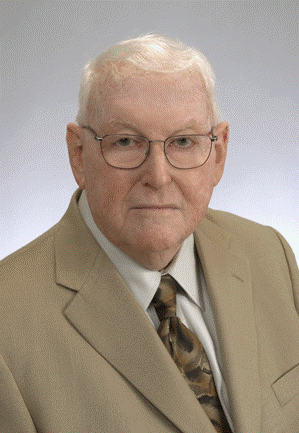
One bonus of the adventure was that I got to meet Wann Langston, a famous UT paleontologist (above left). He’ll be featured in the book because of his research on fossils in Texas, which played an important role in the Museum’s early development, including my own experiences in the “Rocks and Fossils” classes.

Langston shared some of his current work on fossilized giant crocodiles from the Big Bend area. I think they were Deinosuchus. He showed us several models made from creatures with jaws big enough to swallow a man whole, especially one who by then was exhausted from his photo shoot (harder than you may think) and his explorations of the UT campus(es).

“Free” as in free enterprise?

When Clear Channel has a station at the DFW airport saying “FREE Charge and Internet™”, would you think that it offers free charging AND free Internet”? I foolishly did, in part because I thought the ™ applied to “FREE Charge and Internet” and that they hadn’t actually trademarked “Internet”.

It’s possible that they meant that you could get free Internet if you were already a home Clear Channel subscriber, but for me, it was $7.95. I know, it’s less than two medium lattes, but that still fails to add to my already incalculable love of flying.

This is from a press release on their website:

“FreeCharge™ has, not surprisingly, been very popular with passengers flying in and out of our busy airport. They provide not only free power but also free internet with CAT 5 and USB ports.”

On network neutrality

Today’s News From the University of Illinois at Urbana-Champaign

ON NETWORK NEUTRALITY: A MINUTE WITH U. OF I. EXPERT CHIP BRUCE

Editor’s note: The proposed deal between Google and Verizon to create two tiers of service for Internet traffic has made waves throughout the technology and telecommunications industry. It also managed to rile network neutrality and privacy advocates, who see the proposed partnership in much starker terms, with some even going as far as calling the deal the end of the Internet as we know it.

Chip Bruce, a professor of library and information science at the University of Illinois, was interviewed by News Bureau reporter Phil Ciciora about the Google-Verizon partnership and its impact on network neutrality.

What makes the proposed partnership between Google and Verizon so scary for consumers? Why should this give the average person pause?

Today, you can go online to see content offered by Google or Verizon, but also that of other large computer and communications companies, small businesses, governments and non-governmental organizations, and potentially any of the world’s 2 billion Internet users as well as content produced originally offline. Google says that this partnership won’t endanger that, but the loss of net neutrality is a first step away from open access to information and toward pre-packaged service.

Verizon wants to be able to serve its content faster or even in lieu of any of its competitors’ content. You’d be able to get news, music, videos and sports as always, but Google-Verizon could say which version you’d see. This immediately endangers free speech and the free flow of information, because private companies would essentially have the final say on what gets out. It also has implications for privacy of Internet use, since the providers will need to examine Internet content in order to control it.

There are also major risks for innovation on the Internet. Suppose that someone in a dorm or a garage devises a better way to deliver television and movies. If major providers control which information flows in what way, those young entrepreneurs may never get the chance to enter their idea into the marketplace.

Net neutrality advocates would argue that the increasing corporate control over the Internet essentially has privatized a service that was developed at public expense to serve public needs. Does that line of reasoning also hold for wireless networks?

Much of the basic technology for both wired and wireless systems has been developed at public expense to serve public needs. The communications corporations would argue that they’ve invested a huge amount on top of that, and in absolute dollar terms, they have.

But beyond any argument about who paid for what, we should remember why public funds have been used to support basic communications. The primary reason is the understanding that a viable democracy requires free and open communication among an educated public. In addition, an open system fosters economic development, cultural exchange, education and many other public goods.

Corporate control over the Internet offers no assurance that these public values will be served. In fact, by law, corporations have a fiduciary responsibility to serve their stockholders, not the public.

Google CEO Eric Schmidt recently has argued against the “sheer impracticality” of net neutrality on wireless networks. Is he correct?

There has never been nor will there ever be full and absolute net neutrality. Money and power speak in many ways to ensure, for example, that an ordinary person does not have the same access as a major multinational corporation does. With demand exceeding capacity, it may be difficult in the short run to maintain net neutrality on wireless networks. However, the bigger question is what policies we should strive to maintain. Do we want communications systems that afford the greatest possible freedom of access and use for all, or do we want a small set of closed systems, offering controlled and pre-packaged content?

It seems like corporations are increasingly setting the terms for the net neutrality debate. What should the FCC do to re-assert its jurisdiction and authority?

A key issue is whether we want to allow the major means for Internet access to become a set of packages of controlled information, like an individual book or magazine in print form. That’s what the loss of net neutrality could mean.

But I see the Internet as a communications system, and major communications companies as common carriers of those communications. As such, it’s crucial that they be required to deliver communications without tiers for special services, favoritism or control of content. In that sense, the Internet is more akin to the print publishing world, not to a single book.

This means that the FCC needs to “reclassify” broadband from being an information service to a telecommunications service, which would then require communications companies to ensure open use.

What would an Internet without net neutrality look like?

We don’t know for sure, and there are many reasons why – corporations may react in different ways, the public may acquiesce or rebel, and the technologies may change in radical ways we can’t foresee today.

It’s increasingly likely, however, that the Internet experience will become one defined by the specific service one purchases, whether that’s through Verizon, Comcast, AT&T, or some other company. Each corporation will seek to meet consumer needs, but in a way that maximizes its profit. For example, every service will offer movies, but the cost, terms of service, and so on, will be those of that provider. There will be a financial incentive to deprecate services that don’t generate revenue. What’s being sold is then a package of services, not general communication access.

The ordinary user will see some enticing new services, as each corporation tries to lure customers. But she or he will not find some content they find now, because it won’t support the business model. A recent example is Comcast’s undermining of net neutrality by shutting down peer-to-peer networking – in particular, BitTorrent. A U.S. Appeals Court ruling in April allowed that under the assumption of the Internet as information service.

And it’s not just cheap entertainment that will be lost. About the same time as the U.S. Appeals Court ruling, WikiLeaks released a classified U.S. military video showing the killing of more than a dozen people in Iraq, including two Reuters news staffers. What guarantee do we have a profit-seeking corporation will provide open access to independent media?

Suppose you think BitTorrent and WikiLeaks are wrong. Do you want your Internet provider to decide what you can and cannot see? Beyond the specifics of access, privacy, free speech and innovation, the big question is, “Who should decide Internet policy?”

Visit the News Bureau for more U. of I. news.


See also:

Mosque debate plays into the hands of extremists

Dina Temple-Raston reports today on National Public Radio that the protest against the proposed community center and (the so-called “ground zero”) mosque in lower Manhattan has been a boon for terrorism. The rise of bigotry and the erosion of Constitutional rights are only part of the story.

While the ugly debate goes on, there has been an “an altogether different view” on radical blogs and web forums:

All this controversy and vitriol are not only encouraged; they’re welcomed. Extremists and radical clerics posted a stream of “I told you so” messages: After years of telling followers that Islam was under attack by the West, the harsh reaction to a simple community center seemed to prove it.

The fact that extremists, even possibly violent ones, enjoy hearing attacks on the community center is not a reason to stop the dialogue about it, any more than the violence of a few is reason to curtail the religious freedom on which this country was founded or to actively disparage those who worship in different ways. But it is reason for all of us to reflect on our actions.

Just because something seems strange or uncomfortable doesn’t justify an uninformed attack on it, especially when doing so is exactly what extremists have been saying all along: “They (the West) are out to get us, they won’t listen, and they won’t accept our hand, even when we offer it generously. How else can we defend ourselves?”

You can read or listen to the story at Rancor Over Mosque Could Fuel Islamic Extremists.

Network neutrality notes

Network neutrality means no restrictions by Internet Service Providers and governments on content, sites, platforms, attached equipment, or modes of communication. This includes neither blocking sites nor offering tiered service models. It can be viewed from the perspective of users wanted to access particular content, such as peer-to-peer sites for video or music, or from the perspective of producers seeking to deliver their content more effectively to users.

History. Concerns with telegraph: “messages received from any individual, company, or corporation, or from any telegraph lines connecting with this line at either of its termini, shall be impartially transmitted in the order of their reception. (Pacific Telegraph Act of 1860)

In 1934, Congress created the Federal Communications Commission (FCC) with the purpose “to make available, so far as possible, to all people of the United States… A rapid, efficient, Nation-wide, and world-wide wire and radio communications service with adequate facilities at reasonable charges, for the purpose of the national defense, [and] for the purpose of promoting the safety of life and property through the use of wire and radio communication.”

The Internet developed out of public funded services, such as Arpanet, NSFnet, TCI/IP. Eventually centralized routing aspects were removed, allowing the free-wheeling Internet we use today. But in recent years, corporate control over key aspects of the Internet has grown, essentially privatizing a service developed at public expense to serve public needs.

Tiered service. Opponents of net neutrality see it as “a solution in search of a problem”, arguing that broadband service providers have no plans to block content or degrade network performance. Yet, Comcast, for example, “intentionally and secretly blocked access to lawful content on the Internet,” e.g.,  peer-to-peer (P2P) communications, such as BitTorrent. The FCC attempted to block that, but lost that authority after a US Court of Appeals decision on April 6, 2010.

Google may soon reach an agreement with Verizon, which will severely compromise the free flow of information that has made the Internet such a powerful force for creativity, collaboration, and learning.

Issues.

  • Innovation: The Internet has been a striking incubator of new ideas, enterprises, products, services, and jobs. This is to a large extent based on its open practices.
  • Privacy: An Internet with built-in nonneutrality would require an additional level of monitoring, i.e., surveillance, so that packets of information can be routed at the agreed-upon speed and that premiums can be charged. (Cohen, 2010).
  • Free speech: The more service is based on the ability to pay, the less access will ordinary people have to the public forum. ISPs, with a legal responsibility to their shareholders alone, have no incentive to guarantee high quality access to all, and in fact, are legally bound not to do so. They could degrade or block any Web site that was critical of them or did not support their political views.
  • Secrecy: In a Kafkaesque mode, there is no provision for corporations to reveal their selective control of content, including whom they target for preferential or degraded service, why they do so, or even whether or how much they have done. Nearly all major phone and cable companies have promised their shareholders that they plan to block or degrade the content and services of their competitors.
  • Access to information: The other side of free speech. Access suffers when what’s available is based on how much someone paid to put it there.

Who decides. Beyond the specifics of access, privacy, free speech, innovation, etc., the big question is “Who should decide internet policy?”

References

Cohen, Noam (2010, August 15). Internet proposal from Google and Verizon raises fears for privacy. The New York Times.

Pacific Telegraph Act of 1860. Central Pacific Railroad Photographic History Museum.

US Court of Appeals (2010, April 6). Comcast Corp. v. Federal Communication Commission..

Priorities and values

Money reflects priorities, and priorities reflect values. Consider US Government expenditures to

Put another way:

The US government has in effect offered $3.80 for each of the 20 million people who’ve lost family members, food, clean water, homes, and livelihoods because of the floods. It’s spent 158 times that for military aid, much of which has not gone to fight terrorism, but to bolster a military dictatorship, to provide heavy weaponry that threatens India, and to benefit the US defense industry. It’s spent 4,276 times as much to fight a war that shows little prospect of winning hearts and minds, nor for ending terrorism.

(Of course, we may later spend more on flood relief; we could consider annual, rather than total costs; all of the numbers are contested estimates. But regardless of how you cut it, the differences are striking.)

Then we ask: Why don’t “they” love us and embrace our values?

Udderbot

This may be a big mistake, but I’m now learning about udderbots.

This coming Friday at 8 pm there’ll be the “World’s First Udderbot Recital” at the UC Independent Media Center in Urbana. But here and now are some samples: “Queen of the Nite” and “kleismic joy”.

Jacob Barton is a co-inventor of the udderbot, and undoubtedly its greatest virtuoso. He’s now an Americorps worker at the IMC, who earlier studied composition and performed on the udderbot at Rice University, my alma mater. There’s a feature article with photos in the News-Gazette today, and you can also read about it on the udderbot wiki [photo from the wiki].

Islamic community center in New York

Based on the evidence, this post seems unnecessary and even risks treating bigotry with more respect than it deserves. But based on rhetoric in the mass media and polling numbers the post seems overdue.

The Cordoba Initiative is building an Islamic community center in Lower Manhattan, called Cordoba House. The center will include a mosque, an auditorium, a swimming pool, a restaurant, and a bookstore. It’s based on the model of Jewish community centers and Y’s in Manhattan; the board will include Muslim, Christian, and Jewish leaders. The center is “dedicated to pluralism, service, arts and culture, education and empowerment, appreciation for our city and a deep respect for our planet” and to serve as a model of moderate Islam.

Located near (but not at) Ground Zero, Cordoba House replaces a building damaged in the September 11 attacks. Announcement of the plans led to a brouhaha, what Anthony DiMaggio calls a “manufactured controversy.” Although there is both support and opposition among every group (9/11 survivors and families, people in Lower Manhattan, Christians, Muslims, etc.), the majority view is opposed. Some people go so far as to argue in effect for an abandonment of the First Amendment, for the government to establish which religions should be allowed to practice where, not to mention an extraordinary abridgment of private property rights.

But as Todd Gitlin writes, it is not the duty of American governments “to construct a mosque-free zone around the World Trade Center site because some Americans oppose putting it there.” To his credit, Mayor Bloomberg gave unambiguous support to the idea that the fact of terrorism should not be allowed to destroy American values or Constitutional rights.

Referring to the firefighters and police officers who entered the trade center on September 11, Bloomberg said, “In rushing into those burning buildings, not one of them asked, ‘What God do you pray to?’ ‘What beliefs do you hold?’” Further, “We do not honor their lives by denying the very Constitutional rights they died protecting. We honor their lives by defending those rights—and the freedoms that the terrorists attacked.”

Bloomberg based his actions on general principles of religious freedom and against bigotry. But having lived for many years in Cambridge and Somerville, Mass., I can’t help noting that his parents had to hide their identity when they wanted to buy a house in Medford. Joyce Purnick says in her biography:

“My uncle wouldn’t dare sell to a Jew,” says a childhood friend of Mike, Thomas Buckley, about his relative, the realtor who sold the stone-and-clapboard houses in the newly built community that attracted the Bloombergs. “If he did, he would have been out of business. He knew they were buying it. He just didn’t say anything.”

No Jews lived in the immediate neighborhood, very few anywhere in Medford. But everyone assumed that would change, including the Bloombergs, who resolved not to let residual anti-Semitism block their path. “They weren’t very happy,” Mrs. Bloomberg said of some neighbors. “Our lawyer, George McLaughlin, who was Irish, bought the house and sold it to us.

Bloomberg managed to survive Medford and later endowed his hometown synagogue, Temple Shalom. It was renamed for his parents as the William and Charlotte Bloomberg Jewish Community Center of Medford.

After 9/11, many people asked Muslims to condemn the trade center attacks, fanaticism, terrorism, and Osama Bib Laden. They also demanded that Muslims reach out to mainstream America. That’s exactly what the Cordoba Initiative is doing. But even if they weren’t doing that, our Constitution as well as basic human decency call on us to respect the rights of all, even those we misunderstand.

References

Barbaro, Michael, (2010, August 12). Mayor’s stance on Muslim center has deep roots. The New York Times.

Clawson, Julie (2010, June 8). Forgiveness, Fear, and the Mosque at Ground Zero. Sojourners.

DiMaggio, Anthony (2010, August 12). The Muslim community center at Ground Zero: A manufactured controversy. counterpunch.

Gitlin, Todd (2010, August 13). American values and the Ground Zero mosque. The New Republic.

Purnick, Joyce (2009). Mike Bloomberg: Money, politics, power. PublicAffairs, Perseus Books Group.

Salisbury, Stephan (2010, August 10). Mosque mania. Mother Jones.

Perseid meteor shower

Don’t miss the annual Perseid meteor shower, which should be especially good this year:

Sky watchers could catch a dazzling treat Thursday night and early Friday morning, with the peak of the annual Perseid meteor shower… The Perseid shower occurs each year when the Earth passes through a wide stream of debris shed by the comet Swift-Tuttle, which orbits the sun once every 130 years or so and last passed through the inner solar system in 1992…Views of the shower are expected to be particularly good this year, since the moon will set early in the evening.

via Short Sharp Science: Moonless sky sets stage for dazzling meteor show.

The death of net neutrality

This is bad news.

Google, once a defender of net neutrality and a company whose informal motto was “don’t be evil,” may soon reach an agreement with Verizon, which will severely compromise the free flow of information that has made the Internet such a powerful force for creativity, collaboration, and learning.

WASHINGTON — Google and Verizon, two leading players in Internet service and content, are nearing an agreement that could allow Verizon to speed some online content to Internet users more quickly if the content’s creators are willing to pay for the privilege. via Google and Verizon near deal on pay tiers for web

Essentially this means large corporations and governments will have access to the high-speed lanes; their content will be seen first and fastest. The Internet will become a reserved lane system with the on-ramps blocked for those who can’t pay. A system built with public funds will increasingly become a means to fill the pockets of the few at the expense of the public.

Let’s push that metaphor a bit more: Internet corporations are legally responsible to their shareholders and not to the public. We will soon see them devoting virtually all of their resources to improving only the high-speed lanes leaving potholes for the rest of us.

Save the Internet and others are pushing Google and Verizon to be more socially responsible, but that’s at best a short-term fix. Net neutrality, including our access to information, requires legislative and judicial protection. Otherwise, we’re facing a serious compromise of the First Amendment.

References

Silver, Josh (2010, August 5). Google-Verizon deal: The end of the Internet as we know it. Huffington Post.

Tady, Megan (2010, August 5). Google turns its back on net neutrality. Save the Internet.

Wyatt, Edward (2010, August 4). Google and Verizon near deal on pay tiers for web. New York TImes.