The blizzard of 2015

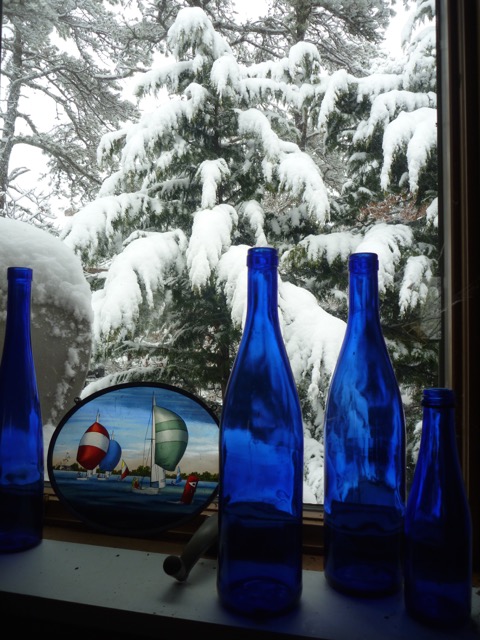
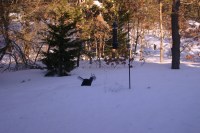
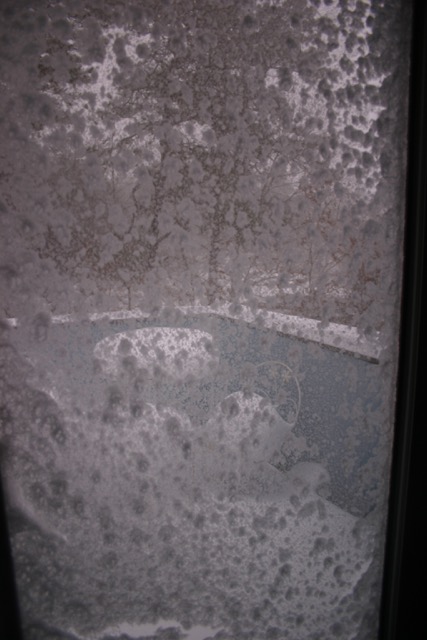
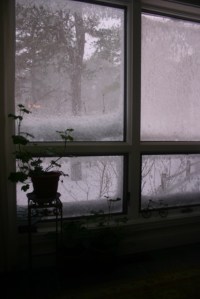
View from our bedroom this morning

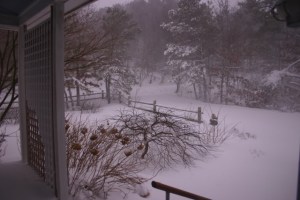
View from our bedroom this morning

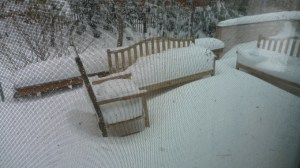
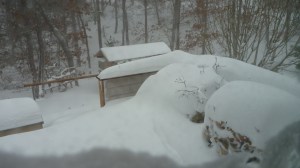
I had convinced myself that buying new X-C skis last fall was going to prevent us from ever seeing snow again on Cape Cod. The ski god must have relented. We may get as much as two feet.

Susan took some photos through the blowing snow. The photo at left shows the view from our bedroom this morning. That light blue is the wall of the small deck, and you can faintly see the metal table and chair.

The garage door to the front porch is the only one we can safely open. But one of the geraniums in the music room is still blooming.

In a few hours a neighbor will come and do a preliminary plow of our driveway. We arranged that in case my eye doctor could set me up with my new, much needed scleral lenses. That’s now postponed until Thursday.

Since you’re getting this, you know we still have power. That may not last all day, since there’s a lot more snow and wind to come. The UPS unit has been clicking on and off as the power fluctuates. Coffee is ground for tomorrow, in case we have to use a camping stove for breakfast. And we can melt snow to flush toilets.

In the meantime, we can ski, if we don’t sink too much into the powder snow.

A non-selfie: the Andromeda Galaxy

On January 5 this year, NASA released an image of a portion of Andromeda (aka M31), the nearest galaxy to our Milky Way. It’s the largest picture ever taken, a 1.5 billion pixel image (69,536 x 22,230) requiring 4.3 GB disk space. The full image is made up of 411 images captured by the NASA/ESA Hubble Space Telescope. 

The largest NASA Hubble Space Telescope image ever assembled, this sweeping bird’s-eye view of a portion of the Andromeda galaxy (M31) is the sharpest large composite image ever taken of our galactic next-door neighbor. Though the galaxy is over 2 million light-years away, The Hubble Space Telescope is powerful enough to resolve individual stars in a 61,000-light-year-long stretch of the galaxy’s pancake-shaped disk. It’s like photographing a beach and resolving individual grains of sand. And there are lots of stars in this sweeping view–over 100 million, with some of them in thousands of star clusters seen embedded in the disk. (via Hubble’s High-Definition Panoramic View of the Andromeda Galaxy | NASA)

A video http://youtu.be/udAL48P5NJU takes you through the photo (thanks to Chuck Cole for spotting this). Andromeda probably has a trillion stars, ten thousand times what is shown in the photograph.

Andromeda and the Milky Way will collide in about 4 billion years. Although more than a trillions stars are involved, the distances between them are so great that it is unlikely that any of them will individually collide.

Walk to Ptown

Ever since moving to the Cape, I’ve wanted to walk to Provincetown. It wasn’t because of the Wampanoag people, or other early explorers and settlers who wrote about the area, such as Gosnold, Champlain, the Pilgrims, or Thoreau. It was simply that I wanted to connect with the land and sea in a way that walking does, more than riding in a car or bus, or even on a bicycle.

Yesterday, Emily, Stephen, and I managed to do it–what turned out to be 35,000 of my steps.

We walked out the front door, down the hill to Wellfleet center, across route 6, past the ponds of Herring, Williams, Higgins, Slough, Horse Leach, and Round. Then we split up, with Stephen taking the beach walk along the Cape’s backside while Emily and managed the brambles on the dune ridge. We met up again at Ballston Beach, where Emily took a break, having carried the pack the entire way. Stephen and I continued on the beach past Long Neck Beach to a spot between the abandoned North Truro Air Force station and Highland Light. At that point we turned west to cross the Cape to the Bay side. From there it was a straight shot north to Provincetown, where we met up with Emily and Susan and had a lovely early dinner.

This slideshow requires JavaScript.

2014 in review

The WordPress.com stats helper monkeys prepared a 2014 annual report for this blog.

Here’s an excerpt:

The concert hall at the Sydney Opera House holds 2,700 people. This blog was viewed about 14,000 times in 2014. If it were a concert at Sydney Opera House, it would take about 5 sold-out performances for that many people to see it.

Click here to see the complete report.

Breathing the same air

Last July, Eric Garner was killed by police who choked him as he repeated “I can’t breathe.” He cried out 11 times, but eventually succumbed.

We didn’t need yet another example of police killing a young, unarmed black man. Michael Brown, Tamir Rice, and way too many more reveal a pervasive inability of some individuals, and more importantly, of our entire legal system to recognize that we all breathe the same air.

The Senate Intelligence Committee’s report on the CIA’s detention and interrogation program at first seems worlds away from the racism and social injustice of America’s cities. But it too reveals racism and social injustice. It too shows how those in power use that power to oppress even admittedly innocent people. Often, the “crime” was to have a different religion, to wear different clothes, to speak a language other than English, or to be poor. The parallels are disturbing, even without considering how a favored torture technique of the CIA was waterboarding–to deprive people of air.

In the commentary regarding both of these cases I’ve been struck with how little there is about the victims as living, breathing individuals. Those who rightly argue for legal due process for the police or agents involved, talk about mistakes the victims had made, but not about them as people. Some mainstream news coverage does point out a little, that Garner was considered to be an even-tempered, good-natured presence in his community. He was the neighborhood peacemaker. He had asthma and sore feet. And yes, he had run-ins with the police before. But as one neighbor said, “His last penny was your last penny.”  (see “Friends: Man in NYC chokehold case ‘gentle giant’“). Rapidly, however, the real “Eric Garner” vanishes from the discourse as a person and becomes just a term to signal a point of disagreement between factions that seem to have little ability to understand one another.

In the last chapter of her 1902 book, Democracy and Social Ethics, Jane Addams writes about racism and corruption of a century ago, and the consequent need for political reform. Her examples draw on the glaring disparities in wealth of the Gilded Age, which are unfortunately being reproduced today.

Addams talks about the “honest absence of class consciousness” among the immigrants she worked with. That absence supported their faith in American democracy. They were taught ideals for “honorable dealing and careful living. They were told that the career of the self-made man was open to every American boy, if he worked hard and saved his money, improved his mind, and followed a steady ambition. [sic]”

Addams then recalls an anecdote from her childhood: “the village schoolmaster told his little flock, without any mitigating clauses, that Jay Gould had laid the foundation of his colossal fortune by always saving bits of string . . . as a result, every child in the village assiduously collected party-colored balls of twine.” In this way, children failed to learn that “the path which leads to riches and success, to civic prominence and honor, is the path of political corruption.” The end result was that every citizen participated in that corruption, even those who suffered from it. Her statement of this shared responsibility still holds today:

This is the penalty of a democracy,–that we are bound to move forward or retrograde together. None of us can stand aside; our feet are mired in the same soil, and our lungs breathe the same air.

The penalty that Addams describes is also the basis for making a democracy possible. Ethics cannot be limited to the individual virtues, such as honesty, courage, or duty, but must encompass social relations as well, the social ethics of her book’s title. That idea is expressed well in an essay she had written a few years earlier, called “A Modern Lear.” It’s about the railroad czar George Pullman:

Our thoughts . . .cannot be too much directed from mutual relationships and responsibilities. They will be warped, unless we look all men in the face, as if a community of interests lay between. . .To touch to vibrating response the noble fibre in each man, to pull these many fibres, fragile, impalpable and constantly breaking, as they are, into one impulse, to develop that mere impulse through its feeble and tentative stages into action, is no easy task, but lateral progress is impossible without it.

Addams knew that democracy was a hollow ideal without social ethics. So, it’s depressing to realize that the inequities of wealth, the racism, and the corruption of her day are still with us, and in some ways have become worse. Our social ethics appears piecemeal and ephemeral. At times the “mere impulse” seems nonexistent.

Can those who defend the CIA or the all-too-common official homicides imagine how they would feel if their own child, lover, or best friend were subjected to the same treatment? Could we instead see every person as a citizen who shares in a community of interests, regardless of race, religion, or official papers? What would it take to recognize the humanity in every one of us?

I’m reminded of the ending of “Salute to Life” by Pablo Casals:

Each second we live is a new and unique moment of the universe, a moment that never was before and will never be again. And what do we teach our children in school? We teach them that two and two make four, and that Paris is the capital of France. When will we also teach them what they are?

We should say to each of them: Do you know what you are? You are a marvel. You are unique. In all of the world there is no other child exactly like you. In the millions of years that have passed there has never been another child like you. And look at your body–what a wonder it is! Your legs, your arms, your cunning fingers, the way you move! You may become a Shakespeare, a Michelangelo, a Beethoven. You have the capacity for anything. Yes, you are a marvel. And when you grow up, can you then harm another who is, like you, a marvel? You must cherish one another. You must work–we all must work–to make this world worthy of its children.

Wildlife in Wellfleet

White fox, Truro, by Desmond  Tetrault

White fox, Truro, by Desmond Tetrault

We’re fortunate in Wellfleet to have frequent interactions with wildlife.

We’ve always had many birds around the house, but are now likely to have more since we just set up a bird feeder. Even though it’s late in the season, some chickadees and American goldfinches have been happy to discover that. The goldfinches seem like a different species from the bright yellow ones we saw in the spring mating season.

Birds that live near the water here, such as loons, mergansers, gulls, and gannets have also been feasting. Last week the water temperature dropped suddenly, resulting in the stunning of many small fish. The birds were happy to scoop up the unexpected bounty, so they’re very visible near shallow waters.

Blurry fox, Wellfleet marina

Blurry fox, Wellfleet marina

A more unusual visitor is the white fox. We know of two now, one residing in Wellfleet and one in Provincetown. We saw the Wellfleetian at the pier last night. It was as interested in us as we were in it. The quick smartphone photo doesn’t show much, but at least you can see that the eyes are not red as they would be for an albino fox. This condition is called leucistic. See also A fox of a different color in Provincetown – Gate House.

Turtle rescue at Mass Audubon

Turtle rescue at Mass Audubon

The same cold snap that stunned the fish and pleased the birds was a disaster for the sea turtles. Hundreds of turtles in Cape Cod Bay have been washed ashore. Most are endangered Kemp’s ridley sea turtles or leatherback turtles, and one is the largest loggerhead turtle ever to come ashore in Massachusetts (300 pounds, 3 feet long). About a thousand have been rescued and taken to the Massachusetts Audubon Society’s Wellfleet Bay Wildlife Sanctuary, and later to the Animal Care Center in Quincy.

Sharing science across generations

In my last post I talked about an intergenerational reading experience. The day after that occurred, I had an intergenerational science experience when I attended the 12th Annual State of Wellfleet Harbor Conference.

The Harbor conference is always interesting, moving smoothly between very local issues in Wellfleet Harbor to regional issues in Cape Cod and New England, and on to global issues, especially those related to human activity, such as global warming, sea level rise, pollution, and decreasing biodiversity.

The presentations and posters dealt with a wide variety of topics: river herring spawning migration, including transponder tracking, training robots to assess landscape change in the Herring River floodplain, shellfish for nitrogen mitigation, horseshoe crab conservation, modeling sea level rise and vegetation change, ocean sunfish strandings, eel monitoring, restoring the Mayo Creek salt marshes, diamondback terrapin nesting, among others.

Although the sessions were diverse, there was a common theme of restoration, going from “How can we assess the damage?” to “How bad will it get?” to “Is there anything that can be done?” It was depressing to see the many ways that we’ve destroyed a beautiful habitat, even one that is supposedly protected by the National Seashore. On the other hand the efforts at restoration are impressive and may at least provide information about what not to do in the future. There was discussion of plans to restore Herring River and Mayo Creek, salt marshes, and many individual species of sea life. If these restoration projects are to succeed they need to involve a large public of all ages, not just a few scientists.

The conference was a delight to attend, even more so since most of the topics related to areas easily accessible by walking or paddling from our home. For example, we’ve seen the amazing ocean sunfish stranded on Mayo Beach only ten walking minutes from home and friends have encountered live ones while kayaking just offshore.

Aside from presenting an opportunity to learn about many topics, the conference was another good example of an intergenerational experience. Presenters included college students and volunteers of all ages. The audience was diverse as well, with some who remember well times long before the National Seashore was created.

One of the presentations was by Nauset Regional High about their own research in collaboration with the Wellfleet and Truro fifth grades. It was the first time to have K-12 presenters at the conference. The students wanted to compare oyster growth and mortality in Herring River and Mayo Creek. An interesting question for their study is that the streams experience tidal variation and high salinity at their outlets, but vary to mostly fresh water higher up: Would oysters be able to survive and thrive away from the sea? Each group of students measured and marked a set of ten oysters. There were five bags for different locations on the Herring River and three for Mayo Creek. The young scientists left each bag with oysters for six weeks, then collected it and re-measured the oysters.

The students learned some of the challenges of field science. For example, one of the oyster bags was missing when they went back to collect it. Valerie Bell, the environmental science teacher at the high school, asked the audience almost as a joke, “if you come across a bag like this can you give us a call?” To my amazement, someone in the back called out that they had in fact found the bag. It must have broken from its mooring and floated with the tide to another location. It was a small thing, but a nice example of community science in action.

Sharing reading across generations

I recently had an enlightening day reading with middle schoolers. It was definitely more fun than when I had to be in middle school myself. I had volunteered for an intergenerational reading group, part of Project Read. This meant that adults in the area would read the same texts and do the same homework as the students. We would then meet with them in small groups during regular class hours to discuss the reading.

On this particular day, we had all read Shirley Jackson’s story, The Lottery. This classic of secondary school has long provided fodder for discussion, confusion, and in some cases distress. I know at least one person my age who says that she’s still disturbed by it. It’s interesting to read the reactions of readers as shown in their letters to the New Yorker, where it was first published in 1948.

There were four class periods with small reading groups, then whole-class discussion, so I was able to hear a variety of responses and share my own:
  • Many students were excited to discover the similarity of the story to that of The Hunger Games novel/film, and even more to learn that others had made the same discovery.
  • I was surprised to hear one boy say that the story must have been set very long ago, because “the heads of household were all men.” Another added that “the men did all the talking and mostly talked about the women, rather than letting them talk.” I don’t believe that middle school boys from my time would have said the same.
  • One student said that the stoning in the story was wrong “because there were only 300 people in the village.” (One death would make a big difference.) We then talked about whether stoning someone to death was ever justifiable.
  • A big question concerned why people in the story, especially Mr. Warner, didn’t want to change. Several students agreed that the people who resisted ending the practice of stoning were similar “to the people who resist allowing fast food restaurants into Brewster. People are afraid of new things.” I didn’t do a poll, but I imagine a sharp generation divide on the fast food issue, with the older ones opposed. The students were right: The older folks don’t want change. Nevertheless, I was uncomfortable equating stoning people to death with opposing fast food.
  • A volunteer adult added, “sometimes you’ve been doing something your whole life and it’s hard to admit that you were wrong.” I doubt that the 13 year-olds have that same feeling about doing something their whole life.
  • I was dismayed to hear two girls in separate groups describe incidents in which boys had thrown (multiple) stones at them.
  • Another student said that Tessie Hutchinson was stoned because she was engaging in protest. The usual reading is that her cry that the stoning was unfair was disingenuous since she never said anything until after she’d been selected. But in the context of Ferguson events I can now understand the interpretation the student made.
  • My best contribution was to bring up Martin Niemöller’s famous First they came… statement. This much-quoted passage reads all the more powerful for me knowing Niemöller’s own earlier national conservative views and anti-semitism. And it makes his analogy to Tessie Hutchinson more telling. The statement is quoted in a book that the students will be reading later in the year in their Holocaust unit.

Like any good learning experience, this one was shared broadly. The teachers, volunteers, and middle school students had to cross some boundaries, but all learned something about the story and about each other. A quote on the classroom wall seemed especially a propos for this intergenerational encounter:

Travel is fatal to prejudice, bigotry, and narrow-mindedness, and many of our people need it sorely on these accounts. Broad, wholesome, charitable views of men and things cannot be acquired by vegetating in one little corner of the earth all one’s lifetime.” –Mark Twain, The Innocents Abroad

Child-centered classification

I’ve been reading about Metis, a Dewey-free library classification system developed and implemented in 2011 by the librarians at the Ethical Culture School in New York City (Kaplan et al., 2013). The system places the thinking, interests, information needs and information-seeking behavior of children at its center. It was developed as an alternative to the Dewey decimal system, which is currently the most commonly used system in school and children’s sections of public libraries.

Metis is named for the Titan Metis, who was the mother of Athena. The Greek word metis means a quality that combines wisdom and cunning. The system is designed to encourage productive independent browsing and successful catalog searching by children. Its emphasis on situation specificity, flexibility, and user-centered design is closer to John Dewey than to Melvil Dewey. I liked this on the Metis site:

Our decision to create Metis is a result of our progressive approach to education and the library. The system isn’t a cut-down version of adult thinking. Kids feel empowered to navigate the library because it is organized in a way that they understand. Metis increases the success rate of finding books, which fosters self-reliance and produces joyous discovery.

The Metis main categories are based on studies of the practices of young children. They put users and their needs and interests at its center, and curriculum, collection, and library geography second. In contrast to the Dewey system, they are not meant to reflect the state of human knowledge or depict the relationship of one branch of knowledge to another. The categories are ordered using the letters of the alphabet, A-Z. This is the only code that is not whole language.

For example, H. Arts, might include art books, biographies of artists, and fiction featuring artists, whereas in most other systems those would all be in widely separate categories. U. Scary is a category of special interest to children, either as one to seek or one to avoid. G. MakingStuff would include cooking, model building, magic tricks, and crafts of all kinds.

Some obvious concerns about Metis are whether youthful readers can make the transition to other systems. One critic asked “What happens to these children when they arrive at a college or university and need to learn the Library of Congress classification system?” Notwithstanding the fact that very few college-educated adults presently learn LC, I’m inclined to support an experiment aimed at getting children to read more. Moving to another school could present problems, too, but seeing classification as a human construction could be a valuable learning experience in itself.

Almost a century ago, Célestin Freinet developed a classification scheme with a similar motivation, to facilitate the easy finding of documents. It was also for his Bibliothèque de Travail, a collection of student and teacher-made booklets for the classroom. The Freinet classification is also a simple system, similar to the Dewey decimal system, and reliant on the decimal coding.

There are 12 major divisions, such as 1.3 2. Plants1.4 3. Animals, and 1.5 4. Other sciences, with subdivisions and sub-subdivisions. Many educators see it as more logical and natural for school work than the Dewey system, although it is closer to that than is Metis. The Freinet classification is still used in the libraries of some elementary schools.

I’ll be interested to see how well these alternatives work and how much they spread to other libraries.

References