Skerwink Trail

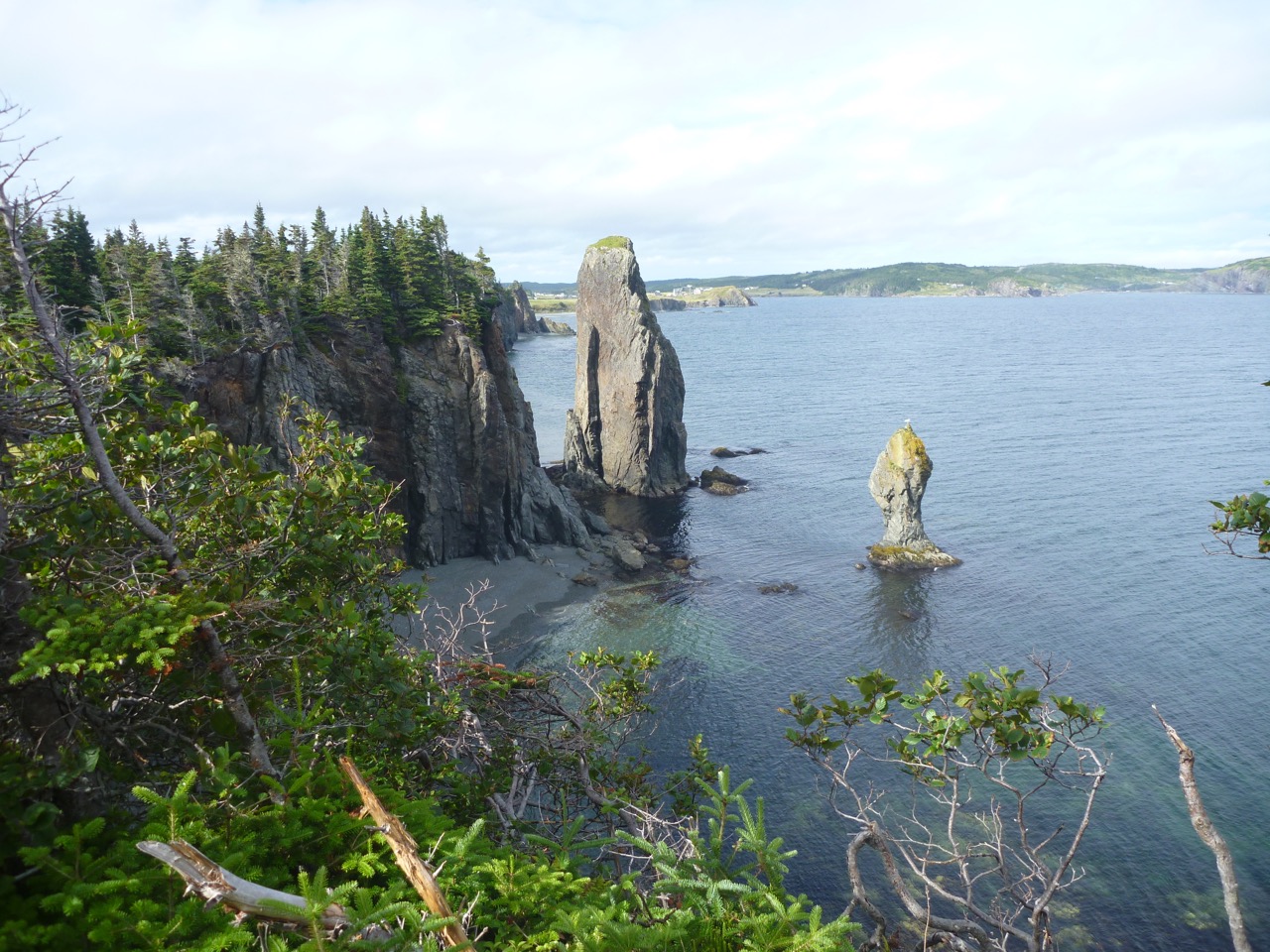
Sea stacks

Sea stacks

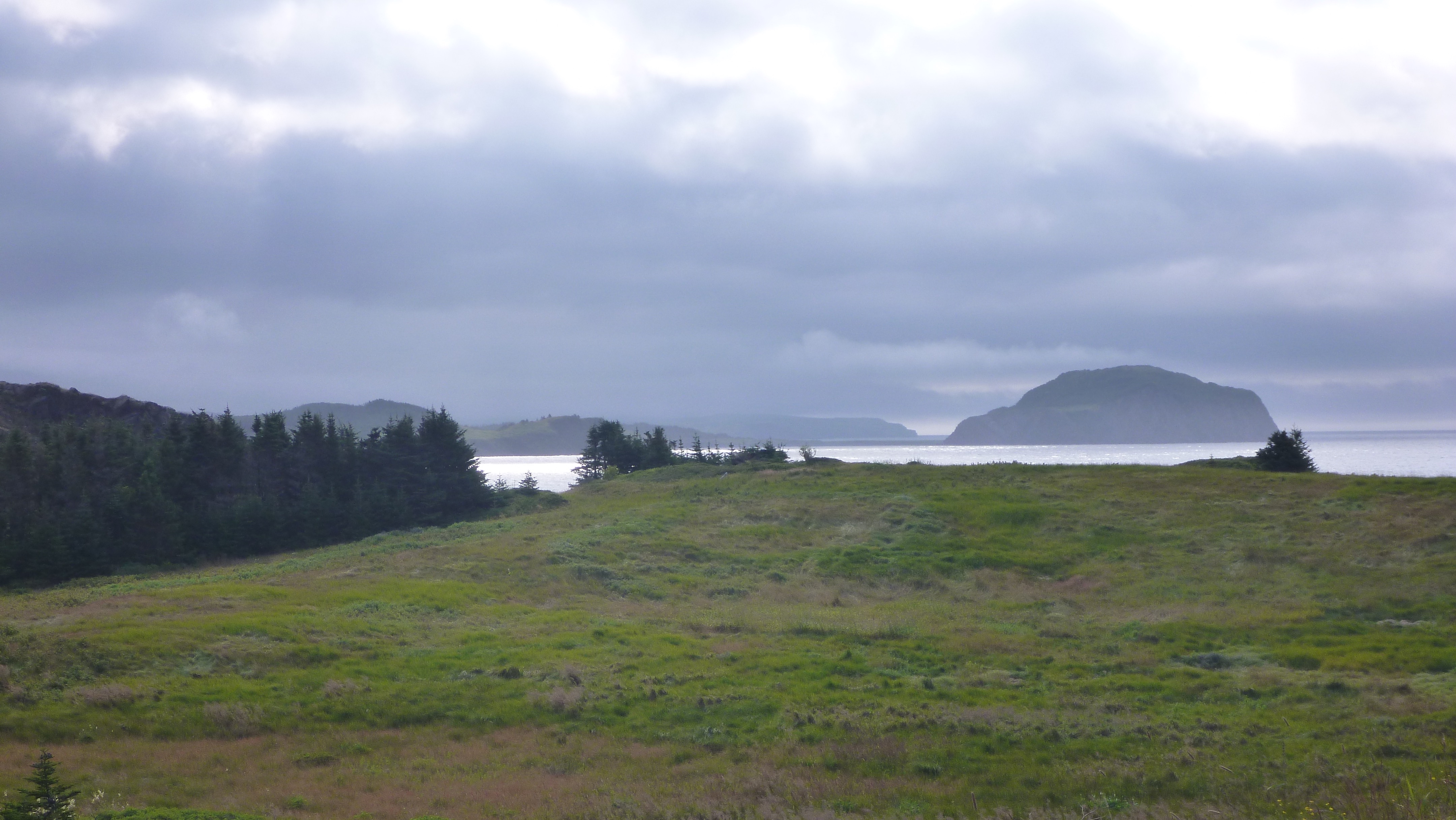
We just walked the beautiful Skerwink Trail, which is reachable by a short path from our house rental. The trail loops around Skerwink Head, a rocky peninsula between Port Rexton and Trinity East, Newfoundland.

The peninsula is mainly sedimentary rock, especially sandstone. It’s been shaped into fantastic cliffs, sea stacks, arches, and beaches by the Atlantic storms and freeze/thaw cycles.

Along the walk we saw whales and seabirds, wildflowers, mushrooms, edible wild berries, and a variety of habitats, including determined plants on steep cliffs, mixed forest, craggy meadows, tuckamore, bog, freshwater pond, birch tree clusters, and gravel beach.

The early day was foggy and drizzly, but by late afternoon the sun was shining. A gentle breeze turned into a stronger wind than I liked in the exposed areas.

The trail is considered moderate–difficult. Numerous steps, boardwalks, and rails are what makes it moderate. There is also good signage, including several “Caution” or “Danger: Unstable cliffs.” As an accomplished acrophobe, the recommendation for caution was unnecessary for me. I could easily see the danger, and instead wished for a “Turn back now!” sign.

We celebrated the end of the walk with a dinner of fresh mussels purchased from a roadside truck at Trinity Bay, where they’re farmed. Steamed in white wine and accompanied by some garlic mayonnaise, they were delicious. It didn’t hurt that the price was a little over $1 (US)/pound.

You can see some of the sights in the slides below and on the Skerwink Trail site.

This slideshow requires JavaScript.


Clints and grikes

Clints and grike

Clints and grike

We’ve walked on more interesting trails in Newfoundland than I can count, and those are a tiny fraction of the possibilities. Many are in National or Provincial Parks; some are on private land or Crown Land. Since 95% of Newfoundland and Labrador is provincial Crown Land, there’s a lot to explore.

Some of the trails have been developed by small towns, including outport communities. For example, Flower’s Cove on the Great Northern Peninsula has the White Rocks Walking Trail. This wanders across a limestone barrens, where I learned firsthand about clints and grikes.

Limestone barrens

Limestone barrens

Limestone barrens are odd, unforested areas with what appear as large, limestone paving stones, mortared with mosses, small conifers, wildflowers, and other flora. These are unique ecosystems with extremes hot and cold, plus cycles of drought and flooding and frost. They represent less than 1% of the total area of the island, but host 10% of the rare plants.

The limestone pavement of the barrens is a type of karst landform. These formations have blocks, called clints, separated by deep vertical fissures known as grikes. Karst is derived from the Slovenian word kras, meaning a bleak, waterless place.

Solied pants

Solied pants

From experience, I strongly advise you to be careful, stepping only on the clints. This advice is not always easy to follow, since plants grow up through the grikes and often spill over onto the clints. Thus it’s possible to step on what seems to be a thin layer of green on the clint and find your foot going deep into a grike.

This happened to me near the end of a walk. My left foot sank down nearly up to the knee. I the fell forward hitting both knees on the clint. I was just lucky that I hadn’t caught the foot more, or I might have had a twisted ankle or even a broken foot, possibly one wedged into the grike. Since I was walking alone at the time, I might have come to understand truly what Slovenians mean by kras.

Instead, I suffered no worse than embarrassment and soiled pants.

Completing the circle

Matthew replica

Matthew replica

We’re staying near Bonavista, possibly where John Cabot landed his ship, the Matthew, in “New Founde Lande” on June 24, 1497. There’s a plaque in the cottage commemorating “the 500th anniversary” with celebrations held in 1997. However, the human presence here is much longer than that celebration suggests.

Newfoundland is famous for its dramatic, detailed, and precise record of life on earth. This includes two of the most important GSSPs, or Global Boundary Stratotype Section and Points, one of which we saw at Green Point. Its record of human life is becoming more fleshed out as well.

Recreated long house

Recreated long house

This shows that the cultures of Newfoundland are intertwined over many millennia, just as the mixed forest, slips into tuckamore, then tundra, building upon and shaping each other. That’s true everywhere of course, but the connections seem more evident here, and are notable for a relatively small, non-urbanized population.

For example, Newfoundland was one of England’s oldest colonies, reflecting Cabot’s voyage in 1497. However, in the 17th-century it was more French than English. Those French were largely Normans, Bretons, and in the western area we first visited, Basque. The English kept the French place names, but chose to pronounce them in the English, or sometimes the uniquely Newfoundland way.

Carlb-ansemeadows-vinland-02

English and French records show that during this time Mi’kmaq families were active along the Western coast. They incorporated the island of Newfoundland along with Cape Breton into their domain of islands. I was surprised to learn that in discussions of cultural eras, they’re often now grouped with the European period, due to the timing, their close interaction with the Europeans, and the fact that many were Roman Catholic.

The long history of Newfoundland with its connected cultures can be seen at L’Anse aux Meadows, a site at the far north end of the Northern Peninsula. It was discovered only in 1960. The settlement probably supported Leif Erikson’s attempt to establish the colony of Vinland, 500 years before Cabot’s voyage. This makes it the best evidence for first contact between peoples of Europe and America and the most famous site of a Viking settlement in North America outside of Greenland.

World Heritage Convention symbol at L'Anse Aux Meadows

World Heritage Convention symbol at L’Anse Aux Meadows

L’Anse aux Meadows might have been presented as the beginning before the beginning–the voyage that was 500 years before what we had earlier celebrated as the first one. Instead, the site today rightly talks about those who came to greet the Vikings, who they were and where they came from.

Tracing back, it shows how early modern humans left Africa 100,000 or more years ago. Some dispersed across Asia then moved into North America and eventually Newfoundland from the west. Others went north into Europe, Iceland, Greenland, and eventually from the east.

L’Anse aux Meadows thus represents many things. But one of the most significant is the reconnection of these streams of humanity. The metaphor of “completing the circle” symbolizes the completion of human migration around the world. The Vikings and the Dorset or Late Palaeo-Eskimos were the front people in this re-encounter.

L’Anse Aux Meadows is a UNESCO World Heritage site. Its story aptly reflects the World Heritage Convention symbol, with its emphasis on global connection.

Blow Me Down

Towards Lark Harbour

Towards Lark Harbour

Trail through forest

Trail through forest

Trail through open area

Trail through open area

When, in the middle of August, you need to light up the wood stove to warm your feet, there’s snow at 2000 feet, and an iceberg floats by your cabin window, you know that you’re in an unusual place.

A close encounter with a caribou on a hiking trail, meeting a traditional carver of stone and bone, and eating cod caught a few hours earlier by the restaurant owner’s two young sons add to the pleasant surprises. But the most remarkable thing about Newfoundland are the stories.

Serpentinite

Serpentinite

Every local we meet seems to have a trove of stories, freely mixing what some Viking did a thousand years ago with what they ate for breakfast. And every place, remarkable though it may be on its own terms, comes packaged with intertwined history, myths, and legends,

Beyond the island in front of our lodging in York Harbour was the Blow Me Down Mountain (650 m). Its name comes from the story in which Captain Messervey in 1771 anchored his boat below the range and said “I hope they don’t blow me down!” To this day it’s famous for its powerful winds that blow in every direction at once. It’s also known as an amphitheater that amplifies the sound of thunder. I heard stories of walkers fleeing in terror when Thor seemed to go on a rampage.

Blow Me Down mountain

Blow Me Down mountain

Stairway in a cave

Stairway in a cave

There have been at least 17 communities that share the odd name of Blow Me Down, not to mention mountains, mountain ranges, parks, and other geographical objects.

We took a walk through Blow Me Down Provincial Park nearby, which generated some personal stories to add to the corpus. The trail was beautiful, but a bit of a workout, because of the mud and running water from a recent storm. My activity tracker thought it was more than 100 floors up.

Newfoundland diary: Bottle Cove

York Harbour

York Harbour

I had intended to write a Newfoundland diary, but the onslaught of beautiful rocky coasts, wildflowers and butterflies, fragrant forests of balsam fir, moose and caribou, seabirds, icebergs, quaint fishing villages, lighthouses, Paleoeskimo archeology, world renowned geological sites, challenging hikes with gorgeous views, tundra, friendly people, widely divergent regional dialects, and more has distracted me.

This is beginning to look more like a five-day report, maybe a quinquery? Even now, I feel that I’m just highlighting a few of many rich experiences.

Bottle Cove

Bottle Cove

It wasn’t just the overload of rich experiences. The problem began on the first full day. We had arranged to stay in a cabin in York Harbour, on the central west coast, not far from Corner Brook. The cabin was on the seacoast, with a view of mountains and islands. That would have been difficulty enough.

However, the next day we ventured to Bottle Cove. It’s a fishing village with a population of just 10 people, but deservedly has its own Wikipedia entry. Two of those ten were very good friends who welcomed us with treats, including cheeses and homemade beer.

Trail's End, named by Captain Cook

Trail’s End, named by Captain Cook

The cove is aptly named, given its narrow mouth, but apparently it’s actually an Anglicization of the French bateau, from its days as a French fishing village.

The surrounding terrain is part of the Appalachian Mountains. That’s the justification for including the trails in the area in the International Appalachian Trail system.

We had a beautiful walk to the headland named Trail’s End by Captain Cook, when he first explored the area. The trails are suffused with wildflowers, beautiful mushrooms, and interesting rock formations.

The rocks are mostly ophiolites, meaning they came from the oceanic crust and the upper mantle of ancient seas.  They were uplifted and exposed above sea level, often on top of shale and other continental crustal rocks. A prevalent and striking example are the green serpentinites. We saw them in walks around Bottle Cove and also at the nearby Cedar Cove, another beautiful, but quite different formation.

View from the headland

View from the headland

After a day in the Bottle Cove area I was in a mixed state, exhilarated from the beauty and good experiences, but depressed by the thought that everything to come would be a let-down.

Where is everybody?

Earl Holliman,

Earl Holliman, “Where is everybody,” 1959

Where is Everybody?” was the first Twilight Zone episode. It tells about a test pilot, Mike Ferris, who undergoes an isolation experiment in preparation for a trip to the Moon.

We don’t learn about the isolation experiment or its purposes until the end of the story. Instead, traveling with the pilot, we experience the effects of the isolation on his mind. Essentially, it drives him temporarily insane. In the final scene, the commanding officer glosses the problem: “The barrier of loneliness–that’s the one thing we haven’t licked yet.”

I liked the story when it first aired in 1959. It seems very far from my experience; among other things, I’m afraid of heights. But I learned that it was to be much closer to my reality than I had imagined when I first watched the show. Viewing it again recently I saw it from a new perspective, because of an event in my own life.

During my time at college in Houston, I eagerly responded to part-time work opportunities. One of these during the first, or maybe second, year, was for a part of the Apollo space program. There were many such projects in the Houston area, linked with NASA facilities in the Houston area, the medical research facilities, and local universities, especially at Rice.

President Kennedy speaking on the space program at Rice University, Sep 12, i962

President Kennedy speaking on the space program at Rice University, Sep 12, i962

The particular project I signed on to required just a weekend of work. Well, to be honest, it was a three-day weekend, plus some, which meant I had to cut some classes. It was minimum wage ($1.25/hour), but for 24 hours per day, so to me that was a huge sum of money that I could earn in one longish weekend. And of course, the space travel aspects sounded interesting.

It’s worth noting that the wage at that time translates to $9.59/hour in today’s dollars. Minimum wage workers in the present earn about 75% of the wage I received, despite most of those today working harder and having a greater need than I had.

I was disappointed, although not really surprised, to learn that my project wouldn’t involve actual space travel. But it was still intriguing for an 18 year old. Three of us were to enter a simulated Apollo capsule and carry out a mission with tasks similar to those the astronauts might encounter. We were to wear pilot jumpsuits while being connected via 11 electrodes, wires, and cables to devices monitoring ECG, EEG, and other bodily functions. We would eat freeze-dried space food and carefully monitor our input and output of food and fluids.

Interior of actual Apollo capsule (not my simulated one)

Interior of actual Apollo capsule (not my simulated one)

Before that time, all of the US space voyages had been of short
duration. Project Gemini had supported two-person flights of short duration. Meanwhile, the Soviet space program was more advanced, and had already had a person in space for over 24 hours, a person sleeping in space, and multi-person crews.

However, the Apollo program was a large jump forward for the US, one that envisaged three-day and longer flights. The first manned flight of Apollo was in 1968 and culminated in flights to the Moon. Early on there were many questions about the effects on physical and mental health, social interaction, and the ability to maintain vigilance on boring tasks.

Because I had arrived first among the three volunteers, I was designated as Captain. This proved to be important at several times during the mission.

Electrode kit for EEG

Electrode kit for EEG

After the arrival of the complete crew there were various liability releases to sign. My crew was then informed about my promotion to a position of authority,

We then underwent a procedure that seemed routine at the time but turned out to have significance for the space program. The researchers wanted to measure our vital signs over the three-day period of the simulation, This was as much to test out the measurement protocol as to monitor our particular signs. They shaved patches on my legs, my chest, and four places on my head. Paste-on electrodes would then record signals from the brain (EEG) and heart (ECG). They could also measure pulse, blood pressure, and perhaps other signs.

Wires from the 11 electrodes were gathered into cables that emerged from caps we each wore on our heads. We then entered a box barely big enough for three bucket-like seats and various electronic equipment, including displays and buttons to push. I’d guess now that the room was about 9′ long, 5′ wide, and 7′ high. It would not have pleased a claustrophobe. One of the big issues over the three days was moving about the confined space of the capsule without entangling each other in the cables and other gear.

Like the actual astronauts we were confined for the entire mission, although we had an out for emergencies that they wouldn’t have. We received food from a sliding drawer that mimicked the food supply on the Apollo capsule. We had to use plastic bags for elimination of waste products. Most of our time was spent monitoring displays to look for anomalous occurrences, such as a sequence of digits changing its pattern. It reminded me that much of space flight involves routine, even if it has moments that soar.

As I said, the routine procedure of monitoring through electrodes turned out to be more significant than any of us imagined. For two and half days everything worked well, just as it had for the Mercury and Gemini programs. all of whose flights were of short duration. But on the third day, one of the electrodes malfunctioned, then another. We had to break the isolation protocol to have our skin re-shaved and the electrodes re-pasted.

It soon became clear that hair would grow back too fast, There had to be an alternative to paste-on electrodes for use on longer flights. I believe that NASA initially resorted to implantable electrodes for the longer missions, in part due to our experiment. I believe that my rapidly growing hair thereby made a contribution to the space program.

It was also interesting to see the effects of my nomination as Captain. As I mentioned, the confined quarters and bothersome equipment led to ever-growing annoyance over the three days. I became the final arbiter for major disputes, such as “your cable tangled with mine, not the other way around.” I found that quick, firm decisions, which over time roughly balanced the wrongs to the parties involved restored peace to the capsule and appeared to be accepted by all.

At the end of the simulation we had debriefings, showers, etc. Television crews then arrived. I learned as I’ve learned several times since, that I’m terrible at saying anything the least bit intelligent in front of a camera. Although I thought that the experience was fascinating on many levels, I couldn’t bring myself to say that it was terrifying or ennobling in the way the reporters seemed to want. (It seemed crass to mention how pleased I was to learn that we were to be paid for four full days.)

In “Where is Everybody?” Mike Ferris was an astronaut in training confined to an isolation room for 20 days, not the 3 that we experienced. Researchers were assessing whether he could handle the psychological stress of a prolonged, solo trip to the Moon, whereas we were just college students there to test the equipment as much as ourselves. Ferris hallucinated a complete town, without any people, out of his sensory-deprived mind. We weren’t privileged to such elaborate images, but each of us had unusual dreams and changed in the short course of the experience.

For Ferris, space travel meant being alone. As a result of just a simulation, his mind spun a fantastic reality in which all other people had ceased to exist.

The overall effect of my simulation experience was the opposite. Every aspect of my body was monitored 24 hours a day. When I deviated on the routine tasks, alarms would go off. The presence of my co-volunteers was inescapable, instilling another kind of madness, and a desire to be away from them at all costs. Even emerging from the capsule, I was confronted by a team of researchers, reporters, and television cameras. For me, the “everybody” was everywhere. I longed for nobody, and wondered where it could be found.

Quake in Nepal

KLL situation room

KLL situation room

A growing sense of despair spread through Katmandu on Sunday as the devastated Nepali capital was convulsed by aftershocks that sent residents screaming into the streets, where they were pelted by heavy rain. via Nepal Terrorized by Aftershocks, Hampering Relief Efforts – NYTimes.com.

The situation in Nepal sounds awful. Nature in the form of aftershocks and rain, is conspiring with poverty and political discord to make a dire situation.

I know several people there, including some former students, and am relieved that so far they’re doing OK.

I’ve also been impressed with the work of the Humanitarian OpenStreetMap Team [HOT], which acts as a bridge between the traditional humanitarian responders and the OpenStreetMap community. Nama Budhathoki, a former student and friend, works with Kathmandu Living Labs and HOT to provide vital information, first about the road network and then about buildings. The Tasking Manager is a tool they designed to coordinate these efforts. It helps to divide up a mapping job into smaller tasks that can be completed rapidly.

The photo, taken from the KLL Facebook page, shows the situation room with Nama on the right.

Who invented the amazing paper bag?

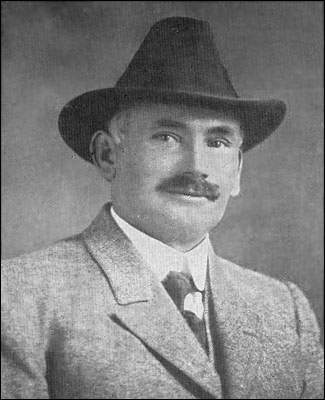
Luther Childs Crowell

Luther Childs Crowell

Envision, if you can, a technology that sharply improves the efficiency with which goods can be delivered to the consumer; that, in the view of one prominent economist, is the ”most effective innovation during the preceding decade in speeding up American retail sales”; that within only a few years of its introduction becomes a pervasive feature of American life.

Such a technology, according to the historian Daniel J. Boorstin, was the square-bottomed paper bag, invented circa 1870 by one Luther Childs Crowell. –Krugman, 1997, “Technology makes us richer; the paper-bag revolution”

It doesn’t take long in Wellfleet to be impressed with the local lore. There’s a lot to learn, about native peoples, Pilgrims, pirates, psychiatrists, and painters. We hear about Baker inaugurating the banana trade, Marconi sending the first trans-Atlantic wireless, and Crowell inventing the paper bag. There is a little truth in this lore. However, as with any item in history, there’s more to the story than often claimed.

Kraft paper bag

Kraft paper bag

One widely held idea, as evident in the quote above and some of the citations below, is that without Luther Childs Crowell of Wellfleet we’d never have the square-bottomed paper bag that makes shopping so convenient (and competes with the ubiquitous plastic ones). That’s an appealing story, especially for a small town that was in the doldrums during much of the industrial revolution.

Although he wasn’t born in Wellfleet, Crowell became a prominent, long-time resident. He’s considered the third most prolific American inventor of the 19th century. Among his inventions were an aerial machine (helicopter), a double supplement printing press, and a bottle-labeling machine. He’s a figure to remember.

Margaret E. Knight

Margaret E. Knight

Moreover, Crowell did play a role in the development of machines to make paper bags. He received one patent for this in 1867. Five years later he devised a machine to make square-bottomed paper bags, and later, the side-seam paper bag.

But the story is a bit more complicated than one inventor working alone to develop his brilliant idea. Paper bags were manufactured commercially in Bristol, England, starting in 1844. In 1852, Francis Wolle, of Bethlehem, Pennsylvania patented and built a  “Machine for Making Bags of Paper” (15 years before Crowell’s first bag patent). In 1869 Wolle and others founded the Union Paper Bag Machine Company. Many people consider Wolle to be “the” inventor. However, Wolle’s was an envelope-shaped bag, which was limited in terms of durability and interior space.

About then the plot thickens. In 1870, Margaret Knight designed a machine to cut, fold and paste paper bag bottoms. This meant that she could produce flat/square-bottomed paper bags, a great improvement on the earlier envelope-style bag design. Her work clearly preceded Crowell’s square-bottomed paper bag machine.

Knight became the first woman to achieve a U.S. patent in her own name, one of 89 in all. She held patents for improvements to automobile engines, for a window frame and sash, and for a shoe-sole-cutting machine. Almost immediately, she became the first woman to suffer patent infringement. Charles Annan filed a patent application making use of her design. Knight then filed a patent interference suit. In the trial, Annan argued that Knight could not have been the inventor. As a woman, she “could not possibly understand the mechanical complexities of the machine.” But Knight had full documentation, with drawings, paper patterns, diary entries, and more, demonstrating the complex and detailed work she had done over two years. She prevailed in court.

Patent model of Knight's machine for making paper bags, 1879

Patent model of Knight’s machine for making paper bags, 1879

A decade later, in 1883, Charles Stilwell was awarded a patent for making a “Square-Bottom Paper Bag w/ pleated sides.” His design was nicknamed “S.O.S.” (self-opening-sack), and provided the model for the mass-produced paper bags we know today. William Purvis and others received paper bag patents, with improvements such as the thumb cut to ease opening, serrated tops, and handles.

Crowell was an important player in this mix, but hardly the sole inventor. He actually acknowledged Knight as the true inventor, but declared that he had rights to make and sell the bag. Henry Petroski, who has one of the most thoroughly researched accounts of the paper bag development (see also Aidan O-Connor’s blog post), writes

The invention of the familiar square- or flat-bottomed paper bag–the “grocery bag”–is commonly but incorrectly attributed to Luther Childs Crowell, of Boston, Massachusetts, who in 1872 received a patent for an “Improvement in Paper-Bags.”

Note the use of the word, “improvement,” a sure sign that Crowell knew that he was helping the bag design to evolve, not inventing de novo. Crowell added several important features such as a bag top with unequal front and back sides. This made it easier to open the bag. He is thus rightly recognized as a major inventor, one who contributed to the design of paper bag we use today.

Stillwell patent, 1889

Stillwell patent, 1889

Knight’s contributions were for a long time under-appreciated, no doubt in part because she was a woman. But now, there are scholarly articles, museum exhibits, PBS shows (“History Detectives: Women inventors”) and children’s books about her: Margaret Knight: Girl inventor, In the bag!: Margaret Knight wraps it up, and Marvelous Mattie: How Margaret E. Knight became an inventor.

It’s impossible to identify the top paper bag inventor. Francis Wolle started on the path to mechanized production of the bags, but his envelope design had limited usefulness. Margaret Knight arguably made the biggest jump up from that with her machine for making flat-bottomed paper bags. But Stilwell’s significant addition of the accordion pleats on the sides made the bags much more useable, easier to store and access.

Luther Crowell, William Purvis, and others also made important contributions. A search for “paper bag” in the title of US patents yields 212 since 1920, including the most recent to Noe Yanez Castro, Guadalupe Acevedo, and Cipriano Hinojos for a “clampless bar mechanism” for “paper bag bottoming.”

Crowell’s work was important and still worth sharing. But the fuller story involving the first major US woman inventor, paper bags in different countries, patent battles, and the evolution of design for multiple purposes makes a truer and far more interesting account.

References

Embracing vInes

Celastrus orbiculatus (Oriental bittersweet)

Celastrus orbiculatus (Oriental bittersweet)

When Celastrus orbiculatus grows by itself, it forms thickets; when it is near a tree or shrub, the vines twist themselves around the trunk. The encircling vines have been known to strangle the host tree to death … All parts of the plant are poisonous. –Wikipedia, Celastrus orbiculatus

Oriental bittersweet continues to spread on Cape Cod, along with poison ivy, Virginia creeper, and English ivy. We now have kudzu, which used to be primarily in the American South.

Climate change is making poison ivy grow faster, bigger and meaner. Rising atmospheric levels of carbon dioxide and higher temperatures are to poison ivy what garbage is for rats, dormant water is for mosquitoes and road kill is to buzzards. –Templeton (2013)

Vines are spreading everywhere–lianas in Panama and air potato in Texas, which grows 8 inches a day. New York is releasing thousands of harmful Asian weevils as the only way to combat the relentless mile-a-minute vine. It’s happening all over the planet. Whether we like it or not, vines are embracing us, our walls and fences, and our trees.

Dioscorea bulbifera (air potato)

Dioscorea bulbifera (air potato)

Vines are increasing in many places because of forest fragmentation and habitat destruction. They’re also benefitting globally from increased CO2 in the atmosphere and global warming. Since they sequester less carbon than the trees they replace do, they then contribute to the growth of CO2. It’s a vicious cycle. Trees, but also ferns and other plants are at risk.

If you’ve ever walked through the jungle, you’ll know it can be surprisingly dark down on the forest floor. You see trees soaring up all around. You’re creating a dense canopy overhead. And climbing toward that canopy, snaking up the trees are the vines.

Now it may seem peaceful in there, but what you’re witnessing in very slow motion is a fight to the death: a fight between the trees and their old rivals, the vines. It’s a battle as old as the forests themselves. Now, scientists say the vines are winning. –Science Friday, NPR

Toxicodendron radicans, poison ivy

Toxicodendron radicans, poison

Vines can be quite beautiful. Grape vineyards have developed on the Cape, to what I’d consider to be a good end. BougainvilleaCampsis (trumpet vine), Wisteria can be beautiful. Lathyrus odoratus (sweet pea) and Passiflora edulis (passionfruit) have delicious fruits. Even poison ivy provides forage for many animals and the fruits are popular with birds (who help spread it around).

Vines aren’t all bad, Maybe we should embrace them back.

But we may have to say good bye to the trees. And they were nice to have around, too.

References

Reverse silhouettes

And the end of all our exploring
Will be to arrive where we started
And know the place for the first time.

T.S. Eliot — “Little Gidding”

This slideshow requires JavaScript.

I knew the name, György Kepes, mostly because he’s one of those notable Wellfleetians, but I can’t say that I knew much about him until recently.

My exploration started with a “Picture of the Day” in New Scientist, showing one of his reverse silhouettes, and describing an exhibition of his works at Tate Liverpool. More images are shown in the slide show above, on the website of the new Kepes Institute, Museum, and Cultural Center in Eger Hungary, and at Hommage à György Kepes.

Cape Cod Modern,  Peter McMahon, Christine Cipriani

Cape Cod Modern, Peter McMahon, Christine Cipriani

I looked up Kepes in the wonderful new book by Peter McMahon and Christine Cipriani, Cape Cod modern: Midcentury architecture and community on the Outer Cape. There are interesting stories and photos there about the house that Marcel Breuer designed for the Kepes family on Long Pond, and about their interesting relationship with Wellfleet and Cambridge, Mass, including living in Wellfleet without a car. There is some about his wife, Juliet Kepes, who has had considerable accomplishments of her own, including winning the Caldecott Award for Five little monkeys. They had met in London when she was then 17-year-old Juliet Appleby.

I then started examining more of the Kepes art, writings, and history.

The Wellfleet library may be small, but it’s an excellent source for this kind of investigation. It has many books by György Kepes, including his Vision + value series. As I read through the contributors, I couldn’t believe what I saw.

Kepes (1906-2001) was a Hungarian-born painter, photographer, designer, filmmaker, educator, and art/design theorist. As a young artist, he was concerned about the relation between art and social justice, seeking to alleviate “the inhumane conditions of the Hungarian peasantry.” He followed László Moholy-Nagy to London, and later, to teach design at the New Bauhaus in Chicago and later founded the Center for Advanced Visual Studies at MIT.

Five Little Monkeys, Juliet Kepes

Five Little Monkeys, Juliet Kepes

Kepes promoted an idealistic conception of visual communication as a universal language that could enhance communication and social relations:

Visual communication is universal and international; it knows no limits of tongue, vocabulary, or grammar, and it can be perceived by the illiterate as well as by the literate (Language of Vision, p. 13).

There are many reasons to question that bold statement, and Kepes must have done so as well. While at New Bauhaus he developed ideas about design theory, form in relation to function, and the “education of vision.” This implies that although visual communication may be universal it is not immediately apprehended. Kepes’s teaching and writing, including the anthologies he edited argue for it as something to be studied and learned. Kepes goes on to say: “Visual language must be adjusted, however, to meet its historical challenge.” This challenge is to reunite people and knowledge, to establish a more integrated being in a changing world.

What especially struck me about Kepes’s work was how much it tied together disparate threads in my own life. He saw fundamental connections between people in fields that are often considered to be far apart. In exploring his work I felt that I was getting know a new friend, but also, as Eliot suggests, getting to know myself better as well.

Kepes’s Bauhaus strand is strong in Wellfleet, including in the life and work of friends Ati Gropius and John Johansen, Marcel Breuer, Walter Gropius, Serge Chermayeff, Paul Weidlinger, and others. He worked with science educators, such as Gerard Holton and Philip Morrison. He was involved in the development of computer sciences, especially regarding data visualization, and worked with Norbert Wiener and Jerome Wiesner. He worked with psychologists, including Rudolf Arnheim and Erik Erikson, mathematicians–Stanislaw Ulam, biologists–C. H. Waddington, communications theorists–Marshall McLuhan, artists–Piet Mondrian, Mark Rothko. And he is most strongly identified with designer/theorists such as Christopher Alexander, Buckminster Fuller, and Charles Eames. Thus, the worlds of art, science, education, technology, and social justice were in the same mix. This can be seen in his exhibition/book, The new landscape in art and science, in which artwork was interlaced with images from x-rays, stroboscopes, electron microscopes, sonar, radar, telescopes, and infrared sensors.

Some more examples are his reverse silhouettes. Using a technique that has become a children’s museum staple, Kepes made “photograms” by arranging objects directly on top of light-sensitive paper and illuminating them. I wish I could see the new display in Liverpool, but in lieu of that am enjoying the art and ideas in his many books. These ideas are still fresh and have inspired many others, including the whole field of computational aesthetics (see for example, Form + code)

References

  • Kepes, György (1995/1944). Language of vision. New York: Dover.
  • Kepes, György (1949). Graphic forms: The arts as related to the book. Cambridge MA: Harvard University Press.
  • Kepes, György (1956). The new landscape in art and science. Chicago: Paul Theobald.
  • Kepes, György (1965-66). Vision + value [series] (The education of vision; Structure in art and science; The nature and art of motion; Module, symmetry, proportion, rhythm; Sign, image, symbol; and The man-made object). New York: George Braziller.
  • Kepes, György (1966). The visual arts today. Wesleyan University Press.
  • Kepes, György (1972). Arts of environment. New York: George Braziller.
  • McMahon, Peter, & Cipriani, Christine (2104, Spring). Cape Cod modern: Midcentury architecture and community on the Outer Cape. New York: Metropolis.
  • Picture of the day (2015). Reverse silhouettes capture the beauty of nature. New Scientist.
  • Rawsthorn, Alice (2010). A master of image and information. The New York Times.
  • Reas, Casey; McWilliams,Chandler; LUST (2010). Form + code: In design, art, and architecture. Princeton, NJ: Princeton Architectural Press.