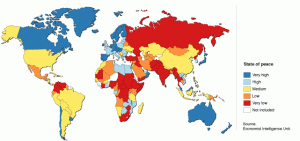
US advances to 83rd on the Global Peace Index

This year, the US advanced from 97th to 83rd on the Global Peace Index ( GPI). On this day of peace, it’s not just parochial competition that makes me wish that it ranked much higher. When the nation with the most powerful military and the largest weapons industry ranks low, the whole world suffers.

The GPI is a project of the Institute for Economics and Peace, which identifies some of the drivers of peace and then ranks the nations of the world by their peacefulness (or ‘absence of violence’).

144 countries are ranked on 24 measures within, as well as between, nations. These measures include levels of democracy and transparency, education and material well being, military expenditure, relations with neighboring countries, and respect for human rights. The data used come from the International Institute of Strategic Studies, the World Bank, various UN offices and Peace Institutes, and the Economist Intelligence Unit.

On the map, red indicates violence and blue the absence of violence. Yellow is in between.

References

Engelhardt, Tom (2009, December 22). In nightmares begin responsibilities: Why war will take no holiday in 2010. TomDispatch.com. “Excuse the gloom in the holiday season, but I feel like we’re all locked inside a malign version of the movie Groundhog Day…”

Moving the world: A celebration of writing and community

Parc de la Tête d'Or, Lyon, Sergio Canobbio

Last Wednesday, I was fortunate to attend a significant literary event, called Moving the World: A Celebration of Writing and Community.

Over a three-hour period, I heard essays, letters, poems, and collaborative writing, but also saw drawings and paintings. I got to meet with the artists and to ask them questions about their work. The intellectual and artistic quality as well as the variety of the works were outstanding. The program was beautifully organized by Patrick Berry and Cory Holding.

An event such as this one is not uncommon; what made this one special was that it was held in the chapel of the Danville Correctional Center, and the artists were all inmates. They showed off the work they’ve done through courses offered by the Education Justice Project (EJP), led by Rebecca Ginsburg. EJP is a response to the abundant evidence showing that

College-in-prison programs reduce arrest, conviction, and reincarceration rates among released prisoners. Evidence has also linked the presence of college-in-prison programs to fewer disciplinary incidents within prison, finding that such programs produce safer environments for prisoners and staff alike. College-prison programs also have benefits for inmates’ families and, hence, their communities.

Captured Potential, Larry Brent

The EJP is an outstanding effort to help young men who want to become better family and community members. If you had experienced Moving the World, you’d at least have seen inmate-students focusing their energies on reading and writing, on reflecting about their lives, families, and communities, and perhaps most significantly, engaged in how they can make positive contributions to the world both inside and outside the prison.

As I said, the quality of the writing and the oral performances was superb. I was impressed with nearly all of the works. One, entitled “Progressive tears: A prisoner’s retrospective cry for Dewey’s help,” asked the philosopher John Dewey whether his progressive vision was still relevant today. Do we as a people still believe in equality and justice? Do we still see education as a means for building a better society? One may wonder, since the use of Pell Grants for prisoners was eliminated in 1994, and most prison college programs have closed.

Another essay asserts “We all want the same things.” It shows that both prisoners and ordinary people on the outside want prisoners to turn from crime to productive citizenship. Other works included letters to family members, poems, reflections on life. The painting, “Captured potential,” and its accompanying text, express well both the tragedy of prison and the possibilities. I doubt whether anyone made it through the event with dry eyes.

You can see some of the writing itself in the National Gallery of Writing.

An event like Moving the World makes the drudgery and nonsense of many other parts of life much more bearable. I not only enjoyed it in the sense of savoring, rather than counting, the moments, I was also impressed by the obvious thoughtfulness, organization, and high standards that went into it. I now understand why one instructor said that her participation has raised the standards back at the university.

References

New literacies and frogs

I visited the University of Connecticut in Storrs yesterday. It was a brief stop, but enough to be once again impressed with the excellent work of the New Literacies Research Team, led by Don Leu. They use new media, not simply to enhance or modernize in a superficial way, but to return classroom literacy to its roots in real communication. Nearly every project I heard about emphaizes reading and writing with a purpose and communication with real audiences.

For example, one project links a fourth-grade class studying the continents with a first-grade class in another state doing the same. The fourth-graders made online slide presentations to help teach the younger students, but quickly learned that their language was too advanced. They then recorded audio explanations to help explain things better.

On the way to UConn, I passed through nearby Willimantic, which is famous for its legend,“The Battle of Frog Pond”. This great battle occurred in 1754 around the time of the French and Indian War. It started with a huge racket in the middle of the night. The terrified villagers seized their muskets and prepared for the attack. In some accounts, they fired wildly across the town common. But no attack materialized. Instead, when morning arrived, they found hundreds of dead bullfrogs. A nearby pond had dried up causing the bullfrogs to fight for the remaining water.

Later, American Thread Company established a mill in the town, which grew to be one of the largest producers of thread in the world. Willimantic became known as “Thread City,” and today boasts four statues on its bridge across the Willimantic River, each with a huge thimble and a giant, now silent, bullfrog.

Goodbye, maple

We had to take down a beautiful maple tree at the back of the house that was way too close to the foundation. Still, there are other maples nearby. And look at the dogwoods. Burning bush, pruned by the deer up to nose height. And leaves from yesterday’s storms. We still have plenty of trees. –Susan Bruce

Apples and apples

IMG_8487There’s more than corn and beans in the farmland here. Last Sunday, we visited an apple farm/orchard in Monticello, Illinois, which had 17 varieties.

Appropriately (for Monticello), one was Thomas Jefferson’s favorite, Spitzenberg. We got a little carried away and bought five half-pecks for $20.

IMG_8489Fortunately, one is a long-keeper, Buff, which is supposed to last until late winter if it stays cold.

IMG_8485If we don’t eat them all, we can feed them to our deer. See this backyard scene, where we played boule at the potluck in honor of John Dewey’s 150th birthday on Tuesday.

Preserving the $ by invading Iraq

This is old news, but I was reminded of it by a discussion on this weekend. It’s worth thinking about again in these parlous economic times.

Sharma, Tracy, and Kumar (2004) talk about one of the major, but little-discussed reasons for invading Iraq. Is militarism the best way to boost our economy?

What prompted the U.S. attack on Iraq, a country under sanctions for 12 years (1991-2003), struggling to obtain clean water and basic medicines? A little discussed factor responsible for the invasion was the desire to preserve “dollar imperialism” as this hegemony began to be challenged by the euro.

References

Caryl, Christian (2009, October 16). Decline of the dollar. Foreign Policy.

Sharma, Sohan; Tracy, Sue; & Kumar, Surinder (2004, February). The Invasion of Iraq: Dollar vs Euro Re-denominating Iraqi oil in U. S. dollars, instead of the euro. Z magazine.

The Soloist (2009)

The Soloist (2009) is an excellent film based on the true-life book, The Soloist by Steve Lopez. Lopez is a Los Angeles Times columnist who discovers Nathaniel Ayers, a Juilliard School dropout, who becomes schizophrenic and homeless, living on the streets of LA.

Ayers is a classically-trained cellist, who now has only a two string violin to play and instead of a concert stage, an urban tunnel or street corner. Lopez wonders how Ayers can stand to play in those conditions, but Ayers tells him that “the only thing that I hear is the music and the applause of the doves and the pigeons.” Ayers is hooked and decides to write a series of feature articles in the Times.

Robert Downey Jr. portrays  Lopez in the movie, and Jamie Foxx portrays Ayers. The two main characters give terrific performances, as do the actual homeless extras from the Lamp Community.

Ayers’s story makes us wonder about the many other homeless people in LA and elsewhere. As Lamp says,

Close to 74,000 people are homeless in Los Angeles–more than in New York, Chicago, and San Francisco combined. Los Angeles’ Skid Row, a 52-block area east of the downtown business district, has the highest concentration of homelessness in the United States. More than half of the homeless men and women in this area are chronically homeless, meaning they struggle with a mental or physical disability and have been living on the street for years.

That relatively greater challenge in LA doesn’t of course diminish the shameful job we do across the US in dealing with homelessness. The book, Ayers’s music, and the movie all reinforce Jane Addams’s view that art and cultural activities can reduce our isolation form one another, and reinforce essential human: “Social Life and art have always seemed to go best at Hull-House.”

The DVD includes features with the real Steve Lopez and Nathaniel Ayers, and also, Beth’s Story, an animated short telling another story of homelessness:

References

Addams, Jane (1930). The second twenty years at Hull-House: September 1909 to September 1929. New York, Macmillan.

The US supplies the guns

weaponsAfter the 9/11 attacks I wrote about 12 steps to respond to 9/11, because “we have to do something!” Number 3 on that list was for the US to stop being the world’s top supplier of arms around the world, at that time selling over 1/2 of all the weapons.

The New York Times Pentagon correspondent Thom Shanker, provides a helpful update, showing that the US market share has grown to 2/3, establishing a virtual monopoly:

Despite a recession that knocked down global arms sales last year, the United States expanded its role as the world’s leading weapons supplier, increasing its share to more than two-thirds of all foreign armaments deals, according to a new Congressional study.

The United States signed weapons agreements valued at $37.8 billion in 2008, or 68.4 percent of all business in the global arms bazaar, up significantly from American sales of $25.4 billion the year before.

via Despite Slump, U.S. Role as Top Arms Supplier Grows – NYTimes.com.

When we wonder about wars around the world, why don’t we ask about our own role in supplying the weapons that people use to fight them?

Tom Engelhardt raises some more disturbing questions in his essay, Is America hooked on war?

References

Engelhardt, Tom (2009, September 17). Is America hooked on war?. Mother Jones.

Health care illogic

Following Rep. Joe Willon’s (R, SC) outburst druing the President’s speech, the Obama administration has scrambled to show that it will guarantee no reasonable means of healthcare for people in the US illegally. That position strikes many people as sensible. But it’s not only cruel, unfair, and unmanageable, it actually undermines the very effort to secure affordable, reliable healthcare for everyone.

No one in power is even talking about government health care for all (that’s a plan that would really work). Instead, the proposal is simply to require everyone to get health care insurance, through a government-managed insurance exchange, employer-provided group coverage, or private insurance. With a large pool of buyers in the exchange, it’s possible that health care costs could be controlled.

Denying undocumented workers and their families access to both the exchange and employer-provided group coverage means that very few will have insurance of any kind. This, in turn, will increase demands on expensive emergency room care, whose costs are ultimately borne by the government and individuals with private insurance.

Rep. Luis Gutierrez (D, IL) put it this way last week:

So, and remember, we’re not talking about government health care, we’re talking about everybody is going to be required to get health care insurance,” said Gutierrez. “And so as we go to this big store, right, where everybody is required. And this exchange, the health care exchange, where if you don’t have health care you are required to go purchase it. When you go and attempt to purchase it, what does the administration say? The administration says, ‘You will have to prove that you are legally in the United States and have a Social Security number and a right to that.’

Some immigrants, and let me say it – hundreds of thousands of them — who have businesses, who are prospering, who are paying taxes— even when they wish to buy because it’s going to be a requirement to buy it, this administration has told them don’t buy. You can’t. You can’t buy.

via Latino Lawmaker Rips Obama for Making It Harder for Illegals to Buy Private Insurance – George’s Bottom Line

One thing that could make the exchange work is to bring in large numbers of relatively healthy people. New immigrants use 55% less health care than native-born Americans, according to a Harvard/Columbia University study (Physicians for a National Health Program, 2005).

Denying health insurance is foolish and spiteful. It’s also absurd: We should demand that immigrants share the burden of paying for healthcare, not exclude them in a way that ultimately endangers not only theirs, but everyone’s health and finances.

See also The bottom line in health care.

References

Physicians for a National Health Program (2005, July 27). Immigrants’ health care costs are low.