Minds-on Math, Science, and Social Studies with standard school supplies

Jack Easley was an professor at the University of Illinois from 1962 until his retirement in 1989. His research on cognitive development in the learning of science and mathematics across various cultures influenced educators around the world. He co-founded the Dialogues in Methods of Education group, which continues to this day. He was also a much loved friend, who died December 10, 1994.

I recently came across some insightful email messages from Jack. Here’s one that I’m certain he would like to have shared more widely, even though they were simply rough notes related to a project:


There is a lot of attention given over to kits and manipulative materials for inquiry. Since these are not always available, it is worthwhile looking at what can be done without the kits, the manipulative blocks, etc.

Math

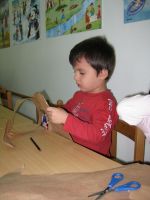
The Japanese schools use cardboard replicas of plastic tiles, and several teachers in the US have found that these can be cut out of file folders with a paper cutter. It is not necessary to have one set for each child, but the following sizes would be appropriate for each team:

  • 5 square units (half-inch squares are usually fine, but 1in or 1 cm can be used.)
  • 2 oblongs, 5 units long (e.g., .5 in by 2.5 in)
  • 5 oblongs, 10 units long (e.g., .5 in by 5 in)
  • 2 fifties (e.g., 2.5 in by 5 in)
  • 10 hundreds (e.g., 5 by 5 in)

With rulers, children can mark one side of the oblongs, fifties and hundreds into ways that show how they all fit together. Other sizes ( 20s, 40s, 25s, etc.) are often convenient, depending on the story problems (going to the bank, etc.) children are solving with these cardboard tiles.

Using bulletin board paper, scrolls of 500 or 1,000 units can also be cut and rolled up (e.g., 5 in by 25 in, or 5 in by 50 in). To make representations of even larger numbers is not much of a problem with the smaller sized units, but if you use 1 sq in as a unit, it begins to get out of hand.

The size of unit can be chosen not only with the fine motor coordination of children in mind, but with the fact that place value and round numbers upwards of 99 are much easier to talk about than those between 9 and 100. Smaller unit sizes (.5 in or 1 cm) should permit more meaningful work with scrolls for numbers like 5,000 or 10,000.

In my opinion, and that of a minority of mathematics educators, the word “ten” is one of the least often suspected but most often confused among number names. The problem may be that “ten” is not a word that easily takes adjectival modification as in “Two tens, three tens, etc.” Ten is most often used as an adjective itself as in “ten fingers, ten hundred, etc.” Research suggests that it takes children until about fourth grade to realize that ten can be a unit instead of just a counting number or the cardinal number of a collection (Cobb & Wheatley, 1988; Steffe, 1983; Steffe & Cobb, 1988.) Informal observations suggest that 100, 1,000, and 1,000,000 are treated as abstract units quite naturally by most 6-year-olds. The debate is whether or not young children can plausibly attach concrete representations to those units.

There are other troubles with the names of numbers greater than 9 and less than 100, e.g., 18 and 81 sound too much alike, both beginning with the word, “eight,” and there are few people who would think that “twenty” was originally pronounced, and possibly spelled, “twain tens.” (Some have tried introducing new number names, onety, twoty, threety, fourty, fivety, and doing that seems to help in regrouping, but teachers and parents complain that children don’t know how to translate them into standard English.) Saying how many tens there are in 11, 22, 35, etc. is no longer a part of English speech today. Instead, everyone learns to rattle off the counting numbers 1 to 100 without pausing to think that there are ten cycles in that series. It may work like telling time or money. (With digital timepieces, we count minutes from 01 to 59 and then hours. We count cents from 01 to 99 and then dollars.) Starting over, which is the essence of place value, is something we don’t seem to think about naturally with those funny two-digit number names. (In the orient, and many native American languages, number names are much more sensible than in European languages.) However, all is well when we get to a hundred and we have three digits. A great deal of regrouping in arithmetic, which is the real advantage of understanding place value, can be learned by working with cardboard tiles and scrolls, without adding and subtracting those peculiarly named numbers from 10 through 99. Adding and subtracting hundreds and thousands, multiplying and dividing by hundreds and by thousands teach place value well and provide ample practice for first and second graders on basic, one-digit addition and subtraction facts.

Cutting templates for drawing the cm size tiles and scrolls in coffee can lids permits children in first and second grade to represent numbers by drawings on paper instead of actually manipulating the tiles themselves. The Japanese have found that drawings of tiles to represent an operation is a valuable intermediate step between manipulation of tiles with number sentences and writing numerical algorithms without manipulations, for it helps children invent and test their own algorithms.

Geometrical forms can be cut out of folders or paper. Also, it is instructive to draw circles, squares, triangles, and other regular figures six or seven inches across and measure their circumferences in various ways. One way to measure a circumference is to set the compass for an inch or a cm of separation and count how many steps it takes to walk around the figure and back to the starting point.

Place a pencil across your hand near the tips of your fingers. Put the heel of your other hand on top of it. Predict, Observe, Explain (POE) where the pencil will be when you have moved the heel of your top hand back until it is over the heel of the bottom hand. Do this motion several times without the pencil, then POE where the pencil will be.

Architecture

Tiling patterns that repeat endlessly can be made on a flat surface. One interesting challenge is to design and cut-out a piece of paper that folds up to make a box, a prism, a pyramid, or some other shaped three-dimensional object.

Columns can be made from rolled or folded construction paper and tested for load bearing by piling textbooks on top. The number of science books, or math books, that a column can hold is something to predict, observe, and explain (POE). One can even measure (POEM) the length, diameter, and circumference of such columns and figure out some kind of graph that represents how those quantities relate to the load a column will carry. Applications (POEMA) of what has been learned can be found, in studying the structure of buildings, bridge supports, street light and traffic light posts, and in making models of buildings. (This is also a good use for science and mathematics books which children and teachers find boring.)

Making designs for stained glass windows with a compass is an intriguing activity. A six-pointed rose window is one goal, but many other designs are possible. Of course coloring one’s design in the most attractive way possible is an added challenge, which assumes everyone has some crayons, or whatever to color them with.

Optics

Punching a pencil through the middle of a dark piece of construction paper 8-11 inches wide and laying it down on a white piece of paper on a flat desk in a well-lighted classroom raises the following question: Looking at the white spot (after making the edges neat by tearing off or folding back the torn pieces the pencil left), try to predict (P) what shape and size that white spot will become when the dark paper is raised an inch or two. (Of the hundreds of people I have asked that question, only one 3rd grade girl, who must have tried it before and one physics Ph.D. could come close.) Observe and Explain (POE) what has been observed. Measure (POEM) how high the dark paper is raised above the white paper and measure what you can of the pattern of light you can see when looking underneath the dark paper (POEM). Is there a relation between the two measurements? What is the best way to make such measurements as you gradually raise the dark paper higher and higher? Plot a graph.

Apply (POEMA) this phenomenon to other sources of light besides schoolroom lights. E.g., tape the dark paper to the window, and cover the rest of the window(s) and turn out the lights. If you hold a thin piece of white paper near the pencil hole, can you see any pattern on the white paper? Substitute a magnifying glass or hand lens for the pencil hole? How does that change the way things look? the graph? Go outdoors on a sunny day with a piece of dark paper in which you have carefully cut three or four different shaped holes about the size of a dime or less. Hold the dark paper so it casts a shadow over a white paper. What is the shape of the light spots going through the holes? How do they change as you move the dark paper higher? (POEM)

Put some water in the plastic cup or glass bottle. Put a pencil in the water. How does it look? Why? If you can find a straight soda straw, put it in and compare it’s shape with the pencil. POE what you will see when you look through the soda straw into the water.

Air

  • Blow through a piece of tubing or soda straw into a jar or cup of water. What is the smallest bubble you can blow? What is the biggest bubble you can blow? Can you blow a bubble and suck it back in before it leaves the end of the tube or straw? What is inside the bubbles you blow? How is it different from the air in the room? Where does the air in the bubble come from? Where does it go when a bubble pops?
  • Put a wad of tissue or paper towel in the bottom of the plastic cup or glass bottle, big enough so it won’t fall out when you turn it upside down. (Use tape if necessary to hold it.) POE what will happen to the paper when you push it carefully up-side down into a coffee can, plastic tub, acquarium, or other large container half full of water. (POEM) Measure how much water goes into the cup or jar. If possible, make measurements at different depths under the water. Plot a graph of how much water goes into the jar for each depth under the water. POEMA What use can you think of for the air trapped in an open container under water? Can you arrange for a cricket or other small animal to breathe that air while under water? Pour out the air trapped in a container while it is under water. Do you think you could catch it in another container under the water, pouring it from one to the other under water? Borrow another container and try.
  • Put a soda straw into water and place your finger or thumb over the open end. Raise it out of the water. What is inside? Can you do that with a piece of hose? (POE) What makes the water run back when you let go? (POEA) Homework (with parental consent and assistance): Can you do it with a wide tube like a cardboard tube waterproofed with rubber cement or melted wax?
  • If you can get a box that a drink (milk or juice) was in, and put the hose over the straw, can you blow and suck on the tube to make the sides of the box go out and in? What does it take to make a tight fit? What happens when the air can leak around the straw? What happens to the tube when you blow or suck on it?

Social Studies
Graphs

  • Sample people in your class to find out how many live with grandparents, aunts and uncles, with one parent, two parents, etc.
  • Find out who knows where various foods are produced, what kind of people produce them, etc.
  • Find out what children think about where adults get the money they need for food and rent if they work at a bank, a store, a restaurant, a post office, a police station, a school, as a house cleaner, a nurse, a doctor, a care giver, a university, a power company, etc. What do such people have to spend money for to do their work?

Science

For the following science activities, certain other things like wax paper, a mirror, a soda straw, a milk carton, a large bowl, etc. are mentioned as needed. Other things in the generic kit may be used, and POEMA may be used also. They come from: Science Games & Puzzles, by Laurence B. White, Jr. drawings by Marc T. Brown, Addison Wesley, 1975

  • Racing drops of water on wax paper.
  • Stand sideways against a wall. Push the side of your foot against the wall. Now try to lift your other foot.
  • Dip one end of a drinking straw in dishwashing liquid. Take it out. Blow in the other end. Keep blowing. Try cut ting your straw end like a cross.
  • Blow bubbles on a very cold day. Your warm breath makes them very light.
  • Push a thumbtack into a pencil eraser. Touch the thumbtack on your lip. Rub the tack hard 20 times on your sleeve and touch it to your lips again.
  • Try to drop a coin into a glass under water in the middle of a big bowl.
  • Collect and taste rain water. Does it taste different from other water?
  • Try printing your name while looking at the pencil and paper in the mirror.
  • Roll a little piece of foil in a ball and drop it in a funnel. You cannot blow it out unless you stop up the funnel.
  • Balance a ruler on your finger. with & without a ball of clay on top.
  • Have your friend lay his (her) head on a table or desk while you tap softly on the bottom.
  • Hold a pencil in your teeth while scraping on it.
  • Is your pet right or left pawed? Put some food in a jar. Which paw is used?
  • Can you freeze a penny in the middle of a piece of ice?
  • Can you turn yourself upside down with a teaspoon?
  • Can you eat an apple without tasting it?
  • Which is longer your forearm or your foot?
  • Can you tie your arms in a knot? Cross them and hold the two ends of a tube while uncrossing.
  • Write ‘A BOX’ on a card and look at it in a mirror several different ways.
  • Punch three holes in a paper cup or milk carton. Which hole will squirt best?
  • Can water stick to itself? Punch two holes side by side.
  • Can you separate pepper and salt that have been mixed?
  • Roll down a slope a full can, an empty can, a hollow ball, a base ball, etc. Which one wins?
  • Tie a string around a nail, then tie the string around another nail, and another. This is how to make a string nail xylophone, which you can play with another nail.

Is Pluto redeemed after all?

27181601There’s a fascinating article, Is Pluto a planet after all?, by Stephen Battersby in the July 27, 2009 New Scientist about the continuing controversy over whether Pluto is a planet. It shows how scientific discourse reflects multiple cultural and political forces, why defining any word is hard, and how our continuing transactions with nature lead us to think again.

How many planets are in the solar system? The official answer is eight – unless you happen to live in Illinois. Earlier this year, defiant Illinois state governors declared that Pluto had been unfairly demoted by the International Astronomical Union, the authority that sets the rules on all matters planetary.

Click on the image to see the New Scientist diagram, which explains part of the debate.

Using photography for qualitative research

nikon-d40-digital-cameraWhile lost amidst sorting through 30 boxes of my files, I’ve occasionally come across some gems. One is

English, Fenwick W. (1988, May). The utility of the camera in qualitative inquiry. Educational Researcher, 17, pp. 8 – 16.

As we do research, prepare proposals for conferences, and work with community members to document their own experiences, it’s worth thinking about alternative methods for doing and presenting research.

English’s article (available online through Sage or the UI Library) uses interesting photographs to discuss the role of the camera in inquiry. He also explores the metaphor of the photo as a way of thinking about different approaches to a research subject, foe example, the wide angle view that surveys a situation versus the telescopic that focuses in on a particular issue.

Blue sea, wilt thou welcome me?

Emily Dickinson’s “My River” tells the comforting tale of the river running to the gracious sea:

My river runs to thee.
Blue sea, wilt thou welcome me?
My river awaits reply.
Oh! sea, look graciously.

I’ll fetch thee brooks
from spotted nooks.
Say, sea, Take me!

But as a recent article in The Economist (Sin aqua non, April 11-17, 2009, pp. 59-61) points out, many rivers no longer reach those welcoming waters:indus

An alarming number of the world’s great rivers no longer reach the sea. They include the Indus [at right], Rio Grande, Colorado, Murray-Darling and Yellow rivers. These are the arteries of the world’s main grain-growing areas.

Along with the rivers being depleted, the Aral Sea drying up. 

Fish stocks in lakes and rivers have fallen roughly 30% since 1970. This is a bigger population fall than that suffered by animals in jungles, temperate forests, savannahs and any other large ecosystem. [Moreover,] half the world’s wetlands…were drained, damaged or destroyed in the 20th century, mainly because, as the volume of fresh water in rivers falls, salt water invades the delta, changing the balance between fresh and salt water.

Of course, the seas won’t disappear. In fact they’re actually rising due to the melting of the Greenland and polar ice caps. Thus, the world will survive, but it may not be one with blue seas and “brooks from spotted nooks.” People may survive, too, but in what kind of world? What will our poetry become when we’ve destroyed the brooks, the rivers, the forests, the fish and other animals,  the plants, and the beauty of the planet?

Hidden Her-story: The Top-Secret “Rosies” of World War II

leann_ericksonNorma Scagnoli referred me to a wonderful podcast by LeAnn Erickson, Associate Professor of Film and Media Arts at Temple University. Erickson is an independent video/filmmaker, whose work has appeared on public television, in galleries, and has won national and international awards.

Entitled, Hidden Her-story: The Top-Secret “Rosies” of World War II, it was recorded in January at the EDUCAUSE 2009 Mid-Atlantic Regional Conference in Philadelphia. I expected to listen for a minute and then go on to more pressing things, but after listening a little I decided that those things weren’t so pressing after all. It’s a fascinating story for anyone who has an interest in history, computers, women, education, mathematics, warfare, politics, Philadelphia, science, workplace equity, morality, or life in general.

In 1942, only months after the United States entered World War II, a secret military program was launched to recruit women to the war effort. But unlike recruiting “Rosie” to the factory, this search targeted female mathematicians who would become human “computers” for the U.S. Army. These women worked around-the-clock shifts creating ballistics tables that proved crucial to Allied victory. “Rosie” made the weapons, but the female computers made them accurate. When the first electronic computer (ENIAC) was invented to aid ballistic calculation efforts, six of these women were tapped to become its first programmers. “Top Secret ´Rosies’: The Female ‘Computers’ of WWII” is a documentary project currently in postproduction that will share this untold story of the women and technology that helped win a war and usher in the modern computer age.

Controls for the podcast appear beneath the description on the EDUCAUSE page.

Grandeur in this view of life

Darwin bustCharles Darwin was born 200 years ago today. In November this year it will be 150 years since he published On the origin of species.

Although others talked about evolution and natural selection before he did, his work was what made the ideas enter our collective consciousness, changing forever our views of science and life. Aside from his detailed scientific work to reveal the workings of natural laws, Darwin was able to write in an engaging way. What’s most evident in those writings is that he revered life, yet saw in death the possibilities for renewal.

The last paragraph of On the origin of species is worth quoting again on this, his birthday:

It is interesting to contemplate an entangled bank, clothed with many plants of many kinds, with birds singing on the bushes, with various insects flitting about, and with worms crawling through the damp earth, and to reflect that these elaborately constructed forms, so different from each other, and dependent on each other in so complex a manner, have all been produced by laws acting around us…

Thus, from the war of nature, from famine and death, the most exalted object which we are capable of conceiving, namely, the production of the higher animals, directly follows. There is grandeur in this view of life, with its several powers, having been originally breathed into a few forms or into one; and that, whilst this planet has gone cycling on according to the fixed law of gravity, from so simple a beginning endless forms most beautiful and most wonderful have been, and are being, evolved.

See the references for interesting stories about Darwin and the evolution of his own ideas and texts.

References

Darwin, Charles R. (1859). On the origin of species. Various publishers and editions; the link here and the quote are for the 1st edition, in Project Gutenberg.

Krulwich, Robert (2009, February 12, ). Death of child may have influenced Darwin’s work. NPR Morning Edition. speaker

Urbanowicz, Charles F. (2002). There is a grandeur In this view of life. In Amanda Chesworth et al. (eds.), Darwin Day collection one: The best single idea ever. Albuquerque, New Mexico: Tangled Bank. See also the full version: On Darwin: Countdown to 2008 / 2009!

Children’s House (Çocuklar Evi) in Çanakkale, Turkey

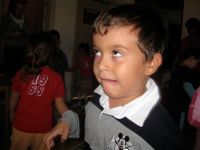
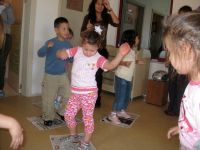
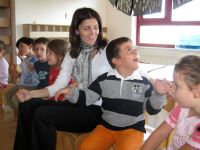
On Monday, I was invited by Ebru Aktan Kerem, an early childhood teacher/researcher at Çanakkale Onsekiz Mart Üniversitesi (in Turkey), to visit Çocuklar Evi, or Children’s House. Ebru’s innovative research contributes to a wonderful, university-based school for children, ages 3-6, and a site for learning for teachers and researchers.

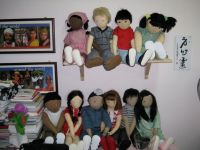
The Principal, Derya Bedir, and the teachers use persona dolls to help develop understanding across differences. They promote art, music, science, and healthy interaction in the spirit of Reggio Emilia or the University (of Illinois) Primary School.

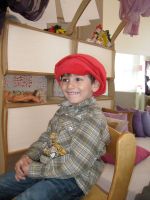
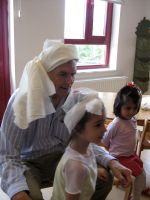
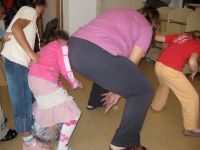
Some visitors apparently observe for an hour, have tea, and then leave. They come away with a rich picture of an outstanding school. But I was captivated by the children and the creative activities led by the teachers. I hope I didn’t overstay my welcome. I joined in on the Turkish songs and taught the children “Skidamarinkadinkadink.” They helped me with my Turkish. One activity led to another, then lunch, and then interesting art projects after lunch. I kept up reasonably well, but was reminded that preschool children can get up and down much faster than I can!

Click once on a photo to enlarge it; click again to enlarge it further.

Growing our food with sewage

One fifth of the world’s food is now grown in urban areas and for half of the urban fields the only source of water is untreated city sewage. Thus, according to a recent study from the International Water Management Institute (IWMI), one tenth of the world’s food is now grown using raw sewage.

Sewage abroad

Raw sewage brings heavy metals, pathogenic bacteria, and worms. But the water is necessary for the plants, and the sewage contains nitrates and phosphates, which promote plant growth. In many areas the use of city sewage has become necessary to prevent starvation. This is just one reminder of the consequences of our unjust global economic system and of the interconnections among water supplies, waste treatment, agriculture, the environment, and economic development.

Sewage at home

But the issues about sewage and agriculture are not confined to crowded cities in developing countries. In most of Europe and North America, about half of the sewage sludge is now spread on farmland, but after treatment that breaks down most of the complex organic molecules and kills most of the pathogens. A major contribution of US industry and the Environmental Protection Agency, has been to promote the term “biosolids,” for the treated stuff, which sounds much better than “sewage,” “sludge,” or “shit.” But despite the name change, we know little about the health and environmental effects of using it.

A report in 2002 from the National Academy of Sciences says that unsafe pathogens and chemicals remain in biosolids. No epidemiological studies have been done to show whether spreading them on land is safe for agriculture workers, nearby residents, or food consumers. In short, we don’t know whether we’re better off than the 10% getting the raw stuff.

Experimental sewage

Meanwhile, biosolid experiments are underway. Could sludge be a fix for hazardous lead paint by lowering the the rate at which lead enters the bloodstream and circulates to organs and tissues? A study asking that was conducted recently on a vacant lot in East St. Louis next to an elementary school. The 300 students were black and almost entirely from low-income families. It’s not clear how the residents could make informed decisions about participating in the study, given the NAS report that no studies have ever been done on its safety.

Where is the public?

Issues such as this never get mentioned in political campaigns, and rarely make the mainstream news. They’re unpleasant to think about, and solutions might require changes in lifestyle or large expense. Most of us are so confused that we can’t even frame the questions. Nevertheless, these issues deserve more attention as part of the world we’re making for ourselves and our children.

Writing in 1927, John Dewey (in The Public and Its Problems) noted that “The public is so confused and eclipsed that it cannot even use the organs through which it is supposed to mediate political action and polity.” In contrast to Walter Lippman, who argued for a knowledgeable elite to address complex problems, Dewey saw full participation in civic life as essential:

We have the physical tools of communication as never before. [But] the thoughts and aspirations congruous with them are not communicated, and hence are not common. Without such communication the public will remain shadowy and formless, seeking spasmodically for itself, but seizing and holding its shadow rather than its substance. Till the Great Society is converted into a Great Community, the Public will remain in eclipse.

I doubt that sewage will become the rallying call for the Great Community, but Dewey was annoyingly vague about what that call might be. What’s clear is that we need to find better ways to create the kind of democracy in which people really participate and which addresses the most basic problems we all face.

See also:

World’s farmers turn to raw sewage for irrigation – health (New Scientist)

Sludge tested as lead-poisoning fix (AP)

Sewage Sludge Standards Need New Scientific Basis (NAS)

The school as social center

What did Dewey mean when he imagined the school as social center of the community and as a site for building a democratic society? How is that different from just teaching history and government, or discussing the local newspaper in class? Are there any schools today that realize Dewey’s vision?

Dewey articulated these ideas in an early speech called “The School as Social Center.” He recognized even then that there were dramatic innovations in transportation & communication, the relaxation of social discipline & control, the growing need for knowledge in all affairs of life, and the need for lifelong learning. As a result, he saw the need to change the image of what constitutes citizenship and therefore the image of the purpose of the school. These ideas are developed more in an excellent new book called Dewey’s Dream.

One implication of this perspective is the creation of community schools, many of which are allied through the Coalition for Community Schools. Through that network, individuals and organizations share work on “education K-16, youth development, community planning and development, family support, health and human services, government and philanthropy.”

Other implications are to move beyond elitist models of service and to focus on reflective transformation of ourselves and our own organizations:

the creation of public spaces can be a seedbed for productive, pluralist, citizen-owned politics in an age of gated communities and privatized resources. We need to change the now dominant view of civic learning as community service or service learning, if we are to develop the political sensibilities of our students. Organizing involves understanding education as about transformation, the “reworking” of ourselves and our contexts. An organizing approach is what we need to develop, if we are to think and act politically. (Boyte, 2003)

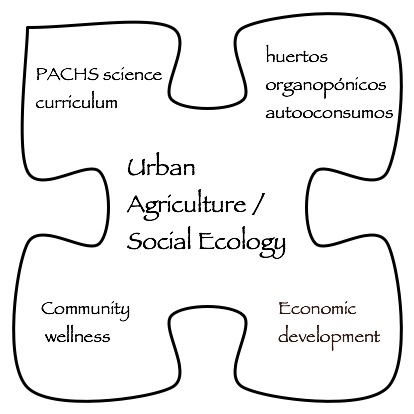
A project at the Pedro Albizu Campos High School in Chicago is an excellent example of what Dewey meant. It embodies the community school idea, as well as ideas urban agriculture projectof transformation and collaborative inquiry to address community needs. In this case, “seedbed” has a literal meaning as well.

The project (Urban Agriculture in the Context of Social Ecology) began as a way for students to learn science with hands-on investigations of hydroponics and soil-based gardening. It has since expanded to include the study of urban agriculture, community wellness, and economic development. For example, students will grow the ingredients needed for salsa de sofrito, such as tomatoes, onions, garlic, green bell peppers, ajíes dulces, oregano, cilantro, and other spices. Growing these and making the sauce will afford a deeper understanding of their cultural heritage. Bottling and selling the sauce will contribute to community economic development as well as affording an understanding of economics and food processing.

See The Quill greenhouse project in Hartford.

References

Benson, Chris, & Christian, Scott (Eds.) (2002). Writing to make a difference: Classroom projects for community change. Teachers CP. Projects in which young people write for community change.

Benson, Lee, Harkavy, Ira, & Puckett, John. (2007). Dewey’s dream: Universities and democracies in an age of education reform. Philadelphia, PA: Temple University Press.

Boyte, Harry Chatten (2003). A different kind of politics: John Dewey and the meaning of citizenship in the 21st century. The Good Society, 12(2), 1-15.

Dewey, John (1902, October). The school as social center. The Elementary School Teacher, 3(2), 73-86.

The Quill greenhouse project in Hartford

Tending the plants Tending plants in the greenhouse Writing at the one Apple II computer Writing at the one Apple II computer

The images here are from 25-year-old 35 mm slides, so they’re not very clear, but the story is still relevant.

In 1982-84 I did some work with the Mary Hooker elementary school in Hartford, CT. We had developed a computer program called Quill, which allowed children to write and send email. Our test classroom at the school was taught by Jim Aldridge, who learned a week before classes started that he was to teach 6th, not 3rd, grade, was to work with the local garden club on a greenhouse project, and was to be a test site for Quill.

Jim’s class had 35 students, all from Puerto Rican, Cuban, and African-American backgrounds. There was a high level of transiency. Some students spent large portions of the winter in Puerto Rico; others simply didn’t come to school. The school was under-resourced and had policies such as requiring students to specify in advance how many sheets of toilet paper they needed for a bathroom trip, since students weren’t trusted with full paper rolls.

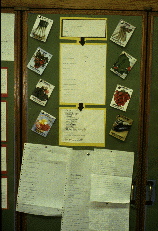
As a fairly new teacher, Jim was naturally a bit concerned. We worked out a way to use the Quill Planner feature for students to do lab reports on the plants in the greenhouse. This at least made the innovations more manageable. As things settled down, we found that the greenhouse became a focal point for learning. Several students who were on the verge of dropping out stayed in the class so they could work with the greenhouse and the computer. Some of this work is described in Electronic Quills: A Situated Evaluation of Using Computers for Writing in Classrooms (B. C. Bruce & A. Rubin; pub: Erlbaum, 1993).

It’s exciting to see how far we’ve come with similar projects today, such as Urban Agriculture in the Context of Social Ecology at the Pedro Albizu Campos High School in Chicago, which exemplifies the idea of the school as social center.

Seed packets and Planner notes
GreenhouseGreenhouse