
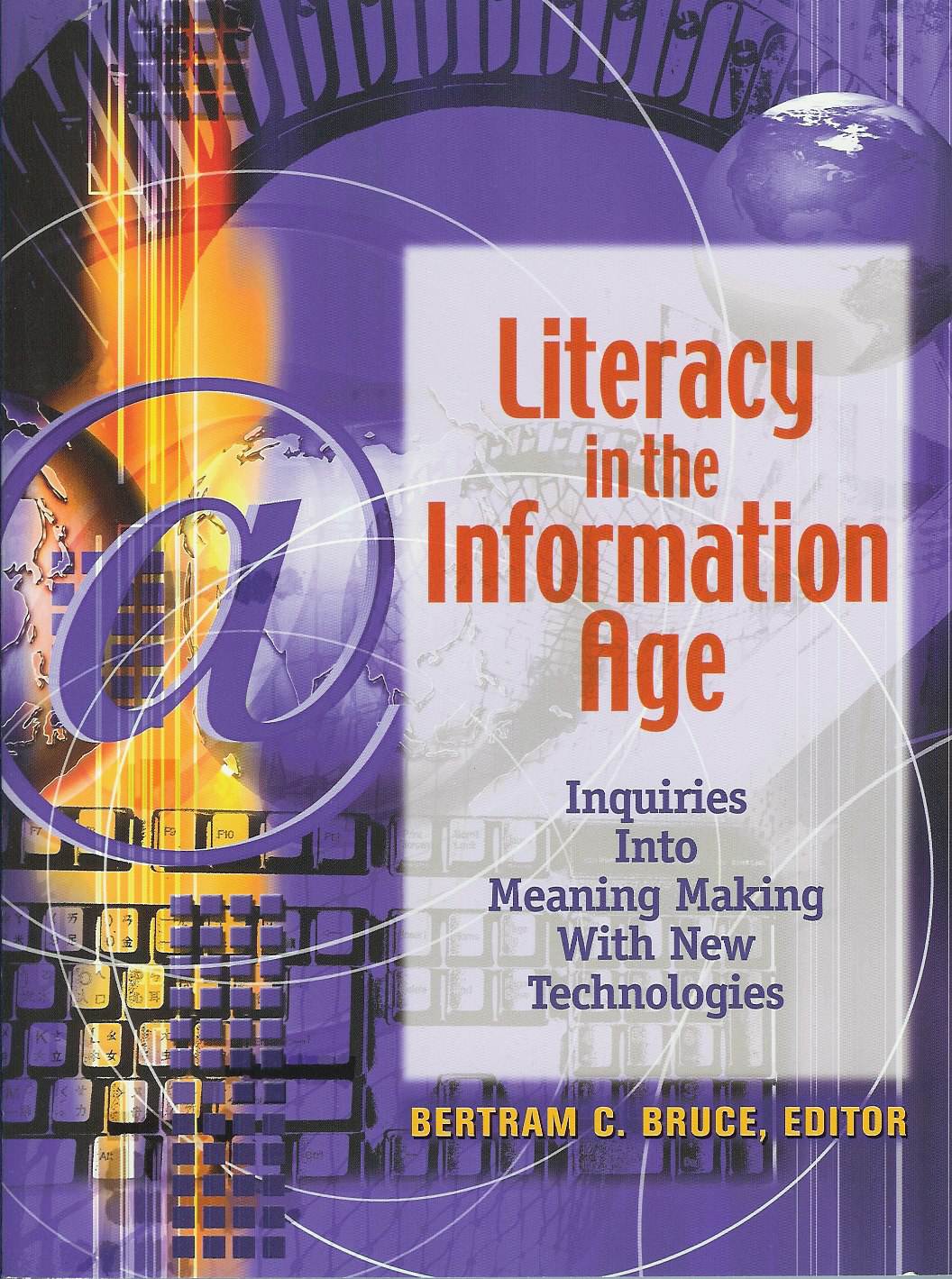
 Educators today want to go beyond how-to manuals and publications that merely celebrate the many exciting new technologies as they appear in schools. Students are immersed in an evolving world of new technology development in which they are not passive recipients of these technologies but active interpreters of them. How do you help learners interpret these technologies as we all become immersed in the new information age? Continue reading
mybook
Discoveries
Discoveries (1995) is a series of four interactive CD-ROM programs for Grades 3-6 (ages 8-12). It includes hypertext, panoramic images, and immersive technology in a pre-web ecology.
 Into the Forest (Great Smoky Mountains National Park) [ISBN 0-669-36168-2]
Editor: Grace Talusan
Designer: Angela Sciaraffa
Logo: Pamela Esty
Cover photo illustration: Daniel Derdula
Teacher to teacher: A professional’s handbook


Alvermann, D. E., Arrington, H. J., Bridge, C. A., Bruce, B. C., Fountas, I. C., Garcia, E., Paris, S. G., Ruiz, N. T., Schmidt, B. A., Searfoss, L. W., & Winograd, P. (1995). Teacher to teacher: A professional’s handbook for the primary classroom. Lexington, MA: D. C. Heath. [218 pp.; ISBN 0-669-35984-X]
Alvermann, D. E., Arrington, H. J., Bridge, C. A., Bruce, B. C., Fountas, I. C., Garcia, E., Paris, S. G., Ruiz, N. T., Schmidt, B. A., Searfoss, L. W., & Winograd, P. (1995). Teacher to teacher: A professional’s handbook for the intermediate classroom. Lexington, MA: D. C. Heath. [216 pp.; ISBN 0-669-35985-8]
Electronic Quills: A situated evaluation of using computers for writing in classrooms
 Quill was a suite of software tools designed to foster an environment for literacy in classrooms. We wrote it in Pascal for the Apple II computer. The software, teacher’s guide, and workshops were used widely, including in village schools in Alaska, which I visited three times during the project in 1983-84. Carol Barnhardt played a major role in setting up that Alaska project and in helping us understand the history and context of schooling in Alaska.
Continue reading
Network-based classrooms: Promises and realities
 Students in network-based classrooms converse in writing through the use of communications software on local-area computer networks. Through the electronic medium they are immersed in a writing community–one that supports new forms of collaboration, authentic purposes for writing, writing across the curriculum, and new social relations in the classroom. The potential for collaborative and participatory learning in these classrooms is enormous. Continue reading
Reasoning Under Uncertainty

Student-created box plot
Reasoning Under Uncertainty was a project funded by the National Science Foundation under its EHR/Applications of Advanced Technology program during 1985-91. The project led to a variety a publications and presentations (e.g., Rosebery & Rubin, 2007; Rubin & Bruce, 1991). Andee Rubin and I were the PIs, but the project eventually involved many other colleagues at Bolt Beranek and Newman, MIT, and local schools in the Cambridge, Massachusetts area. Continue reading
Quill teacher’s guide
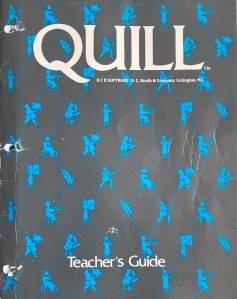
Quill is a set of microcomputer programs that use the computer’s capabilities to help teachers teach writing. Students from third grade through high school have been successful with Quill, including gifted and talented, special education, and English as a second language students.
The Quill programs are tools for teachers and students. Teachers can use Quill to provide challenging, meaningful writing activities for students. Students can use the programs to practice various types of writing and produce finished products they can share with classmates and teachers. These are motivating, adaptable writing activities that supplement and enrich existing language arts curricula, and can be integrated into all content areas.
Theoretical issues in reading comprehension
 [Reissued, Routledge, 2019]
For many years, the study of reading was taken to apply almost exclusively to the process of learning the written code. It was often assumed that once a child could recognize words in their written form, the understanding system already available from the child’s oral language experience would permit comprehension to proceed smoothly.
Continue reading
Dissertation: The logical structure underlying temporal references in natural language
Bruce, B. C. (1971). The logical structure underlying temporal references in natural language. Ph.D. dissertation, The University of Texas at Austin, Computer Sciences Department. [Note: The archival file is very large; here’s the content in a smaller file size.]
Committee: Norman M. Martin (Co-Chair), Robert F. Simmons (Co-Chair), Michael Richter, Terrence W. Pratt
From the Introduction:
Temporal reference in natural language include tenses and other time relations, references to specific times, and a variety of phrases such as “present”, “later”, “when”, “how often”, and “never”. Their high frequency of occurrence reflects the importance of time to the users of natural language. Although the structure underlying temporal references may appear complicated, it is a working assumption of this thesis that a sound logical explanation of its characteristics can be made.
 Chip's journey