Elizabeth Peratrovich Day

Today, February 16, is Elizabeth Peratrovich Day. I learned about it from Bonnie and Hans, friends of nearly 30 years. They have a great blog, Bonnie & Hans’ Excellent Adventure, out of Grayling Alaska.

In a recent post, Elizabeth’s Day, they talk about Elizabeth Peratrovich the Anti-Discrimination Act of 1945, Alaska’s Civil Rights Day, and the film For the Rights of All: the Ending of Jim Crow in Alaska, a documentary about the work of Alaska Natives to end discrimination.

Keeping tabs

In The Public and its Problems, John Dewey (1927) talked about the need for a vibrant Public as a necessary condition for a healthy democracy. This meant the development of what’s been called a “critical, socially-engaged intelligence,” for citizens who respect each others’ diverse viewpoints, who inquire about their society, and are actively engaged in improving it. Doing this requires open diaolgue, the ability to speak without reprisals, and, it should go without saying, the confidence that one is not being hounded by agencies who operate in secret with little check on their behavior.

A colleague of mine recently showed me her copy of Jane Addams’s FBI file. It’s 188 pages of prying into the life of one of the greatest Americans. Hull House, which she co-founded (1889), was a settlement home for thousands of immigrants in Chicago, providing food, shelter, education, arts, English classes, and an introduction to particpatory democracy. It was the beginning of sociology, social work, and public health. The first little theater in America, the first playgrounds in Chicago, and so much more, came out of Addams’s lifetime of dedication to building a better world for all.

It’s true, Addams protested against World War I. For that she won the Nobel Peace Prize (1931), but also the attention of the Federal Bureau of Investigation, thanks in part to the machinations of J. Edgar Hoover. At least those files are finally public. You can judge for yourself whether our Nation was more secure because of that assault on personal liberty.

Another colleague pointed me to a court case in Canada related to the Canadian Security Intelligence Service’s (CSIS) file on Tommy Douglas. Douglas was premier of Saskatchewan from 1941 to 1960, and led in the development of a universal, publicly-funded single-payer health care system. The success there led eventually to the national Medicare plan in Canada. In part for that work, Douglas was selected as “The Greatest Canadian” of all time.

Now, CSIS argues in an affidavit filed in court last month that “Secrecy is intrinsic to security intelligence matters.” They say that full disclosure of Douglas’s file could endanger the lives of confidential informants.

Since the file is secret, we can’t know whether CSIS is correct in saying that it’s absolutely necessary to maintain secrecy on its operations. For that matter, how do we know that their reluctance isn’t based on covering up their own violations? Reading the file on Addams, I’d say that the only people who might want to hide it are those in the FBI. One thing we do know is that there’s no public basis for these security investigations–no violence, no plots, no attempts to undermine the government.

If the file on Douglas is anything like the one on Addams, we should all ask about the extent to which our security services really serve the public good. Why do we create dossiers on our great leaders, without any public evidence? Does security intelligence trump all other values? Does it help create a vibrant Public when secret agencies are given free rein to explore and document our lives, with little oversight on their own actions?

References

CSIS trying to block release Tommy Douglas’ file. Toronto Sun.

Dewey, John (1927). The public and its problems. New York: Holt.

Maloney, Steven Douglas. The public and Its problems.

Canadian Imams issue Fatwa against terrorism

Twenty Imams affiliated with the Islamic Supreme Council of Canada issued a Fatwa (or religious edict) on January 8 declaring that attacks on Canada or the United States by any extremist are an attack on the ten million Muslims living in North America.

The Fatwa is consistent with what I hear from the many Muslim friends and colleagues I have both in the US and abroad. They all condemn violence and feel just as threatened by terrorists as anyone else. Their statements and this latest Fatwa directly answer a question some people have asked: “Why don’t Muslims speak out against terrorism?”

There are several reasons we don’t hear more: Mainstream media finds it more newsworthy to publicize the latest violence than a statement deploring violence. Also, Muslims would no more consider terrorism done in the name of Islam to represent their religion than would Christians consider the Oklahoma City bombings to represent Christianity. The first response of either might be “Of course it’s wrong! How could it be my religion? Why do I need to say anything at all?”

Based on the Qur’an, the Fatwa says in part,

Muslims in Canada and the United States have complete freedom to practice Islam…In many cases, Muslims have more freedom to practice Islam here … than in many Muslim countries.

In fact, the constitutions of the United States and Canada are very close to the Islamic guiding principles of human rights and freedom. There is no conflict between the Islamic values of freedom and justice and the Canadian/US values of freedom and justice.

Therefore, any attack on Canada and the United States is an attack on the freedom of Canadian and American Muslims…[and on] thousands of mosques across North America. It is a duty of every Canadian and American Muslim to safeguard Canada and the USA. They must expose any person, Muslim OR non-Muslim, who would cause harm to fellow Canadians OR Americans.

May Allah save Canada, the United States and the entire world from the evil of wrong doers. Ameen.

Civil rights for the LGBT community, and for all

In his ‘Letter from the Birmingham jail‘, Martin Luther King placed the struggle against injustice in Birmingham in a larger context:

Moreover, I am cognizant of the interrelatedness of all communities and states. I cannot sit idly by in Atlanta and not be concerned about what happens in Birmingham. Injustice anywhere is a threat to justice everywhere.

While those lines are often quoted, they’re more often ignored. For many people, injustice means what happens to them directly, not what happens to others.

Countering that passivity, and calling on progressives allies to stand up, is a video made by one of my students, Phil Reese. It’s an excellent message about civil rights for all, including the LGBT community. In addition to conveying an important message, it’s done in a creative way, reminding us of the many silenced voices around us.

Progressives can’t sit by while Civil Rights are taken away from Americans–help us and become a true ally in the fight for Equality! -HEY #p2 We’re talking to you! AFTER THE VID VISIT http://bit.ly/HEYP2ALLY for more!

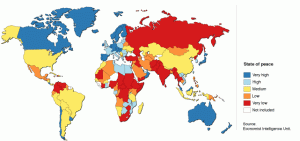
US advances to 83rd on the Global Peace Index

This year, the US advanced from 97th to 83rd on the Global Peace Index ( GPI). On this day of peace, it’s not just parochial competition that makes me wish that it ranked much higher. When the nation with the most powerful military and the largest weapons industry ranks low, the whole world suffers.

The GPI is a project of the Institute for Economics and Peace, which identifies some of the drivers of peace and then ranks the nations of the world by their peacefulness (or ‘absence of violence’).

144 countries are ranked on 24 measures within, as well as between, nations. These measures include levels of democracy and transparency, education and material well being, military expenditure, relations with neighboring countries, and respect for human rights. The data used come from the International Institute of Strategic Studies, the World Bank, various UN offices and Peace Institutes, and the Economist Intelligence Unit.

On the map, red indicates violence and blue the absence of violence. Yellow is in between.

References

Engelhardt, Tom (2009, December 22). In nightmares begin responsibilities: Why war will take no holiday in 2010. TomDispatch.com. “Excuse the gloom in the holiday season, but I feel like we’re all locked inside a malign version of the movie Groundhog Day…”

Moving the world: A celebration of writing and community

Parc de la Tête d'Or, Lyon, Sergio Canobbio

Last Wednesday, I was fortunate to attend a significant literary event, called Moving the World: A Celebration of Writing and Community.

Over a three-hour period, I heard essays, letters, poems, and collaborative writing, but also saw drawings and paintings. I got to meet with the artists and to ask them questions about their work. The intellectual and artistic quality as well as the variety of the works were outstanding. The program was beautifully organized by Patrick Berry and Cory Holding.

An event such as this one is not uncommon; what made this one special was that it was held in the chapel of the Danville Correctional Center, and the artists were all inmates. They showed off the work they’ve done through courses offered by the Education Justice Project (EJP), led by Rebecca Ginsburg. EJP is a response to the abundant evidence showing that

College-in-prison programs reduce arrest, conviction, and reincarceration rates among released prisoners. Evidence has also linked the presence of college-in-prison programs to fewer disciplinary incidents within prison, finding that such programs produce safer environments for prisoners and staff alike. College-prison programs also have benefits for inmates’ families and, hence, their communities.

Captured Potential, Larry Brent

The EJP is an outstanding effort to help young men who want to become better family and community members. If you had experienced Moving the World, you’d at least have seen inmate-students focusing their energies on reading and writing, on reflecting about their lives, families, and communities, and perhaps most significantly, engaged in how they can make positive contributions to the world both inside and outside the prison.

As I said, the quality of the writing and the oral performances was superb. I was impressed with nearly all of the works. One, entitled “Progressive tears: A prisoner’s retrospective cry for Dewey’s help,” asked the philosopher John Dewey whether his progressive vision was still relevant today. Do we as a people still believe in equality and justice? Do we still see education as a means for building a better society? One may wonder, since the use of Pell Grants for prisoners was eliminated in 1994, and most prison college programs have closed.

Another essay asserts “We all want the same things.” It shows that both prisoners and ordinary people on the outside want prisoners to turn from crime to productive citizenship. Other works included letters to family members, poems, reflections on life. The painting, “Captured potential,” and its accompanying text, express well both the tragedy of prison and the possibilities. I doubt whether anyone made it through the event with dry eyes.

You can see some of the writing itself in the National Gallery of Writing.

An event like Moving the World makes the drudgery and nonsense of many other parts of life much more bearable. I not only enjoyed it in the sense of savoring, rather than counting, the moments, I was also impressed by the obvious thoughtfulness, organization, and high standards that went into it. I now understand why one instructor said that her participation has raised the standards back at the university.

References

Howard Zinn’s “Three Holy Wars”

Howard Zinn spoke at the Progressive magazine’s 100 Anniversary Conference. He makes a persuasive case for questioning even the good wars, such as the “three holy wars” of US history.

It’s worth thinking about Zinn’s argument in light of Obama’s Nobel Prize lecture, in which he says “Still, we are at war, and I am responsible for the deployment of thousands of young Americans to battle in a distant land. Some will kill. Some will be killed.” Is the war in Afghanistan a more holy war than the ones that Zinn questions?

Overconsumption is the problem, not population

When we watch farmlands or forests being paved over for new housing, or see images of starving children, it’s hard not to think that there may be just too many people, that we have “exponential” population growth. This leads soon to the idea that we need to “do something” about population.

That view has a long history, including Paul Ehrlich’s The Population Bomb (1968) and Thomas Robert Malthus’s An Essay on the Principle of Population. There may well be negative effects and ultimate limits, but most of the blame assigned to population today would be better assigned to overconsumption.

How we understand the causes of present problems such as climate change, depletion of natural resources, hunger, and war is important, because different causes call for different remedies. An article by Fred Pearce in New Scientist, via Population: Overconsumption is the real problem – opinion – 27 September 2009, summarizes well the major issues here.

The population “bomb” is fast being defused. Women across the poor world are having dramatically fewer babies than their mothers did – mostly out of choice, not compulsion. Half a century ago, the worldwide average for the number of children a woman had was between five and six. Now she has 2.6. In the face of such a fall it is hard to see what more “doing something” about global population might achieve.

Half the world now has a fertility rate below the replacement level, which, allowing for girls who don’t make it to adulthood, is around 2.3. This includes most of Europe, east Asia, North America and the Caribbean. There are holdouts in a few Muslim countries – but not Iran, where fertility is 1.7 – and many parts of Africa

Thus, even if we have too many people, the rate of growth is decreasing, and all the indicators point to further reductions accompanying development. So, if the problem is not exponential population growth, what is it? Pearce goes on to point out that

the world’s richest half billion people – that’s about 7 per cent of the global population – are responsible for 50 per cent of the world’s emissions. Meanwhile, the poorest 50 per cent are responsible for just 7 per cent of emissions. One American or European is more often than not responsible for more emissions than an entire village of Africans.

Every time those of us in the rich world talk about too many babies in Africa or India, we are denying our own culpability. It is the world’s consumption patterns we need to fix, not its reproductive habits.

Pearce talks mostly about climate change, but his argument holds for other aspects of environmental stress, including the basic issue of hunger. Overconsumption in the rich countries occurs through waste, a diet heavily based on meat, and simply too much eating. A study directed by Timothy Jones at the University of Arizona Bureau of Applied Research in Anthropology, indicates that up to fifty per cent of all food ready for harvest in the US never gets eaten. That amount alone is enough to address worldwide hunger needs.

There’s no doubt that we’d do better to balance our population with the available resources, but before we criticize the mote in the eye of starving villagers in Africa, we might well consider the beam in our own.

References

Rethinking schools

Rethinking Schools began in 1986 in Milwaukee, Wisconsin, as an effort to address problems such as “basal readers, standardized testing, and textbook-dominated curriculum.”

It’s since become an international publisher of educational materials, with a magazine and books on classroom practice and educational theory, social justice, anti-racism, vouchers and marketplace-oriented reforms, funding equity, and school-to-work. The publications are written by and for teachers, but speaks to students, parents, administrators, researchers, and community members as well.

I like their vision of the common school:

Schools are about more than producing efficient workers or future winners of the Nobel Prize for science. They are the place in this society where children from a variety of backgrounds come together and, at least in theory, learn to talk, play, and work together.

Schools are integral not only to preparing all children to be full participants in society, but also to be full participants in this country’s ever-tenuous experiment in democracy. That this vision has yet to be fully realized does not mean it should be abandoned.

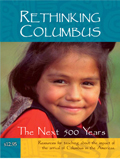
I highly recommend their publications, including the classic, Rethinking Columbus: The Next 500 Years, which was my introduction. I’ve used several of the books or magazine issues in my own teaching and can say that I’ve learned important things from every one of them.