Camara in third-level education

Camara shop We’ve recently had discussions between National College of Ireland and Camara. The Camara process involves collecting donated computers, testing and repairing them, loading software, shipping the the packages to Africa, setting up school or community technology centers, and training local residents. It also includes developing multimedia presentations and educational software, databases, networking, and a variety of software applications and system components.

It turns out that enacting these processes addresses the learning objectives of the third-year work experience requirement, as well as major parts of courses in hardware, multimedia, networks, management technology, marketing, and other areas. Many students and staff are interested as volunteers as well.

training At the same time, having National College of Ireland students involved meets special needs of Camara in terms of certain skills, especially hardware. College students could help with the pile of computers now waiting patiently for treatment in the Camara Computer Hospital. Some students will participate through coursework, which should help in terms of consistency of participation.

banner This is an excellent example of the principle: The community is the curriculum. When learning grows out of concrete lived experience, learning activities start out being integrated. When it derives from real community needs those activities are automatically purposeful. They highlight independent and critical thinking, responsibility, communication, collaboration, and problem solving, not because someone decided these should be taught, but because these are needed to achieve a common purpose. All of the participants, including whether in the College, the Camara facility, or a village in Africa, become both learners and contributors.

Second photo courtesy of the Camara Flickr site.

Changing the spiral of violence into a spiral of hope

stack of monitors Camara is a wonderful program, which could be described in simple terms as a way to stop filling landfill sites with the hazardous waste of old computers, and instead, send those computers to schools and colleges in Africa. But it’s really much more than that.

I was fortunate to get a tour of the new Camara facilities now located in the Digital Hub near the Guinness Warehouse in the Liberties area of Dublin. I’ve now also had a chance to meet with various Camara staff and volunteers. I learned that Camara delivers computers to schools throughout Africa; sends volunteers to teach technology in Africa, and creates computer training materials and educational multimedia for schools in Africa.

refurbishingThere are many distinctive features of the Camara operation. One is that computers are loaded with Camarabuntu. This is a complete operating system (Linux), plus an office suite, web browser, many educational applications, and a condensed Wikipedia. It’s designed for a teacher to be able to setup a complete computer-based classroom quickly and easily.

There is also much attention to the volunteer experience, including providing opportunities for people with a wide range of skills and available time. Post-prinary and third-level students participate, as do retired people, and many others. Camara finds ways to involve everyone. Even those who donate computers are asked to help with the initial sorting of parts. They also help with culture shock for those who make the four-week trip to Africa.

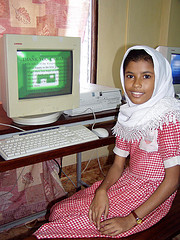
girl at site

One derivation of the name, Camara, is from a West African word meaning, “one who teaches from experience.” Another is from Dom Hélder Pessoa Câmara the Roman Catholic Archbishop of Olinda and Recife, who had an uncompromising commitment to the poor. Câmara’s “Spiral of Violence” calls upon the youth of the world to break the spiral that their ancestors and parents have perpetuated. The Camara computer to Africa program brings together these aspects of learning and social justice in a refreshingly practical and successful way.

Photos courtesy of the Camara Flickr site.

Fulbright Chair at National College of Ireland, 2007-08

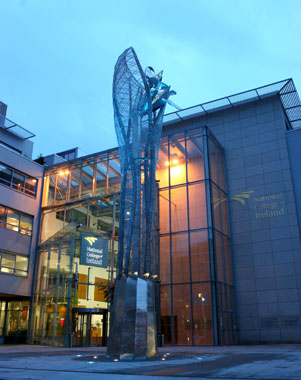
NCI Iris

My Fulbright Distinguished Chair position is hosted by the National College of Ireland, a third-level institution in Dublin. The College is very different from my own University of Illinois in terms of size, history, student population, local community, and emphasis on postgraduate education. And yet, I sensed from the position description and confirmed through subsequent interactions that there was an excellent fit with my own interests, experiences, and values.

The College was established in Ranelagh by Jesuits. Initially known as the Catholic Workers College, it was designed to serve workers and to fulfill the social justice mission of the Jesuits. It was also a response to the threats of totalitarianism revealed by the leadup to and aftermath of the Second World War, seeing education as the means to preserve a democratic society.

In 2000, the name was changed to National College of Ireland, and in 2003 the College moved to the International Financial Services Centre in the Dublin Docklands area. Over its history the nature of work had changed from manufacturing to service, digital technologies had become ubiquitous, and Ireland had grown into a wealthy nation. But not everyone participated fully in the Celtic Tiger; in the Docklands itself, one sees high-rise buildings for multinational banks and insurance companies next to housing for families who see little chance for success in schooling or in the economy. In this context, the College has maintained its social justice commitment, but renewed that in the context of a changing economy and demographics.

It was clear from my initial meetings in the College that there was a strong desire among both the leadership and the staff to bring social action together with academic excellence. There was a commitment to foster social responsibility along with new economy skills. There was an openness to seeing social commitment as an integral part of the learning experience and of scholarship in the College. Because of this, I saw a real opportunity to connect my work on community inquiry. My work came to focus on widening participation, enriching the learning environment, and promoting an active research culture, which were also key aspects of the College strategic plan.

Continue reading

The radio museum in Howth

This could have been a post about a walk on the Cliffs of Howth, a small seaside town north of Dublin. Yesterday was a beautiful day, with a brisk wind and light cirrus clouds–a great day for a cliff walk if you don’t stand too close to the edge and if you watch your footing on the muddy track and wet rocks.

Pat and EmilyBut before we began the walk, we happened upon a wonderful small museum about the development of radio: Ye Olde Hurdy-Gurdy Museum of Vintage Radio. It’s in the Martelo Tower above the harbor, at one end of the cliff walk. Pat Herbert, the founder, is passionate about what he’s learned about radio, and communications in general, drawing everyone else into it. Susan adds:

Pat played a tape on which a group of amateur radio enthusiasts had recorded a conversation with the Space Shuttle Columbia during the few minutes it was over Ireland in 1983, 20 years prior to its tragic crash over Texas. One of the astronauts at the time was an amateur radio enthusiast, and Irish amateur radio people had spent hours trying to contact him. A visitor to the museum gave Pat the tape, which he owned only because his brother had been one of the 1983 radio buffs. The entire visit was like that, just one story after another… He had many stories, mostly directed at Emily. And, typically, at about 1:00, announced that it was about time for a cup of tea and biscuits. So we sat around and talked for a good while.

Howth cliffPat said that not many school groups come to the museum. That’s a shame, because the exhibits could be fascinating to young people as well as to those who lived through some of the times presented there. I think especially of young people in transition year programs (age ~15), who are doing new media projects, such as at the Suas Foundation’s excellent Bridge to College (B2C) programme . The museum would introduce interesting technologies as well as add an historical perspective.

Susan and EmilyWhen we did manage to set off on the hike we had a wonderful windy time, circling a good part of the Howth peninsula with grand views of the Ireland’s Eye and the Dublin harbor, and then making it up to the Ben of Howth. Eventually returned to the port in time for early dinner at The Oar House.

Premier of “Round Here”

Round Here sceneWe attended a gala movie premier last night at the National College of Ireland (NCI). The film, Round Here, explores themes of community and identity in the rapidly changing Dublin Docklands area.

.

.

limoTwelve young people from the Docklands area not only star in the film, but devised it based on their own experiences there. Philip McMahon wrote the actual script following interviews with the young people; it was directed by Colin Thornton. I thought it was an excellent portrayal of the challenges facing many young people today.

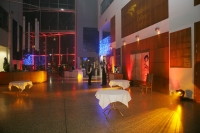
NCI atriumThe event began with the young people arriving by limo and walking down a red carpet. They were announced by young escorts wearing top hats and tails. There was of course popcorn and soft drinks as for any cinema event. Kirsten Sheridan (My Left Foot, In America, August Rush) was a surprise guest who presented DVDs of the movie to the young stars. Afterwards, we were able to visit with the cast and crew over cocktails.

actorsThe project was a joint venture of NCI, Calipo Theatre and Picture Company, and the Sheriff Street After Schools Education and Support Programme (Celine Howard) and was funded by patrons of the NCI.

people-3Photos courtesy of the National College of Ireland.people-2

Community Informatics Research Network conference, Prato, 2007

lunch on the terraceLast week I went to the Community Informatics Research Network conference at the Monash University Centre in Prato, Italy. The theme was “prospects for communities and action.” Attendees came from over 22 countries including Finland, New Zealand, Peru, Puerto Rico, and Mozambique. There were days devoted to both community informatics and to development informatics.

The next conference will be held 27-30 October, 2008.

Villa RucellaiWe stayed at Villa Rucellai di Canneto, a lovely old villa situated on a hill above the Bisenzio river. The fortified tower was built in the Middle Ages, and it’s described as a villa in 1427.

Maramureş

Barsana Monastery church I’m attaching a couple of photos from Romania, where we went in September. One is a wooden church in the Maramureş style. It’s part of the Barsana Monastery. Another was one of many hitchhikers we picked up. Our old Dacia wasn’t much as a car, but it beats walking or horse-drawn cart when you’re tired. We had learned enough Romanian to figure out that the man is 82, has 9 children, and knows the woman who works in the post office and runs our B&B. We also saw what may be the oldest, and is certainly the longest-running Unitarian Church (in Cluj-Napoca). I spent an hour with the pastor, learning about their history and the church building and furnishings.

In Maramures, we saw Elie Wiesel’s home/museum. As you friend in Botizamay know, Maramureş was one of the worst holocaust sites, with over 20,000 Jews from Sighetu-Marmaţiei alone sent to Auschwitz. Later, Communists in Romania sent tens of thousands of “Saxons” (ethnic Germans) to work and die on the Danube canal construction. Roma people managed to be persecuted throughout, and still suffer from prejudices today (although projects such as Şanse Egale are working to improve opportunities).

We also saw the museum sometimes called the “Museum of Suppressed Thought”, which made me aware that my imagination is limited in conceiving all the ways people can oppress one another, and all the different ethnic prejudices that can be realized. Maramureş and Transylvania in general have seen more than their fair share. That’s especially disturbing to think about in a country which is otherwise so beautiful, friendly, and welcoming.

I gave a talk on Dewey, Hull House, and Paseo Boricua at the Philosophy of Pragmatism: Salient Inquiries conference at Babeş-Bolyai University in Cluj-Napoca. I’d certainly value any comments or suggestions on the draft.

The school as social center

What did Dewey mean when he imagined the school as social center of the community and as a site for building a democratic society? How is that different from just teaching history and government, or discussing the local newspaper in class? Are there any schools today that realize Dewey’s vision?

Dewey articulated these ideas in an early speech called “The School as Social Center.” He recognized even then that there were dramatic innovations in transportation & communication, the relaxation of social discipline & control, the growing need for knowledge in all affairs of life, and the need for lifelong learning. As a result, he saw the need to change the image of what constitutes citizenship and therefore the image of the purpose of the school. These ideas are developed more in an excellent new book called Dewey’s Dream.

One implication of this perspective is the creation of community schools, many of which are allied through the Coalition for Community Schools. Through that network, individuals and organizations share work on “education K-16, youth development, community planning and development, family support, health and human services, government and philanthropy.”

Other implications are to move beyond elitist models of service and to focus on reflective transformation of ourselves and our own organizations:

the creation of public spaces can be a seedbed for productive, pluralist, citizen-owned politics in an age of gated communities and privatized resources. We need to change the now dominant view of civic learning as community service or service learning, if we are to develop the political sensibilities of our students. Organizing involves understanding education as about transformation, the “reworking” of ourselves and our contexts. An organizing approach is what we need to develop, if we are to think and act politically. (Boyte, 2003)

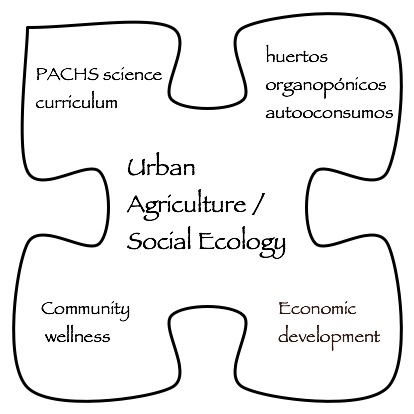
A project at the Pedro Albizu Campos High School in Chicago is an excellent example of what Dewey meant. It embodies the community school idea, as well as ideas urban agriculture projectof transformation and collaborative inquiry to address community needs. In this case, “seedbed” has a literal meaning as well.

The project (Urban Agriculture in the Context of Social Ecology) began as a way for students to learn science with hands-on investigations of hydroponics and soil-based gardening. It has since expanded to include the study of urban agriculture, community wellness, and economic development. For example, students will grow the ingredients needed for salsa de sofrito, such as tomatoes, onions, garlic, green bell peppers, ajíes dulces, oregano, cilantro, and other spices. Growing these and making the sauce will afford a deeper understanding of their cultural heritage. Bottling and selling the sauce will contribute to community economic development as well as affording an understanding of economics and food processing.

See The Quill greenhouse project in Hartford.

References

Benson, Chris, & Christian, Scott (Eds.) (2002). Writing to make a difference: Classroom projects for community change. Teachers CP. Projects in which young people write for community change.

Benson, Lee, Harkavy, Ira, & Puckett, John. (2007). Dewey’s dream: Universities and democracies in an age of education reform. Philadelphia, PA: Temple University Press.

Boyte, Harry Chatten (2003). A different kind of politics: John Dewey and the meaning of citizenship in the 21st century. The Good Society, 12(2), 1-15.

Dewey, John (1902, October). The school as social center. The Elementary School Teacher, 3(2), 73-86.

Messing about in technology

If we were to establish a hall of fame for reflective writing about teaching, especially for texts revealing deep, yet accessible ideas about pedagogical theory/practice, it would be difficult to find better candidates than “Messing About in Science” by David Hawkins (1965). The paper describes his work in a fifth-grade class teaching about pendulums as part of the Elementary Science Study, which grew out of his discussions with Eleanor Duckworth, another insightful science educator. Although the study was grounded in a specific setting, the ideas might be applied to any subject of study or types of learners, including learning about and with digital technologies.

Phases in science learning

Hawkins identifies three patterns, or phases, of school work in science. These phases induce different relations among children, materials of study, and teachers. If we substitute “mentors” or “colleagues” for “teachers,” we see that they apply fairly well to science work itself and to other kinds of learning and work. That’s not so surprising, given that the essence of the phases is that the form of inquiry in science is not that different from the form of inquiry in learning. In fact, Hawkins prefers the term “work” over “play” in his model, even though it might appear that he’s just arguing for allowing children to have time to play.

Hawkins has in mind the kind of work one might do on a boat, citing the famous passage by in The Wind in the Willows, by Kenneth Grahame (1908):

“Believe me, my young friend”, said the water rat solemnly, “there is nothing…absolutely nothing…half so much worth doing as simply messing about in boats. Simply messing…nothing seems really to matter, that’s the charm of it. Whether you get away or whether you don’t; whether you arrive at your destination or whether you reach somewhere else, or whether you never get anywhere at all, you’re always busy, and you never do anything in particular…”
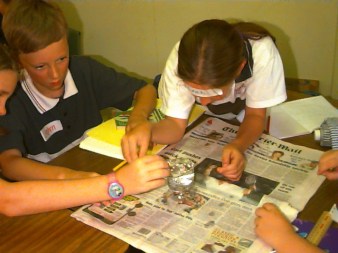
slipping pennies into water

(Slipping pennies into water in an investigation of surface tension, in a school in Brisbane; note the name tape on the forehead!)

Hawkins discovered that in order to learn in science we need ample time to “mess about.” Because it may appear that we don’t “get anywhere at all,” this phase is often neglected and undervalued. Thus, he devotes most of his article to the circle (◯) or “messing about” phase, in which learners engage in “free and unguided exploratory work” (p. 67).

In the pendulum study, Hawkins had planned to allow the children to explore for an hour or two, before getting into the science lesson per se. But he soon discovered that they needed more time to become familiar with the materials. Moreover, the materials provided a structure to their investigations. Their messing about was far from chaotic or undirected. In fact, as they messed about they began to generate the very questions that the lesson was intended to address, but in a way that was more involved, and connected to their direct experience.

Hawkins goes on to describe two additional phases, which he sees as essential, but more often included in science teaching. The triangle (△) phase, involves “multiply programed material” to support work that is “more externally guided and disciplined” (p. 72). The square (▢) phase is for “discussion, argument, and the full colloquium of children and teacher” (p. 74). The phases are unordered, and all are important. Learning in science requires the opportunity to experience al of the phases in a connected way, and to move easily among them.

Franz and Papert (1988) build on Hawkins’s ideas in a paper about students learning how to measure time. They argue that using computers well for learning requires

open-ended projects that foster students’ involvement with a variety of materials; …activities in which students use computers to solve real problems; …[connection of] the work done on the computer with what goes on during the rest of the school day, and also with the students’ interests outside of school; …[recognizing] the unique qualities of computers; …[taking advantage of] ow-cost technological advances…, which promote integration of the computer with aspects of the students’ physical environment.

Youth community informatics

In our Youth Community Informatics project, middle-school students make podcasts of stories important in their lives. Their work (learning) appears to follow the models we see in the pendulum and time projects, especially in terms of the value of messing about. They need time to explore, experiment, and become comfortable with the technologies.

In the project, young people select images from the web, scan in family photos, create graphics, find and download music, create audio files, edit audio using Audacity, and create presentations. They learn about copyright and citing sources, as well as about design and story-telling. More importantly, they use the podcasts as a way to connect with and talk about their families and their lives outside of school.

Like Hawkins, we see the value of guided inquiry (△) and of full colloquium (▢) in this work, but we have seen increasingly the need for ample time to mess about (◯) as well. Doing that allows students to make the technology part of their lived experience and not something divorced from it.

References

Hawkins, David (1965). Messing about in science. Science and Children, 2(5), 5-9.

Franz, George, & Papert, Seymour (1988, Spring). Computer as material: Messing about with time. Teachers College Record, 89(3), 408-417.

Writing for a Change

As you all may know, the campus has an effort, led by Libbie Morley, to establish a National Writing Project site here. There will be an opening reception at Levis Faculty Center on April 3.

Among the materials we’re reviewing prior to submitting a proposal for the site is a new book, Writing for a Change: Boosting Literacy and Learning Through Social Action, edited by Kristina Berdan et al. (Jossey-Bass, 2006). It reflects a collaboration between the National Writing Project and the Centre for Social Action at De Montfort University in Leicester, England. I was struck in reading it how close the goals of an NWP site could be to what we’re doing with Community Informatics.

Below is an abstract, although it doesn’t do justice to the social action dimension as shown in the book:

Writing for a Change shows teachers how to engage students in “real world” problem-solving activities that can help them to acquire voice, authority, and passion for both reading and writing practice. Written in collaboration with the Center for Social Action in England, the book describes the innovative Social Action process for encouraging students to collaborate on problems of their own choosing—to analyze options, develop action plans, discover solutions, and finally to reflect on their work. Featuring stories by teachers who have successfully used the method, the book shows that first graders as well as high-school students can enjoy this exciting and educational process. Practical guidance for applying the process to any curricular area is provided along with an extensive list of classroom activities.