The ecosystems perspective on learning offers a new way of thinking about how learning through life — work, play, home, family, and community — relates to formal education and its many informal counterparts in libraries, clubs, churches, online, etc. It conceives education broadly as the central process of democratic life. For the educator in formal or informal settings, it provides a theoretical framework for what the best educators are already doing. For the researcher or evaluator, it offers tools for analysis. For anyone it suggests ways to reflect on our own learning through life.
Sandy Hook is a beautiful, peaceful respite. There are interesting walks and cycle routes all over. The big activities are in other-than-human nature, since the principal human activity was the now dilapidated Fort Hancock.
Beach plums bloom wildly in the spring, promising unlimited jams and jellies. Menhadens litter the beach. Perhaps a school was attacked by bluefish, or seabirds? Ospreys circle overhead, in flocks of four or more, a pattern that I’d never seen before. The tides move inexorably, but the whitecaps come and go as the wind keeps changing. The Raritan bay side and the Atlantic ocean side each have their distinctive character.
Beach plum bush with blossoms
The isolation and calm aren’t for everyone. Sarah Patterson was appointed Assistant Keeper of the Lighthouse in 1867. She assisted her brother, Charles Patterson, who was Head Keeper and tended the lighthouse from 1861 to 1885. She complained about what seemed monotonous to her:
…I get homesick…I can only look at sand and water [here]. We can’t hardly tell whether its spring or not… [because] it is always one thing here; the sand and cedars never change.
Sarah Patterson Johnson in a letter to her father at the family farm in Howell Township, NJ
Sarah never knew that the beach season would disrupt the calm of Sandy Hook starting each June. I imagine that it’s quite different then. Huge parking lots, A through M, imply hundreds of cars, beach parties, loud music, frisbees, dogs, and raucous times.
The summer could offer a fun adventure, but I’ll settle for quiet interrupted only occasionally by the warning horn of the ferry approaching the nearby dock, gorgeous sunsets and sunrises over the water, and sand and cedars that actually change all the time.
I am amazed at this spring, this conflagration Of green fires lit on the soil of the earth, this blaze Of growing, and sparks that puff in wild gyration, Faces of people streaming across my gaze.
D. H. Lawrence, “The Enkindled Spring”
We’re now seeing family in New Jersey. This means renewing ties that have been too long restricted to email, phone and zoom. But it also means newing (?) ties with Claire, the baby who joined the world last September 5.
Yesterday we went for a walk in Deep Cut Gardens, an enchanting site with waterfalls, formal and informal gardens, statuary, and lush trails. It’s a marked contrast to the life of the man who developed it, Vito Genovese. He reportedly sought a retreat from mob warfare in New York City. See The Gangster’s Garden.
We met Stephen on Tuesday and saw his new apartment in Central Park West.
Afterwards, we picked up a half dozen baguettinis at Perfect Picnic, a sandwich place across from the Park. While there, I learned that the owner wasn’t around because she was in Provincetown setting up a branch there.
It’s not authentic old Cape Cod cuisine but is a welcome addition, especially for a good, easy lunch. We ate sitting on a bench along the Hudson River around 100th St.
We’re staying on the barrier spit, Sandy Hook, which is a miniature Cape Cod (3 versus 339 square miles). It’s part of the Gateway National Recreation Area, similar to the Cape’s National Seashore.
There are beach plums aplenty, cedars more than pitch pines, shipwrecks, ospreys, seals, and inviting sandy beaches. There’s even an old military base (Fort Hancock) and an old lighthouse like those on the Cape.
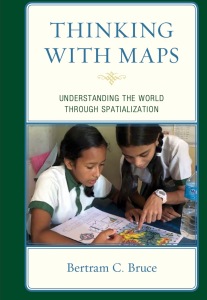
I’ve received the good news that my new book, Thinking with Maps, is now out. I asked to have a copy mailed to Austin so I can pick it up there.
Spatial reasoning, which promises connection across wide areas, is itself ironically often not connected to other areas of knowledge. Thinking with Maps: Understanding the World through Spatialization addresses this problem, developing its argument through historical analysis and cross-disciplinary examples involving maps.
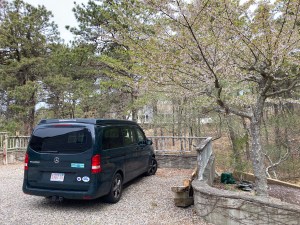
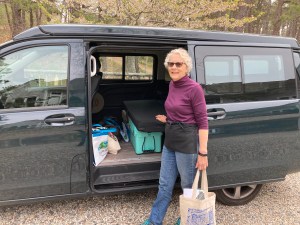
After eight months hibernating, we’re about to set off on a big adventure. We’ll travel through 30 or more states in our vanagain, camping along the way, and visit well over 30 family members and old friends. We’re leaving just as the cherry tree is about to lose its last blossoms.
Susan and I now have our covid vaccinations and I’ve had my cardiac ablation. These should lessen our danger to others and ourselves, especially with the camping.
The new camper van is similar to the VW, but it’s built on a Metris platform. Although much of it is familiar, the heater and AC both work. There’s also better gas mileage and enough acceleration to enter an interstate highway safely. So, a little less drama, but it’s still fun to drive.
The vanagain has all we need for extended travel and camping, but it doesn’t require us to stay in an RV park. It even parks in a standard garage.
During February-March, 2019, I had a wonderful Fulbright Specialist experience hosted by King’s College in Kathmandu, Nepal. This followed on two previous trips to there to work with educators from K-12 through college levels, in and out of school.
This video shows part 2 of a project on the north side of our house.
Part 1 was to clear out multiflora rose, Asian bittersweet, poison ivy, knotweed, and other noxious plants. Part 3 will be to introduce some new planting, a bench or two, and other amenities.
As you may know, a major barrier delaying international distribution of COVID-19 vaccines is intellectual property restrictions. Biden could remove that barrier by supporting a TRIPS Waiver.
Such a move is supported by many organizations such as Oxfam, Medicins san Frontieres, and Human Rights Watch. Without it, the pandemic will continue, quite likely increasing, and new lethal variants are certain to arise.
A TRIPS waiver is important to save perhaps millions of lives worldwide, but also for bringing the pandemic under control in the US.
Here’s a summary: Artificial intelligence has been imagined as powerful, intelligent, and autonomous (independent of human prejudices, power relations, etc.). While it is definitely powerful, it is neither intelligent nor autonomous. Benevolent use of AI calls for critical, socially engaged intelligence on the part of both technologists and ordinary citizens.