The picture shows her on the day of graduation from
in May, 2003.
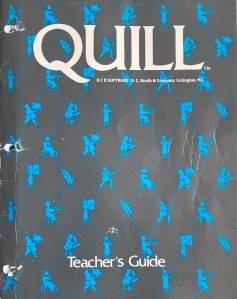
Quill teacher’s guide

Quill is a set of microcomputer programs that use the computer’s capabilities to help teachers teach writing. Students from third grade through high school have been successful with Quill, including gifted and talented, special education, and English as a second language students.
The Quill programs are tools for teachers and students. Teachers can use Quill to provide challenging, meaningful writing activities for students. Students can use the programs to practice various types of writing and produce finished products they can share with classmates and teachers. These are motivating, adaptable writing activities that supplement and enrich existing language arts curricula, and can be integrated into all content areas.
Susan Porter
Theoretical issues in reading comprehension
For many years, the study of reading was taken to apply almost exclusively to the process of learning the written code. It was often assumed that once a child could recognize words in their written form, the understanding system already available from the child’s oral language experience would permit comprehension to proceed smoothly.
Continue reading
Science for the People
From a brochure produced by the Boston group (1975)
Science for the People means recognizing the political nature of science; it means access for all people to useful human knowledge; it means the organizing of women and men in science to struggle along with other communities aimed at fundamental social change.
I was an active member from 1976 to 1989, working especially with the Sociobiology Study Group.
Center for the Study of Reading
While at BBN, I helped write the proposal for the Center for the Study of Reading. It was established at the University of Illinois at Urbana-Champaign by the National Institute of Education in response to the growing concern about the quality of reading instruction in American schools. The proposal became the basis for the book Theoretical issues in reading comprehension: Perspectives from cognitive psychology, linguistics, artificial intelligence, and education.
How Bruce Piano Co. nearly lost, then saved Elvis’s career
In the dark recesses of the Bruce Piano Company archives lies a story about a daring rescue of the equally renowned career of Elvis Presley. We can thank this event for the perpetuation of the late Elvis as the King, and led to many Elvis impersonators for years afterwards.
Background
To understand this story you’ll need some background. My father, who founded the piano store, loved music––classical, jazz, big band, solo pop of the Ella Fitzgerald or Bing Crosby varieties––but most assuredly not rock music, country, or Elvis in particular. I imagine much grave-spinning around the thought that his company was to play such a crucial role for Elvis.
My Dad, however, did not live to see this disturbing event. He died in late 1969. His brother Don, whom he had invited into the business shortly before, took over. But then he died just two years later. Both men were in their early 50’s. My mother remained as the owner of what was by then a struggling business. The growth of electronic entertainments, such as TV and hi-fi, the advent of big box stores, smaller families, and other large societal changes meant that the image of a piano in every middle-class home was fading away.
Although my mother would have been a very good business person (as this story will demonstrate), her upbringing in Georgia nearly a century ago told her that this was not a role for a lady. The same logic would extend to her daughters, who were also busy with family and work. Her son was far away, doing something or another.
A sale of the business seemed to be the obvious path. But there was no willing buyer. Rather than having a distress sale, which would have yielded little, we worked out a deal whereby the manager, Harvey, would buy the store over time, using the revenues the business would generate. Harvey couldn’t have been guaranteed a very good salary. This way he could establish his own pay based on the success he could generate, and in the end, he’d own a business. My mother would be able to draw something from the business that had been the center of the family for many years. The arrangement wasn’t ideal, but was probably the best solution all around.
Ultimately the broader changes in society did the business in. But for a while, Harvey did his best and Bruce Piano Co. was a going concern. Harvey tried to follow my father’s model, offering a range of instruments, working with piano teachers, assisting the local concert scene, and participating in music conventions. A conflict between the last two of these was what put Elvis’s career in jeopardy. (My children say that I’m prone to exaggerate, but you may rest assured that that is the greatest falsity ever uttered.)
Elvis’s concerts in Fort Worth
The problem was that Harvey had agreed that the store would supply a piano for Elvis’s concerts in Fort Worth. There were to be four productions at the Tarrant County Convention Center. Although Elvis was near the end of his career, and life, and his audience had aged along with him, there was still excitement and adoration for the idol. Fans didn’t mind the $10 ticket price for an hour-long concert, and would love even the shortened versions of his big hits, including “Love Me Tender,” “Fever,” “Why Me Lord,” “Houn’ Dog,” and “Suspicious Minds.”
But then Harvey left for the music convention, without arranging to fulfill the promise to deliver a piano. Elvis’s manager was understandably upset when he discovered that there was no piano on hand. He called the store, only to learn that Harvey was away and unreachable in those pre-cell days. He called Don’s wife Nancy, who didn’t know how to help. He finally called Bert’s wife and my mother, Catherine, the one who claimed that she didn’t know anything about business.
Obtaining the piano
Catherine began to problem solve. She contacted the piano movers, but they had gone fishing. She pointed out that she had a key to the store, as the still current, if somewhat removed, owner. If Elvis’s team could come up with movers, she could get them in to the piano.
They met at the store. Elvis sent three bodyguards, who, while not expert in piano moving, were at least strong and committed. But they didn’t know which piano had been ordred. Catherine decided that they wouldn’t go wrong with a concert grand, the biggest model. She found the wooden boxing that was needed to transport a grand piano safely. The team boxed the piano and carried it to the concert venue. After the four weekend concerts the piano was returned safely and Bruce Piano Co, could chalk up another successful service.
Conclusion
Could Elvis have found another piano, or performed without one? Could his career have survived a busted Fort Worth concert? Was the near disaster a sign of the end of both the piano store and Elvis? You’ll have to be the judge of that.
I can say that my mother proved that she could solve a business problem in a difficult and time-pressured circumstance. And I think that my father would have been proud that his company fulfilled its commitment, as long as he didn’t have to go to hear Elvis himself.
Bolt Beranek and Newman, Inc.
I worked at Bolt Beranek and Newman for 16 years on Speech Understanding, Quill, the Center for the Study of Reading, and other projects in the fields of artificial intelligence and education.
Dissertation: The logical structure underlying temporal references in natural language
Bruce, B. C. (1971). The logical structure underlying temporal references in natural language. Ph.D. dissertation, The University of Texas at Austin, Computer Sciences Department. [Note: The archival file is very large; here’s the content in a smaller file size.]
Committee: Norman M. Martin (Co-Chair), Robert F. Simmons (Co-Chair), Michael Richter, Terrence W. Pratt
From the Introduction:
Temporal reference in natural language include tenses and other time relations, references to specific times, and a variety of phrases such as “present”, “later”, “when”, “how often”, and “never”. Their high frequency of occurrence reflects the importance of time to the users of natural language. Although the structure underlying temporal references may appear complicated, it is a working assumption of this thesis that a sound logical explanation of its characteristics can be made.
Summer jobs
This is a summary of some of the summer and part-time jobs I had before going to graduate school at the University of Texas.
- Programmer. Summer, 1968 (age 21). I was a research assistant at the Institute for the Study of Cognitive Systems at Texas Christian University. The Institute, directed by Selby Evans, was interested in pattern recognition by computer. I wrote a program to produce systematic distortions in black and white images so that we could assess the effectiveness of different pattern detection algorithms (see “Production and control of visual pattern variability by computer”). For example, we could then say that algorithm X could detect a pattern which had been distorted 30% along a particular dimension, but not 40%. The distortions included various versions or rotating, stretching, flipping, or just adding random noise.
Experimental psychology research assistant. School year, 1966-67 and 1967-68. Psychology department research assistant at Rice University. I helped set up experiments on behavioral conditioning in rats and learned a little about electrical circuit design.
School year, 1965-66. Mail room worker at Rice University. I briefly got to drive the little mail truck until one of the other workers got drunk and smashed it up.
Summer, 1964 (age 17). Concession stand worker at the Fort Worth Zoo. We sold soft drinks, fries, and BBQ sandwiches. Each morning we had to fill out a squirrel damage report detailing any destruction of supplies due to squirrels and other zoo residents. This started with things like “3 bags of corn chips had chew holes in them.” But we were called in when it began to say, “4 large drinks, 2 BBQ sandwiches, 1 without onions, 3 orders of fries.”My friends Leslie, Ben, John, Hull, and others worked there, too, so we had lots of time to talk about books, life, and our futures. We’d go bowling at lunchtime, sometimes managing to get to the bowling alley, bowl three games, and still get back before the half hour lunch break was over.
Summer, 1962 (age 15). Piano repair at the Bruce Piano Company.