Mother Jones

This May, I feel connections to Mary Harris Jones, who was born in 1830, possibly on Mayday, in Cork, Ireland. She was a prominent labor and community organizer in the US, best known as Mother Jones. Her birthplace is in one of my favorite counties in Ireland and her burial place is not too far from my home in Illinois in the Mount Olive Union Miners Cemetery. That cemetery is also the home for coal miners killed in rioting associated with strikes which she had led.

Mother Jones’s legendary work during her 100 years of life is an inspiration. Her concern for working people caused her to be at odds with union leadership at times, as well as with companies or government. This combativeness led to her being called many things, including the “Miners’ Angel.”

Another labor organizer described her as “the greatest woman agitator of our times.” A DA called her “the most dangerous woman in America,” because she could inspire supposedly contented workers to demand their rights. When a Senator denounced her as the “grandmother of all agitators”, she answered, “I hope to live long enough to be the great-grandmother of all agitators.” She herself said “I’m not a humanitarian; I’m a hell-raiser.” I can’t pretend to or even fully imagine anything like the life she led, but I still admire her courage and caring.

Mother Jones magazine

Beyond place and dates, I feel a connection to Mother Jones in that I find the magazine named after her, to be one of the best sources for insights into current events. It probes deeper into issues than mainstream news services such as NY Times, BBC, or Deutsche Welle and has more factual content than most blogs or opinion magazines.

A good example, and what I started to write about today, is an article called Irony Man, by Nick Turse. It’s in part a review of the film Iron Man, but is really more a review of America’s disastrous foreign policy and how its most enduring harm may be to our own psyche and culture.

Dodder birds

Dodder walkFor much of my time here in Dublin, I’ve walked to work alongside waterways. First, it was the Liffey River. Then for a long time it was the Dodder, the second large, remaining, and still aboveground river in Dublin. Sometimes, it has been the Grand Canal. Each of the waterways has its collection of birds, the best being those along the Dodder.

I would often see a grey heron just downstream from the bridge near our apartment. There is also a pair of mute swans, who swim almost always close together, but every few weeks they have a day when they separate by a half mile. There are two main types of gulls, one I think being a Galway gull. swan in DodderThey’re fond of standing on the walkway’s stone railing, until I’d get with 44.5 inches, or was it 46.3?

Near where the Dodder joins the Liffey, I occasionally see cormorants. Further upstream mallards are very common and also moorhens, but they’re a little harder to see because they hang out below the brush near the bank. Magpies will also come down to the water at times.

mallardNote: The distant, red cranes in the photo of the walkway aren’t the feathered kind.

The Fís Book Club

Fis Book Club

The Fís Book Club has received an enthusiastic response from schools here in Ireland, and now in the UK. Fís means “vision” in Irish, and also stands for Film in Schools. It’s been developed at the Institute of Art, Design, and Technology in Dun Laoghaire.

The Fís Book Club is essentially a web-place where children post video book reviews based on their independent reading. The methods for making and posting the reviews are simpler and more straightforward than on other sites I’ve seen, thus allowing the focus to be on the reading and response.

The collected video book reports form a child-friendly online video Book Review Catalogue, which is accessible only to the participating schools. Teachers and children within the project can watch the videos of other children’s book reviews, find books they might like to read, or compare responses. There are no advertisements in the site.

Death and taxes

An excellent report from Christian Aid Ireland has just been published. It paints a graphic and disturbing picture of the global economic system and the devastating impact of policies sustained by transnational corporations (TNC) and the governments that serve them. Have any of the US Presidential candidates even mentioned issues such as this?

The report, Death and taxes: the true toll of tax dodging, shows how the global taxation system allows the world’s richest to avoid social responsibilities while continuing to under-develop much of the world. This system costs poor nations far more than they receive in all the governmental and private aid. It’s essentially a relentless mechanism for taking money from the poor to give to the rich.

As the report says,

This is in part to do with super-rich individuals. It is also to do with governments, including the UK government, who have let this situation develop and persist. But it is mostly about the world’s transnational corporations wielding their enormous power to avoid the attentions of the tax man – with devastating results.

The situation is stark and urgent. We predict that illegal, trade-related tax evasion alone will be responsible for some 5.6 million deaths of young children in the developing world between 2000 and 2015. That is almost 1,000 a day. Half are already dead.

Corporations “avoid…the tax man” in various ways, including setting up legal schemes for tax-avoidance and demanding tax concessions and low royalty rates on output. They also use false accounting, such as fake invoices, mispriced transfer of goods, services, and finances, and illicit transfers of cash.

Research by Raymond Baker, a senior fellow at the US Center for International Policy, says that 7 per cent of global trade involves the illicit movement of capital between countries by TNCs and other business entities. Transfers of goods and services within a TNC are mispriced to take advantage of differing tax rates and to minimise profits where they are high. Accomplices in unrelated companies issue false invoices to disguise the profits made in a transaction and reduce the tax liability. Baker says:

For the first time in the 200-year run of the free-market system, we have built and expanded an entire integrated global financial structure the basic purpose of which is to shift money from poor to rich. [It is] the ugliest chapter in global economic affairs since slavery.

The Death and Taxes report provides much more detail on the real, immediate, and personal impact of what may seem to be an obscure or esoteric issue. It also offers recommendations for what can be done about it. The data and analysis support the efforts of the Organisation for Economic Co-Operation and Development to regulate tax havens and end the secrecy. They also show the urgent need for an international accounting standard that requires companies to reveal country-by-country accounting.

Aid from organizations such as Christian Aid Ireland is vital in today’s world. But the bottom line on the accounting here is that if wealthy nations abandoned all their aid programs they would be more decent partners in the world than they are now, if they simply acted honestly and fairly with others.

Learning at work seminar

Learning at Work Seminar

The National Centre for Partnership and Performance (NCPP) and National College of Ireland are today hosting the Learning at Work Seminar: Practical Responses to the Future Skills Challenge.

Participants will discuss responses to the challenge posed in video case studies, as well as learn about:

  • Organizing learning opportunities
  • Public and private-sector workplace initiatives
  • What motivates people to take up skills courses
  • How to nurture a learning culture
  • Blended learning

My slides are below:

The fountain of knowledge

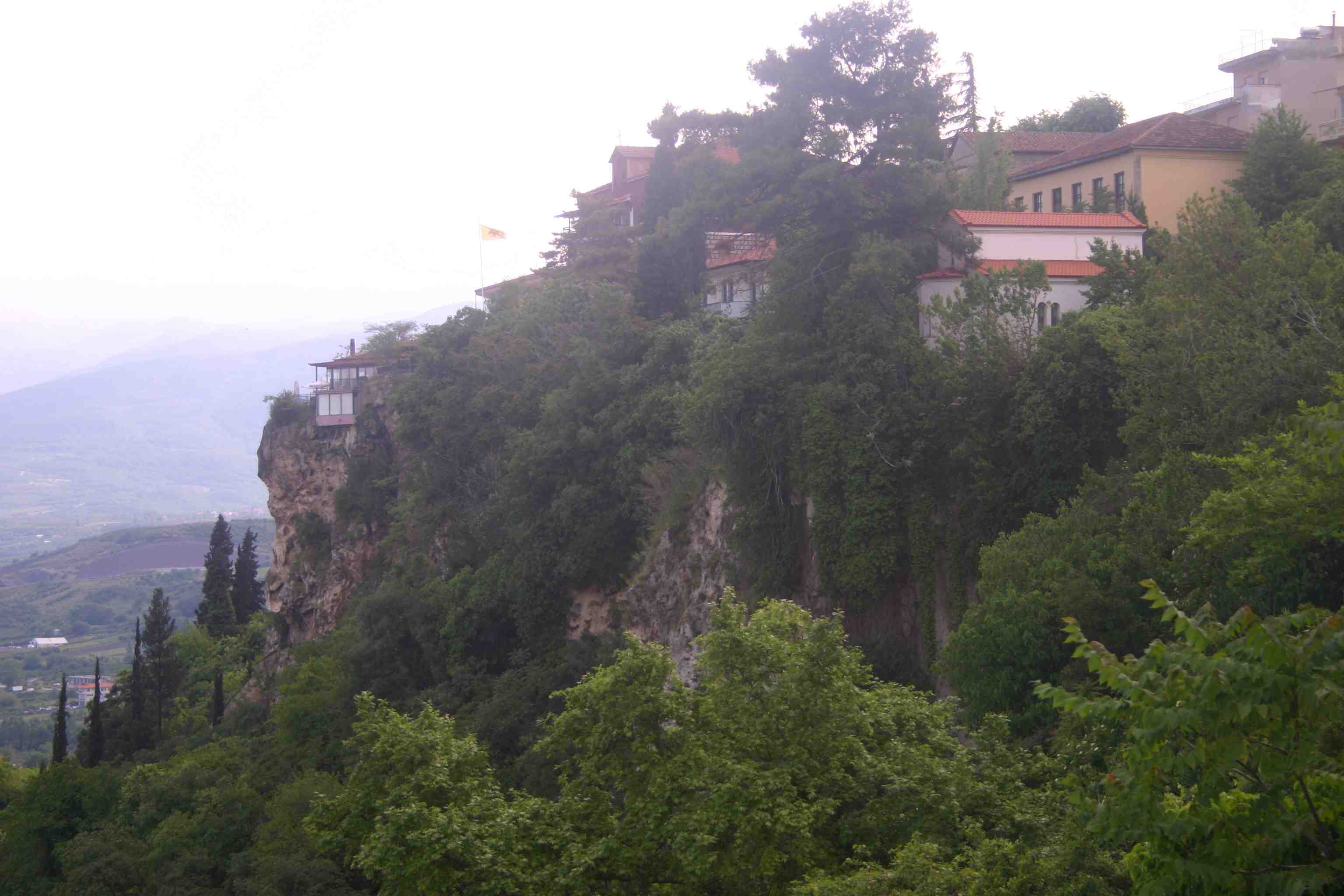
Edessa waterfallsWhereas many Greek towns might be dusty and dry, Edhessa (Έδεσσα) is lush and wet. Much of it is free of cars as well. The reason is a river cascading down from the mountains to the north. It flows through the town, allowing park spaces along the banks and a complex array of paths and bridges crisscrossing the waters. Then, at the edge of the old town (Varossi), the river descends rapidly, culminating in two large waterfalls, which I came to see as fountains of knowledge.

Following the Networked Learning Conference earlier last week in Halkidiki, Greece, we had headed west through Thessaloniki to the region around Edessa. This is where Alexander the Great was born and where his father, Phillip II and Aristotle went to to school together. It includes what are now the major archaeological sites of Vergina, the site of the ancient Macedonian royal city of Aegae, and Pella, the later capital. Alexander, of course, was the one whose conquests spread Hellenistic culture throughout Asia Minor, Syria, Egypt, and eventually the entire Persian Empire, going as far as India. Supposedly, he slept with a copy of the Iliad under his pillow throughout the campaign. His exploits might not represent the origin of the knowledge, but they certainly helped it flow and created an early version of a global culture.

The oracles of Delphi and other sites might allow Greeks to claim the fountain of knowledge. Towns with names like Grammatico make one feel that love of knowledge is intrinsic to daily life. Add in the beginnings of Western science and philosophy and the whole nation would seem to be a bubbling fountain of knowledge, if it just weren’t so sunny and dry!

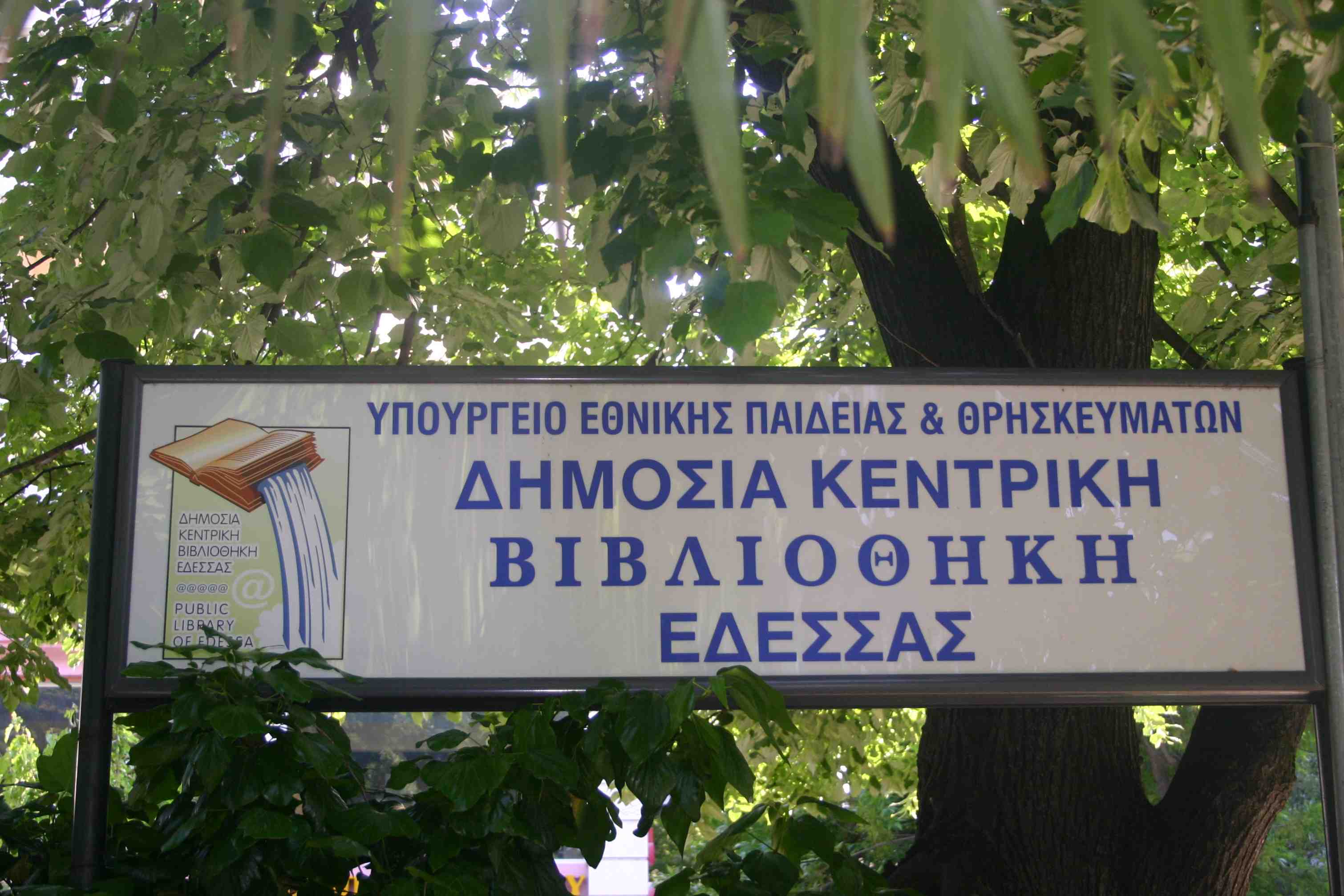
Edessa libraryI thought we might be approaching the fountain when we came to Meixa, the location of Aristotle’s school (from the Greek schole), where Alexander had studied. But it was just north of there in Edessa, that the fountain revealed itself.

The pleasure of experiencing the water town was only enhanced for me when we visited the wonderful town library. Staff there helped us access the internet and told us more about Edessa.

The library has a unique logo combining two of my favorite things, books and water. It suggests that the ideas of Plato, Sophocles, Hippocrates, Thucydidies, Heraclitus, and all the rest flow from the library, providing pleasure for the mind as the cataracts do for both body and mind. I like the way the logo incorporates the @ sign, too. Fortunately, knowledge is never owned by any one time, place, or people, but Edessa and its library make as good a claim as any to being its source.

Make your own electronic whiteboard

One of the more interesting, and on-going, inquiries around technology and learning is related to a device–a low-cost, multi-touch, interactive whiteboard using a Wiimote. As most people know, an interactive whiteboard is a large interactive screen on which a projector can mirror a computer’s display. Users can then control the computer using a special pen, finger, or other device. They’re used in a variety of settings including classrooms at all levels, work groups, broadcasting, etc., but cost thousands of dollars. A Wiimote is the remote controller from the Nintendo Wii computer game, which costs just a few hundred.

Johnny Chung Lee, a graduate student at Carnegie Mellon University, has a variety of interesting projects involving human-computer interaction. He discovered a way to build an interactive whiteboard using a Wiimote. His version is portable and can be built for a tiny fraction of the cost of a commercial whiteboard. He’s recently come out with the Wiimote Whiteboard v0.2.

Lee’s inquiry continues with his writing and reflections in his blog, procrastineering. There he writes:

One of the great, unexpected, and perhaps most influential aspects of creating these videos has been how many people they have inspired and sparked an innovative spirit in. I’ve gotten hundreds of emails from young students that express this enthusiasm. But, perhaps one of the best testimonials is this news article about kids in the Clara Byrd Baker Elementary School’s Lego Club in Williamsburg, VA. The students there, led by Kofi Merritt, are getting excited about innovating in technology by creating their own electronic white boards.

Merritt worked with four fifth-graders and a parent volunteer to build the whiteboard. It’s a great example of making the tools for one’s own inquiry.

Rothesay, Isle of Bute, Scotland

rothesayLeo Casey and I just traveled to Rothesay, Isle of Bute, Scotland, where we went for a day of writing on digital literacy with Allan Martin. As you can see in the photo, it’s a beautiful island, harbor, and town.

We stayed in the Victoria Hotel on the seafront just below the church to the left and worked in a house also on the seafront, behind the white ferry in the center of the harbor. There was time for a walk in the hill above the harbor, and a Chinese meal in the town center,

The night before was in Glasgow where managed to visit the famous Horseshoe Bar. I have a big presentation tomorrow, a keynote at the inaugural International Professional Development Association meeting, which will be held at St Patrick’s College in Drumcondra, Dublin.

Best stories for digital story (re-)telling

Digital storytelling can be for any kind of story, but one application I see a lot in schools is essentially responding to a story by retelling it in a digital form, often with interesting rewriting done by the students. This is carried out using software such as Comic Life or PhotoStory, or sometimes with full video. There’s often the use of clay or puppet animation.

I’ve seen all sorts of stories and media used, such as claymation in a 1st-grade class around The Little Red Hen or in a third grade around The Three Little Pigs. You can see in my blog a post about The Hundred-Mile-An-Hour Dog in a fourth grade.

A teacher asked me whether there were any best stories for this, especially in the context of introducing the technology to other teachers. Other than thinking that stories with distinctive characters and action plots lend themselves well to digital storytelling, I hesitated to recommend any particular stories. But he wanted to have some suggestions of what has worked well, or is likely to work well, in terms of engaging students and making good use of the media.

Do you have any experience with this, or suggestions about his question?

Ching-Chiu Lin, who works in this area, says:

I thought about an article in Art Education that discusses ways that illustrators tell stories in picture books, such as pace of turning the pages and arrangement of images (see below). Instead of seeking exemplary books for teachers to use, another suggestion is to think about the possibilities of transforming/applying these artistic storytelling styles into digital form.

For example, David Wiesner’s Tuesday and Flotsam (style of combination and arrangement of images) may encourage students to write their own unique stories (scripts) based on the same images they view. The use of diagonals and geometric patterns in Gerald McDermott’s Anansi The Spider may be easy for younger students to making their videos by using the collage style animation. Or students can use a story from one book and represent it by borrowing another book’s style.

This line of thinking may help teachers not only thinking about the story itself, but also ways of presentation, learning objectives, and learners’ prior knowledge.

Eubanks, P. (1999). Learning to be a connoisseur of books: Understanding picture books as an art medium. Art Education, 52(6), 38-44.

Louise Michel, the Paris Commune, and Learning

The Women IncendiariesLast Monday night, we visited Square Louise Michel at the foot of Sacre Coeur in Paris. The park and the nearby streets of Montmartre are a living history book, with every cobblestone suggesting times of struggle, hope, fear, and disillusionment. Staying there for a few days makes me feel that I just have to share some thoughts about the Paris Commune and Louise Michel.

There was a time when I knew very little about the Paris Commune, which held Paris for two months in the spring of 1871. It wasn’t part of my history lessons in school, nor did it enter into political debates or everyday conversations. As I read, I began to see references to it—”the democratic and social republic!”, the petroleuses, the horrible siege prior to the commune, which led to the eating of zoo animals, the Federales’ Wall, early establishment of rights for women, why Sacre Coeur was built—but these references were disjointed, so that much what I did know was confused and contradictory. It took living in Paris for a year to help me understand more of what it was about.

I knew even less about Louise Michel, one of the heroes of the Paris Commune, and as I’m learning, much more besides. But I feel a shiver now whenever I think of her. I’m amazed by her passion and ideals, the violence in her life, her writing, her work as an educator in many senses of that word, and her life fully lived.

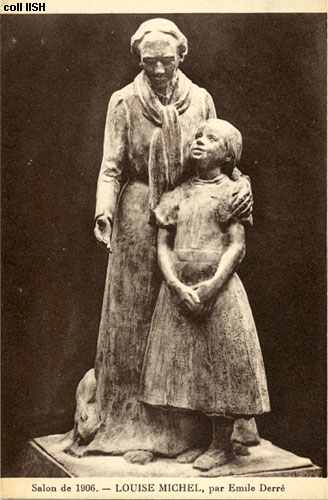
Louise MichelFor a long time Michel was the only woman other than saints to have a Paris métro named after her. The recent renaming of the Pierre Curie métro to Pierre et Marie Curie makes two (or one and a half). Schools all over France bear her name as well. She comes alive in books such as Édith Thomas’s The Women Incendiaries (reprinted by Haymarket Books, 2007; original in French in 1963). I think of her when I play Le Temps des Cerises, a song often associated with the commune and with Michel, even though it was written five years before the Commune.

I’ve also learned that she was an early practitioner of what I’d call inquiry-based teaching and learning. She was a continual learner, inspired by the works of Charles Darwin and Claude Bernard. As a school teacher, she used methods promoted in the progressive education movement (which came much later): interaction with objects such as flowers, rocks, and animals, studies outdoors, and scientific methods. She declared,

The morality I was teaching was this: to develop a conscience so great that there could exist no reward or punishment apart from the feeling of having done one’s duty, or having acted badly.

After the Commune fell, Michel was deported to New Caledonia. Unlike her jailers and many of the other Communards, she befriended Polynesians. She gave lessons to one in “the things whites know,” while he taught her his language. Later, she ventured deep into the forest to work with and study groups still practicing cannibalism. She collected their legends and music as a modern ethnographer might do. When there was a native revolt, Michel joined the side of the Polynesians. Throughout, she wrote poetry, prose, and letters on behalf of prisoner rights.

Later, she opened a school in London for the children of political refugees (The International School). There was a statement in the prospectus taken from Mikhail Bakunin’s God and the State:

All rational education is at bottom nothing but this progressive immolation of authority for the benefit of liberty, the final object of education necessarily being the formation of free men full of respect, and love for the liberty of others.

As infed says, there were no compulsory subjects, teaching was in small groups, and there was an emphasis on rational and integral education. Often, groups of children would bring their own ideas about what to study. Michel wanted students to learn to think for themselves, just as she did herself and encouraged others to do throughout her life.

Louise Michel was a complex person whose every year might fill the life for someone else; a blog post feels totally inadequate. Moreover, one might criticize both the Commune and her participation on many grounds. Nevertheless, her commitment to social justice, her caring for all life, her passion for learning and teaching, her striving for women’s rights and democracy in general, her unselfish work on behalf of others, her strong moral stance, and her unfailing courage set a mark to inspire anyone.

References

  • Michel, Louise (2004). Louise Michel [Rebel lives series, Nic Maclellan, ed.). New York: Ocean.
  • Saudrais, Hélène (2005). Louise Michel. Amsterdam: International Institute of Social History.
  • Thomas, Édith (2007/1963). The women incendiaries. Chicago: Haymarket Books (reprinted in 2007; original in French, Les Petroleuses, in 1963).