“Club Ed: This University Is at Your Service”

Thomas Bartlett writes in the Chronicle about High Point University in North Carolina, which takes student services to a new level. It’s a stark contrast to the idea of student service discussed at the conference on The student as the axis of change in the university, or Dewey’s idea of The school as social center. As we continue on the path to a greater divide between rich and poor, I imagine we’ll see copies of High Point’s approach accompanied by increasing irrelevance of universities to the world around.

Lots of colleges treat students like customers. But how many have an ice-cream truck? And valet parking? And a concierge desk? And an enormous hot tub in the middle of the campus?

Not too many. Actually, only one: High Point University.

This once-sleepy institution in the hills of North Carolina has undergone a revival in the last couple of years, thanks in part to its jaw-dropping menu of student services. Behind it all is High Point’s president, Nido R. Qubein, a motivational speaker and businessman who believes that the customer (that is, the student) should be not only satisfied, but wowed.

Club Ed: This University Is at Your Service – Chronicle.com.

The Springfield Race Riot of 1908

Loper's restaurantToday marks the 100th anniversary of the Springfield race riot. The riot was a shameful episode in America’s history. It occurred in the Illinois State capital and the hometown of Abraham Lincoln. Anti-black riots followed in East St. Louis and Chicago. There was one positive outcome: In 1909, reformers called a small meeting to address the violence and racism, out of which grew the National Association for the Advancement of Colored People, the nation’s oldest and largest civil rights organization.

The riot, and the subsequent rationalizations, is an event that I’ve found especially disturbing. It’s a frightening reminder of the consequences of racism and mob violence. It may touch me more not only because I live nearby, but also because my father’s family was from Springfield. Although the events happened long ago, they remind us to look closely at our contemporary beliefs, attitudes, and values about race, immigration, and people we see as “other.”

Roberta Senechal writes (Illinois History Teacher, 3(2), 1996):

On the evening of August 14, 1908, a race war broke out in the Illinois capital of Springfield. Angry over reports [later revealed as a concocted allegation] that a black man had sexually assaulted a white woman , a white mob wanted to take a recently arrested suspect from the city jail and kill him. They also wanted Joe James, an out-of-town black who was accused of killing a white railroad engineer, Clergy Ballard, a month earlier.

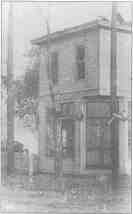
Tree where man was hangedLate that afternoon, a crowd gathered in front of the jail in the city’s downtown and demanded that the police hand over the two men to them. But the police had secretly taken the prisoners out the back door into a waiting automobile and out of town to safety. When the crowd discovered that the prisoners were gone, they rioted. First they attacked and destroyed a restaurant [top left] owned by a wealthy white citizen, Harry Loper, who had provided the automobile that the sheriff used to get the two men out of harm’s way. The crowd completed its work by setting fire to the automobile, which was parked in front of the restaurant.

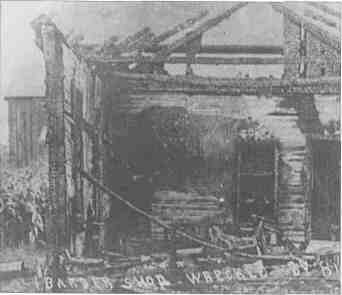
barber shopIn the early hours of the violence, as many as five thousand white Springfield residents were present, mostly as spectators. Still angry, the rioters, minus most of the spectators, next methodically destroyed a small black business district downtown, breaking windows and doors, stealing or destroying merchandise, and wrecking furniture and equipment. The mob’s third and last effort that night was to destroy a nearby poor black neighborhood called the Badlands. Most blacks had fled the city, but as the mob swept through the area, they captured and lynched a black barber, Scott Burton, who had stayed behind to protect his home [hanging tree, above right; barber shop, left].

[snip]

The pattern of attacks supports [one black resident’s] opinion that black success brought danger. The first area targeted was the black business district. The two blacks killed were well-off, successful businessmen who owned their own homes. All of those targeted for hit-and-run attacks were also well-off. Although what triggered the riot may have been anger over black crime, very clearly whites were expressing resentment over any black presence in the city at all. They also clearly resented the small number of successful blacks in their midst.

See more at The Springfield Race Riot of 1908 and A Minute With Clarence Lang.

“I Came a Stranger” by Hilda Polacheck

I Came A StrangerI just finished reading I Came a Stranger: The Story of a Hull-House Girl, by Hilda Satt Polacheck, and edited by her daughter, Dena J. Polacheck Epstein (University of Illinois Press, 1991). It’s a fascinating account of Polacheck’s journey from Wloclawek, Poland to Chicago, and the role that Jane Addams of Hull House played in her life.

The book is interesting on many levels: Hilda’s life is filled with many compelling, poignant, and humorous stories; she makes the immigrant experience in late-19th, early 20th century Chicago come alive; and she shows what Hull House meant to a girl like her, who “came a stranger” to Chicago, knowing no English and learning to survive by doing. The labor and feminist politics of the era have immediate meaning for her, and she recounts stories about Emma Goldman, Eugene V. Debs, Clarence Darrow, Alice Hamilton, and other great figures of that time. She describes her struggles, romance, triumphs, and tragedies.

It’s a pity then, that the book wasn’t published in her lifetime, as there was no interest in the life of an “obscure woman.” But I was drawn in by her honesty and commitment to the ideals she saw in Jane Addams. I also gained a deeper understanding of the remarkable role that Hull House played in the effort to, as Addams says, “make the entire social organism democratic.”

first Youth Community Informatics Forum

In the Youth Community Informatics Forum held June 27-28, 2008, about 40 young people and youth leaders came to Champaign from a variety of economically disadvantaged, mostly minority communities throughout the state.

There was a youth media festival on Friday. Then on Saturday, participants spent the morning working in one of four small groups to investigate “information spaces” in the community. These included the Center for Children’s Books, Champaign Public Library, the Independent Media Center, Espresso Royale, Native House, Cafe Paradiso, Transit Plaza, Illini Union, and bronze plaques around campus. The group leader introduced a staff member from the center to the students for a small tour and helped them use a Flip video camera and a GPS receiver to record their observations.

At each site, the youth asked questions such as:

  1. What do we see in this information center? How do we like it?
  2. What is this center about?
  3. What do we want people to know about the center?
  4. How can we give others a clear idea about the center through watching/hearing our report?

In the afternoon, they created a Google map with their videos, text, and GPS coordinates. They also added music (an innovation we hadn’t planned on, but perfectly appropriate). They then shared their findings in a public presentation.

The activity was conceived in terms of an Inquiry Cycle:

Inquiry cycle

Inquiry cycle

  • Ask: What are the information spaces in the community?
  • Investigate: Visit, listen, explore, video, determine geo-coordinates.
  • Create: Make a GIS site with video, music, text.
  • Discuss: Share the product and the findings with others.
  • Reflect: Think about issues of journalism, democracy, careers, technologies, etc.

We found that the students learned technology skills, problem solving, cooperative work, writing, public presentation, specific information spaces, community journalism, university life, and much more.

Although the June activity made use of diverse new technologies, it is important to note that the focus was on learning about the community, asking questions, and sharing findings with others, not on the technologies per se. The most effective use of these technologies in libraries and similar settings would likely involve embedding that use in a larger, purposeful context. That context in turn could be a way to help connect youth with other resources, such as books and structured activities.

We’re now planning a similar activity in October with the Mortenson Center Associates, a group of visiting, international librarians. This will be the first day of a two- or three-day event. The longer time will allow for discussion about how the information spaces might differ in different countries, what technologies are available in different contexts, how valuable the activity would be for youth in their libraries, and so on. Students from the Community Informatics (LEEP) course would lead the investigation of the local-area information centers.

Both youth leaders and young people said they enjoyed the Forum, learned a lot, and hope for more. One youth leader said that next year he’d like to bring a much larger group. Another wrote,

I believe, in the not too distant future, that this conference will be seen as a landmark in developing a new perspective as part of the partnership between those marginalized sectors of civil society and the university in bridging the digital divide.

As Myles Horton might say, that’s a long haul, but at least there was good spirit of cooperation in learning, which I hope will carry over to continuing work in these communities.

[Cross-posted on social issues]

Living teaching: The genius loci

My most memorable moments in Dublin came through encounters with living people, the many warm individuals who introduced me to life in the city and country, and from all the enriching, direct experiences, some of which I’ve tried to recount here.

But oddly enough, I also value the encounters I had with people who live on only in their writings or institutions. I say “oddly,” because I could easily have come to know them somewhat without being physically present in Ireland, and yet I seemed to need the tradition of place, or genius loci, to open the book.

One of these is Cardinal John Henry Newman. I didn’t know much about his work, other than valuing the many Newman Centers on university campuses. Frankly, I had a negative view, that his focus was on education for “gentlemen,” and that he held an elitist and sectarian approach to learning. At best, his ideas were locked away in 19th-century Ireland and unlikely to be relevant to my world today.

Cardinal John Henry NewmanFortunately, a colleague, Leo Casey, was able to gently point out that my conception was based on not knowing anything, and to suggest that if I did open a book, I might learn something.

In this case, the book was Cardinal Newman: The Catholic University, which contains a selection of his writings. University College Dublin, which he presided over, published it in 1990, to commemorate the century after his death. One of the essays in the collection is entitled “Living Teaching rather than passive reception of facts.” It’s from his The Idea of the University, and introduced me among other things to the term, genius loci.

Newman writes about “young men,” but I believe that today he’d quickly revise his essay to include all people. He asks a provocative question: Suppose we

had to choose between a so-called University, which dispensed with residence and tutorial superintendence, and gave its degrees to any person who passed an examination in a wide range of subjects, and a University which had no professors or examinations at all, but merely brought a number of young men together for three or four years, and then sent them away…[which of these would be] more successful in training, moulding, enlarging the mind, which sent out men the more fitted for their secular duties, which produced better public men, men of the world, men whose names would descend to posterity

Newman is quick to say, in his 19th-century style, that he can’t fully endorse the second model, as he considers “idleness an intolerable mischief.” But he has “no hesitation in giving the preference to that University which did nothing, over that which exacted of its members an acquaintance with every science under the sun.” He explains as follows:

When a multitude of young men, keen, open-hearted, sympathetic, and observant, … come together and freely mix with each other, they are sure to learn one from another, even if there be no one to teach them; the conversation of all is a series of lectures to each, and they gain for themselves new ideas and views, fresh matter of thought, and distinct principles for judging and acting, day by day…students come from very different places, and with widely different notions, and there is much to generalize, much to adjust, much to eliminate, there are inter-relations to be defined, and conventional rules to be established, in the process, by which the whole assemblage is moulded together, and gains one tone and one character…

that youthful community will constitute a whole, it will embody a specific idea, it will represent a doctrine, it will administer a code of conduct, and it will furnish principles of thought and action. It will give birth to a living teaching, which in course of time will take the shape of a self-perpetuating tradition, or a genius loci

Here then is a real teaching…it at least recognizes that knowledge is something more than a sort of passive reception of scraps and details; it is a something, and it does a something, which never will issue from the most strenuous efforts of a set of teachers, with no mutual sympathies and no inter-communion, of a set of examiners with no opinions which they dare profess, and with no common principles, who are teaching or questioning a set of youths who do not know them, and do not know each other, on a large number of subjects, different in kind, and connected by no wide philosophy

Newman recognizes the limits of such self-education, but nevertheless argues, the result is better than for

those earnest but ill-used persons, who are forced to load their minds with a score of subjects against an examination, who have too much on their hands to indulge themselves in thinking or investigation, who devour premiss and conclusion together with indiscriminate greediness, who hold whole sciences on faith, and commit demonstrations to memory, and who too often, as might be expected, when their period of education is passed, throw up all they have learned in disgust…they leave their place of education simply dissipated and relaxed by the multiplicity of subjects, which they have never really mastered, and so shallow as not even to know their shallowness.

How much better, he says,

to eschew the College and the University altogether, than to submit to a drudgery so ignoble, a mockery so contumelious! How much more profitable for the independent mind, after the mere rudiments of education, to range through a library at random, taking down books as they meet him, and pursuing the trains of thought which his mother wit suggests! How much healthier to wander into the fields…

[or from] the beach, and the quay, and the fisher’s boat, and the inn’s fireside, and the tradesman’s shop, and the shepherd’s walk, and the smuggler’s hut, and the mossy moor, and the screaming gulls, and the restless waves, to fashion for himself a philosophy and a poetry of his own!

Newman’s style is dated, but his questions are more relevant today than when he wrote. Our university education, indeed formal education at all levels in both the US and Ireland, often strives to do little more than load minds against examinations. We run from the idea of genius loci and see no need for living teaching.

Meanwhile, university administrators worldwide now measure success against a benchmark of mechanization. Efficient, modular, and uniform delivery of certifications is the goal. Newman reminds us that achieving that goal means not only that students will “throw up all they have learned in disgust,” but that society will ultimately throw up the university in disgust as well.

The last flower in WALL-E

Our family had a rare trip to an in-theater movie on Sunday, as opposed to watching one of the many movies we see at home. It was a good choice for the theater, WALL-E, with its sweeping scenes of dance in outer space and the counterpoint of its portrayal of robots with minimalist, but very believable emotions.

It’s a delightful movie for children or adults, but the adults are more likely to squirm as they see characters depicted in lounge chairs with drink holders, more similar than they might like to see to the audience sitting in now extra-wide theater seats with holders for 44-ounce cups. The story shows how a culture of excess consumption, with little regard for the environment, community, or meaningful activity, ultimately destroys a livable earth and nearly, the people themselves.

The plot hinges on the robot Wall-E’s discovery of a living plant, either the last to survive massive environmental destruction, or perhaps, the first to signal a possible recovery of the planet. He and another robot, EVE, protect the plant until it re-energizes humankind to save the planet they nearly destroyed.

It reminded me of James Thurber’s The Last Flower, a graphic novel published in November 1939, two months after World War II began. I haven’t seen the parallel mentioned elsewhere, but it seemed surprisingly close to me. In Thurber’s story, we read:

One day a girl who had never seen a flower chanced to come upon the last one in the world…The only one who paid attention to her was a young man she found wandering about. Together the young man and the girl nurtured the flower and it began to live again.

In only 48 cartoon frames, Thurber talks about wars, which never end, and the causal factors of greed, intolerance, the inability to understand others, and a fetish of violence. He also describes human and environmental destruction in both words and pictures. There is a deep pessimism in the seeming inability of people to maintain a respect for life or to find common ground, but also optimism, in the refusal of the flower to disappear entirely.

WALL-E presents a happier, less complex position. Some of the causal factors are there, but WALL-E’s world seems to have eliminated wars and racism. And although humanity has come close to a final disaster, the plant that WALL-E and EVE nurture appears to redeem it once and for all.

Thurber’s plant, unlike WALL-E’s, has a flower, which holds the promise of reproduction, as do his (non-robot) people. It is essential that the plant have a flower, which is visited by a bee, because biological reproduction in all its messiness is integral to the rebirth of Thurber’s world. WALL-E offers a vision more akin to Coca-Cola commercials about holding hands around the world. I liked WALL-E, but seeing it gave me a new appreciation for what Thurber managed to do using much simpler technology, but a deep insight into people and life.

Youth Community Informatics Forum

Forum flyer p. 1The goal of the Youth Community Informatics project is to encourage youth to consider careers in library and information science by engaging them in technology-rich activities that benefit their local communities. Youth ages 12-18, along with their adult leaders.

  1. participate in technology-mediated learning modules on a range of information science topics;
  2. work on community informatics projects in collaboration with local community partners and university students from LIS and related fields;
  3. participate in campus events to experience a wide variety of library and information science careers;
  4. Forum flyer p. 2help develop computer technology centers for their own use, and for use by others in their communities.

In the Youth Community Informatics Forum, to be held on June 27-28, 2008 at the University of Illinois in Urbana-Champaign, groups of youth will investigate information spaces around campus using digital cameras and GPS, along with their own eyes and ears, create Google Maps representations of what they learn, discuss their findings with other groups. They will also learn about LIS careers and about working with their own communities.

The project is supported by the Institute of Museum and Library Services (IMLS).

A functional curriculum for youth

Earlier this week I was browsing a freebie rack containing books that someone had discarded. Following the principle that one’s trash is another’s treasure, I looked closely and discovered William B. Featherstone’s, A Functional Curriculum for Youth. It was published in 1950, shortly before his untimely death, and long before current talk about integrative learning, service learning, community-based education, or youth community informatics.

Featherstone talks about a broad curriculum, based upon the idea that the school’s function is “building meanings for life.” He argues for education that contributes to “improvement of daily living in the here and now” and that supports the individual’s “involvement in in community life.” He advocates community councils to guide schools in their role as the co-ordinators of the complete educational effort within a community, essentially, the school as social center. The focus is on wholeness of learning and action in the world, so that schools

do not teach language arts as such; they teach life, carrying on projects, units, and other lifelike enterprises in which language arts function as principal means of communication and expression.

One of his more surprising suggestions is that youth should be paid to go to school. The rationale is that schooling is a social investment that benefits the entire society; going to school is socially useful work of value at least equal to that of most jobs:

when the right kind of school is provided, society cannot afford to allow any youth to remain out of school…solely because his personal economic resources …do not enable him to continue.

In Featherstone’s day, and even more so in ours, there are relentless attempts to reduce schooling to a factory model. Capitalist economics extends that agenda to many other realms of life–office work, grocery shopping, community involvement. Featherstone realized that even if we could somehow justify the factory approach for the school experience that it would in no way prepare students for the life that he valued. He saw, as Ella Flagg Young had before him, that the project of promoting democratic education was inseparable from the project of working towards a democratic society.

Community development: What works, or not?

Much has been written about community development from the perspectives of community members, educators, activists, local governments, social workers, or other participants. Although each perspective highlights particular issues, common themes run through some very diverse settings.

These themes are highlighted in a 2005 report, Community Development: A Guide for Grantmakers on Fostering Better Outcomes Through Good Process, written by Bill Potapchuk of the Community Building Institute, with Malka Kopell, of The William and Flora Hewlett Foundation. But the perspective is one I hadn’t considered, namely that of grantmakers, those who seek to foster community development through grants. The report identifies eight elements of good process for community development:

  • Requires advocacy, seeking a process that leads to more investment, connection, and authentic participation
  • Effectively coordinates, links, combines, and supports various initiatives to ensure that they work in concert, using a shared strategy and supporting a common vision
  • Responds to and reflects a widely divergent set of interests
  • Is not imposed on people
  • Ensures that community residents are meaningfully engaged and have sufficient power to influence decisions
  • Creates safe opportunities for authentic dialogue across differences
  • Fosters collaborative conversations that become more strategic, holistic, and systemic over time
  • Anticipates conflict and seeks to discuss it in ways that forges common ground

We could use these eight elements as a rubric for describing or evaluating community-building efforts. For example, I recently encountered a quasi-governmental organization, which had control over significant funding but distributed that in a very patriarchal way. There was little opportunity for authentic participation, which meant that it was difficult for different initiatives to work in concert, use a shared strategy, or support a common vision. Activities were imposed on people, thus lessening the value of even worthwhile initiatives. Meanwhile, real needs were often not met or even recognized. There was little authentic dialogue across differences or a chance to forge common ground. The net result was that the organization failed to meet its lofty mission statement.

In contrast, I’ve seen at St Andrew’s Resource Centre in Dublin an organization that embodies all eight elements–authentic participation, a common vision, respect for difference, all leading to collaborative conversations that forge common ground–even if they might use different terminology. Similarly, Paseo Boricua in Chicago succeeds in part because it creates that space for dialogue and a respect for each individual.

In fact, it is the respect for difference that enables each of these very different organizations to build a sense of a common purpose. In each case, the realization of the eight elements is both means and end. Engaging participants makes it possible to accomplish specific tasks, but the engagement is itself a crucial aspect of community building. As a result, the sense of purpose and individual worth within these communities enables them to achieve far more, even with limited resources.