The Soloist (2009)

The Soloist (2009) is an excellent film based on the true-life book, The Soloist by Steve Lopez. Lopez is a Los Angeles Times columnist who discovers Nathaniel Ayers, a Juilliard School dropout, who becomes schizophrenic and homeless, living on the streets of LA.

Ayers is a classically-trained cellist, who now has only a two string violin to play and instead of a concert stage, an urban tunnel or street corner. Lopez wonders how Ayers can stand to play in those conditions, but Ayers tells him that “the only thing that I hear is the music and the applause of the doves and the pigeons.” Ayers is hooked and decides to write a series of feature articles in the Times.

Robert Downey Jr. portrays  Lopez in the movie, and Jamie Foxx portrays Ayers. The two main characters give terrific performances, as do the actual homeless extras from the Lamp Community.

Ayers’s story makes us wonder about the many other homeless people in LA and elsewhere. As Lamp says,

Close to 74,000 people are homeless in Los Angeles–more than in New York, Chicago, and San Francisco combined. Los Angeles’ Skid Row, a 52-block area east of the downtown business district, has the highest concentration of homelessness in the United States. More than half of the homeless men and women in this area are chronically homeless, meaning they struggle with a mental or physical disability and have been living on the street for years.

That relatively greater challenge in LA doesn’t of course diminish the shameful job we do across the US in dealing with homelessness. The book, Ayers’s music, and the movie all reinforce Jane Addams’s view that art and cultural activities can reduce our isolation form one another, and reinforce essential human: “Social Life and art have always seemed to go best at Hull-House.”

The DVD includes features with the real Steve Lopez and Nathaniel Ayers, and also, Beth’s Story, an animated short telling another story of homelessness:

References

Addams, Jane (1930). The second twenty years at Hull-House: September 1909 to September 1929. New York, Macmillan.

Voyages with the Rob Roy

rob_royI had shoulder surgery on August 18, so my days of paddling through rapids or hoisting a canoe on my shoulders need to be postponed. As a substitute, I’ve been reading A thousand miles in the Rob Roy canoe on rivers and lakes of Europe (1866), by John Macgregor (1825-1892).
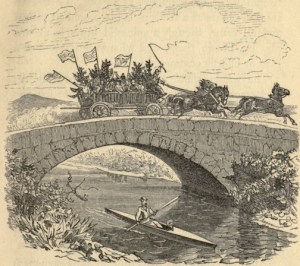
singers_wagonMacGregor himself led a life that sounds like an overdone adventure yarn. At the age of three months, he was rescued from a burning ship whil een route to India with his parents. At the age of 12, he helped launch a rescue boat for a ship in distress off Belfast, then slipped aboard secretly a the last moment to help out. He grew up sailing, boat-building, riding, reading, and experimenting with home-made steam engines, batteries, and chemicals that led to several major explosions. He attended seven schools before graduating from Trinity College, Dublin in mathematics. He traveled throughout the world, fighting Greek pirates and crocodiles, climbing Mont Blanc, Etna, and Vesuvius. He won awards for sharpshooting, drew for Punch and illustrated books, and wrote his own books on marine propulsion, patent law, travel, and transcriptions of Syrian and Egyptian melodies he had heard in his travels.

MacGregor built a hybrid canoe / kayak with a sail and a double-bladed, kayak paddle which he named the “Rob Roy”. He then paddled through the rivers, lakes and canals of Germany, France and Switzerland, portaging between waterways on a cart or on trains. His account of the journey became a best seller and was the beginning of the recreational canoeing movement. His trip inspired many, including Robert Louis Stevenson, who made his own voyage in a Rob Roy, and then wrote about it in his first published book, An inland voyage.

morningMacGregor’s account portrays a Europe with only distant resonance to today. Instead of shopping centers and freeways, there were people cutting hay with hand tools. Instead of the Web, there were newspapers, 3241 in Germany alone.

A thousand miles displays a buoyant optimism and refreshing sense of discovery. MacGregor talks of “a strange feeling of freedom and novelty which lasted to the end of the tour,” (p. 15), and throughout, of a reverence for the canoe, which I share:

Something like it is felt when you first march off with a knapsack ready to walk anywhere, or when you start alone in a sailing-boat for a long cruise.

But then in walking you are bounded by every sea and river, and in a common sailing-boat you are bounded by every shallow and shore; whereas, I was in a canoe, which could be paddled or sailed, hauled, or carried over land or water to Rome, if I liked, or to Hong-Kong. (p. 15)

digueI also like his descriptions of wildlife, for example of herons “wading about with that look of injured innocence they put on when you dare to disturb them.” (p. 35) Later, he refers to a gathering including the

long-necked, long-winged, long-legged heron, that seems to have forgotten to get a body, flocks by scores with ducks of the various wild breeds, while pretty painted butterflies and fierce- looking dragon-flies float, as it were, on the summer sunbeams, and simmer in the air. (p. 71)

At the village of Geisingen it was discovered that the boiler of my engine needed some fuel, or, in plain terms, I must breakfast. (p. 59)
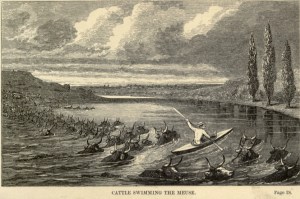
meuseMacGregor’s challenges along the way become not discouragements, but the very stuff of the journey. He  reminds me that a broken shoulder is just a toss on the billows, one that can be an opportunity to learn:

It is, as in the voyage of life, that our cares and hardships are our very Mentors of living. Our minds would only vegetate if all life were like a straight canal, and we in a boat being towed along it. The afflictions that agitate the soul are as its shallows, rocks, and whirlpools, and the bark that has not been tossed on billows knows not half the sweetness of the harbour of rest. (p. 37)

The US supplies the guns

weaponsAfter the 9/11 attacks I wrote about 12 steps to respond to 9/11, because “we have to do something!” Number 3 on that list was for the US to stop being the world’s top supplier of arms around the world, at that time selling over 1/2 of all the weapons.

The New York Times Pentagon correspondent Thom Shanker, provides a helpful update, showing that the US market share has grown to 2/3, establishing a virtual monopoly:

Despite a recession that knocked down global arms sales last year, the United States expanded its role as the world’s leading weapons supplier, increasing its share to more than two-thirds of all foreign armaments deals, according to a new Congressional study.

The United States signed weapons agreements valued at $37.8 billion in 2008, or 68.4 percent of all business in the global arms bazaar, up significantly from American sales of $25.4 billion the year before.

via Despite Slump, U.S. Role as Top Arms Supplier Grows – NYTimes.com.

When we wonder about wars around the world, why don’t we ask about our own role in supplying the weapons that people use to fight them?

Tom Engelhardt raises some more disturbing questions in his essay, Is America hooked on war?

References

Engelhardt, Tom (2009, September 17). Is America hooked on war?. Mother Jones.

Inquiry Page and Community Inquiry Labs

inquiry_pageIn a previous post, I described the latest version of Community Inquiry Labs (CILabs). I’d like to add to that, based on some questions.

A precursor of CILabs, is the Inquiry Page. This site is still very active, open, and free. It offers an easy way to learn about inquiry-based teaching and learning, to search a large database of Inquiry Units, and to create your own, either de novo or a spin-offs of existing units. There are other features, including help with evaluation and quotes about learning.

CILabs just offers another way to do Inquiry Units, but in the context of the group support functions (blog, document center, group email, web pages, etc.). The two sites were developed at very different times, using different software (Perl vs. Drupal). A current effort is to make the connections between them more evident and to enable them to work synergistically.

Governor’s Home Town Award for UC Books To Prisoners!

UC Books To Prisoners – a project of the UCIMC (B2P) is based in Urbana, Illinois. B2P mails books to Illinois inmates at no cost to them and operates lending libraries in the two local county jails.

guv_mansionB2P has just been awarded a Governor’s Home Town Award (for volunteerism).  The award makes B2P eligible for the Governor’s Cup, a traveling silver trophy signifying the project deemed most representative of the spirit of Illinois volunteerism. The award will be presented at the Governor’s Mansion in Springfield on October 29. At that time, we’ll learn what level of award B2P has received.

Books to Prisoners has also received a Social Justice grant from the Illinois Disciples Foundation, with a press conference on October 1, and an honorable mention from the McKinley Foundation Social Justice Awards.

b2p_booksale_fall_2009

Community Inquiry Labs

Inquiry cycle

Inquiry cycle

Community Inquiry Labs (aka CIL’s or CILabs) is rising again!

What is CILabs?

Drawing from the work of John Dewey and others, showing that education begins with the curiosity of the learner, CILabs promotes an iterative process of inquiry: asking questions, investigating solutions, creating new knowledge, discussing experiences, and reflecting on new-found knowledge, in a way that leads to new questions.

In addition to the standard features found on group support sites, such as Ning, Google, Yahoo, and Moodle, CILabs offers a means for building Inquiry Units based on the Inquiry Cycle. Also, unlike most university-supported software there is a secure means for users without university netid’s to participate. This is crucial for university-community collaborations.

CILabs (aka iLabs) are being used currently in courses such as Will Patterson’s Hip Hop as Community Informatics and Martin Wolske’s Intro to Network Systems. Projects such as Youth Community Informatics use it as do a variety of  other projects and organizations.

The redesign

Despite filling a need for many individuals and groups since 2003, use of CILabs fell off after a security hole was discovered in CILabs 3. That led to a temporary shutdown and a major redesign on the Drupal platform.

Thanks to the support of Robert Baird at CITES EdTech, a project to rebuild CILabs was led by Alan Bilansky with Julieanne Chapman as lead programmer. Claudia Serbanuta represented GSLIS and the CILabs user base. The new CILabs is now hosted by the University of Illinois College of Education, thanks to Ryan Thomas and John Barclay. This represents an unusual and successful collaboration across two colleges and CITES, with support from the Center for Global Studies, Community Informatics Initiative and the Illinois Informatics Institute.

I encourage you to give it a try now, and to let us know how to improve it.it

Health care illogic

Following Rep. Joe Willon’s (R, SC) outburst druing the President’s speech, the Obama administration has scrambled to show that it will guarantee no reasonable means of healthcare for people in the US illegally. That position strikes many people as sensible. But it’s not only cruel, unfair, and unmanageable, it actually undermines the very effort to secure affordable, reliable healthcare for everyone.

No one in power is even talking about government health care for all (that’s a plan that would really work). Instead, the proposal is simply to require everyone to get health care insurance, through a government-managed insurance exchange, employer-provided group coverage, or private insurance. With a large pool of buyers in the exchange, it’s possible that health care costs could be controlled.

Denying undocumented workers and their families access to both the exchange and employer-provided group coverage means that very few will have insurance of any kind. This, in turn, will increase demands on expensive emergency room care, whose costs are ultimately borne by the government and individuals with private insurance.

Rep. Luis Gutierrez (D, IL) put it this way last week:

So, and remember, we’re not talking about government health care, we’re talking about everybody is going to be required to get health care insurance,” said Gutierrez. “And so as we go to this big store, right, where everybody is required. And this exchange, the health care exchange, where if you don’t have health care you are required to go purchase it. When you go and attempt to purchase it, what does the administration say? The administration says, ‘You will have to prove that you are legally in the United States and have a Social Security number and a right to that.’

Some immigrants, and let me say it – hundreds of thousands of them — who have businesses, who are prospering, who are paying taxes— even when they wish to buy because it’s going to be a requirement to buy it, this administration has told them don’t buy. You can’t. You can’t buy.

via Latino Lawmaker Rips Obama for Making It Harder for Illegals to Buy Private Insurance – George’s Bottom Line

One thing that could make the exchange work is to bring in large numbers of relatively healthy people. New immigrants use 55% less health care than native-born Americans, according to a Harvard/Columbia University study (Physicians for a National Health Program, 2005).

Denying health insurance is foolish and spiteful. It’s also absurd: We should demand that immigrants share the burden of paying for healthcare, not exclude them in a way that ultimately endangers not only theirs, but everyone’s health and finances.

See also The bottom line in health care.

References

Physicians for a National Health Program (2005, July 27). Immigrants’ health care costs are low.

Momos

momosMy student Nama has introduced us to momos (Nepali: म:म:), a dumpling that is fun to make and delicious to eat.

Momos are made with a simple flour-and-water dough, with any of several fillings. We’ve had turkey, with onions, garlic, and cilantro, but one could choose goat, yak or vegetables instead. The filled dough can be shaped into a crescent, or as our son did, as a Russian pelmeni (or vareniki, pierogi). They’re then steamed and served with an Indian pickle achar.

What do Boston & Cambridge have to say to Champaign Unit 4?

violin_may06Ann Abbott inspired me to say more about the connections between the Boston desegregation experience in my last post and that of Champaign Unit 4.

I’d have to say that Boston is a good example of how not to do it. As I said in that post, Judge Garrity made the correct, and only legally justifiable decision, but rulings alone cannot accomplish much if there is widespread resistance, especially from political and religious leaders, school officials, and media. The racism thwarted integration of the schools, and in the process did major damage to the school system and to Boston as a civilized city.

In contrast, just across the Charles River, Cambridge managed relatively successful desegregation during the same period. Cambridge adopted a “freedom of choice” or “controlled open enrollment” desegregation plan in 1981. Parents would specify a list of  the schools they wanted their children to attend. Their preferences were followed as long as explicit desegregation controls could be maintained. There were no guarantees of attending any particular school.

Graham_parksBecause the program was coupled with interesting magnet programs at every school, there were many viable options for families. As parents we almost welcomed the fact that we didn’t have to make the final choice between the Maynard School’s dual language (two-way Spanish-English bilingual) program, Tobin’s School of the Future, with innovative uses new technologies, the Graham & Parks Alternative Public School, with its open education plan (see mural above), or the closer by Peabody, Fitzgerald, or Lincoln schools, each with things to recommend it. It helped that Cambridge did not have the urban sprawl of midwestern cities, which meant that unlike Champaign, Cambridge offered several schools within walking distance.

Although not without its problems, this plan was effective in substantially desegregating Cambridge schools, and maintained public support and involvement with the public schools. It’s not surprising then that Robert Peterkin, Superintendent, was called in as a consultant on the similar plan in Champaign. The story in Champaign is still unfolding (as it is in Cambridge and Boston as well). But if I had to draw lessons today from these three experiences, I’d say that it’s essential for Champaign residents today to avoid the disastrous path of resistance that Boston experienced

champaignThe Champaign school district has been struggling to address concerns such as too many black students in special education and discipline referrals; too few in gifted and honors classes; and black students being bused out of their neighborhoods. Responses such as denying the problems or siting new schools outside of black communities (though still technically north side) remind me of Boston’s response. Everyone would benefit if the school system and residents were to embrace not only the technical details of the Cambridge (or similar) plan, but also the spirit that saw how desegregation could enrich the learning for all.

References

Don’t blame Judge Garrity for the failure of school busing in Boston

W. Arthur Garrity Jr., the federal judge whose order to desegregate Boston’s public schools triggered mob violence and an image of bigotry in the city that prided itself on being the cradle of American liberty, died Thursday of cancer.

Garrity’s death at 79 came two months after the Boston school board voted to end busing for integration, 25 years after Garrity’s order launched a tumultuous period in the city’s history.

via W. A. Garrity; Judge Desegregated Boston Schools – Los Angeles Times.

garrity1I moved to the Boston area on the first of June, 1974. On June 21, Judge Garrity filed a 152-page opinion, in which he ruled that the School Committee of the city of Boston had “knowingly carried out a systematic program of segregation affecting all of the city’s students, teachers and school facilities.” The ruling was unanimously affirmed by the U.S. Court of Appeals. It ordered the School Committee to desegregate Boston schools by instituting student assignment, teacher employment, and facility improvement procedures, as well as the use of busing on a citywide basis. When the Committee failed to present an adequate plan the court assumed an active role in in the desegregation, a role that continued for fifteen years, my entire time of living in the Boston area.

The Community Action Committee of Paperback Booksmith, a bookstore in the area, published the decision in 1974 as The Boston School Decision. Publishing a lengthy court opinion may seem like a foolish business decision, but it was in fact a courageous and consequential act to inform the public debate. I still have my well-read copy.

Following the decision, there was resistance, violence, and white flight. When regular drivers refused to drive buses for schoolchildren out of racism or fear for their own safety, brave people, such as my friend Henry Kingsbury, volunteered to take their place. Given all that and the fact that 30 years later, the Boston schools had become even more segregated than before, one might consider Judge Garrity’s decision to be a failure. A persistent myth arose that this was an example of social engineering gone awry. For example, Bruce G. Kauffmann, in “Judge took Beantown for bumpy ride in 1974” describes it as “a liberal judge’s infatuation with experimental social engineering programs.”

school-busBut Garrity was both courageous and correct. The problem was not his, nor anyone else’s, attempt to engineer social relations. For twenty years after the Supreme Court had ruled that the legal maintenance of segregated schools violated the US Constitution, and even more, the fundamental values of the United States for simple justice, the Boston School Committee and other political leaders steadfastly resisted every attempt at incremental reforms. Ideas about placement of schools, magnet programs, voluntary busing, and so on, which might have led to gradual and peaceful integration, were subverted or outright blocked.

The decision demonstrates conclusively that the School Committee had consistently and deliberately acted to thwart Constitutional guarantees of equal rights, not only maintaining the “separate” aspect of Jim Crow, but failing also at any semblance of the “equal.” Schools designated for Black children were not just segregated, but denied resources in terms of teacher preparation, class size, curriculum, materials, physical plants, and other necessary tools for learning.

Given the entrenched racism, and the clear history of subversion of basic civil rights, Garrity had no choice. Unfortunately, the failure of leadership in Boston, both Black and White, pro-and anti-desegregation, led to undermining Garrity’s decision and the earlier Brown V. Board of Education decision.

References

Garrity, W. Arthur, Jr. (1974). The Boston School Decision: The text of Judge W. Arthur Garrity Jr.’s decision of June 21, 1974 in its entirety. Boston: The Community Action Committee of Paperback Booksmith.

Weinbaum, Elliot (2004, Fall). Looking for leadership: Battles over busing in Boston. Penn GSE Perspectives on Urban Education, 3(1).