This may be a big mistake, but I’m now learning about udderbots.
This coming Friday at 8 pm there’ll be the “World’s First Udderbot Recital” at the UC Independent Media Center in Urbana. But here and now are some samples: “Queen of the Nite” and “kleismic joy”.
Jacob Barton is a co-inventor of the udderbot, and undoubtedly its greatest virtuoso. He’s now an Americorps worker at the IMC, who earlier studied composition and performed on the udderbot at Rice University, my alma mater. There’s a feature article with photos in the News-Gazette today, and you can also read about it on the udderbot wiki [photo from the wiki].
Based on the evidence, this post seems unnecessary and even risks treating bigotry with more respect than it deserves. But based on rhetoric in the mass media and polling numbers the post seems overdue.
The Cordoba Initiative is building an Islamic community center in Lower Manhattan, called Cordoba House. The center will include a mosque, an auditorium, a swimming pool, a restaurant, and a bookstore. It’s based on the model of Jewish community centers and Y’s in Manhattan; the board will include Muslim, Christian, and Jewish leaders. The center is “dedicated to pluralism, service, arts and culture, education and empowerment, appreciation for our city and a deep respect for our planet” and to serve as a model of moderate Islam.
Located near (but not at) Ground Zero, Cordoba House replaces a building damaged in the September 11 attacks. Announcement of the plans led to a brouhaha, what Anthony DiMaggio calls a “manufactured controversy.” Although there is both support and opposition among every group (9/11 survivors and families, people in Lower Manhattan, Christians, Muslims, etc.), the majority view is opposed. Some people go so far as to argue in effect for an abandonment of the First Amendment, for the government to establish which religions should be allowed to practice where, not to mention an extraordinary abridgment of private property rights.
But as Todd Gitlin writes, it is not the duty of American governments “to construct a mosque-free zone around the World Trade Center site because some Americans oppose putting it there.” To his credit, Mayor Bloomberg gave unambiguous support to the idea that the fact of terrorism should not be allowed to destroy American values or Constitutional rights.
Referring to the firefighters and police officers who entered the trade center on September 11, Bloomberg said, “In rushing into those burning buildings, not one of them asked, ‘What God do you pray to?’ ‘What beliefs do you hold?’” Further, “We do not honor their lives by denying the very Constitutional rights they died protecting. We honor their lives by defending those rights—and the freedoms that the terrorists attacked.”
Bloomberg based his actions on general principles of religious freedom and against bigotry. But having lived for many years in Cambridge and Somerville, Mass., I can’t help noting that his parents had to hide their identity when they wanted to buy a house in Medford. Joyce Purnick says in her biography:
“My uncle wouldn’t dare sell to a Jew,” says a childhood friend of Mike, Thomas Buckley, about his relative, the realtor who sold the stone-and-clapboard houses in the newly built community that attracted the Bloombergs. “If he did, he would have been out of business. He knew they were buying it. He just didn’t say anything.”
No Jews lived in the immediate neighborhood, very few anywhere in Medford. But everyone assumed that would change, including the Bloombergs, who resolved not to let residual anti-Semitism block their path. “They weren’t very happy,” Mrs. Bloomberg said of some neighbors. “Our lawyer, George McLaughlin, who was Irish, bought the house and sold it to us.
Bloomberg managed to survive Medford and later endowed his hometown synagogue, Temple Shalom. It was renamed for his parents as the William and Charlotte Bloomberg Jewish Community Center of Medford.
After 9/11, many people asked Muslims to condemn the trade center attacks, fanaticism, terrorism, and Osama Bib Laden. They also demanded that Muslims reach out to mainstream America. That’s exactly what the Cordoba Initiative is doing. But even if they weren’t doing that, our Constitution as well as basic human decency call on us to respect the rights of all, even those we misunderstand.
Don’t miss the annual Perseid meteor shower, which should be especially good this year:
Sky watchers could catch a dazzling treat Thursday night and early Friday morning, with the peak of the annual Perseid meteor shower… The Perseid shower occurs each year when the Earth passes through a wide stream of debris shed by the comet Swift-Tuttle, which orbits the sun once every 130 years or so and last passed through the inner solar system in 1992…Views of the shower are expected to be particularly good this year, since the moon will set early in the evening.
Google, once a defender of net neutrality and a company whose informal motto was “don’t be evil,” may soon reach an agreement with Verizon, which will severely compromise the free flow of information that has made the Internet such a powerful force for creativity, collaboration, and learning.
WASHINGTON — Google and Verizon, two leading players in Internet service and content, are nearing an agreement that could allow Verizon to speed some online content to Internet users more quickly if the content’s creators are willing to pay for the privilege. via Google and Verizon near deal on pay tiers for web
Essentially this means large corporations and governments will have access to the high-speed lanes; their content will be seen first and fastest. The Internet will become a reserved lane system with the on-ramps blocked for those who can’t pay. A system built with public funds will increasingly become a means to fill the pockets of the few at the expense of the public.
Let’s push that metaphor a bit more: Internet corporations are legally responsible to their shareholders and not to the public. We will soon see them devoting virtually all of their resources to improving only the high-speed lanes leaving potholes for the rest of us.
Save the Internet and others are pushing Google and Verizon to be more socially responsible, but that’s at best a short-term fix. Net neutrality, including our access to information, requires legislative and judicial protection. Otherwise, we’re facing a serious compromise of the First Amendment.
In the early 1980’s, the Quill in Alaska project was a great adventure in learning about stories, writing, computers, classrooms, Alaska village life, bush travel, and much more. Although the temperatures were often -20˚F or below, stories from that time are burned deep in my brain. I learned that stories relate our lives, but that they also shape our lives, and create endless stories to follow.
One involved a kind of networking that shows the value of being there, even in our time of electronic communications. As I recall, on a cold, snowy day in March, I had boarded a De Havilland Beaver, similar to the one shown above, to fly from Chevak to Bethel, at the head of Kuskokwim Bay. I may have been the only passenger for that short nonstop flight.
Shortly after takeoff, the pilot announced that we’d be making an unscheduled stop to pick up passengers in Scammon Bay, a village on a point jutting out into the Bering Sea. The propellers had scarcely stopped spinning when a young couple boarded. We started talking. I shared some stories about my travels to small villages around Alaska and they told me why they were flying to Bethel. They had just married, and were on their honeymoon to the big city (pop. 3000).
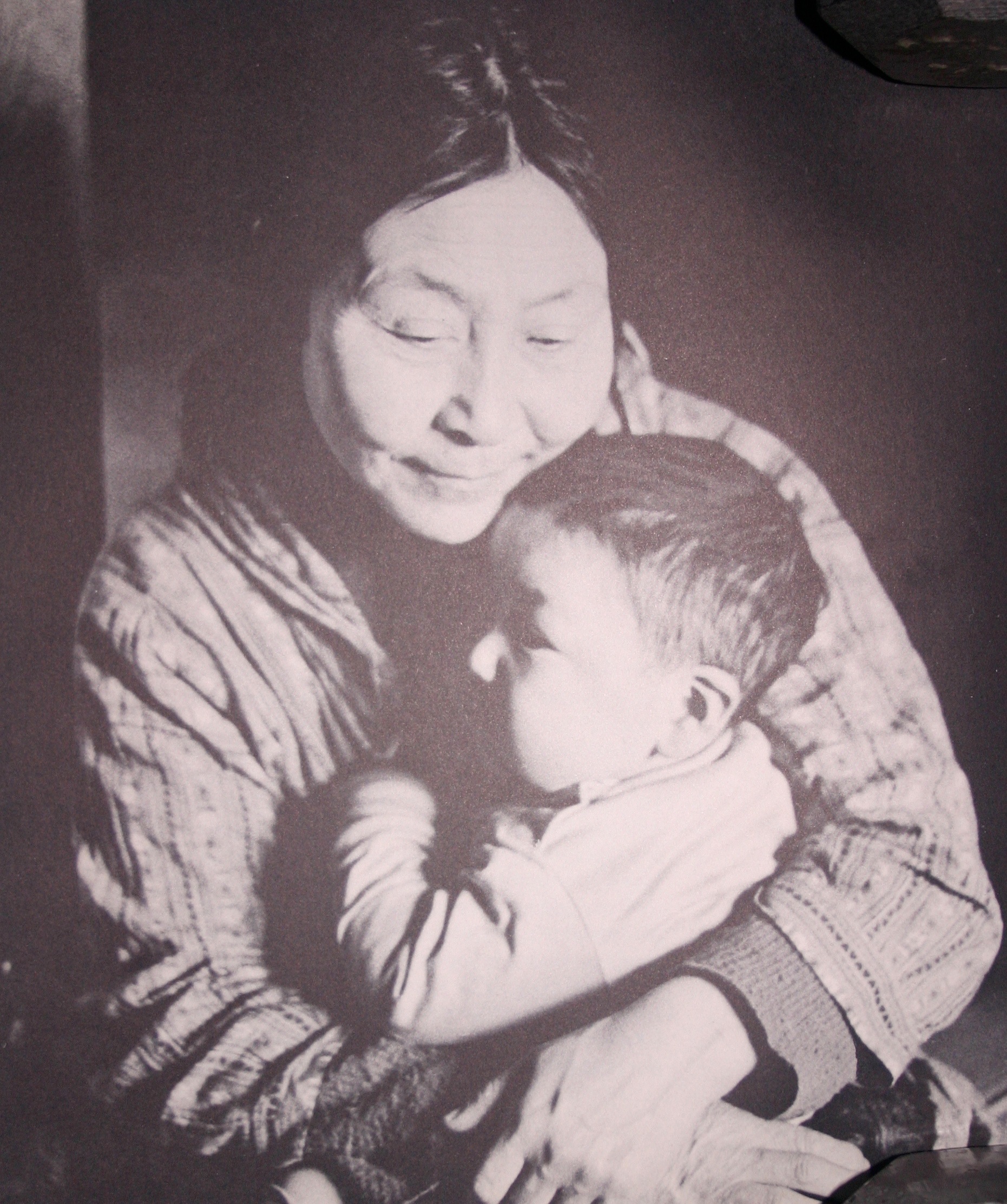
I asked them whether they knew of Aylette Jenness. She’s a writer of children’s books, photographer, and anthropologist, and more, a good personal friend. In the 1960’s Aylette had lived in Alaska in their very village for a year and a half. Based on her experiences there, she wrote a wonderful book, Dwellers of the Tundra: Life in an Alaskan Eskimo Village, with beautiful photos by Jonathan Jenness.
They were too young to have met Aylette, but they knew of her, and they cherished the book she wrote about their village. The young man asked me whether I remembered a photo of a woman in the book holding a young child. I said yes, it was one of my favorites in the book. He then stunned me by saying: “That woman is my mother, and that baby is me.”
We talked the rest of the flight. When I returned to Cambridge, the first thing I had to do was to tell Aylette that story, about how the characters in her book had a continuing life and were now old enough to get married and fly to Bethel. She was fascinated and immediately said: “I have to go back!”
She soon returned to their village, one generation, and more than 20 years later. Being the writer and photographer she is, wrote a second book: In Two Worlds: A Yu’pik Eskimo Family (1989).
This time, the book was co-authored, with Alice Rivers, a Scammon Bay resident, shown on the left here with Aylette on the right. The change in authorship reflects both changes in the way we write about others and Aylette’s own deepening connection with the people there.
The title reflects changes, too. It uses the name Scammon Bay residents themselves use, Yu’pik, not just a broad category, like Eskimo, and everyone is more conscious of living in multiple worlds. The people and Scammon Bay are now identified by name. The books make vivid for me my time in Alaska, even though my stay in Scammon Bay itself was probably just 15 minutes.
And the photos are now by Aylette. They’re sharper than in the first book, less dreamy and more reflective of the many facets of life in modern, yet still traditional, Alaskan villages—the two worlds.
It’s now been another generation, and time for more stories and another Scammon Bay book. In the Introduction to In Two Worlds, Alice and Aylette ask: “maybe one of Alice’s daughters will write that one. Mattie? Sarah? How about it?”
I don’t think the books are still in print, but you can easily find good quality used copies online.
After the earlier counterterrorism (CT) strategy failed in Afghanistan, the US began to emphasize counterinsurgency (COIN). Now that COIN has been shown to fail (e.g., as in WikiLeaks’s Afghan War Diary in ), we’re switching to CT again. This is called “evolving thinking.”
When President Obama announced his new war plan for Afghanistan last year, the centerpiece of the strategy — and a big part of the rationale for sending 30,000 additional troops — was to safeguard the Afghan people, provide them with a competent government and win their allegiance.
Eight months later, that counterinsurgency strategy has shown little success, as demonstrated by the flagging military and civilian operations in Marja and Kandahar and the spread of Taliban influence in other areas of the country.
Our evolving thinking should be showing us that there is still no clearly articulated and shared goal for the US enterprise in Afghanistan. Without that, it’s difficult to say which of these two, or some other approach, does work or to recognize success once it’s achieved. As Andrew Bacevich writes (2010), there’s growing evidence that western way of war itself has failed.
Harry Paget Flashman (see book cover above) had difficulty separating fiction from reality in his own exploits in Afghanistan. Apparently, reviewers of the Flashman books had the same problem. But we can’t afford to do that any longer in Afghanistan.
I thought I saw a B-17 bomber, a “Flying Fortress,” flying low over our house while I was outside talking to my sister Susan! But I was afraid to admit it, thinking I might be taken away for observation. Maybe I could chalk it up to bad eyesight.
There’s some dispute about whether the war in Afghanistan has become the longest war in US history, but there’s no question that it’s gone on a long time and that it shows little sign of heading toward even an end, much less a successful resolution.
When people talk about WWII, there is sometimes disagreement about the means–were the atomic bombs and fire-bombings necessary? There is less debate about the outcome in terms of ending Nazi terrorism and the Japanese expansion. And even during the war there was a sense all around that an end of some sort would be achieved; there would be a surrender or at least an armistice. The fighting would eventually stop, one way or another, and it did.
But we’ve now entered the era of the endless war. Can Kandahar be secured? Maybe, maybe not. But what then? Do the shifting alliances of enemies–Al-Qaeda, Taliban, the Haqqani network simply walk away? Is there a version of Hirohito to say “the war situation has developed not necessarily to Japan’s advantage” and then surrender? Will young Afghani’s ignore the poverty and devastation and choose to move on? Will ordinary people forgive the occupation, the drones, the collateral damage, the cultural insensitivity, the broken promises? Where are even implausible scenarios of how that will happen?
It’s not enough to say that there are people on the other side who have done or want to do bad things. There must be a vision of change. Yet all we hear is that top operatives have been killed, some place has been temporarily conquered, or that we have a timetable for success.
Writing in Mother Jones, Ann Jones says,
It goes round and round, this inexorable machine, this elaborate construction of corporate capitalism at war, generating immense sums of money for relatively small numbers of people, immense debt for our nation, immense sacrifice from our combat soldiers, and for ordinary Afghans and those who have befriended them or been befriended by them, moments of promise and hope, moments of clarity and rage, and moments of dark laughter that sometimes cannot forestall the onset of despair. —Jones (2010)
Obama has been a good President in many ways, and still has the potential to be a great one, but his continuance and expansion of the war, now across a wide swath of Africa to Asia, reveals a spiritual deficiency in the American polity. Rev. Martin Luther King’s words from the Vietnam War time are even more relevant today.
A nation that continues year after year to spend more money on military defense than on programs of social uplift is approaching spiritual death. —King (1967)
References
King, Rev. Martin Luther (1967, April 4). Beyond Vietnam: A time to break silence. Speech delivered by Dr. Martin Luther King, Jr. at a meeting of Clergy and Laity Concerned at Riverside Church in New York City.
I recently met with Charlie Stigler, a very creative, rising HS senior, who’s written various iPhone apps and open source software gadgets, including SelfControl.
SelfControl is for those sorts of people who can’t control their use of email, facebook, web surfing, solitaire, and other invitations to procrastination. I would never presume that you were vulnerable to such distractions, or even had close friends who were, but you may someday encounter someone who is.
One thing I can guarantee is the time you spend reading about it, downloading and installing it, setting it up, and remembering to use it won’t be wasted on real work!
Has your sleep returned to normal after BP’s Deepwater Horizon disaster? If so, it may be time to think about why this was not an aberration, why we’re likely to see more and even larger disasters in the near future.
The only question is: What will the next Deepwater Horizon disaster look like (other than another Deepwater Horizon disaster)? The choices are many, but here are four possible scenarios for future Gulf-scale energy calamities. None of these is inevitable, but each has a plausible basis in fact.
The only thing that seems implausible is that we can continue to extract energy at the rate we do now without ever greater environmental, political, and economic costs.

 This may be a big mistake, but I’m now learning about udderbots.






 Chip's journey