
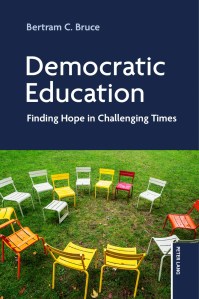
My latest book has just been published. It’s Democratic Education: Finding Hope in Challenging Times.
Here’a an excerpt:
This book opens with a quote from John Dewey’s 1938 essay, “Democracy and Education in the World of Today.” In that essay, Dewey calls on us to educate “the youth of the country in freedom for participation in a free society.” He points out that the “anti-democratic states of Europe … take seriously the formation of the thoughts and minds and characters of their population for their aims and ideals.” The same could be said of anti-democratic forces within the United States today. They take seriously, and act, by taking over school boards, regimenting curricula, banning books from school libraries, and even working to fire individual teachers. They operate at multiple levels, from the individual classroom to national test services and educational publishers.
The political action occurs through multiple forms of schooling as well. The charter school movement began as a better way to meet the needs of low-income and minority students, specifically as an alternative to troubled urban schools. It is becoming essentially a mechanism to provide public funding for private schools, often representing residential segregation by class and race. Private and religious schools, which often promote only limited democracy, are flourishing, promoting ideologies that may afford little opportunity for democratic education. The concerted effort to promote anti-democratic ideology also occurs through the public schools, which have become a political battleground as different sides vie to select or control superintendents, curriculum developers, and local curricula. It occurs through informal education, such as 4-H, scouts, museums, and libraries. And, it occurs through colleges and universities, which increasingly are under fire for their programs and how they deal with freedom of speech.
All too often, advocates of democracy fail to, as Dewey advocates, “take as seriously the preparation of the members of our society for the duties and responsibilities of democracy.” Their focus is on national or state politics, not the painstaking work of local democracy. Even at the national level, education seems less urgent than many other issues. But urgency is not the same as importance. As parents know, young people move ever so rapidly into adulthood, with jobs, families, and civic engagement, including voting. Moreover, in the long run, democracy can only be maintained by the young, not by laws, rules, regulations, amendments, hard-fought court appointments, Presidents, or other mechanisms. If we want to keep democracy we must keep democratic education.
In a landmark legal case, a precursor to Watergate, Judge Damon Keith ruled that the Government could not wiretap U.S. citizens without a warrant. He famously wrote, “Democracies die behind closed doors.” In just five words, Keith captured an essential aspect of democratic education: A democracy requires that citizens not be kept in the dark. Education can illuminate that space. The Washington Post adapted Keith’s saying for its motto: “Democracy dies in darkness.”
Democracy is the means to practice intelligent moral inquiry together, bringing light, and seeking solutions to common problems. It enables democratic education while requiring democratic education as its foundation. That education is training for communal life, a democratic way of living. It enables democracy while being dependent upon it. Thus, democracy and democratic education reinforce and shape one another; they are mutually constituted. Even in the darkest times, we can work to make them stronger.
Learning is fundamental to our humanity. It occurs beyond the formal classroom—in the workplace, in the home, online, in libraries and museums. It is essential to our enterprises, whether political, social, or intellectual. There is no reasonable way to separate discussion of democracy from education. We need critical, focused, and compassionate understanding of education, not quibbles about mechanical procedures. That highlights the importance of democratic ed-u cation, especially education with democracy, in which students learn democracy through their work on democratic practice.



 Chip's journey