In 1939, Billie Holiday recorded Strange Fruit, a searing depiction of lynching, written by Abel Meeropol. Two years later she released another haunting song “God Bless the Child.”
“God Bless the Child” is a classic, covered by Aretha Franklin, Blood, Sweat & Tears, and many others. It has many interpretations, from hope in a time of trouble, to self-reliance, or stewardship. In her autobiography Holiday says that she got the idea after approaching her mother for a loan. Despite being the birth mother and benefiting from her daughter’s financial assistance, she refused. Holiday shouted back: “God bless the child that’s got his own.”
One interpretation is that Blacks need to act for themselves, but that message rings hollow in the face of Jim Crow laws, analogues of which persist to this day.
For me, though, the song seems uncannily appropriate given the recent Supreme Court decision on affirmative action. There’e been much written about that decision, including perspectives from the Fourteenth Amendment, public policy, sociology, history, and education. But one thing that stands out is expressed in the song’s beginning:
Them that’s got shall get Them that’s not shall lose So the bible said and it still is news
One could argue that affirmative action has fallen short at increasing diversity or mitigating discrimination. But it’s been an important tool to lessen the reality of an unjust and racist society.
The decision leaves in place the myriad ways that our college admissions system perpetuates, even extends, racial injustice–legacy admissions, unequal funding of K-12 education, biased testing, access to sports, opaque pricing of colleges, healthcare inequities, to name just a few. These perpetuate wealth disparities as well as racial prejudice.
Holiday’s song reminds us:
Money, you’ve got lots of friends They’re crowding around the door
A starkly politicized Supreme Court is doing its best to ignore the reality that Holiday sang about. It’s become a stalwart friend of Money and as Holiday says, “Empty pockets don’t ever make the grade.”
It seems that we’re back to offering crusts of bread, but only for those who stay in their place.
Rich relations give crusts of bread and such You can help yourself, but don’t take too much
Project Condor is an excellent example of how collaboration between private and public sectors can help mitigate climate change, while educating students for positive contributions to our future. My thanks to Muhammed Shah and Mojgan Momeni for the photos and other assistance in producing this article.
World Innovations Network
Condor was developed within the framework of World Innovations Network (WIN). WIN provides the glue for projects that engage community college students, to work on socially beneficial projects. For example, through the United Community Alliance, West Valley College students and faculty, local government officials, entrepreneurs, high-tech leaders, and the venture capital community have worked on COVID-19, student homelessness, and clean water.
Project Condor co-founders bring the car on campus to be worked on
Interdisciplinary, multi-organizational, and cross-role collaboration
The project was started by Muhammed Majid Shah, Tim Hyde, and Akilan Babu through an internship project organized and mentored by WIN in the spring of 2022. Silicon Valley Clean Energy helped sponsor the project through their education fund.
OEM Honda Hybrid system within the 2002 Honda Insight
The students partner with mentors from higher education and industry. They gain practical experience related to their studies, while the industry partners contribute to education and positive social change. Along the way, students find jobs and companies find experienced employees. And the public sees solutions to social, economic, and environmental problems.
Project Condor team inspires potential West Valley College students at the open house
Like other WIN projects, Condor represents a true interdisciplinary collaboration across organizations. It’s since grown to a team of 12-15 students from Mission College, many with a business focus, and West Valley College, many with an engineering focus. It’s highly interdisciplinary with students from science, math, engineering, business, and marketing.
The technology
Installing a manual control board that allows the driver to request on-demand assist and regen braking from the hybrid system
One of the key inspirations in our project has been the work done by John Sullivan, who designed the battery management system that we’re currently studying. Our goal with Project Condor goes beyond just providing a technological solution–we strive to provide student participants with a resume-building experience through hands-on work on a real-world project.
Showcasing the new hybrid system, unveiled by temporarily removing the safety cover over the internal components, all within the same enclosure
In pursuit of this goal, we’re eager to demonstrate the potential of this new hybrid technology by using a Honda Insight as our initial platform. Our team is focused on collecting and analyzing data from both before and after the battery conversion. Once we’re able to effectively prove the feasibility and benefits of this technology, we plan to implement a similar system for the most ubiquitous player in the hybrid market––the Toyota Prius.
We’ve learned that design and business is an iterative process and the importance of having an interdisciplinary approach.
About 14 years ago, Mojgan Momeni was earning her Master’s degree in Library and Information Science at the University of Illinois. That was the beginning of a saga both tragic and renewing, one involving several people and linking over time. It reminds us of the importance of connecting with nature and others.
I invited Mojgan to share what happened. What follows is the story in her own words:
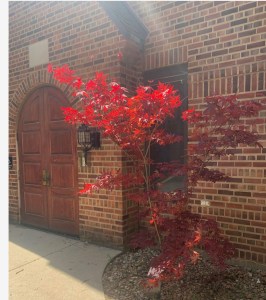
The Japanese maple today in front of the iSchool building
Last month, I came across a stunning photo on LinkedIn of a Japanese maple tree with bright red leaves under the afternoon sun at the School of Information Science. I had been curious for years if the tree was still alive. This was important to me because I had planted it in 2009 in memory of my classmate Yingbo Zhou, who tragically passed away following a hit-and-run car accident on an icy freeway.
Yingbo Zhou
Jill Gengler, Director of Alumni Affairs at the School of Information Sciences, took the shot and shared it. She informed me that the tree had been officially turned into a memorial tree with a plaque (the first bilingual marker on campus). Thanks to the efforts of Professor Kate Williams, Yingbo’s tree is now an official University of Illinois at Urbana-Champaign memorial tree. I am incredibly grateful!
I was also deeply moved by Yingbo’s parents, who gave me a gift as a gesture of appreciation during their summer visit.
I completed my Master’s degree from GSLIS (Graduate School of Library and Information Science) in May 2009. This experience was a significant turning point in my life, and I felt a sense of purpose and direction. That’s why I wanted to express my gratitude by giving back to the school somehow. As a gardening enthusiast, I purchased some perennials and bulbs to plant in a few areas in the school front yard and a young Japanese maple tree. After finishing the design and planting, I dedicated the tree to Yingbo.
The tree in 2009
Planting is one thing, but watering it during an Illinois summer can be challenging. After graduating, my student ID expired, and I could not access the building. Consequently, I had to drive to the new garden daily with water containers from home. I would sit on the stairs hoping that someone would exit the building so I could refill the containers. I felt honored when Chip brought a group of visitors to tour my garden, and shared his positive feedback about it on his blog.
Long story short, I got a job at a software company and relocated to California. I had been curious about the garden and tree for over a decade until I saw Jill’s post by chance.
It can take me a long time to recognize something wonderful right in front of me, even as I blame my troubles on lacking some item of little value.
One such under-appreciated gem is Radoslav Tsanoff. His Humanities 100 course opened new doors for my understanding of philosophy, but I’ve only recently come to fully appreciate that opportunity.
Radoslav & Corinne Tsanoff, c, 1916
Tsanoff’s bio
Radoslav Tsanoff was born in Sofia, Bulgaria. Coming to the US at age 16 to study at Oberlin, he received his PhD in philosophy at Cornell. He became the first professor of philosophy at Rice in 1914 and went on to become a brilliant teacher who inspired generations of students. He was a noted authority on intellectual history and author of many excellent books.
After a five-year retirement, Radoslav returned as Professor of Humanities, before retiring for the second time in 1974. He won many awards. With his wife Corinne, he was an active supporter of music and arts in Houston. He was religious and politically liberal, but not a member of any church or political party. He died just two months after Corinne died.
I recall that Radoslav donated his time, teaching for $1 a year. He would carefully empty his satchel at Fondren Library to allow the student at the door to check that he wasn’t stealing any books. In her excellent blog on Rice history, Melissa Kean tells many fascinating stories about the Tsanoff’s.
Tsanoff at Rice University, much as I remember him when he was my professor in 1967-68
Guiding principles
Radoslav’s close colleague says this about the couple:
They know what makes life worth living…. [Their happiness] comes from their enthusiasm for things life has to offer…. their wisdom consists in their constantly drawing on the great wealth contained in the achievements of the human spirit––in science, letters, and art, in the beauty of nature, and in the deep satisfaction that comes with working with other people toward common goals….
They throw themselves resolutely and devotedly into these boundless realms of value, try to assimilate, absorb, and enjoy them, and then do all they can to make these values patent and accessible to others…. The result is that magic we sense when we were in their presence.
Konnie Kolenda, speaking at an event honoring Radoslav and Corinne Stephenson Tsanoff, 1973; document recovered by Melissa Kean
Revisiting The Great Philosophers
Radoslav’s own The Great Philosophers was the text for Humanities 100. It’s scholarly, yet very readable, a bridge between popular discussions of philosophy as one might find in a good magazine and detailed, technical analyses found in a philosophy journal.
Recently, I’ve been having weekly discussions with an 88 year old friend. He’s a former shop teacher, who never took a philosophy course. We’ve read various short selections, including blog posts, entries in the Stanford Encyclopedia of Philosophy, and other sources. But we’ve settled on The Great Philosophers, as a book offering plenty of substance in an accessible form.
Re-reading that book has renewed my appreciation of Radoslav Tsanoff. His discussions of various issues are enlightening still, 70 years after the book was written and 55 years after I first read it. Among other things, he has interesting commentary on Epicurus and Spinoza, whose stars have risen anew since 1953. His capsule summary of pragmatism, especially of James and Dewey seems more prescient than that found in similar books.
Dreamers and doers
In an essay for Humanities 100, I included a New Yorker cartoon. I can’t find a copy of that essay, or of the cartoon, but I recall it showing two bums slouching in an alleyway. One says, “There are the dreamers and there are the doers. I’m a dreamer.”
Radoslav said that it was the only illustrated student essay that he ever received. I’m not sure, but I think that was a compliment. I know that he illustrated his own lectures with verbal images of works of art and architecture, cityscapes, and scenes from nature.
He also reminded me that one can’t always be just a dreamer; that life means engagement with ideas, arts, nature, and community.
His own life exemplified both dreaming and doing. Perhaps that’s why the last chapter emphasized philosophical pragmatism.
It’s worth quoting from the final paragraph, written 70 years ago. Many people might assume he’s talking about our own age:
Ours is a transitional age, and unsettled in its thinking, and in its social structure, facing exceedingly grave perils, yet having the possibility of unprecedentedly rich fruition…. Philosophy disposes only of its routine tasks. Its major inquiries may become more enlightened, but they cannot be terminated. This is not a skeptical reflection. It signifies, not that philosophical thought is futile, but that it is inexhaustible.
The first North Atlantic right whale mother and calf pair has arrived in Cape Cod Bay. The Right Whale Ecology Program team from the Center for Coastal Studies (CCS) sighted the pair on March 18––Porcia, a 21-year-old right whale, and her newborn calf. They were first seen in late December off the coast of Georgia.
Yesterday, Susan and I were fortunate go on a Whale Walk sponsored by the Center. It turned out to not much of a walk because whales came close to shore next to the pavilion where we were supposed to start. They were relatively easy to see as they fed at the surface, so we had a sort of stationary walk.
We learned a useful tip from Jesse Mechling who led the group: If you see a large black rock moving across the water, it’s probably a right whale. There’s no evidence for black rocks off Cape Cod moving in that way.
Jesse showing baleen that right whales use to capture their principal food source, copepods
The North Atlantic right whales are critically endangered. There are fewer than 340 individuals left and only 80 breeding females. The principal factors in their decline are shipping and entanglement from fishing gear. They’re called “urban whales” because they’re trying to survive off the shore of dense human populations with some of the most active shipping and fishing in the world.
They’re also affected by global warming, which results in warming of the oceans, shifts in the populations of copepods, alterations of the feeding patterns of the whales, coming into the way of new harms, etc. These issues are discussed at our annual Wellfleet harbor conference.
Cape Cod Bay from the Herring Cove pavilion in Provincetown
I have very mixed feelings right now. On the one hand I feel incredibly fortunate to benefit from organizations such as the CCS and their public engagement programs. I love being able to go a short distance to see relatively unpolluted beaches and magnificent creatures such as the right whales, directly from shore.
But on the other hand, I feel shame knowing that my generation is responsible for the destruction of these whales and other wildlife, and the habitats that they need to survive.
To say that someone has a musical gift, or is gifted, usually means that they have unusual talent or can perform beautifully for others. I mean something quite different here.
When I say “musical gift” in this and the next two posts, I mean a gift to me, one that enhances my enjoyment of music. I was granted these through no effort on my own––no long, arduous hours of practice.
Opportunities to learn
My dad at his piano store c. 1954
The first of the three gifts is opportunity. It came in multiple ways.
My father sold pianos through his store. We always had a piano in the house; it was part of the store’s inventory. If anyone wanted that model he could sell it as a lightly used piano. That meant that we might discover that our much loved mahogany spinet might be suddenly hauled away and replaced by a large black upright, or in later years by an electronic keyboard.
Electric, interurban streetcar, running from Fort Worth to Dallas; Dunbar HS was near the sixth stop.
I grew up in Fort Worth during the time of legalized racial segregation. There were no African Americans in my school. If not for summer and part-time jobs, I would have had little interaction across the racial divide.
This meant that I knew little about the schools for African Americans in Fort Worth. There were even segregated sports leagues. I think I went to just one Black football game and that was because I became friends with a Black fellow orderly when I worked in the local hospital.
Joe was a halfback on the Dunbar High School football team in the Stop Six neighborhood. I believe that the school is still largely segregated, a consequence not of the law anymore, but of residential segregation.
Rosenwald schools
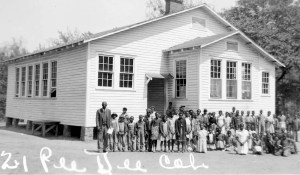
One major gap in my knowledge pertained to the Rosenwald schools. Thanks to Julius Rosenwald, who provided funds for 1/3 of the cost of school buildings, Anna Jeanes, who funded teacher preparation, Booker T. Washington, and others, thousands of schools were born. As important as that external support was, it’s important to note that local Black citizens from a poor, working class, donated cash, labor, and land to make the schools possible.
Fisk University, John Hope and Aurelia E. Franklin Library Special Collection, Julius Rosenwald Fund Archives
These programs provided education for generations of African American students, teachers, and scholars. Maya Angelou and John Lewis were grads from Rosenwald schools. Mamie and Kenneth Clark did their research on Rosenwald fellowships as did Pauli Murphy. Their work was crucial for the decision in Brown v, Board of Education.
The project began in 1915, when Sears and Roebuck President, Julius Rosenwald, established a matching grant fund to construct better quality black schools throughout the South. Between 1917 and 1932, the Fund assisted in the construction of thousands of school buildings This was during a time when public support for educating African American children was shamefully inadequate. Over one-third of black children in the South in the first half of the twentieth century passed through the doors of a Rosenwald school,
Rosenwald School (Public Domain image from the South Carolina Department of Archives and History
Just this past year I’ve learned about Rosenwald’s program to fund more than 10,000 school, college, and public libraries, and library science programs. The libraries not only provided resources for individuals; they enabled accreditation for programs for African Americans, which would otherwise not be possible. Aisha Johnson has a wonderful new book on these libraries, The African American Struggle for Library Equality.
Why didn’t I know?
I probably heard about Rosenwald schools and libraries, or the Jeanes teachers, during my career, but most of that passed right through my head.
With all the current talk about DEI and social justice, isn’t it a collective failure that the fact of those programs—the very need for them at all, their struggles, and their impact on individuals and society—were so little known by so many of us?
This symposium shares ways to think about democratic education in today’s world, and how we should plan for the future. How should issues such as indigenous people’s rights, racism, women’s rights, authoritarian governments, the concentration of wealth, the climate crisis, pandemics, and more make us analyze, discuss, and work to create democratic education?
We highly encourage submissions from classroom educators at all levels, from educators outside the United States, and from educators associated with alternative schools or informal learning.
Our initial call for papers in February 2022 led to proposals by almost 40 educators from all over the world. We held two zoom workshops for contributors over the past summer, which led to exciting manuscript submissions. The submissions include articles about teacher education for democracy, a ninth grade program devoted to the dreams and hopes of its students, and a social justice program for pregnant and parenting teenagers. These three articles will appear in the Spring 2023 issue of Schools, marking the first of what promises to be a robust and ongoing symposium.
Manuscript preparation
Interested authors should submit a one-page prospectus describing what their project entails. This is to determine appropriateness and balance for the special issue. We anticipate a mix of empirical and theoretical contributions. Completed manuscripts will undergo the usual Schools: Studies in Education review process before final acceptance.
Articles should be a maximum of 8000 words (25 double-spaced pages). Please follow the Schools style guide.
There is a possibility of a follow-on book publication based on revised versions of the articles, after publication in Schools.
Deadlines
For consideration in the Fall 2023 publication:
April 15, 2023: final manuscript deadline
May 1, 2023: editors’ review of the manuscript sent to author
June 1, 2023: outside review of the manuscript
July 1, 2023: final revised copy
For consideration in the Spring 2024 publication:
February 15, 2023: one-page prospectus for your proposed article
March 15, 2023: response to the prospectus
October 15, 2023: final manuscript to be considered for the Spring 2024 issue
In an age of climate disasters, extreme income inequality, conspiracy theories, anti-democratic movements, segregated schooling, pandemic, and more, the need for democratic education has never been greater, but it may also seem less viable than ever. Classics such as John Dewey’s Democracy and Education are still relevant, but invite us to re-invent education for today.
The symposium
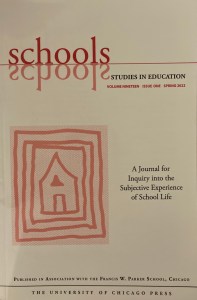
Schools: Studies in Education, published by the University of Chicago Press, is hosting a symposium on this topic to celebrate the journal’s twentieth anniversary. The mission of Schools is to present inquiry into the subjective experience of school life. Unique among academic journals of education, Schools features articles by and about the daily life of classrooms, descriptions and reflections on the meaning of what happens when learning actually occurs.
To celebrate our twentieth year of publication, this symposium shares ways to think about democratic education in today’s world, and how we should plan for the future. How should issues such as indigenous people’s rights, racism, women’s rights, authoritarian governments, the concentration of wealth, the climate crisis, pandemics, and more make us analyze, discuss, and work to create democratic education?
We highly encourage submissions from classroom educators at all levels, from educators outside the United States, and from educators associated with alternative schools or informal learning.
Our initial call for papers in February 2022 led to proposals by almost 40 educators from all over the world. We held two zoom workshops for contributors over the past summer, which led to exciting manuscript submissions. The submissions include articles about teacher education, a ninth grade program devoted to the dreams and hopes of its students, an after school leadership program for Black teenagers, and a social justice program for pregnant and parenting teenagers. Some or all of these articles will likely appear in the first of what promises to be a robust series of an ongoing symposium.
Manuscript preparation
Interested authors should submit a one-page prospectus describing what their project entails. This is to determine appropriateness and balance for the special issue. We anticipate a mix of empirical and theoretical contributions. Completed manuscripts will undergo the usual Schools: Studies in Education review process before final acceptance.
Articles should be a maximum of 8000 words (25 double-spaced pages). Please follow the Schools style guide.
There is a possibility of a follow-on book publication based on revised versions of the articles, after publication in Schools.
Deadlines
For consideration in the Fall 2023 publication:
December 15, 2022: one-page prospectus for your proposed article
January 15, 2023: response to the prospectus
April 15, 2023: final manuscript deadline
May 1, 2023: editors’ review of the manuscript sent to author
June 1, 2023: outside review of the manuscript
July 1, 2023: final revised copy
For consideration in the Spring 2024 publication:
February 15, 2023: one-page prospectus for your proposed article
March 15, 2023: response to the prospectus
October 15, 2023: final manuscript to be considered for the Spring 2024 issue
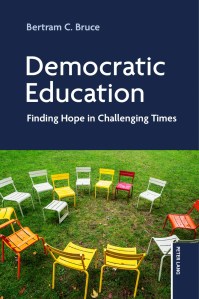
The book asks readers to adopt a critical and comprehensive view of education (pre-K to lifelong learning) as existing both within classroom walls, and in the surrounding world, including communities and workplaces. It presents an integrated view of online learning, community schools, communiversities, and learning through work.