The radio museum in Howth

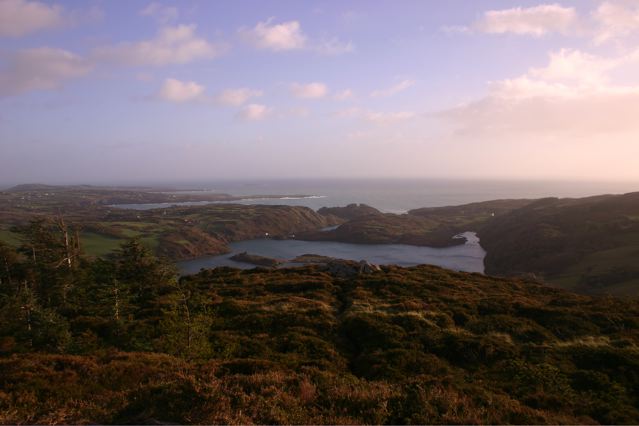
This could have been a post about a walk on the Cliffs of Howth, a small seaside town north of Dublin. Yesterday was a beautiful day, with a brisk wind and light cirrus clouds–a great day for a cliff walk if you don’t stand too close to the edge and if you watch your footing on the muddy track and wet rocks.

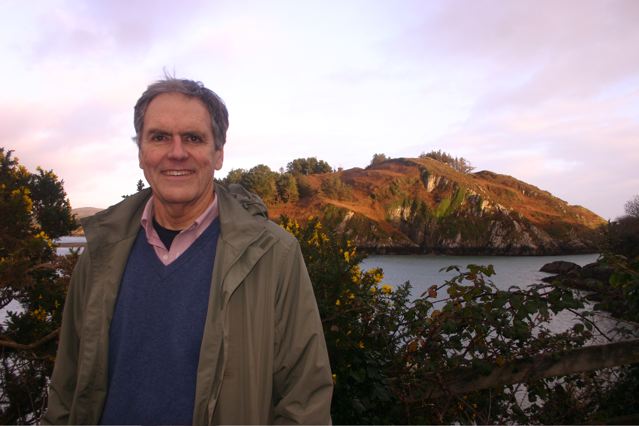
Pat and EmilyBut before we began the walk, we happened upon a wonderful small museum about the development of radio: Ye Olde Hurdy-Gurdy Museum of Vintage Radio. It’s in the Martelo Tower above the harbor, at one end of the cliff walk. Pat Herbert, the founder, is passionate about what he’s learned about radio, and communications in general, drawing everyone else into it. Susan adds:

Pat played a tape on which a group of amateur radio enthusiasts had recorded a conversation with the Space Shuttle Columbia during the few minutes it was over Ireland in 1983, 20 years prior to its tragic crash over Texas. One of the astronauts at the time was an amateur radio enthusiast, and Irish amateur radio people had spent hours trying to contact him. A visitor to the museum gave Pat the tape, which he owned only because his brother had been one of the 1983 radio buffs. The entire visit was like that, just one story after another… He had many stories, mostly directed at Emily. And, typically, at about 1:00, announced that it was about time for a cup of tea and biscuits. So we sat around and talked for a good while.

Howth cliffPat said that not many school groups come to the museum. That’s a shame, because the exhibits could be fascinating to young people as well as to those who lived through some of the times presented there. I think especially of young people in transition year programs (age ~15), who are doing new media projects, such as at the Suas Foundation’s excellent Bridge to College (B2C) programme . The museum would introduce interesting technologies as well as add an historical perspective.

Susan and EmilyWhen we did manage to set off on the hike we had a wonderful windy time, circling a good part of the Howth peninsula with grand views of the Ireland’s Eye and the Dublin harbor, and then making it up to the Ben of Howth. Eventually returned to the port in time for early dinner at The Oar House.

Christmas in Kilcrohane

sheep on Sheepshead Wayme in KilcrohaneWe had a wonderful Christmas in Kilcrohane on the Sheepshead Peninsula in West Cork. We went with Stephen, over from St. Petersburg, Russia; Emily, from Minneapolis; and Matt, one of their friends, from Saint-Raphael, France. Our week included a visit to Fitzpatrick’s one evening, several to the O’Mahony store, and stops in Durrus, Bantry, Ahakista, and other charming towns.

swan lakeWe also had winds, fog, sleet, and torrential rain. Locals call it “rain,” even though it blows horizontally, rather than falling sensibly from the top down. There were several terrific gales (or was it one long one?), which made us thankful for the stone walls of Betsy and Michael’s cottage. Sitting by a warm fire, we could look out on gorgeous Dunmanus Bay with sunny skies one time and am awesome storm the next.

Lough HyneDespite the general theme of winter storm, we had frequent sun and glorious skies. That allowed us to manage several good walks. One was in the ancient forest above Glengariff; another around Lough Hyne south of Skibbereen; and others on the Sheepshead Way. We made good use of Kevin Corcoran’s West Cork Walks.Mizen peninsula

Emily was a writing dervish, thus missing some of the walks. Her friend Matt played his guitar, while posed on the large window seat. Stephen had a swim down at the end of the road. He was inspired in part by Frank O’Mahony, who had done the St Stephen’s Day charity swim at the pier. Perhaps it was warmer for the swimmers to be in the water than in the air, given the sleet and winds. And we played a fair bit of bridge.

Photos by Susan Porter Bruce.

Digital Literacy in Irish Primary Schools

National College of Ireland is starting a new project, Digital Literacy in Irish Primary Schools (DLIPS). The aim is to investigate digital literacy practices and to develop a conceptual framework for the needs of the Irish Primary Education system. Digital Literacy is regarded as incorporating a broad range of competencies; there is a need to investigate new approaches that facilitate greater student engagement and connection to everyday experiences.

The project involves the evaluation of how teachers integrate ICT into their classroom activities to promote teamwork, collaboration, creativity and co-operative learning using a project-based learning approach. This approach will be evaluated with regard to the student’s academic performance and engagement with learning, particularly in relation to their literacy proficiency. The framework will be developed by reviewing existing frameworks and adapting these according to the above research findings.

This is a collaborative project with the Education Research Centre, the Digital Hub Development Agency and the National Centre for Technology in Education. It is funded by the Department of Education and Science research and development council. Leo Casey and I are co-principal investigators.

Premier of “Round Here”

Round Here sceneWe attended a gala movie premier last night at the National College of Ireland (NCI). The film, Round Here, explores themes of community and identity in the rapidly changing Dublin Docklands area.

.

.

limoTwelve young people from the Docklands area not only star in the film, but devised it based on their own experiences there. Philip McMahon wrote the actual script following interviews with the young people; it was directed by Colin Thornton. I thought it was an excellent portrayal of the challenges facing many young people today.
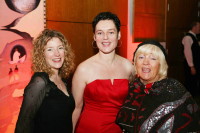
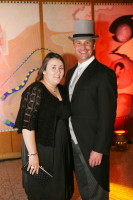
NCI atriumThe event began with the young people arriving by limo and walking down a red carpet. They were announced by young escorts wearing top hats and tails. There was of course popcorn and soft drinks as for any cinema event. Kirsten Sheridan (My Left Foot, In America, August Rush) was a surprise guest who presented DVDs of the movie to the young stars. Afterwards, we were able to visit with the cast and crew over cocktails.

actorsThe project was a joint venture of NCI, Calipo Theatre and Picture Company, and the Sheriff Street After Schools Education and Support Programme (Celine Howard) and was funded by patrons of the NCI.

people-3Photos courtesy of the National College of Ireland.people-2

Catch 22 in Iraq

Michael Schwartz has an excellent piece in Mother Jones, Catch 22 in Iraq: Why American Troops Can’t Go Home, about why the Iraq occupation is likely to last a long time. He cites a recent video-conference press briefing for reporters in which Col. Jeffrey Bannister refers to the five-year plan, not just any old plan, but the plan. This implies a generally understood long-term mission, one which is not based on changes on the ground, such as a reduction in sectarian violence.

Moreover, he quotes and links to articles showing that the leading Democratic party contenders are fully with the program, seeing “vital national security interests,” i.e., oil in the region as grounds for continuing military force. The Catch 22 is that violent resistance to the occupation is defined as terrorism; thus, the military presence is needed to combat the very terrorism that it creates.

Schwartz’s article provides further evidence that the issue in Iraq is not promoting democracy, ending sectarian violence, reducing terrorism, promoting peace and justice in the Middle East, or any of a number of other worthwhile goals. It is to secure and maintain ample, low-cost supplies of oil to fuel the global economy, and especially for the Western nations, which use such a disproportionate share of the world’s resources.

All of this makes me think that my 12 steps to respond to 9/11, because “we have to do something!” is still relevant.

Top 100 tools for learning

The Centre for Learning & Performance Technologies in Somerset, England asked learning professionals to identify their 10 favorite e-learning tools, either for their own personal learning or for fostering learning for others. You can see the combined lists with links to their individual lists.

It was an interesting exercise. My list changes depending on situation and purpose. It’s also hard to say whether I should list a specific product or a type. I use Firefox as a web browser, but Safari works almost as well. Should I pick just one, or say “web browser”? Is Google just a “search tool”? It has enough special features to stand out as a suite of tools. For some categories, any of several products are fine. You can see my own list and I’d welcome comments or suggestions for changes.

Community Informatics Research Network conference, Prato, 2007

lunch on the terraceLast week I went to the Community Informatics Research Network conference at the Monash University Centre in Prato, Italy. The theme was “prospects for communities and action.” Attendees came from over 22 countries including Finland, New Zealand, Peru, Puerto Rico, and Mozambique. There were days devoted to both community informatics and to development informatics.

The next conference will be held 27-30 October, 2008.

Villa RucellaiWe stayed at Villa Rucellai di Canneto, a lovely old villa situated on a hill above the Bisenzio river. The fortified tower was built in the Middle Ages, and it’s described as a villa in 1427.

Maramureş

Barsana Monastery church I’m attaching a couple of photos from Romania, where we went in September. One is a wooden church in the Maramureş style. It’s part of the Barsana Monastery. Another was one of many hitchhikers we picked up. Our old Dacia wasn’t much as a car, but it beats walking or horse-drawn cart when you’re tired. We had learned enough Romanian to figure out that the man is 82, has 9 children, and knows the woman who works in the post office and runs our B&B. We also saw what may be the oldest, and is certainly the longest-running Unitarian Church (in Cluj-Napoca). I spent an hour with the pastor, learning about their history and the church building and furnishings.

In Maramures, we saw Elie Wiesel’s home/museum. As you friend in Botizamay know, Maramureş was one of the worst holocaust sites, with over 20,000 Jews from Sighetu-Marmaţiei alone sent to Auschwitz. Later, Communists in Romania sent tens of thousands of “Saxons” (ethnic Germans) to work and die on the Danube canal construction. Roma people managed to be persecuted throughout, and still suffer from prejudices today (although projects such as Şanse Egale are working to improve opportunities).

We also saw the museum sometimes called the “Museum of Suppressed Thought”, which made me aware that my imagination is limited in conceiving all the ways people can oppress one another, and all the different ethnic prejudices that can be realized. Maramureş and Transylvania in general have seen more than their fair share. That’s especially disturbing to think about in a country which is otherwise so beautiful, friendly, and welcoming.

I gave a talk on Dewey, Hull House, and Paseo Boricua at the Philosophy of Pragmatism: Salient Inquiries conference at Babeş-Bolyai University in Cluj-Napoca. I’d certainly value any comments or suggestions on the draft.

Earn money for good causes doing web searches

You can earn money for your favorite charity with every web search. One option is Goodsearch, which donates 50% of its revenue to the charities and schools designated by its users…You use GoodSearch exactly as you would any other search engine (it’s powered by Yahoo!).  The money GoodSearch comes from its advertisers.

A better model still may be Search Kindly. It’s a state-recognized non-profit corporation, which donates all of its advertising revenue to charity and allows users to select the charity that wins a monthly grant. It uses Google as the underlying search engine.

The school as social center

What did Dewey mean when he imagined the school as social center of the community and as a site for building a democratic society? How is that different from just teaching history and government, or discussing the local newspaper in class? Are there any schools today that realize Dewey’s vision?

Dewey articulated these ideas in an early speech called “The School as Social Center.” He recognized even then that there were dramatic innovations in transportation & communication, the relaxation of social discipline & control, the growing need for knowledge in all affairs of life, and the need for lifelong learning. As a result, he saw the need to change the image of what constitutes citizenship and therefore the image of the purpose of the school. These ideas are developed more in an excellent new book called Dewey’s Dream.

One implication of this perspective is the creation of community schools, many of which are allied through the Coalition for Community Schools. Through that network, individuals and organizations share work on “education K-16, youth development, community planning and development, family support, health and human services, government and philanthropy.”

Other implications are to move beyond elitist models of service and to focus on reflective transformation of ourselves and our own organizations:

the creation of public spaces can be a seedbed for productive, pluralist, citizen-owned politics in an age of gated communities and privatized resources. We need to change the now dominant view of civic learning as community service or service learning, if we are to develop the political sensibilities of our students. Organizing involves understanding education as about transformation, the “reworking” of ourselves and our contexts. An organizing approach is what we need to develop, if we are to think and act politically. (Boyte, 2003)

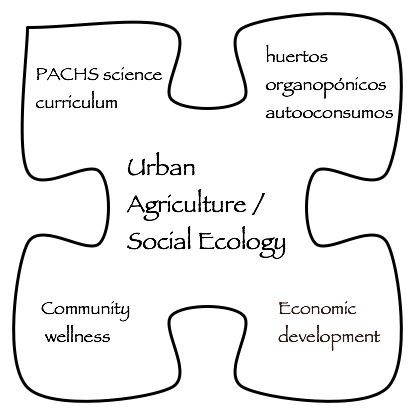
A project at the Pedro Albizu Campos High School in Chicago is an excellent example of what Dewey meant. It embodies the community school idea, as well as ideas urban agriculture projectof transformation and collaborative inquiry to address community needs. In this case, “seedbed” has a literal meaning as well.

The project (Urban Agriculture in the Context of Social Ecology) began as a way for students to learn science with hands-on investigations of hydroponics and soil-based gardening. It has since expanded to include the study of urban agriculture, community wellness, and economic development. For example, students will grow the ingredients needed for salsa de sofrito, such as tomatoes, onions, garlic, green bell peppers, ajíes dulces, oregano, cilantro, and other spices. Growing these and making the sauce will afford a deeper understanding of their cultural heritage. Bottling and selling the sauce will contribute to community economic development as well as affording an understanding of economics and food processing.

See The Quill greenhouse project in Hartford.

References

Benson, Chris, & Christian, Scott (Eds.) (2002). Writing to make a difference: Classroom projects for community change. Teachers CP. Projects in which young people write for community change.

Benson, Lee, Harkavy, Ira, & Puckett, John. (2007). Dewey’s dream: Universities and democracies in an age of education reform. Philadelphia, PA: Temple University Press.

Boyte, Harry Chatten (2003). A different kind of politics: John Dewey and the meaning of citizenship in the 21st century. The Good Society, 12(2), 1-15.

Dewey, John (1902, October). The school as social center. The Elementary School Teacher, 3(2), 73-86.