 During our sabbatical in Beijing and Brisbane, we had a surprising common theme: turtles.
I’ve always liked turtles, so perhaps it was natural that I saw them everywhere we turned. It started when we asked Caroline, a ten-year-old friend from Canada, about her classes at the Bei Da elementary school. She described a strange typing class, which involved typing expressions such as “FD 100 RT 120 FD 100 RT 120”. Although she didn’t realize it at first, this was not typing class, but computer programming using the Logo language. The commands were eventually to be used to command a robotic turtle, or one on a computer screen. In this example, the turtle would be commanded to draw an equilateral triangle, 100 pixels on a side.
 We decided that turtle talk was a nice, limited domain in which to practice our feeble Chinese. Wang Dongyi, a Chinese friend, was helping us with that, and we were helping him with his English. Before long we had a bustling turtle circus going in our apartment at Shao Yuan on the Bei Da campus. Caroline, Emily, and Stephen played the turtles, with occasional help from certain childlike adults. We’d issue Logo commands in Chinese or English, and learn from the consequences of the turtles’ behaviors. In this way, we were all practicing both language and programming skills. We of course had to learn the Chinese word for sea turtle, Hai Gui (海归), so that we could say Turtle Emily, forward 30, or its equivalent in Chinese.
These navigational commands happened to be useful for us visitors, as we were continually seeking of giving directions. We began to refer to taxis as Hai Gui, since they needed to execute programs such as forward ten blocks, left, then forward three more.
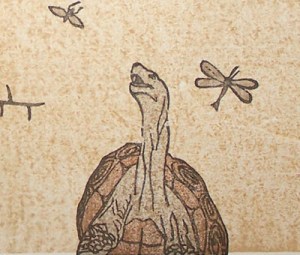
Hai Gui, from Woodblock Dreams
We saw images and sculptures of turtles. We even ate Hai Gui, probably more than we realized, since we couldn’t always identify or obtain a name for what we were eating. We then learned that the “Hai Gui” or “sea turtles” of China are the returning professionals who contribute to the growth of the Chinese economy. These are the students who were sent abroad, like baby sea turtles, to get advanced degrees and Western experiences, then return to lay their eggs in their homeland.
When we reached Australia, we spent a lot of time outdoors, taking advantage of the beautiful countryside in Queensland. We saw many turtles in lakes and in the ocean, and even swam with adult loggerheads. One highlight, near Bundaberg, was Mon Repos Beach, one of the two largest Loggerhead turtle rookeries in the South Pacific Ocean. Successful breeding there aids survival of this endangered species. The research program conducts animal surveys of nesting turtles, studies of reproduction, migration, behavior, incubation, and genetics.
Visitors can watch the turtles, and if they’re lucky, see the adults lay eggs (from mid November to February) or even better, see the hatchlings emerge and crawl to the sea (from January until the end of March). We couldn’t miss that. The night we went was magical. We saw baby turtles hatch and then crawl to the sea. Emily and Stephen took on the role of turtle guides, standing with legs spread and using a flashlight to guide the way. The turtles would follow the light until they neared the ocean edge and then could follow the moonlight.
Susan and I would not have done well as turtle guides since watching Emily and Stephen do this was too wonderful on its own. As Susan wrote in an email at the time, “The theme of any future message will be turtles; we did see the hatchlings and Stephen and I swam with a huge loggerhead on the [Great Barrier] Reef, a few seconds that were worth the total airfare.”
In that year, we were Hai Gui ourselves, emerging from our safe nest with little understanding of the world we were about to encounter.


 Several years ago, I read Schopenhauer’s porcupines: Dilemmas of intimacy and the talking cure: Five stories of psychotherapy, by Deborah Anna Luepnitz.
 Schopenhauer presents his parables as telling us just how life is, but Luepnitz takes this one in a constructive way. She shows through five case studies how we all have simultaneous needs and fears for intimacy, thus creating a dilemma for full living. As she puts it (p. 19):
 Rethinking Schools
 I highly recommend their publications, including the classic, Rethinking Columbus: The Next 500 Years, which was my introduction. I’ve used several of the books or magazine issues in my own teaching and can say that I’ve learned important things from every one of them.
 a podcast on Inquiry Based Learning

