We Make the Road by Walking

I’ve been reading We Make the Road by Walking: Conversations on Education and Social Change, by Myles Horton & Paulo Freire (Temple University Press, 1990). I was reminded of it by Patrick Berry. If you haven’t read it, I recommend it highly. Meeting at a conference in 1987, Freire had invited Horton to join with him in “speaking a book.” The result is essentially a transcript of their lively and provocative conversations.

One section especially caught my interest. It’s called “Is it possible just to teach biology?” As Freire asks, “Is it possible to discuss, to study the phenomenon of life without discussing exploitation, domination, freedom, democracy, and so on?” As I expected, neither one answers “yes”; they reject the idea of neutrality in teaching anything. Many people might read that as advocating the imposition of one’s own ideas on others. But both Horton and Freire talk about sharing their ideas in a way that shows how they actually create more space for students to disagree, or to find their own path to greater understanding. They create a space in which everyone comes to a richer understanding of the subject at hand.

Muzzling science

I know the world of universities and research is pretty small in the greater scheme of things, and therefore not discussed much on the TV news or in newspapers. As a result, it may not be obvious how much Federal policies since 9/11 have impacted research and higher education.

For example, consider this comment from a discussion list regarding a venue for the Association of Internet Researchers (AoIR) conference:

Canada as a north American venue has a lot of appeal for many of our members for various reasons, one of the more important ones being visa issues (most say it’s easier to get visas for Canada than the US, and also some are uncomfortable with the fingerprinting procedure in the US and don’t want to do that).

The AoIR will probably not meet in the US next time. This is happening for other conferences, especially in the newer fields, such as Internet Research.

Put that together with new restrictions on access to scientific and technical information, new barriers for students and researchers from other countries coming to the US, cutbacks in support for research at both the National Institutes of Health and the National Science Foundation, gag orders on scientists (as we saw last month at NASA), distortions of scientific findings (as in the global warming case), and politicizing of scientific review committees. The result is a negative climate for research and higher education. The impact is already evident to researchers and those in higher education, and the impact on the larger economy is beginning.

For the European Union, this is a terrific opportunity to surpass the US. They’ve already initiated a major new research program openly promoted as a way to take advantage of the US policies and to lure the most promising young researchers away from the US. It’s also opened doors for India, China, and other countries.

There are of course national security arguments made for each of these new policies. But there is even stronger evidence that they actually weaken national security. For example, the clampdown on access to scientific and technical information is making it harder to develop responses to biological warfare. It’s also very hard to understand how losing our leadership position in science and technology will make us stronger.

What’s perhaps most worrisome is that muzzling people and information in this way means that it is increasingly more difficult to have open debate about the worth of the policies. As with the Patriot Act or the Detainee Treatment Act, the new laws come with criticism-proof provisions.

Someday, we should ask whether the effort to protect what we value is actually destroying it.

Planetariums: education or entertainment?

As you know, two of the major functions of museums are education and entertainment. David Leake, who is director of the Staerkel Planetarium (and a former student), asked an interesting question about planetariums, which are akin to museums, or include museums, depending on how you look at it:

Why do some planetariums focus on education while others focus on entertainment?

Before reading what he found, you have to know that astronomers study circles. The objects–stars, planets, galaxies, etc–are roughly circular and so are the ways they move in orbits. Diameter then becomes a very important thing to know. So, for example the sun is 100 times the diameter of the earth and as a result 1 million times as massive.

It turns out that planetariums are also circular. As their diameter doubles, their volume and hence cost go up 8-fold. Dave found that planetariums smaller than 75 feet in diameter are low-budget operations, which focus on education. They open up as needed, host school groups, and have programs designed to teach. Above 75 feet they shift to a focus on entertainment. There are high-interest shows (Harry Potter recently) with stiff admission charges.

Dave’s study (a masters thesis) is so beautiful, not only because it provides a plausible and empirically-supported account of a major divide in the field, but also because the account itself (in terms of diameter) is so well-suited to the object of study.

The closest analogy I can come up with for other types of museums is that museums for young people focus on both education and entertainment. They’re all about exploring what’s new, especially through all the senses. As the audience ages the museums gradually shift the emphasis to preserving artifacts. There’s less attention to employing all the senses, and more on conveying the needed information. Is that because the older folks become more conscious of preservation? Or have their senses dulled, so they just want to get the answer in the least amount of time?

Georges-Louis Leclerc, Comte de Buffon

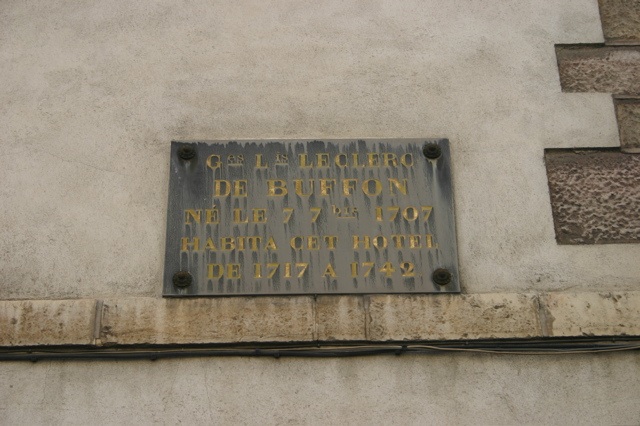
Buffon’s plaqueAfter being inspired by George Reese’s work with Buffon’s needle, then seeing the movie, Le Pacte des loups (Brotherhood of the Wolf), then Buffon’s statue in the Jardin des Plantes, I’ve kept an eye out for Georges-Louis Leclerc, Comte de Buffon. He did amazing work in natural history, mathematics, biology, cosmology, translation, and essays. He also examned alleged specimens for the beast of Gévaudan, which provided the basis for the movie.

On Sunday we saw his house in Dijon (where he lived from 1717 to 1742), on naturally, rue Buffon.

From his Wikipedia entry you can follow links to Buffon’s needle.

Scientific manipulation

As I’m sure you know, on February 18, 2004, a group of 60 prominent scientists issued a statement, “Restoring Scientific Integrity in Policymaking”, which expressed concern over the Bush administration’s misuse or suppression of science in areas such as environment, health, and nuclear weapons. Signers included 20 Nobel laureates and scientists from a broad spectrum of political views. When the statement was released, Russell Train, a lifelong Republican, who served as administrator of the Environmental Protection Agency under Nixon and Ford said “this administration has obstructed that freedom and distorted that objectivity in ways that were unheard of in any previous administration.” The Union of Concerned Scientists issued a companion 37-page report detailing practices such as censorship of scientific documents, rewriting to distort the evidence, packing scientific panels, and dismissing panelists who arrived at the wrong conclusions. Since then, there have been numerous incidents showing that these practices are continuing.

This issue seems absolutely central to the GSLIS mission to promote access for all to reliable information. At the level of National policy, open access to the best information we can obtain is essential in every area and the wanton distortion of evidence undermines effective governance. I’ve signed the statement for those reasons, but also because I believe that manipulation of information in this way is a crucial element in the erosion of democracy.

A closely-related issue is the large-scale removal of scientific and information from the public domain.. There is a National Academies of Science report on this “The Role of Scientific and Technical Data and Information in the Public Domain: Proceedings of Symposium”. (I have a paper copy as well). That report, by the way, took an entire year to come out (compared to the usual 4-5 months); the extra time was most likely for security review. That’s consistent with an environment in which the CIA can mark as “classified” its report on the National Research Council meeting on scientific openness (held in Washington, DC on January 23-24, 2003).

If you’d like to sign the statement, “Restoring Scientific Integrity in Policymaking,” or to read more about the issue, just start with the update message below or follow the links at http://www.ucsusa.org/global_environment/rsi/. You can also see the Bush administration’s April 2 response.

Mars comes the closest it’s been in a long time

On August 27 the earth and Mars will pass just 34.6 million miles apart. Mars will appear 58 times brighter than it did on January 1. As Francis Reddy points out, the last time this happened, Neanderthals flourished and humans had not yet made it to Australia.

If you paste “34,649,589” into Google, you’ll get to a bunch of sites on this, including Celestial Delights Online, which has a beautiful poster you can download and an animation showing how the image of Mars will change.

JAAL Technology Department

During 1997-2002, I edited the Technology Department in the International Reading Association’s Journal of Adolescent and Adult Literacy (JAAL). The columns were intended to promote dialogue about new communication and information technologies and to explore what these media mean for literacy and literacy educators. Each had several distinct sections, including an “email” message from me, an “issue of the month,” often written by a guest author, descriptions of selected websites, and a glossary. In addition to the print version, each column appeared in the Electronic Classroom section of Reading Online.

The columns have now been collected into a book, Literacy in the Information Age: Inquiries into Meaning Making with New Technologies (2003, Newark, DE: International Reading Association).

Beijing and Brisbane, 1996-97

family Xiao Guor
Liqian Stephen in 6th grade in Bardon, Brisbane
Sabbatical with major stays in Beijing, China and Brisbane, Australia and stops in Oklahoma, New Mexico, Arizona, Nevada, Texas, California, Indonesia, Malaysia, Singapore, Italy, and Wales along the way, 1996-1997.

See

While in Queensland, Emily and Stephen attended Rainworth State School in Bardon, Brisbane.

Dialogues in Methods of Education (DIME)

moonSoon after arriving in Illinois in 1990, I joined the Dialogues in Methods of Education (DIME) group.

DIME members have studied together how to improve their own teaching practices through research, the sharing of ideas, and mutual support. They have also engaged in critical analysis of the disciplinary and institutional forces shaping their work.

The history of DIME shows the importance of accommodating difference in providing support for sustained community.

Reasoning Under Uncertainty

Student-created box plot

Student-created box plot

Reasoning Under Uncertainty was a project funded by the National Science Foundation under its EHR/Applications of Advanced Technology program during 1985-91. The project led to a variety a publications and presentations (e.g., Rosebery & Rubin, 2007; Rubin & Bruce, 1991). Andee Rubin and I were the PIs, but the project eventually involved many other colleagues at Bolt Beranek and Newman, MIT, and local schools in the Cambridge, Massachusetts area. Continue reading