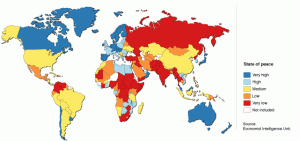
US advances to 83rd on the Global Peace Index

This year, the US advanced from 97th to 83rd on the Global Peace Index ( GPI). On this day of peace, it’s not just parochial competition that makes me wish that it ranked much higher. When the nation with the most powerful military and the largest weapons industry ranks low, the whole world suffers.

The GPI is a project of the Institute for Economics and Peace, which identifies some of the drivers of peace and then ranks the nations of the world by their peacefulness (or ‘absence of violence’).

144 countries are ranked on 24 measures within, as well as between, nations. These measures include levels of democracy and transparency, education and material well being, military expenditure, relations with neighboring countries, and respect for human rights. The data used come from the International Institute of Strategic Studies, the World Bank, various UN offices and Peace Institutes, and the Economist Intelligence Unit.

On the map, red indicates violence and blue the absence of violence. Yellow is in between.

References

Engelhardt, Tom (2009, December 22). In nightmares begin responsibilities: Why war will take no holiday in 2010. TomDispatch.com. “Excuse the gloom in the holiday season, but I feel like we’re all locked inside a malign version of the movie Groundhog Day…”

Moving the world: A celebration of writing and community

Parc de la Tête d'Or, Lyon, Sergio Canobbio

Last Wednesday, I was fortunate to attend a significant literary event, called Moving the World: A Celebration of Writing and Community.

Over a three-hour period, I heard essays, letters, poems, and collaborative writing, but also saw drawings and paintings. I got to meet with the artists and to ask them questions about their work. The intellectual and artistic quality as well as the variety of the works were outstanding. The program was beautifully organized by Patrick Berry and Cory Holding.

An event such as this one is not uncommon; what made this one special was that it was held in the chapel of the Danville Correctional Center, and the artists were all inmates. They showed off the work they’ve done through courses offered by the Education Justice Project (EJP), led by Rebecca Ginsburg. EJP is a response to the abundant evidence showing that

College-in-prison programs reduce arrest, conviction, and reincarceration rates among released prisoners. Evidence has also linked the presence of college-in-prison programs to fewer disciplinary incidents within prison, finding that such programs produce safer environments for prisoners and staff alike. College-prison programs also have benefits for inmates’ families and, hence, their communities.

Captured Potential, Larry Brent

The EJP is an outstanding effort to help young men who want to become better family and community members. If you had experienced Moving the World, you’d at least have seen inmate-students focusing their energies on reading and writing, on reflecting about their lives, families, and communities, and perhaps most significantly, engaged in how they can make positive contributions to the world both inside and outside the prison.

As I said, the quality of the writing and the oral performances was superb. I was impressed with nearly all of the works. One, entitled “Progressive tears: A prisoner’s retrospective cry for Dewey’s help,” asked the philosopher John Dewey whether his progressive vision was still relevant today. Do we as a people still believe in equality and justice? Do we still see education as a means for building a better society? One may wonder, since the use of Pell Grants for prisoners was eliminated in 1994, and most prison college programs have closed.

Another essay asserts “We all want the same things.” It shows that both prisoners and ordinary people on the outside want prisoners to turn from crime to productive citizenship. Other works included letters to family members, poems, reflections on life. The painting, “Captured potential,” and its accompanying text, express well both the tragedy of prison and the possibilities. I doubt whether anyone made it through the event with dry eyes.

You can see some of the writing itself in the National Gallery of Writing.

An event like Moving the World makes the drudgery and nonsense of many other parts of life much more bearable. I not only enjoyed it in the sense of savoring, rather than counting, the moments, I was also impressed by the obvious thoughtfulness, organization, and high standards that went into it. I now understand why one instructor said that her participation has raised the standards back at the university.

References

Howard Zinn’s “Three Holy Wars”

Howard Zinn spoke at the Progressive magazine’s 100 Anniversary Conference. He makes a persuasive case for questioning even the good wars, such as the “three holy wars” of US history.

It’s worth thinking about Zinn’s argument in light of Obama’s Nobel Prize lecture, in which he says “Still, we are at war, and I am responsible for the deployment of thousands of young Americans to battle in a distant land. Some will kill. Some will be killed.” Is the war in Afghanistan a more holy war than the ones that Zinn questions?

Overconsumption is the problem, not population

When we watch farmlands or forests being paved over for new housing, or see images of starving children, it’s hard not to think that there may be just too many people, that we have “exponential” population growth. This leads soon to the idea that we need to “do something” about population.

That view has a long history, including Paul Ehrlich’s The Population Bomb (1968) and Thomas Robert Malthus’s An Essay on the Principle of Population. There may well be negative effects and ultimate limits, but most of the blame assigned to population today would be better assigned to overconsumption.

How we understand the causes of present problems such as climate change, depletion of natural resources, hunger, and war is important, because different causes call for different remedies. An article by Fred Pearce in New Scientist, via Population: Overconsumption is the real problem – opinion – 27 September 2009, summarizes well the major issues here.

The population “bomb” is fast being defused. Women across the poor world are having dramatically fewer babies than their mothers did – mostly out of choice, not compulsion. Half a century ago, the worldwide average for the number of children a woman had was between five and six. Now she has 2.6. In the face of such a fall it is hard to see what more “doing something” about global population might achieve.

Half the world now has a fertility rate below the replacement level, which, allowing for girls who don’t make it to adulthood, is around 2.3. This includes most of Europe, east Asia, North America and the Caribbean. There are holdouts in a few Muslim countries – but not Iran, where fertility is 1.7 – and many parts of Africa

Thus, even if we have too many people, the rate of growth is decreasing, and all the indicators point to further reductions accompanying development. So, if the problem is not exponential population growth, what is it? Pearce goes on to point out that

the world’s richest half billion people – that’s about 7 per cent of the global population – are responsible for 50 per cent of the world’s emissions. Meanwhile, the poorest 50 per cent are responsible for just 7 per cent of emissions. One American or European is more often than not responsible for more emissions than an entire village of Africans.

Every time those of us in the rich world talk about too many babies in Africa or India, we are denying our own culpability. It is the world’s consumption patterns we need to fix, not its reproductive habits.

Pearce talks mostly about climate change, but his argument holds for other aspects of environmental stress, including the basic issue of hunger. Overconsumption in the rich countries occurs through waste, a diet heavily based on meat, and simply too much eating. A study directed by Timothy Jones at the University of Arizona Bureau of Applied Research in Anthropology, indicates that up to fifty per cent of all food ready for harvest in the US never gets eaten. That amount alone is enough to address worldwide hunger needs.

There’s no doubt that we’d do better to balance our population with the available resources, but before we criticize the mote in the eye of starving villagers in Africa, we might well consider the beam in our own.

References

Copenhagen climate summit in disarray after ‘Danish text’ leak

The Guardian reports that the leak of the “Danish text” has put the Copenhagen climate change summit in “disarray” (see Copenhagen climate summit in disarray after ‘Danish text’ leak). Developing countries “reacted furiously to leaked documents that show world leaders will next week be asked to sign an agreement that hands more power to rich countries and sidelines the UN’s role in all future climate change negotiations.” The document apparently sets unequal limits on per capita carbon emissions, allowing people in rich countries to emit nearly twice as much.

Meanwhile, James Hansen, “the scientist who convinced the world to take notice of the looming danger of global warming says it would be better for the planet and for future generations” if the talks collapse.

If our children and grandchildren can’t stop us from destroying their world, who will?

Is it good to synchronize traffic signals?

The Champaign County Regional Planning Commission hopes to apply for a $1.94 million federal grant to coordinate the traffic signals at dozens of intersections in the community, covering major corridors such as Neil Street and Prospect, University, Bradley, Mattis and Florida/Kirby avenues.

Champaign-Urbana Urbanized Area Transportation Study…says the proposed “traffic signal energy efficiency and conservation strategy” could reduce the typical motorist’s annual travel times by 20 to 50 percent, cut fuel consumption by 14 percent and reduce carbon dioxide, methane and nitrogen dioxide emissions by 13.3 percent.

via The News-Gazette.com: Re-timing of traffic signals could be first stage in overhaul.

Champaign_Illinois_20080301_4107Saving energy, reducing pollution, reducing travel time, all sound good. But synchronized signals along University Avenue may have an insidious consequence.

It’s already the case that University Avenue marks and maintains racial divisions in the cities of Champaign and Urbana. Some people south of University, especially whites, view “north of University” as an area they don’t want to be in. And some blacks north of University may view south of University as an unwelcoming place. The busy traffic corridor with miserable access for pedestrians reinforces the view that these two domains are separate, and necessarily so.

As an already busy traffic corridor, University Avenue makes it difficult for alert, athletic adults to cross from one area of town to another on foot or bicycle. It’s positively unsafe for children or anyone without well-honed defensive faculties. Drivers already go too fast and are inattentive to pedestrians and cyclists. This could become worse with synchronization.

Could the street become safer with synchronization? Maybe. But I doubt that will happen if the only concerns considered are overall vehicular traffic flow.

I’m not sure in the final analysis whether the proposed changes should be done or not, but I do believe that we’d be better off if we were to understand better the symbolic and material consequences of slashing through our community.

The Soloist (2009)

The Soloist (2009) is an excellent film based on the true-life book, The Soloist by Steve Lopez. Lopez is a Los Angeles Times columnist who discovers Nathaniel Ayers, a Juilliard School dropout, who becomes schizophrenic and homeless, living on the streets of LA.

Ayers is a classically-trained cellist, who now has only a two string violin to play and instead of a concert stage, an urban tunnel or street corner. Lopez wonders how Ayers can stand to play in those conditions, but Ayers tells him that “the only thing that I hear is the music and the applause of the doves and the pigeons.” Ayers is hooked and decides to write a series of feature articles in the Times.

Robert Downey Jr. portrays  Lopez in the movie, and Jamie Foxx portrays Ayers. The two main characters give terrific performances, as do the actual homeless extras from the Lamp Community.

Ayers’s story makes us wonder about the many other homeless people in LA and elsewhere. As Lamp says,

Close to 74,000 people are homeless in Los Angeles–more than in New York, Chicago, and San Francisco combined. Los Angeles’ Skid Row, a 52-block area east of the downtown business district, has the highest concentration of homelessness in the United States. More than half of the homeless men and women in this area are chronically homeless, meaning they struggle with a mental or physical disability and have been living on the street for years.

That relatively greater challenge in LA doesn’t of course diminish the shameful job we do across the US in dealing with homelessness. The book, Ayers’s music, and the movie all reinforce Jane Addams’s view that art and cultural activities can reduce our isolation form one another, and reinforce essential human: “Social Life and art have always seemed to go best at Hull-House.”

The DVD includes features with the real Steve Lopez and Nathaniel Ayers, and also, Beth’s Story, an animated short telling another story of homelessness:

References

Addams, Jane (1930). The second twenty years at Hull-House: September 1909 to September 1929. New York, Macmillan.

The US supplies the guns

weaponsAfter the 9/11 attacks I wrote about 12 steps to respond to 9/11, because “we have to do something!” Number 3 on that list was for the US to stop being the world’s top supplier of arms around the world, at that time selling over 1/2 of all the weapons.

The New York Times Pentagon correspondent Thom Shanker, provides a helpful update, showing that the US market share has grown to 2/3, establishing a virtual monopoly:

Despite a recession that knocked down global arms sales last year, the United States expanded its role as the world’s leading weapons supplier, increasing its share to more than two-thirds of all foreign armaments deals, according to a new Congressional study.

The United States signed weapons agreements valued at $37.8 billion in 2008, or 68.4 percent of all business in the global arms bazaar, up significantly from American sales of $25.4 billion the year before.

via Despite Slump, U.S. Role as Top Arms Supplier Grows – NYTimes.com.

When we wonder about wars around the world, why don’t we ask about our own role in supplying the weapons that people use to fight them?

Tom Engelhardt raises some more disturbing questions in his essay, Is America hooked on war?

References

Engelhardt, Tom (2009, September 17). Is America hooked on war?. Mother Jones.

What do Boston & Cambridge have to say to Champaign Unit 4?

violin_may06Ann Abbott inspired me to say more about the connections between the Boston desegregation experience in my last post and that of Champaign Unit 4.

I’d have to say that Boston is a good example of how not to do it. As I said in that post, Judge Garrity made the correct, and only legally justifiable decision, but rulings alone cannot accomplish much if there is widespread resistance, especially from political and religious leaders, school officials, and media. The racism thwarted integration of the schools, and in the process did major damage to the school system and to Boston as a civilized city.

In contrast, just across the Charles River, Cambridge managed relatively successful desegregation during the same period. Cambridge adopted a “freedom of choice” or “controlled open enrollment” desegregation plan in 1981. Parents would specify a list of  the schools they wanted their children to attend. Their preferences were followed as long as explicit desegregation controls could be maintained. There were no guarantees of attending any particular school.

Graham_parksBecause the program was coupled with interesting magnet programs at every school, there were many viable options for families. As parents we almost welcomed the fact that we didn’t have to make the final choice between the Maynard School’s dual language (two-way Spanish-English bilingual) program, Tobin’s School of the Future, with innovative uses new technologies, the Graham & Parks Alternative Public School, with its open education plan (see mural above), or the closer by Peabody, Fitzgerald, or Lincoln schools, each with things to recommend it. It helped that Cambridge did not have the urban sprawl of midwestern cities, which meant that unlike Champaign, Cambridge offered several schools within walking distance.

Although not without its problems, this plan was effective in substantially desegregating Cambridge schools, and maintained public support and involvement with the public schools. It’s not surprising then that Robert Peterkin, Superintendent, was called in as a consultant on the similar plan in Champaign. The story in Champaign is still unfolding (as it is in Cambridge and Boston as well). But if I had to draw lessons today from these three experiences, I’d say that it’s essential for Champaign residents today to avoid the disastrous path of resistance that Boston experienced

champaignThe Champaign school district has been struggling to address concerns such as too many black students in special education and discipline referrals; too few in gifted and honors classes; and black students being bused out of their neighborhoods. Responses such as denying the problems or siting new schools outside of black communities (though still technically north side) remind me of Boston’s response. Everyone would benefit if the school system and residents were to embrace not only the technical details of the Cambridge (or similar) plan, but also the spirit that saw how desegregation could enrich the learning for all.

References

Don’t blame Judge Garrity for the failure of school busing in Boston

W. Arthur Garrity Jr., the federal judge whose order to desegregate Boston’s public schools triggered mob violence and an image of bigotry in the city that prided itself on being the cradle of American liberty, died Thursday of cancer.

Garrity’s death at 79 came two months after the Boston school board voted to end busing for integration, 25 years after Garrity’s order launched a tumultuous period in the city’s history.

via W. A. Garrity; Judge Desegregated Boston Schools – Los Angeles Times.

garrity1I moved to the Boston area on the first of June, 1974. On June 21, Judge Garrity filed a 152-page opinion, in which he ruled that the School Committee of the city of Boston had “knowingly carried out a systematic program of segregation affecting all of the city’s students, teachers and school facilities.” The ruling was unanimously affirmed by the U.S. Court of Appeals. It ordered the School Committee to desegregate Boston schools by instituting student assignment, teacher employment, and facility improvement procedures, as well as the use of busing on a citywide basis. When the Committee failed to present an adequate plan the court assumed an active role in in the desegregation, a role that continued for fifteen years, my entire time of living in the Boston area.

The Community Action Committee of Paperback Booksmith, a bookstore in the area, published the decision in 1974 as The Boston School Decision. Publishing a lengthy court opinion may seem like a foolish business decision, but it was in fact a courageous and consequential act to inform the public debate. I still have my well-read copy.

Following the decision, there was resistance, violence, and white flight. When regular drivers refused to drive buses for schoolchildren out of racism or fear for their own safety, brave people, such as my friend Henry Kingsbury, volunteered to take their place. Given all that and the fact that 30 years later, the Boston schools had become even more segregated than before, one might consider Judge Garrity’s decision to be a failure. A persistent myth arose that this was an example of social engineering gone awry. For example, Bruce G. Kauffmann, in “Judge took Beantown for bumpy ride in 1974” describes it as “a liberal judge’s infatuation with experimental social engineering programs.”

school-busBut Garrity was both courageous and correct. The problem was not his, nor anyone else’s, attempt to engineer social relations. For twenty years after the Supreme Court had ruled that the legal maintenance of segregated schools violated the US Constitution, and even more, the fundamental values of the United States for simple justice, the Boston School Committee and other political leaders steadfastly resisted every attempt at incremental reforms. Ideas about placement of schools, magnet programs, voluntary busing, and so on, which might have led to gradual and peaceful integration, were subverted or outright blocked.

The decision demonstrates conclusively that the School Committee had consistently and deliberately acted to thwart Constitutional guarantees of equal rights, not only maintaining the “separate” aspect of Jim Crow, but failing also at any semblance of the “equal.” Schools designated for Black children were not just segregated, but denied resources in terms of teacher preparation, class size, curriculum, materials, physical plants, and other necessary tools for learning.

Given the entrenched racism, and the clear history of subversion of basic civil rights, Garrity had no choice. Unfortunately, the failure of leadership in Boston, both Black and White, pro-and anti-desegregation, led to undermining Garrity’s decision and the earlier Brown V. Board of Education decision.

References

Garrity, W. Arthur, Jr. (1974). The Boston School Decision: The text of Judge W. Arthur Garrity Jr.’s decision of June 21, 1974 in its entirety. Boston: The Community Action Committee of Paperback Booksmith.

Weinbaum, Elliot (2004, Fall). Looking for leadership: Battles over busing in Boston. Penn GSE Perspectives on Urban Education, 3(1).