Obama’s speech: A more perfect union

Barack Obama’s speech in Philadelphia yesterday (full text and video of the speech) was an historic moment, the most direct attention to race and racism from any major Presidential candidate. Speaking in the way he did was an intelligent, courageous, and moral act in an atmosphere of sound bites and back-biting. I don’t know whether it helps or hurts his campaign, but it should help the country.

I saw three main points in the speech, with my comments in brackets:

  1. “Race is an issue that I believe this nation cannot afford to ignore right now.” [Prejudices against those who speak different languages, profess different religions, have different values, or simply look different, are a major problem. However, the legacy of slavery, segregation, and continuing discrimination against Blacks has made that form of racism a defining feature of US history. It’s our biggest challenge, one no other country faces in the same way.]
  2. “Not this time.” [Racism in its historical forms not only continues to undermine our best impulses; it spreads and poisons other issues such as how we address immigration or how we interact with other countries. We need to move the discourse forward this time, to transcend race in a deep way, if we are ever to form “a more perfect union.”]
  3. “We cannot solve the challenges of our time unless we solve them together.” [We can’t do #2 if we don’t address #1.]

Some people express what they know about the pernicious effects of racism in ways that are divisive or factually wrong. In so doing, they fuel the very ignorance and hatred that underly racism. By not acknowledging the possibility of change, they effectively block it. That was Obama’s response to some of Rev. Jeremiah Wright’s comments.

Others ask, “why not just be color blind?”, essentially ignoring the reality of racism. In response to that, Obama said that race is an issue; we need to work to make it not so, but that requires understanding and facing it.

Obama’s speech wasn’t a scholarly critique, but he managed to show for those ready to listen why we need to understand and confront racism. Only then can we work together to build a different kind of society, and bring the focus to issues such as education, health care, and the economy.

Part II: Stepping out of a photo story

Be sure to read Part I: Stepping into a photo story, before this part.

Z’s story

In a recent classroom visit, I saw many of the benefits of digital storytelling: The students were active and deeply involved in learning; they were developing literacy and technology skills; they were building confidence in themselves as learners and as responsible young people. It was a contemporary version of a Froebel classroom. But something happened on one visit that’s made me think again about how we all inquire and learn.

As I described in Part I, the students were asked to write about their first memory. Their stories involved family, religion, play, travel, money, holidays, toys, and other elements of childhood today. As I went from student to student I saw some interesting variations, but nothing too surprising. Then, I encountered Z.

Who is Santa?

Whereas other students had written several lines already and eagerly allowed me to photograph their texts, Z had written nothing. I aksed her whether she had a memory to write about. My paraphrase loses the full force of her story, but perhaps conveys the spirit:

When I was four years old, I heard my parents talking about Santa, but I didn’t believe it. So the night before Christmas, I waited until they’d gone to sleep, then went downstairs. I unwrapped all of the presents, including those meant for my brothers and sisters and played with all of them. Then I took the presents upstairs and hid them in my wardrobe. The next morning my Ma and Dad came and said that Santa didn’t come because I’d been bad. “And where did you put all those presents?!”

Z went on, and I wish I could have recorded her performing. I told her she had a great story, even though I secretly thought that hers might not be as faithful to the truth as the ones her classmates were writing. So, I encouraged her to write it down as the others were doing: “Let me know when you have something written and if you like, I’ll photograph yours as well.”

As L and I went around the room, we talked with each student and photographed their writing. Meanwhile, Z seemed to do the same. She was up and about more than she was sitting writing. She’d be talking to a friend, looking at the photos on their laptop, or generally enjoying herself.

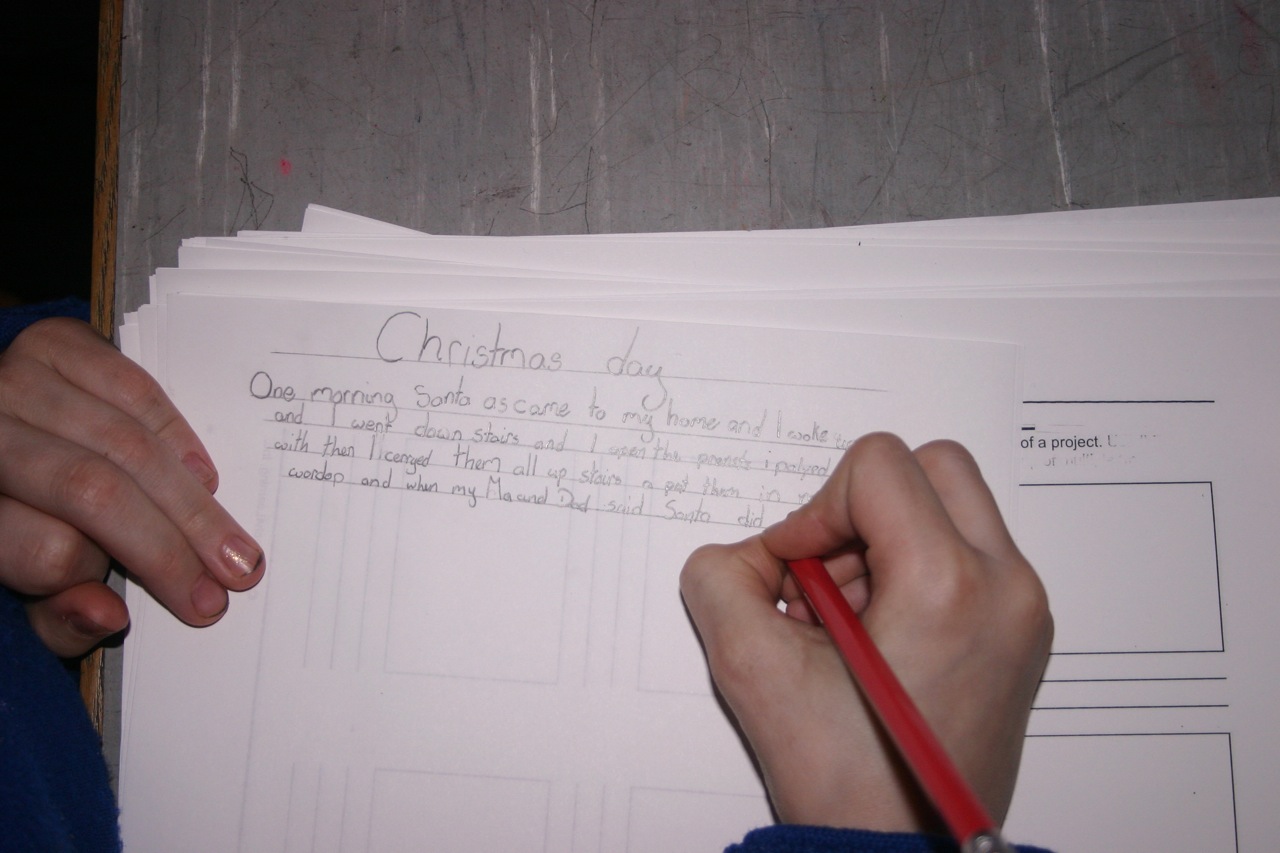
I came back to her several times to ask about her writing. She assured me that she wanted to have it photographed, and I promised that I’d do that as soon as she’d written something. But each time there was animated talk, but very little writing. By the end of the class she had written some (see photo), but it was less than that of most of her classmates and certainly didn’t do justice to the oral form.

What kind of camera is that?

One time she stopped me:

Z: What kind of camera is that?

Me: It’s a Canon. Why do you ask?

Z: My uncle has one like that. Have you seen the kind with the picture that comes out the bottom?

Me: Oh, you mean a Polaroid? Those are fun because you get the printed picture right away.

This conversation continued into different kinds of cameras, how cameras work, and why we have different buttons on the cameras. It was genuine inquiry growing out of lived experience, as Dewey might have described. But it didn’t reside in the classroom inquiry frame. The classroom story line was that students were inquiring through the photostory activity and that I was there to document what they did. They and the teacher were the performers on the classroom stage and I was the spectator, using my notepad and camera to speak to a larger audience. Our roles were clear:

students: photostory activity and materials

L and I: observing activity with notepad, camera

But Z would have none of that. She was just a sometime participant in the photostory activity and like Bertold Brecht, felt perfectly at home “breaking the fourth wall.”

What are you doing here?

Once I came back to see her and she asked:

Z: Why are you here? What are you doing here?

Even more than with the camera incident, I felt that she was challenging our assigned roles, breaking the fourth wall again. I was the spectator, the questioner. She was supposed to be the performer, the respondent. Who was she, a ten-year-old, to disrupt that established order?

But Z deliberately disrupted, albeit in a gentle way. It was genuine questioning, as Socrates or Mme. Curie might have done. No other student had questioned my presence or activity. They accepted as in the natural order of things that a stranger could be observing them and their teacher, asking questions, and taking notes or photos. Whether they didn’t think to ask or were inhibited from asking, I can’t say, but it’s interesting to note that by the age of ten, we’re nearly all so ready to accept that kind of surveillance. But not Z.

me: I’m here to look at this kind of activity and to see what children learn from doing it. Are you learning from it? What do you think you’re learning?

The standard answers to my question here are as I’ve suggested above: Becoming deeply involved in learning; developing literacy and technology skills; building confidence and learning to be responsible. Many ten-year-olds are able to articulate ideas along those lines. But Z was different.

Z: I’m learning to improve my memory.

Reading the world

Well, of course! The day’s activity was framed in terms of “your first memory.” Writing about it and looking at photographs was obviously a way to reinforce and enhance that memory. I just hadn’t thought of ten-year-olds as needing to improve their memories, even though, on reflection, I believe that being able to articulate and express memories is something we do learn how to do. Z had moved to the heart of the activity. Moreover, her compelling oral rendition was her own way to do that improvement.

The photo story activity helps fulfill Friedrich Froebel’s vision of educating the whole child by enlisting imagination, the body, and all of the senses, as well as the mind, in exploring the world. Children participating in the photo story activity did this in a way that would have pleased Froebel. But Z did it even more, by stepping out of the photo story.

Was it the fear of having more Zs enter the world that made the Prussian court in 1851 issue a ban on Froebel’s kindergarten idea?

I’m not sure what this all means. Z’s inquiry is situated, reflective, critical, and connected to experiences in her life beyond the school. It’s also rebellious. Imagine a classroom full of Z’s. Her teacher says she’s a handful. Would anything ever get done? Imagine a society of Z’s. Would so many things go unquestioned?

Ζει” in Greek means “he lives.” It’s a protest slogan referring to the democratic politician Gregoris Lambrakis, whose assassination in 1963 inspired the novel and film, Z. Whatever one might say about our Z’s writing or her ability to focus on the classroom task at hand, it’s indisputable that she lives and that her inquiry is attuned to the world in way that could be a lesson for any of us.I’m of course intrigued to see Z’s final product and wonder where she’ll go next.

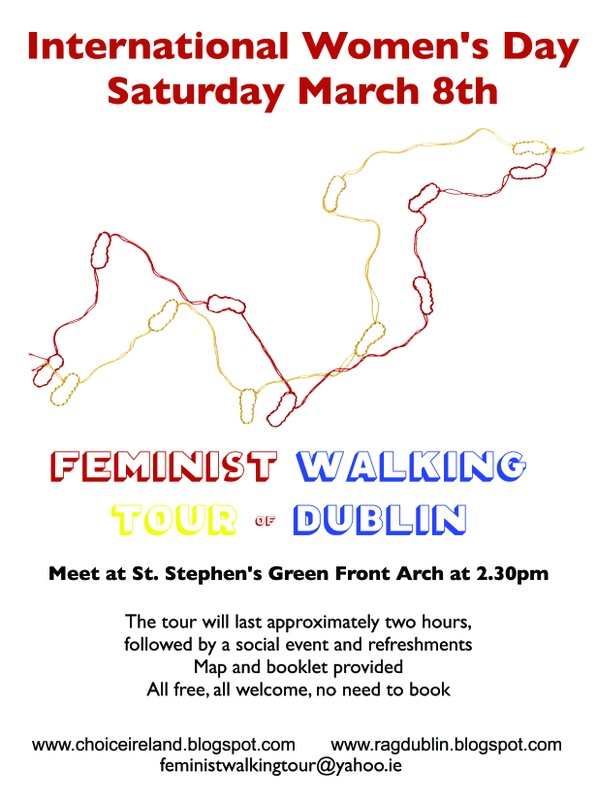
Feminist Walking Tour of Dublin

Yesterday was International Women’s Day. Among the many events worldwide was the Feminist Walking Tour of Dublin. It sounded interesting when I heard about it just the day before, but I was hesitant to go: It had been an exhausting week between my mom’s recovery from a hip fracture and my preparing a lecture on education and community for Wednesday evening. The weather forecast promised rain; there was a Six Nations rugby match (best not discussed after yesterday); and I wasn’t certain I’d be welcome on the tour, not knowing anyone else there.

Feminist Walking Tour of Dublin posterFortunately, and without any doubt in the end, I made the right decision. It turned out that there was not only an enlightening and enjoyable tour, but soup and sandwiches afterwards at the Teachers Club, short movies, a distro (books, zines, and other publications), music, and lots of good discussion.

I had the impression that the organizers expected 20-30 people to show up. But there were at least 120, maybe up to 150, not counting various people who joined in for brief times along the way. What was planned as one group turned into two with an impressing display of organization on the part of Choice Ireland and the RAG collective. One organizer pointed out that their non-hierarchical structure made it easier to respond to unexpected events.

My group was led by Carol Hunt, a history postgraduate student at Trinity and writer for the Irish Independent. She was an excellent guide, leading us from St Stephen’s Green, to the Mansion House, Trinity College, O’Connell St, the Garden of Remembrance, and other spots, each being important sites for women’s history in Ireland. At various stops, others presented on issues such as immigrant rights or women’s centers masquerading as offering full reproductive counseling while in fact proselytizing. I learned far too much to try to convey here, but you can see the tour map and background information in a beautiful and very well-designed booklet, which should still be available in hard copy or pdf.

The tour was bracketed by two precipitations. In the beginning, we were standing next to the seat honoring Louie Bennett and Helen Chenevix. Bennett, a novelist, pacisit, and labor organzer, helped found the Irish Women’s Suffrage Federation, played an active role in the Dublin lockout, helped found the Irish Women’s Reform League, and was active for years in the Irish Women Workers’ Union. As Carol began talking, we had a brief burst of hail. Someone called out that God was a male and He was not pleased!

Then, at our last stop, someone threw potatoes from an upper story window, injuring one of the people on the tour. It’s amazing how cowardly some people can be and how afraid they are of others simply trying to learn.

After the tour, there was a social event in the Teacher’s Club at Parnell Sq. We saw two short films, including The Future of Feminism, by Cara Holmes and Breaking the Silence, by Katie Gillum. There was good music from Heathers, some of which you can hear on their Myspace site. I’m still working to complete all of the exercises in the activity booklet for children designed by Aileen Curtin!

I include the video below only because it gives a taste of the time of Countess Constance Markievicz. I learned on the tour that of all the great women in Irish history, and of all the many statues in Dublin, she is the only woman to have one. All of the other statues of women are of fictional characters or the Virgin Mary.

Markievicz was second in command of the St Stephen’s Green Citizen Army force during the Easter Rising of 1916. Court-martialed afterwards, her potential execution was commuted to life imprisonment because of her gender. She famously replied: “I do wish your lot had the decency to shoot me.”

See more, with photos.

Re-Connecting with Community

Nick and me

On March 5, National College of Ireland hosted an event to consider the relations between third-level education and the communities around them. Emma Kytzia and Beatrice Cantalejo did a terrific job putting it all together.

Nick Rees (left) presided. I was asked to speak on “A Radical Vision for Third-Level Education Today: Re-Connecting with Community.” The lecture was followed by a panel discussion, guided by Paul Mooney, then questions from the audience, and finally, conversation over wine in the President’s office.

I drew from two examples in the Chicago area, Hull House and Paseo Boricua, to examine how educational institutions can re-connect with community. There was a little about current work with the College and the local schools in the Docklands community around widening participation in higher education.panel

The real focus of the evening was on how these experiences might inform education and community work in Dublin today. An excellent panel took up that topic:

  • Mr Ken Duggan, School Principal, Westland Row CBS
  • Prof Áine Hyland, former Professor of Education and Vice President (Academic), UCC
  • Mr Seanie Lambe, Director, Inner City Renewal Group
  • Ms Michele Ryan, Head, School of Community Studies, National College of Ireland

Further Information:presenters

    Children First

    Children FirstI attended a very interesting session yesterday at the National College of Ireland on child protection policies. This related to the about-to-appear Children First: National Guidelines for the Protection and Welfare of Children, and the fact that the College has a significant number of under-18-year-old students, as well as programs for area children.

    There were disturbing stories in the session about recent abuse cases, and also complex accounts of how Ireland is advancing its child protection policies. The latter included issues such as reconciling the constitution’s protection of family rights with the United Nations Convention on the Rights of the Child. The Convention asserts that every child has basic rights, including the rights to live, to express opinions, to be protected from abuse, and to privacy. There were practical tips offered on what to do when observing a situation in which children’s rights were violated as when they are forced to beg on the streets.

    Participating in the session reminded me that 193 nations have ratified the UN Convention, while only two have not–Somalia and the United States. The turmoil in Somalia makes it a special case, which might be excused. But the US should have been the leader, not the wayward one. It’s sad to imagine John Lennon, standing on the other side saying, “We hope someday you’ll join us” and not being able to do so.

    Catch 22 in Iraq

    Michael Schwartz has an excellent piece in Mother Jones, Catch 22 in Iraq: Why American Troops Can’t Go Home, about why the Iraq occupation is likely to last a long time. He cites a recent video-conference press briefing for reporters in which Col. Jeffrey Bannister refers to the five-year plan, not just any old plan, but the plan. This implies a generally understood long-term mission, one which is not based on changes on the ground, such as a reduction in sectarian violence.

    Moreover, he quotes and links to articles showing that the leading Democratic party contenders are fully with the program, seeing “vital national security interests,” i.e., oil in the region as grounds for continuing military force. The Catch 22 is that violent resistance to the occupation is defined as terrorism; thus, the military presence is needed to combat the very terrorism that it creates.

    Schwartz’s article provides further evidence that the issue in Iraq is not promoting democracy, ending sectarian violence, reducing terrorism, promoting peace and justice in the Middle East, or any of a number of other worthwhile goals. It is to secure and maintain ample, low-cost supplies of oil to fuel the global economy, and especially for the Western nations, which use such a disproportionate share of the world’s resources.

    All of this makes me think that my 12 steps to respond to 9/11, because “we have to do something!” is still relevant.

    We Make the Road by Walking

    I’ve been reading We Make the Road by Walking: Conversations on Education and Social Change, by Myles Horton & Paulo Freire (Temple University Press, 1990). I was reminded of it by Patrick Berry. If you haven’t read it, I recommend it highly. Meeting at a conference in 1987, Freire had invited Horton to join with him in “speaking a book.” The result is essentially a transcript of their lively and provocative conversations.

    One section especially caught my interest. It’s called “Is it possible just to teach biology?” As Freire asks, “Is it possible to discuss, to study the phenomenon of life without discussing exploitation, domination, freedom, democracy, and so on?” As I expected, neither one answers “yes”; they reject the idea of neutrality in teaching anything. Many people might read that as advocating the imposition of one’s own ideas on others. But both Horton and Freire talk about sharing their ideas in a way that shows how they actually create more space for students to disagree, or to find their own path to greater understanding. They create a space in which everyone comes to a richer understanding of the subject at hand.

    Tour of Paseo Boricua during AERA

    speaker

    John Dewey Society Sponsored Off-Site Program

    Date: Wednesday, April 11

    Time: 4:30 p.m. – 9:30 pm

    Location: Puerto Rican Cultural Center, 2739-41 W. Division Street

    Cost: $30 (includes bus transportation, program, and dinner)

    Transportation: A bus will collect participants from the front of the Fairmont Chicago hotel at 4:30 p.m. and return there at 9:30 p.m.

    Paseo Boricua, with its motto of ‘live and help others to live’ is renowned for its multigenerational and holistic community activism around human rights and social change and, in particular its model of learning in which ‘the community is the curriculum.’ With its many academic partnerships, Paseo Boricua also provides an outstanding example of university-community collaboration in research, teaching and public engagement.

    The one-hour tour will visit the Puerto Rican Cultural Center and key organizations in the neighborhood, including the community library and media center, the Family Learning Center, Café Teatro Batey Urbano, and the Dr. Pedro Albizu Campos Puerto Rican High School. The tour is followed by dinner and a program presented by the National Boricua Human Rights Network: “Political Repression and Human Rights in the Puerto Rican Context.” Special speakers at the program include Dr. Luis Nieves Falcon, noted sociologist and educator who has played a leading role in the campaign to free Paseo Boricua’s political prisoners.

    Organizers: Bertram (Chip) Bruce, University of Illinois at Urbana-Champaign, chip@uiuc.edu; Laura Ruth Johnson, Northern Illinois University (lrjohnson@niu.edu); Alejandro Luis Molina, National Boricua Human Rights Network and Dr. Pedro Albizu Campos Puerto Rican High School (alejandro@prcc-chgo.org); and José E. López, Executive Director, Puerto Rican Cultural Center.

    Please RSVP to Chip Bruce: chip@uiuc.edu; 217.244.3576

    Muzzling science

    I know the world of universities and research is pretty small in the greater scheme of things, and therefore not discussed much on the TV news or in newspapers. As a result, it may not be obvious how much Federal policies since 9/11 have impacted research and higher education.

    For example, consider this comment from a discussion list regarding a venue for the Association of Internet Researchers (AoIR) conference:

    Canada as a north American venue has a lot of appeal for many of our members for various reasons, one of the more important ones being visa issues (most say it’s easier to get visas for Canada than the US, and also some are uncomfortable with the fingerprinting procedure in the US and don’t want to do that).

    The AoIR will probably not meet in the US next time. This is happening for other conferences, especially in the newer fields, such as Internet Research.

    Put that together with new restrictions on access to scientific and technical information, new barriers for students and researchers from other countries coming to the US, cutbacks in support for research at both the National Institutes of Health and the National Science Foundation, gag orders on scientists (as we saw last month at NASA), distortions of scientific findings (as in the global warming case), and politicizing of scientific review committees. The result is a negative climate for research and higher education. The impact is already evident to researchers and those in higher education, and the impact on the larger economy is beginning.

    For the European Union, this is a terrific opportunity to surpass the US. They’ve already initiated a major new research program openly promoted as a way to take advantage of the US policies and to lure the most promising young researchers away from the US. It’s also opened doors for India, China, and other countries.

    There are of course national security arguments made for each of these new policies. But there is even stronger evidence that they actually weaken national security. For example, the clampdown on access to scientific and technical information is making it harder to develop responses to biological warfare. It’s also very hard to understand how losing our leadership position in science and technology will make us stronger.

    What’s perhaps most worrisome is that muzzling people and information in this way means that it is increasingly more difficult to have open debate about the worth of the policies. As with the Patriot Act or the Detainee Treatment Act, the new laws come with criticism-proof provisions.

    Someday, we should ask whether the effort to protect what we value is actually destroying it.

    Internationalists Anonymous

    It’s true. I’ve been in denial for too long. I kept deluding myself by saying that I was just “looking at the evidence” or “thinking.” Now I know that it is time to face reality and admit that I have become an internationalst.

    I’d like to blame my year abroad, but that’s just shirking the repsonsibility. In fact, it wasn’t just talking to non-Americans (shall I say “un-Americans”?) that caused the problem. It was also the reading, the examination of data, and, dare I say it, looking at history.

    The warning signs were there. I began to ask why the US, the richest nation on earth, lagged far behind others in helping to alleviate world poverty. Figures like .7% (the world goal for development aid) and .015% (the US record) began to gnaw at me. I read about the Arctic ice cap melting faster than anyone had predicted, and then wondered why the US failed to agree to the Kyot o treaty. And of course, the wars in Afghanistan and Iraq, the illegal detentions, the torture, the lies, and the inability to do anything about the root causes of terrorism all made me lose faith in the absolute rightness of the US versus the rest of the world.

    Back in the US now, I see signs of hope. The local newspaper and television news show me the path back to health, when “world news” means “events that involve Americans, especially music or movie stars.” A good dose of shopping malls and lots of time spent driving should help, too, but I realize now that I have to seek real change within myself.

    I want to find a chapter of Internationalists Anonymous. I want to tell my sad story and then work with a support group to return to the fold. What future can there be for me with all these impure thoughts, this questioning of the self-evident rightness of everything the US does? Perhaps, with some concerted effort and ample time, I can rid myself of this dreaded internationalism.