Africa Day, Dublin

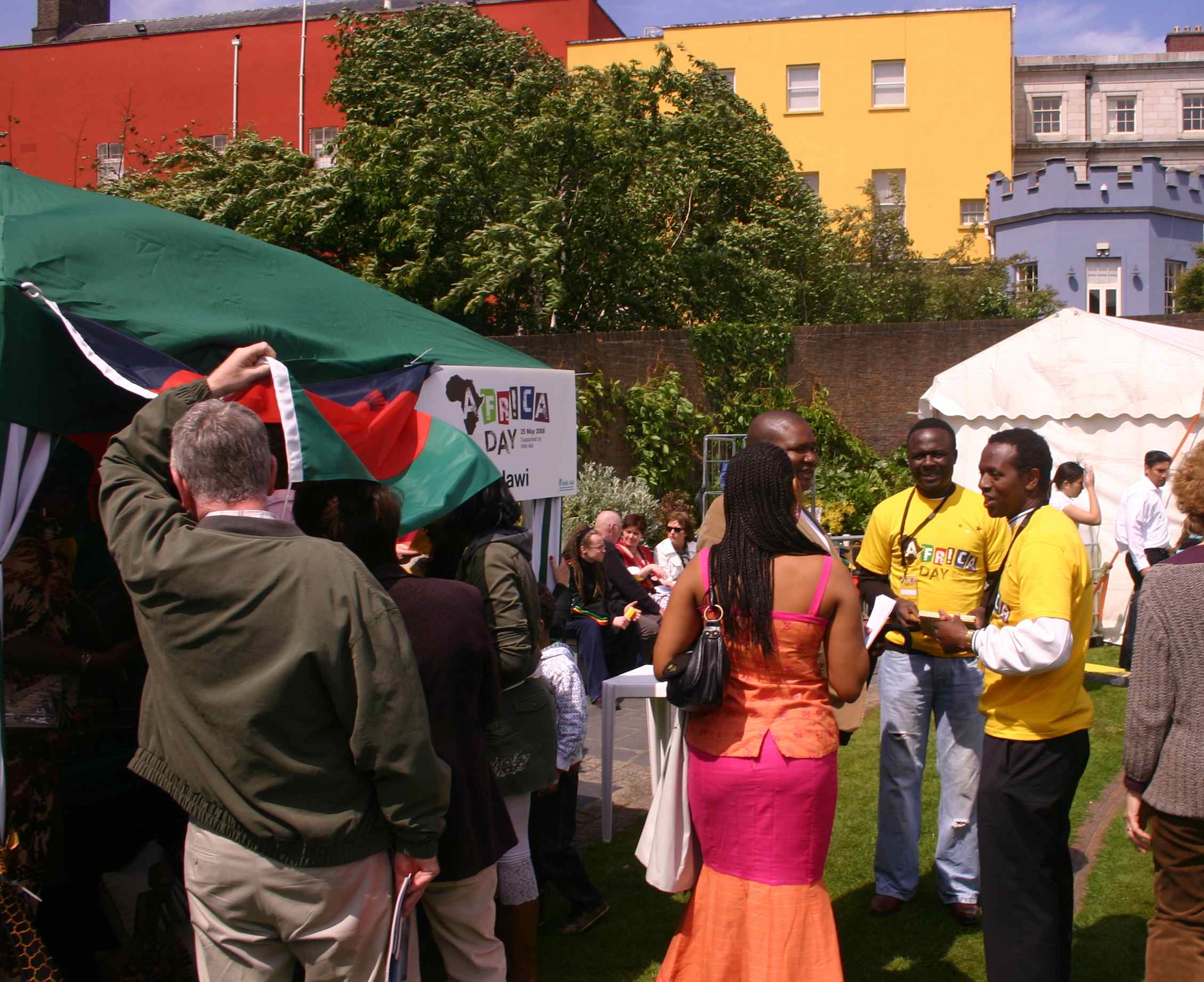
May 25 was Africa Day, the commemoration of the founding in 1963 of the Organisation of African Unity, which later became the African Union. In honor of that, the Irish Aid organized a wonderful set of Africa Day events, held at the Irish Film Institute, the National Botanical Gardens, and other venues. We went to those at Dublin Castle and the Chester Beatty Library.

There were musical performances and dance, lectures, storytelling sessions, photography exhibits, arts and crafts, and food from many regions and cultures of Africa.

A notice prior to the event advised bringing suncreen and umbrellas for the rain, which was a good indication of the variability in the weather this time of year in Dublin. But the weather turned out to be friendly and helped make it a worthwhile day all around. By mid-afternoon there was a line to get in to the Dublin Castle grounds. I hope this becomes an annual event.

Dáil na nÓg Fairsay campaign

The Youth, Media and Democracy conference concluded yesterday at Dublin Institute of Technology. There was an excellent program, with presentations from youth groups using a variety of media–film (documentaries, personal stories, what-ifs), comics, hip hop, remix (VJ-ing, web video mashups), object animation, radio, and more. There were also interesting talks about the Fresh Film Festival, media policy, the 5th World Summit on Media for Children held in Johannesburg, the Story of Movies, Digital Hub FM, and much more.

I was also impressed with the Dáil na nÓg campaign to encourage mainstream media to provide more balanced coverage of youth, especially to show the diversity of youth activities and not just negative images. A small group of Dáil na nÓg representatives has conducted this campaign, called Fairsay. They’ve had multiple meetings with media and policy makers, assisted by Anne O’Donnell from the Office of the Minister for Children.

Dáil na nÓg means “youth parliament”. Young people come as representatives of their local area to tell decision makers in Government what they think of issues that affect their daily lives.

The young Dáil na nÓg representatives gave excellent presentations and participated fully in panel discussions, demonstrating by their presence how young people can learn social responsibility, communication skills, and connected understanding through active civic participation.

So, it’s ironic that the Fairsay work is only partly sanctioned by the schools. For example, when they were waiting for a media callback they had to have their mobile phones on vibrate during class. When a call came it had to be taken down the hall in the study room. The classroom might be a place to teach about government or media, but not to actively engage with it.

Any teacher knows the many distractions available today for young people, mobile phones being near the top of the list. Still, it’s unfortunate that we can’t find better ways (this applies to US schools even more) to make actually participating in democracy take precedence over just talking about it. The young people at the conference showed how they could use media in diverse ways to move beyond the spectator role to become active participants.

Yale Russian Chorus

Last Saturday, Stephen appeared on WTNH TV (New Haven, Connecticut) representing the Yale Russian Chorus. You can see the story and video online . This was to promote a benefit concert called “Songs of Hope”, on January 29, for the Connecticut Bridge of Hope Summer Program for Russian Orphans.

The program brings older Russian Orphans to Connecticut in the summer in hopes of finding their “forever families”. The children spend about one month with a host family learning about family life, attending local day camps, and participating in a typical American summer experience.

Paris, 2004-05

Susan in ParisRue greneta aptWe spent a sabbatical year in Paris in 2004-05. This included a Fulbright Senior Specialist trip to Tampere, Finland, two trips to Germany, the Kaleidoscope conference on Computer-Supported Cooperative Learning in Lausanne, and the ProLearn workshop on learning objects in Leuven.

While in Paris, I worked on the Libr@ries: Changing Information Space and Practice book with Cushla Kapitzke, who came from Brisbane, Australia to finish the editing. Libr@ries bookCushla Continue reading

How Bruce Piano Co. nearly lost, then saved Elvis’s career

In the dark recesses of the Bruce Piano Company archives lies a story about a daring rescue of the equally renowned career of Elvis Presley. We can thank this event for the perpetuation of the late Elvis as the King, and led to many Elvis impersonators for years afterwards.

Bertram Camp Bruce

Bertram Camp Bruce (Sr.)

Background

To understand this story you’ll need some background. My father, who founded the piano store, loved music––classical, jazz, big band, solo pop of the Ella Fitzgerald or Bing Crosby varieties––but most assuredly not rock music, country, or Elvis in particular. I imagine much grave-spinning around the thought that his company was to play such a crucial role for Elvis. 

My Dad, however, did not live to see this disturbing event. He died in late 1969. His brother Don, whom he had invited into the business shortly before, took over. But then he died just two years later. Both men were in their early 50’s. My mother remained as the owner of what was by then a struggling business. The growth of electronic entertainments, such as TV and hi-fi, the advent of big box stores, smaller families, and other large societal changes meant that the image of a piano in every middle-class home was fading away.

Although my mother would have been a very good business person (as this story will demonstrate), her upbringing in Georgia nearly a century ago told her that this was not a role for a lady. The same logic would extend to her daughters, who were also busy with family and work. Her son was far away, doing something or another.

A sale of the business seemed to be the obvious path. But there was no willing buyer. Rather than having a distress sale, which would have yielded little, we worked out a deal whereby the manager, Harvey, would buy the store over time, using the revenues the business would generate. Harvey couldn’t have been guaranteed a very good salary. This way he could establish his own pay based on the success he could generate, and in the end, he’d own a business. My mother would be able to draw something from the business that had been the center of the family for many years. The arrangement wasn’t ideal, but was probably the best solution all around. 

Ultimately the broader changes in society did the business in. But for a while, Harvey did his best and Bruce Piano Co. was a going concern. Harvey tried to follow my father’s model, offering a range of instruments, working with piano teachers, assisting the local concert scene, and participating in music conventions. A conflict between the last two of these was what put Elvis’s career in jeopardy. (My children say that I’m prone to exaggerate, but you may rest assured that that is the greatest falsity ever uttered.)
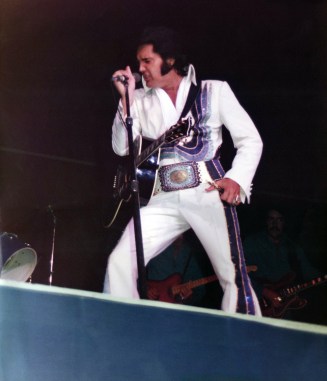
June 15, 1974, Fort Worth, ©James W. Stout

June 15, 1974, Fort Worth, ©James W. Stout

Elvis’s concerts in Fort Worth

The problem was that Harvey had agreed that the store would supply a piano for Elvis’s concerts in Fort Worth. There were to be four productions at the Tarrant County Convention Center. Although Elvis was near the end of his career, and life, and his audience had aged along with him, there was still excitement and adoration for the idol. Fans didn’t mind the $10 ticket price for an hour-long concert, and would love even the shortened versions of his big hits, including “Love Me Tender,” “Fever,” “Why Me Lord,” “Houn’ Dog,” and “Suspicious Minds.”

But then Harvey left for the music convention, without arranging to fulfill the promise to deliver a piano. Elvis’s manager was understandably upset when he discovered that there was no piano on hand. He called the store, only to learn that Harvey was away and unreachable in those pre-cell days. He called Don’s wife Nancy, who didn’t know how to help. He finally called Bert’s wife and my mother, Catherine, the one who claimed that she didn’t know anything about business. 

Obtaining the piano

Catherine began to problem solve. She contacted the piano movers, but they had gone fishing. She pointed out that she had a key to the store, as the still current, if somewhat removed, owner. If Elvis’s team could come up with movers, she could get them in to the piano. 

They met at the store. Elvis sent three bodyguards, who, while not expert in piano moving, were at least strong and committed. But they didn’t know which piano had been ordred. Catherine decided that they wouldn’t go wrong with a concert grand, the biggest model. She found the wooden boxing that was needed to transport a grand piano safely. The team boxed the piano and carried it to the concert venue. After the four weekend concerts the piano was returned safely and Bruce Piano Co, could chalk up another successful service.

Conclusion

Could Elvis have found another piano, or performed without one? Could his career have survived a busted Fort Worth concert? Was the near disaster a sign of the end of both the piano store and Elvis? You’ll have to be the judge of that.

I can say that my mother proved that she could solve a business problem in a difficult and time-pressured circumstance. And I think that my father would have been proud that his company fulfilled its commitment, as long as he didn’t have to go to hear Elvis himself.

Bruce Piano Company

Bert Sr. in the piano storeBertram Bruce, my father, opened Bruce Piano Company around 1950 in Fort Worth. The store later became the authorized Steinway dealer for Fort Worth and provided pianos for performers visiting the Fort Worth Symphony and Opera. We occasionally got to meet those performers in our home.

I worked in the West Lancaster store in the summer when I was 15. I remember learning how to buff hammers, replace bridle straps and damper felts, install new hammer shanks, glue on new plastic key surfaces, and generally, restore most other parts of the piano action. I also helped with refinishing, including converting old uprights into mirror spinets. This was mostly on old uprights, some of which were in sad shape after years of abuse in a bar or humid basement. Many of the operations were challenging at first, but even I could learn them after 88 times.

In the beginning, the store focused on pianos, but later began selling televisions. That led to several robberies in which mostly the new TVs were stolen. This proved to be a great hardship on the small business.

Bertram BruceThe original location was on Fifth and Calhoun St., in the Binyon O’Keefe Moving Company warehouse. Later the store moved to 8th Avenue near Massey’s, then to the Westchester House where it doubled the space. After that it moved to West Lancaster near Farrington Field. My mother made curtains for the first store and played a crucial role in many other ways to help the young store thrive.

Later, Bruce Piano Co. opened a second store on Pipeline Road in Hurst, with Ken Nance as manager. Harvey MacDougall became the manager of the main store. The final location was on Inwood, off of Camp Bowie Boulevard. Bert then invited his brother Don to merge his business.

I remember Don as being an excellent salesman, but like many good sellers, he was an overly willing buyer, too. Rather than insisting on the cash that the store needed, he’d make trades for a boat, a pool table, and once, a donkey. My father had to rein him in from ordering a truckload of the latest amp or band instrument.

All of this happened shortly before my Dad died on December 12, 1969. Don bought the store after my Dad died and then Harvey took over after Don died. Don, who was two years younger than Bert, also died at age 54, just two years later.  Later Harvey bought Bruce Piano Co.

guitarBruce Piano Co. was a well-known part of Fort Worth for 35 years, offering everything from used and low-cost new pianos for families who wanted their children to learn music to Steinways for visiting performers. There were also practice rooms used by local piano teachers.

Over the years it also sold sheet music, organs, guitars, band instruments, speakers and amps, televisions, and even once conducted an ill-advised experiment in bagpipes. But changing habits among the public, with the rise of television and music recording devices, meant that piano sales were less and less a central part of middle-class family life. When the Savings and Loan crisis hit in the 1980’s the bank cut off credit for floor planning and the company could no longer survive.

This is a sad story, but I’m proud of what my father accomplished (with ample help from my mother, Don, and others). I’ve also become more aware of what the store did for the community over many years. There’s a piano in our home with a decal showing that it was once on the floor of Bruce Piano Co. I try to play a little each day, and imagine the others whose lives were also enriched by what the store did.

Fort Worth Opera

My father played a role in bringing Beverly Sills to sing in the Fort Worth Opera in the late 1950’s. Two of his friends then were assistant director Bill Massad and director Rudolf Kruger. Mrs. Kruger and my mother used to visit whenever they attended the performances.