The SixthSense “is a wearable gestural interface that augments the physical world around us with digital information and lets us use natural hand gestures to interact with that information.” It could also be described as a low-cost, portable interactive whiteboard, one that integrates sensing, search, display, and interaction. It can use any surface, respond to the environment, and enable much richer interaction.
It was developed by Patti Maes and Pranav Mistry at the MIT Media Lab. For $350, it’s already less than the $10,000 whiteboards that schools and universities are buying. But the current version is a one-off, so the cost should come down considerably in mass production!
Anyone who writes a blog is curious about who’s reading it and is usually interested to read on similar topics. Both of those motivations lead to an interest in blog aggregators, sites that bring together blog posts from around the world.
Some of these are automatic, based on keywords in the posts. In most cases these turn out to be spam sites, promoting a product or service. I suspect that the large number of hits I received on a post about youth may have come from an automatic aggregator.
There are also more intentional aggregations such as blog rolls or blog carnivals. At blog carnival, for example, you can find carnivals on many topics, and submit your own posts to them. You can also create a new carnival on a topic of your choice. Some of the existing ones are elaborate, representing considerable effort, such as Carnival of Education. But even the best of the carnivals have a little of that quality of random listing that one sees in the spam aggregators.
There are now in between sites, such as Alpha Inventions or Condron. For these, new posts are harvested automatically, but you can also submit a post and categorize it. Visitors to the aggregator site see a slide show like presentation of other sites, often constrained by topic or language. This leads to an enormous boost in hits on blog posts, especially from Alpha Inventions.
Lesley Dewar has been running some experiments on this at No Tall Poppies. I plan to replicate those here, and share the results.
The big question of course, is not whether some scheme can produce more visits to a web page, but what if anything leads people to engage in what they read, to think critically, and to integrate that with their own experiences. My guess is that somewhere in all the surfing, syndication, aggregation, cross-linking, and such, that there are occasional sparks of real connection, but that there’s also a lot of smoke without fire.
Community informatics has very definitions, such as that it
…brings together people concerned with electronically enabling local (and virtual) communities; and structuring collaborations between researchers, practitioners (including industry) and policy makers to support community ICT implementation and effective use.
Definitions such as the one above appropriately name various constituencies, thus serving organizational needs. But for me they are oddly both too narrow, excluding legitimate elements and activities, and too broad, lacking a principled organization or rationale.
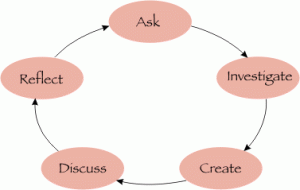
Inquiry cycle
The Inquiry Cycle
I’d like to suggest an alternative, drawing from the experience of the Community informatics Initiative (CII) at the University of Illinois, as well as helpful discussion with CII staff and students. The organizational principle that I’d like to suggest is that community informatics is a form of disciplined inquiry, with central questions, methods of investigation, actions, collaborations, and theories. I’d like to present that here using the the Inquiry Cycle as a framework and CII activities as concrete examples.
The Inquiry Cycle (Bruce, 2009) characterizes inquiry as involving five major aspects: a guiding question (Ask), methods of investigation (Investigate), active participation (Create), collaboration and dialogue (DIscuss), and reflection (Reflect). These aspects don’t necessarily proceed in a prescribed order; inquiry may involve any of the aspects in varying degrees and orders. For example, Reflect is often the beginning point of inquiry, leading to the formulation of the Ask. The idea of cycle (or better, spiral) suggests that inquiry does not complete, but generates further inquiries.
Community Informatics as a Type of Inquiry
The definition below is rather lengthy. Think of the Ask as the core question that defines community inquiry. The other elements then elaborate on that, emphasizing the variety of approaches needed to address the core question.
Ask: How can we work with communities to learn about democratic participation in the digital age, and to promote engagement with information and communication technologies for both individual and community growth?
Investigate: CII investigates the ways that people in communities create and share knowledge, how social networks operate and evolve, how access to technologies is differentially distributed, especially along lines of race and class, and the development of policy regarding information and communication technologies. These communities may be large or small, geographically-based or online. The goal of these investigations is to learn more about the dynamics of communities, their capacities and challenges, and how they make use, or not, of various tools. Basic research such as this is necessary for informed and meaningful action with communities.
Create: CII builds tools, such as Prairienet, Community Inquiry Labs, geographic information systems, media archives, and computer technology centers. It works with organizations such as Books to Prisoners, S.O.A.R. [after-school program]@ B.T. Washington Elementary, Paseo Boricua, and others to expand opportunities for learning and to support social justice. Building as well as using tools in a critical manner not only addresses immediate needs; it’s a key aspect of learning about community informatics.
Discuss: CII provides forums for interaction and collaboration, such as the Journal of Community Informatics, CI Reflections blog, and the CI Research Series. A diversity of theories and methods are not only welcomed, but seen as necessary for understanding diverse and changing social and technological realities.
Reflect: CII helps make sense of experiences of communities as they use information and communication to address their needs. It also critically analyzes its own inquiries, its tools, and its modes of interaction and collaboration. These reflections help build stronger accounts of community informatics, including extensions of critical race theory, political economy, critical literacy, as well as the development of new frameworks, such as the theory of community inquiry, and generate new questions for further inquiry.
References
Bruce, Bertram C. (2009, April). “Building an airplane in the air”: The life of the inquiry group. In Joni Falk & Brian Drayton (eds.), Creating and sustaining online professional learning communities. New York: Teachers College Press. [ISBN: 0-807749-40-0]
I heard Michael Furdyk from TakingITGlobal.org give a very interesting talk with slide show on Thursday. TakingITGlobal – Inspire. Inform. Involve. “is an online community that connects youth to find inspiration, access information, get involved, and take action in their local and global communities.”
It offers many of the features found on other social networking sites, but with a focus on social good and attention to the special needs of schools and youth leaders for protected spaces and appropriate content. Youth can share media they have produced as well as discuss projects around the world. They can participate in fully online communities or build an online community to support their face-to-face interactions. TakingITGlobal now works with 235,701 individual members and 1008 schools in 261 countries.
You can see a short CBC documentary about Michael and co-founder, Jennifer Corriero, here:
Norma Scagnoli referred me to a wonderful podcast by LeAnn Erickson, Associate Professor of Film and Media Arts at Temple University. Erickson is an independent video/filmmaker, whose work has appeared on public television, in galleries, and has won national and international awards.
Entitled, Hidden Her-story: The Top-Secret “Rosies” of World War II, it was recorded in January at the EDUCAUSE 2009 Mid-Atlantic Regional Conference in Philadelphia. I expected to listen for a minute and then go on to more pressing things, but after listening a little I decided that those things weren’t so pressing after all. It’s a fascinating story for anyone who has an interest in history, computers, women, education, mathematics, warfare, politics, Philadelphia, science, workplace equity, morality, or life in general.
In 1942, only months after the United States entered World War II, a secret military program was launched to recruit women to the war effort. But unlike recruiting “Rosie” to the factory, this search targeted female mathematicians who would become human “computers” for the U.S. Army. These women worked around-the-clock shifts creating ballistics tables that proved crucial to Allied victory. “Rosie” made the weapons, but the female computers made them accurate. When the first electronic computer (ENIAC) was invented to aid ballistic calculation efforts, six of these women were tapped to become its first programmers. “Top Secret ´Rosies’: The Female ‘Computers’ of WWII” is a documentary project currently in postproduction that will share this untold story of the women and technology that helped win a war and usher in the modern computer age.
Controls for the podcast appear beneath the description on the EDUCAUSE page.
Illini Summer Academies is a three-day event providing Illinois teens opportunities to explore the University of Illinois campus, study potential careers, develop leadership skills, and meet with youth from across the state. One of the nine academies will be on Youth Community Informatics, in which youth will learn about GPS/GIS, video editing, and other digital communication tools as means for contributing to their own communities.
The Academies are open to youth in grades 8-12. They take place from June 29-July 1 at the University of Illinois at Urbana-Champaign. Delegates live in college dormitories and tour the campus. Joint activities for all delegates offer opportunities to meet with those attending different academies and with youth from around the state. These include opening and closing sessions, activities every evening, and a formal banquet at the Alice Campbell Alumni Center.
The Illini Summer Academies are just one among many camps and activities for youth offered by the University of Illinois at Urbana-Champaign during 2009.
When in Dublin last year, Leo Casey, Abi Reynolds, and I led a little exercise on the question, “Digital literacy, what is it?” This simple activity led to surprisingly fruitful discussions, often extending more than an hour, although it never produced a consensus answer to the question.
We had found six definitions of digital literacy from leading organizations and then modified each of them a little so their source wasn’t easily identifiable. We then printed the modified definitions on A3 paper and hung them around the room. We asked participants to read them all, stand next to the one they agreed with the most, then discuss.
Every time we tried this, every definition had several strong advocates. One interesting phenomenon was that the Microsoft definition often drew the most supporters, which dismayed those who’d selected it. I don’t want to say more here, because I’d like people to experience the activity as our participants did. If you try it on your own, please cast your vote and justification through the comments (link above).
Here are the modified definitions we used:
the term multiliteracies highlights two related aspects of the increasing complexity of texts: (a) the proliferation of multimodal ways of making meaning where the written word is increasingly part and parcel of visual, audio, and spatial patterns; (b) the increasing salience of cultural and linguistic diversity characterized by local diversity and global connectedness
basic computer concepts and skills so that people can use computer technology in everyday life to develop new social and economic opportunities for themselves, their families, and their communities
development of critical, socially engaged intelligence, which enables individuals to understand and participate effectively in the affairs of their community in a collaborative effort to achieve a common good
the knowledge and ability to use computers and technology efficiently
the ability to recognize when information is needed and to locate, evaluate, and use effectively the needed information
a new liberal art that extends from knowing how to use computers and access information to critical reflection on the nature of information itself its technical infrastructure and its social, cultural, and philosophical context and impact
With coaxing, I’m willing to reveal the original definitions and sources.
we need to be developing community technology centers (CTC) differently. Right now, they are developed with the idea that people are coming to the CTC for the technology. As such, traditional desktop or tower cases and larger LCD monitors dominate. Maybe the CTC of the future instead needs to be a place with lots of tables and chairs that can easily be rearranged, and laptops for checkout.
One step in that direction is to think of a CTC as a community media lab (CML). The focus then is on the community and communication, not technology. A CML is an excellent way to promote and learn about digital media use. It also provides a venue for people from a variety of organizations and with diverse technological interests to work together.
How about complementing the CML with exploration kits? These would be available to individual youth, or to organizations such as community centers, after-school programs, boys and girls clubs, 4-H, and so on. They would allow youth to take tools into many different settings, thus promoting ubiquitous learning.
Lisa Bouillion-Diaz from Extension has suggested that the kit might take the form of a backpack, which could be easily transported. It might contain things such as:
GPS receiver
camera
video camera
audio recording equipment if higher quality is needed than on the cameras
physical maps, images, texts, …
activity guides to support community mapping, journalism, history, …
hands-on STEM learning objects, such as magnifying glass, weights, compass, magnets, …
possible: distant measuring tool (electronic or mechanical), temperature probes, motion sensor
All of this would be linked with a website, showing how to make your own kit or to modify the standard one(s) for specific purposes or groups. What else might go into such a kit?
I see kits as intermediate between the indigenous media experiences youth have through mobile phones, Facebook, video games, etc. and the formal learning that occurs (or not) in classrooms. We’re working on them for the Youth Community Informatics project, but their scope could be expanded to include learners of all ages.
David Bergman made an amazing 1,474-megapixel panoramic photo during President Obama’s inaugural address. The detail in the image is impressive; Bergman describes how he found Yo-Yo Ma taking a picture with his iPhone.
The photo is a valuable record of the historic event as well as a technological/artistic tour de force. You can explore the photo itself online and read about how he did it on his blog.
CNN has another photosynth version of this based on photos sent in by diverse individuals at the event:
The Newseum, at Pennsylvania Avenue and Sixth Street, NW, Washington, DC has a great, online map linking to front pages of newspapers around the globe. If you place the cursor on a city, you can see the front page in miniature; click, and it pops up in full, with a link to the newspaper website. You can also view the newspapers in Gallery or List mode. Currently, more than 575 newspapers from around the world submit their front pages to the Newseum.








 Chip's journey