Fences or webs?

old-new schools

In my last post I talked about the Eight-Year-Study, which documented the success of progressive education at fostering intellectual curiosity, cultural awareness, practical skills, a philosophy of life, a strong moral character, emotional balance, social fitness, sensitivity to social problems, and physical fitness.

I had come across materials related to the study in the Progressive Education Association Records in the University of Illinois Archives. This is a treasure-trove, not only of the Progressive Education Association per se, but also of the various social movements they were involved in. I hope to explore it more.

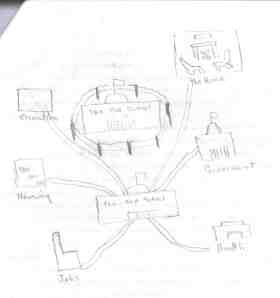
One drawing I found is shown here. It’s included in the folder for the booklet that later appeared as Dare our secondary schools face the atomic age? However, there are no images in that booklet. The drawing shows two visions for schools. In one, the “old school,” there is a fence surrounding the building; activities of the school are separate from those of the world around it, and as a result, schooling is separated from the actual life of the children.

In a second vision, the “new school,” the building is substantially the same, but it is connected to sites for recreation, housing, jobs, health, government, and by implication, all aspects of life. This idea of community-based schools was key to the Progressive Education movement, especially in its later years, as members realized they needed to do more than promote child-centered learning in an individual sense. That was true for “community schools” per se (Clapp, 1939), but actually for all schools, urban or rural, large or small, primary or secondary.

Today, many of these ideas have survived under rubrics such as “civic engagement,” “public engagement,” “community-based learning,” or “service learning.” But often those ideas are seen as one-way or very limited in scope, as in a single course. It’s worth revisiting the earlier visions to understand better how schools and universities could better fulfill the high hopes we place upon them.

References

Benedict, Agnes E. (1947). Dare our secondary schools face the atomic age?. New York: Hinds, Hayden & Eldredge.

Benedict, Agnes E. (1947). Pencil drawing, Progressive Education Association Records, 1924-1961, Record Series 10/6/20, Box 4, folder Dare the Schools Face the Atomic Age?, University of Illinois Archives.

Clapp, Elsie Ripley (1939). Community schools in action. New York: Viking.

Must we obsess about student test scores?

For too long, US education policies have defined progress in terms of student test scores, while ignoring the things that really matter. We’ve operated on the misguided belief that “learning the basics” is best accomplished by a narrow skills focus and micro-management of test scores.

This occurs despite the fact that few of us would be satisfied if our children could successfully answer multiple-choice questions, but failed to develop intellectual curiosity, cultural awareness, practical skills, a philosophy of life, a strong moral character, emotional balance, social fitness, sensitivity to social problems, or physical fitness. What a tragedy then, if the focus on skills per se (as with the failed No Child Left Behind Act) were not even necessary. What if one could help the whole child develop, including teaching basic skills? What if our current irrational obsession with testing actually stood in the way of the things we truly value?

Benedict, Schools face the atomic age?The start of a new administration in Washington is a good time to ask whether we have the schools we need. Above all, it’s not a time to seek ever-more efficient means to produce incremental gains in test scores.

We have an alternative to that in our own history. One of the best program evaluation studies ever conducted was the Eight-Year Study, research conducted between 1932 to 1940 by the Progressive Education Association (PEA). Thirty high schools participated. Instead of narrowly-defined subjects, there were broad themes of significance to the students. “The starting point of the curriculum would be life as the student saw it” (Benedict, 1947, p. 14). Moreover, the schools were community-based. “The schools believed they belonged to the citizens of the community” (ibid, p. 17).
Continue reading

David Bergman’s 1,474-megapixel photo of Obama’s inauguration

David Bergman made an amazing 1,474-megapixel panoramic photo during President Obama’s inaugural address. The detail in the image is impressive; Bergman describes how he found Yo-Yo Ma taking a picture with his iPhone.

The photo is a valuable record of the historic event as well as a technological/artistic tour de force. You can explore the photo itself online and read about how he did it on his blog.

CNN has another photosynth version of this based on photos sent in by diverse individuals at the event:

Copernicus and Erasmus

genealogy1The Mathematics Genealogy Project and its cousins, the AI [artificial intelligence] Genealogy Project, and the Philosophy Family Tree are attempts to compile information about scholars in various fields, including where they received their degrees and the titles of their dissertations. The information is organized in an academic family tree, in which one’s adviser is one’s parent.

Here’s the mission statement for the Mathematics Genealogy Project:

The intent of this project is to compile information about ALL the mathematicians of the world. We earnestly solicit information from all schools who participate in the development of research level mathematics and from all individuals who may know desired information.

Please notice: Throughout this project when we use the word “mathematics” or “mathematician” we mean that word in a very inclusive sense. Thus, all relevant data from statistics, computer science, or operations research is welcome.

I’m actually in all three of these trees. My PhD is in Computer Sciences, specifically in AI; the core of the dissertation is in mathematical logic; and my adviser, Norman Martin, was a philosopher. His work was in the area of logic, as was that of a committee member, Michael Richter, a mathematician.

One of the best Christmas presents I received was a depiction of this tree made by Emily and Stephen (above, click to enlarge). There is so much detail, that you need to see the full-scale poster to read it all, but you may be able to make out the names of my adviser, and co-adviser, Robert F. Simmons, as well as early ancestors, Copernicus and Erasmus. It’s fun to explore the connections, which ultimately show how interconnected we all are.

The hidden race war after Katrina

when_the_levees_brokeRebecca Solnit describes her discovery of the Katrina shootings in a recent Mother Jones article and audio interview. She points out that the hidden race war was never really hidden, but it was conveniently ignored, even today, despite Spike Lee’s award-winning documentary and excellent investigative reports, such as as A. C. Thompson’s in The Nation. I suspect the story would still surprise many people and challenge their image of the Katrina aftermath. It should also cause all of us to become more critical of media reports and our own reactions to those:

While the national and international media were working themselves and much of the public into a frenzy about imaginary hordes of murderers, rapists, snipers, marauders, and general rampagers among the stranded crowds of mostly poor, mostly black people in New Orleans during Hurricane Katrina, a group of white men went on a shooting spree across the river.

Their criminal acts were no secret but they never became part of the official story. The media demonized the city’s black population for crimes that turned out not to have happened, and the retractions were, as always, too little too late. At one point FEMA sent a refrigerated 18-wheeler to pick up what a colonel in the National Guard expected to be 200 bodies in New Orleans’s Superdome, only to find six, including four who died naturally and a suicide. Meanwhile, the media never paid attention to the real rampage that took place openly across the river, even though there were corpses lying in unflooded streets and testimony everywhere you looked—or I looked, anyway.

The widely reported violent crimes in the Superdome turned out to be little more than hysterical rumor, but they painted African-Americans as out-of-control savages at a critical moment. The result was to shift institutional responses from disaster relief to law enforcement, a decision that resulted in further deaths among the thirsty, hot, stranded multitude. Governor Kathleen Blanco announced, “I have one message for these hoodlums: These troops know how to shoot and kill, and they are more than willing to do so if necessary, and I expect they will.” So would the white vigilantes, and though their exact body count remains unknown, at least 11 black men were apparently shot, some fatally.

In his excellent report, A. C. Thompson presents a frightening and dismaying picture of the response in Algiers Point:

Facing an influx of refugees, the residents of Algiers Point could have pulled together food, water and medical supplies for the flood victims. Instead, a group of white residents, convinced that crime would arrive with the human exodus, sought to seal off the area, blocking the roads in and out of the neighborhood by dragging lumber and downed trees into the streets. They stockpiled handguns, assault rifles, shotguns and at least one Uzi and began patrolling the streets in pickup trucks and SUVs. The newly formed militia, a loose band of about fifteen to thirty residents, most of them men, all of them white, was looking for thieves, outlaws or, as one member put it, anyone who simply “didn’t belong.”

References

Lee, Spike (2006). When the levees broke: A requiem in four acts. [TV mini-series].

Solnit, Rebecca (2008, December 22). The grinning skull: The homicides you didn’t hear about in Hurricane Katrina. Mother Jones. Audio interview

Solnit, Rebecca (in press). A paradise built in Hell.

Thompson, A. C. (2008, December 17). Katrina’s hidden race war. The Nation.

Remaining Awake Through a Great Revolution

irvington_statue_of_rip_van_winkleOn November 4, voters in the US made a momentous choice, not only by taking another step towards racial equality, but also by demanding new ways of relating to other countries, to injustice, to the environment, and to truth itself. As of today, that is only one step; nothing has changed except the direction we are pointed.

Where the path leads next depends even more on the rest of us than it does on President-Elect Obama. The great challenges of globalization, racism, poverty, and violence are unaffected by a single election. Yet, there is a risk that we can fall asleep, lose sight of those challenges, and begin to think only of narrow issues, such as many that surfaced in the campaign.

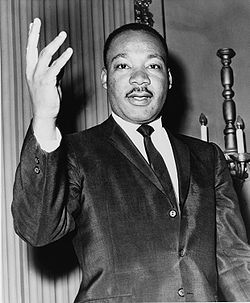
We have the opportunity now to respond to the challenges posed 43 years ago in Martin Luther King, Jr.’s excellent speech, Remaining Awake Through a Great Revolution. In his talk, he relates the story of “Rip Van Winkle,” who slept 20 years. But he reminds us that when Rip went up to the mountain, the sign on the local inn had a picture of King George III of England. Twenty years later, the sign had a picture of George Washington. Rip had not only slept 20 years; he had slept through a revolution. As King says, “Rip Van Winkle knew nothing about it; he was asleep.”

King saw that we are experiencing a scientific and technological revolution, one that challenges us to remain awake, and to develop a world perspective. It’s more imperative than ever to eradicate racial injustice and rid the world of poverty, and to find an alternative to war and bloodshed. Long before talk of flat worlds, King saw that our destinies were intertwined:250px-martin_luther_king_jr_nywts

All I’m saying is simply this: that all mankind is tied together; all life is interrelated, and we are all caught in an inescapable network of mutuality, tied in a single garment of destiny. Whatever affects one directly, affects all indirectly. For some strange reason I can never be what I ought to be until you are what you ought to be. And you can never be what you ought to be until I am what I ought to be – this is the interrelated structure of reality…And by believing this, by living out this fact, we will be able to remain awake through a great revolution.

Remaining awake means looking beyond government as usual and recognizing that children in Haiti are in our “garment of destiny,” as much a part of our world as the person next door. It means knowing that justice is an ongoing project that needs to be defended wherever we hear of abuses of human rights, not seeking ways to justify them. It means finding an end to wars, not simply moving from one venue to another.

Can we do any better now at addressing King’s great challenges?

References

King, Jr, Martin Luther (1965, June). Remaining awake through a great revolution. Commencement address for Oberlin College, Oberlin Ohio.

Learning from graveyards

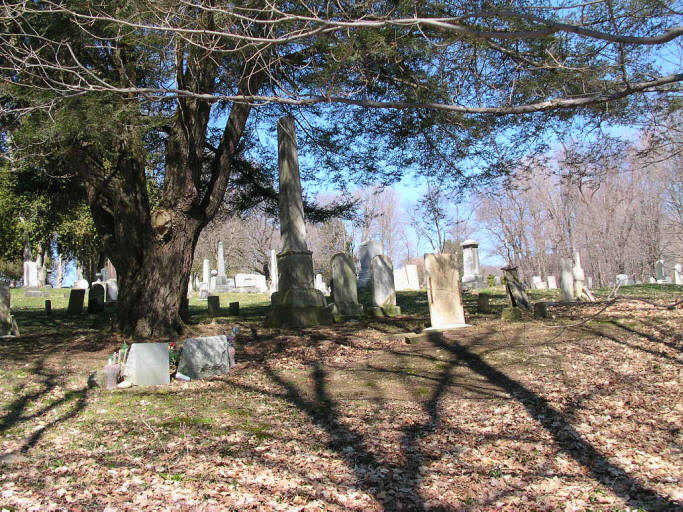
oldsectionhillside-017Starting with the town in which they lived, North Andover, Massachusetts, Caroline Donnan’s third-grade students physically entered history. They each adopted the family name of a European settler from the 1640’s period and thereafter assumed an historical role. A story centered on one of the historical characters would then form the basis of a study. That led to holding meetings, making maps, studying architecture, and discussing issues of the time as their assigned characters might do. (Photo by Ron Taylor, 2005).

Unraveling the town’s history, then, became the common vehicle for covering many skill and subject areas. It was also a wonderful excuse to put students in the position of discoverers, gatherers, and inquirers.

Their trips to a graveyard sparked scientific inquiry.

“People say settlers didn’t live as long as we do these days. What can you find here to prove whether or not that is true?” The class spread out to inspect gravestones. Scribbled columns of notes later turned into graphs and charts, subtraction and regrouping, smallpox and diptheria, questions and conclusions…Putting [the findings] together with a tally of how many people died at what ages, we came full circle to questions, connections, information. In point of fact, if settlers survived the first five years of life, their chances for survival were the same as they are today.

johnsoncottageI’m guessing that there are no surviving homes from the 1640’s era in North Andover. But there is the Johnson Cottage, built in 1789. According to the North Andover Historical Society is the “last surviving artisan’s cottage in North Andover’s Old Center.” The students made an expedition there and discovered low ceilings and short beds. This led to further inquiries into what it was like to live in the even earlier period.

The photo of the Cottage, shown here, is used by permission of the Historical Society. Their archives contain the largest amount of information on the Cottage and on the burial grounds in North Andover. They also host educational programs based on the first burial ground.

The students’ inquiries developed as multiple forms of literacy woven through the daily life of the classroom:

When we couldn’t get to real locations, we worked on constructing our own original one-room “town founder’s house” (located at one end of the classroom) or practiced scenes that eventually became “Starting from Scratch,” a full length musical relating the town’s earliest history. We also spent a substantial amount of time writing settler diaries, field notes, notices for the meetinghouse, town records, sermons, poems, trip lists, hymns, project progress reports, hypotheses, and conclusions. And we drew maps and charts, costumes and scenery, fences and rooftops.

It seems odd that a world tied to the past, even to graveyards, could be so alive for the students and Donnan herself. It’s even odder that this fantasy world became closer to the lived experience of the children than did their usual curriculum. But it’s less odd when we realize that it was based on their actual physical and social surroundings, and related to their own experiences of living spaces, health, family, and neighborhood.

Any learning activity raises questions. I’m curious to know how the class related their experiences in the 1789 Cottage to their simulation of life in 1640. I also wonder how much “Starting from Scratch” recognized the culture and lives of the Wampanoag people who lived in the area before 1640. What I can guess is that Donnan’s students were better able to engage in productive dialogue about these and other issues following their year in her classroom.

Donnan’s article is out of print. That’s a pity, because it’s an impressive example of how learning can be connected to life, offering a model for any age of students. Donnan even addresses the standard curriculum problem:

We had but one problem. In all the pages of the neatly typed, carefully bound, district-required social studies curriculum, never once was there mention of any of this.

She concludes by saying that we don’t have to wait:

With all there is to learn and do in the outside world, we really shouldn’t wait until June to get started.

References

Donnan, Caroline (1988). Following our forebears’ footsteps: From expedition to understanding. In V. Rogers, A. D. Roberts & T. P. Weinland (Eds.), Teaching social studies: Portraits from the classroom (Bulletin No. 82) Washington, DC: National Council for the Social Studies.
Gorvine, Harold (1970, May). Teaching history through role playing. The History Teacher, 3(4), 7-20.
Levstik, Linda S., & Barton, Keith C. (2001). Doing history: Investigating with children in elementary and middle schools (2nd ed.). Mahwah, NJ: Lawrence Erlbaum Associates.

The Women Who Went West

Under the leadership of its first Dean, Katharine Sharp, Illinois’ Graduate School of Library and Information Science sent the first librarians west.

As pioneers immigrated to the western towns of Wyoming, New Mexico and Oregon, graduates of Illinois set up libraries to educate the growing population. Often the only women for miles, these librarians created literacy programs with very little resources. –Here & Now: Videos

The video, The Women Who Went West, features Betsy Hearne, re-telling some of the stories of these early librarians. These early librarians showed courage and resourcefulness in spreading books and literacy. As Betsy says, “democracy depends on an informed population,” and they clearly did more than most to make that happen.

Reference

Des Garennes, Christine (2008, November 23). Video shows UI librarians’ quest to settle the West in 1908. The News-Gazette.

Creative democracy: Yes we can!

Yesterday’s election of Barack Obama as President of the United States was not only promising for our future, but was also a moving reaffirmation of all that America can be.

His Presidency may not fulfill all the dreams that the candidacy inspired; some things may not change at all. But it reminds me of what Thurgood Marshall said after the Brown v. Board of Education decision in 1954, which outlawed segregated schools. When asked what the Supreme Court ruling really meant, Marshall, said that in fact nothing had changed, except that henceforth, repeating the civil rights mantra, “the law is on our side”. In a similar way, Obama’s Presidency offers no guarantees, but does offer exciting possibilities in terms of uniting Americans and restoring America’s role in the community of nations.

The election of Obama is also a reminder that democracy is not a static system, but a process in need of continual renewal by all. Dewey (1976/1939, p. 230) expresses this in his essay, “Creative democracy: The task before us”:

Democracy as compared with other ways of life is the sole way of living which believes wholeheartedly in the process of experience as end and as means; as that which is capable of generating the science which is the sole dependable authority for the direction of further experience and which releases emotions, needs and desires so as to call into being the things that have not existed in the past. For every way of life that fails in its democracy limits the contacts, the exchanges, the communications, the interactions by which experience is steadied while it is also enlarged and enriched. The task of this release and enrichment is one that has to be carried on day by day. Since it is one that can have no end till experience itself comes to an end, the task of democracy is forever that of creation of a freer and more humane experience in which all share and to which all contribute.

Let’s have the audacity to hope that we are capable of creating of “a freer and more humane experience in which all share and to which all contribute.” I might add that John McCain’s concession speech was a gracious and thoughtful step in that direction.

References

Dewey, John (1976). Creative democracy: The task before us. In J. Boydston (Ed.), John Dewey: The later works, 1925-1953, volume 14 (pp. 224-230). Carbondale: Southern Illinois University Press. (Original work published 1939)

Kluger, Richard (1977, 1975). Simple justice. The history of Brown v. Board of Education and Black America’s struggle for equality. New York: Vintage Books.

Income inequality is rising in most OECD countries

According to a new Organisation for Economic Co-operation and Development report, Growing Unequal? Income Distribution and Poverty in OECD Countries, a combination of globalization, economic growth, and other societal changes has not only led to a larger gap between rich and poor nations; it’s also led to a growing gap between rich and poor in more than three-quarters of OECD countries over the past two decades.

Of the OECD countries, except for Mexico and Turkey, the United States has highest inequality level and poverty rate. Since 2000, income inequality has increased rapidly, accentuating a long-term trend that began in the 1970s.

OECD’s Growing Unequal? finds that the economic growth of recent decades has benefitted the rich more than the poor. In some countries, such as Canada, Finland, Germany, Italy, Norway and the United States, the gap also increased between the rich and the middle-class.

Countries with a wide distribution of income tend to have more widespread income poverty. Also, social mobility is lower in countries with high inequality, such as Italy, the United Kingdom and the United States, and higher in the Nordic countries where income is distributed more evenly.

Launching the report in Paris, OECD Secretary-General Angel Gurría warned of the dangers posed by inequality and the need for governments to tackle it. “Growing inequality is divisive. It polarises societies, it divides regions within countries, and it carves up the world between rich and poor. Greater income inequality stifles upward mobility between generations, making it harder for talented and hard-working people to get the rewards they deserve. Ignoring increasing inequality is not an option.”

via Income inequality and poverty rising in most OECD countries