National Day of Listening

The day after Thanksgiving (November 28, 2008), has been declared by StoryCorps as the first annual National Day of Listening.

This holiday season, ask the people around you about their lives — it could be your grandmother, a teacher, or someone from the neighborhood. By listening to their stories, you will be telling them that they matter and they won’t ever be forgotten. It may be the most meaningful time you spend this year.

You can preserve the interview using recording equipment readily available in most homes, such as tape recorders, computers, video cameras or a pen and paper. Our free Do-It-Yourself Guide is easy to use and will prepare you and your interview partner to record a memorable conversation, no matter which method of recording you prefer.

The National Day of Listening site has a four-step scheme to help with the process, including the DIY guide and a video. This looks like a great way to build up a family or community oral history.

The process that StoryCorps describes could of course be done any time, but most of us are inclined to procrastinate. We tend to vacillate between thinking that it’s nothing more than listening again to an old story and thinking that it requires fancy equipment, special expertise, and many days of hard work. Maybe setting aside a National Day, calling for one hour of serious listening, and offering a four-step process will make it easier for any of us to do.

John Dewey in Turkey: Lessons for today

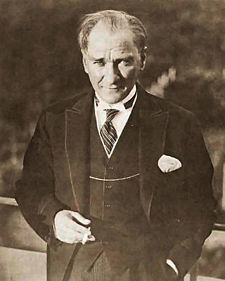
The Republic of Turkey was proclaimed on October 29, 1923. As its first President, Mustafa Kemal Atatürk (photo below) sought to establish the modern Turkey as a “vital, free, independent, and lay republic in full membership of the circle of civilized states.” He recognized the need for “public culture,” which would enable citizens to participate fully in public life, and saw the unification and modernization of education as the key. Accordingly, one of his first acts was to invite John Dewey, who arrived in Turkey just nine months after the proclamation.
In this endeavor, the ideas of Atatürk and Dewey were consonant. Dewey’s words above (“vital, free, …”) could have been written by Atatürk, just as Dewey might have talked about “public culture.” Both recognized the need to institute compulsory primary education for both girls and boys, to promote literacy, to establish libraries and translate foreign literature into Turkish, and to connect formal schooling, the workplace, and government.

Today is John Dewey’s 149th birthday. Back in 1924, he was nearing the age of 65, when many people think of retiring. But his three-month-long study in Turkey was an ambitious project. He addressed issues of the overall educational program, the organization of the Ministry of Public Instruction, the training and treatment of teachers, the school system itself, health and hygiene, and school discipline. Within those broad topics, he studied and wrote about orphanages, libraries, museums, playgrounds, finances and land grants for education, and what we might call service learning or public engagement today.

He laid out specific ideas, such as how students in a malarial region might locate the breeding grounds of mosquitoes and drain pools of water of cover them with oil. In addition to learning science they would improve community health and teach community members about disease and health. Workplaces should offer day care centers and job training for youth. Libraries were to be more than places to collect books, but active agents in the community promoting literacy and distributing books. In these ways, every institution in society would foster learning and be connected to actual community life. As Dewey (1983, p. 293) argued,

The great weakness of almost all schools, a weakness not confined in any sense to Turkey, is the separation of school studies from the actual life of children and the conditions and opportunities of the environment. The school comes to be isolated and what is done there does not seem to the pupils to have anything to do with the real life around them, but to form a separate and artificial world.
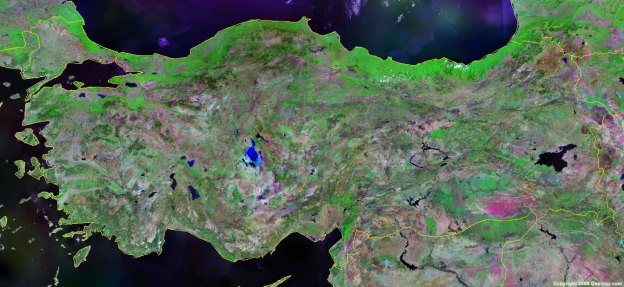
Atatürk saw the need to unify Turkey into a nation state, despite its great diversity. Dewey supported that but emphasized that unity cannot come through top-down enforcement of sameness (p. 281):

While Turkey needs unity in its educational system, it must be remembered that there is a great difference between unity and uniformity, and that a mechanical system of uniformity may be harmful to real unity. The central Ministry should stand for unity, but against uniformity and in favor of diversity. Only by diversification of materials can schools be adapted to local conditions and needs and the interest of different localities be enlisted. Unity is primarily an intellectual matter, rather than an administrative and clerical one. It is to be attained by so equipping and staffing the central Ministry of Public Instruction that it will be the inspiration and leader, rather than dictator, of education in Turkey.

This was realized in many ways. For example, the central ministry should require nature study, so that all children have the opportunity to learn about and from their natural environment, but it should insist upon diversity in the topics, materials, and methods. Those would be adapted to local conditions, so that those in a coastal village might study fish and fishing while those in an urban center or a cotton-raising area would study their own particular conditions.

Many of Dewey’s ideas were implemented and can be seen in Turkey today, as we come upon its 85th birthday next week. What’s even more striking to me is how relevant they are to the US today. Many of our problems can be traced to the “separation of school studies from the actual life of children and the conditions and opportunities of the environment,” but also to the separation of work from learning, of health from community, of libraries from literacy development, or of universities from the public. Dewey would be the first to argue that we need to re-create solutions in new contexts, but his report from long ago and far away still provides insights for a way forward today.

References

Ata, Bahri (2000). The influence of an American educator (John Dewey) on the Turkish educational system. Turkish Yearbook of International Relations (Milletlerarası Münasebetler Türk Yıllığı), 31. Ankara: Ankara Üniversitesi.

Bilgi, Sabiha, & Özsoy, Seckin (2005). John Dewey’s travelings into the project of Turkish modernity. In Thomas S. Popkewitz (ed.), Inventing the modern self and John Dewey: Modernities and the traveling of pragmatism in education (pp. 153-177). New York: Palgrave Macmillan.

Dewey, John (1983). Report and recommendations upon Turkish education. In Jo Ann Boydston (ed.), The Middle Works: Essays on Politics and Society, 1923-1924. Vol. 15 of Collected Works. Carbondale: Southern Illinois Press.

Wolf-Gazo, Ernest (1996). John Dewey in Turkey: An educational mission. Journal of American Studies of Turkey, 3, 15-42.

Which side of the road do they drive on?


Map of the world showing the driving directions for all countries and any changes that have occurred, beginning with Finland’s change in 1858
     drives on right      drove on left, now drives on right      drives on left      drove on right, now drives on left      had different rules of the road within borders, now drives on right

[Map from Right- and left-hand traffic]

While working at the National College of Ireland, I got into a lunchtime discussion about driving, in particular, about why some countries, such as Ireland, drive on the left and others, such as the US, drive on the right. None of us could even say with much certainty how many people in the world did it one way or the other. Seemingly simple questions led to many jokes, confident pronouncements, and further questions about changeovers, what boats and planes do, and so on.

As I began to look into it more, I realized this was yet another example of how simple questions can lead to interesting inquiries without end. One of the most interesting sources I came across was a website, Which side of the road do they drive on?, edited by Brian Lucas, and based in large part on The Rule of the Road: An International Guide to History and Practice by Peter Kincaid. Here’s an excerpt from the site:

The side of the road one drives on seems to be one of those mundane details of everyday life which people take for granted and never bother to write down. In his book, Kincaid comes up with a blank: “I have been unable to discover any firm evidence as to what the rule of the road was in any part of the ancient civilizations in Greece, Rome, or Assyria. It seems inconceivable that there was not one.” We have found, however, evidence that the ancient Romans drove on the left.

In late 1998, the remains of a Roman quarry was discovered at Blunsdon Ridge, near Swindon, England. It is one of the largest and best-preserved Roman quarries known. Ruts in the road leading to this quarry are much deeper on one side of the road than on the other. If it can be assumed that the side of the road with deeper ruts was the side used by loaded carts leaving the quarry, while the side with shallow ruts indicates empty carts arriving, then we can conclude that at this particular location, at least, the Romans drove on the left. (Sources: a web page in the SwindonWeb Local News Archives for October 1998 which has since disappeared, and an article by Gwynne Dyer, Is driving on the right right or wrong?, from 1999.)

Another piece of evidence comes from a Roman coin. Robert Pease writes that he has seen a picture of a denarius from between 50 BC and 50 AD showing two horsemen riding past each other, right shoulder to right shoulder (i.e. each keeping to the left side of the road).

It was amazing to me to learn how this simple practice connects with our physical characteristics, modes of transportation, revolution and empire, warfare, commerce, and many other aspects of daily life.

What we do not know: The betrayal of our values

I returned to the US in June after living a year living in Ireland. Many people have naturally asked, “What was it like? How was it different? What did you learn?”

It’s hard to know where to begin. I may have learned as much about myself and my home country as about Ireland, or other countries I’ve visited. And, mostly, if I learned anything, it was how much I don’t know about other people and places. As Confucius says: “To know that we know what we know, and that we do not know what we do not know, that is true knowledge.”

Our Hollywood Self-Image

But one specific thing I’ve become more aware of is a gap between what most Americans conceive as their moral stance on the world and what many abroad see as our actual practice. I suspect that many of us in the US identify with Jefferson Smith in Mr. Smith Goes to Washington. He’s decent, naive, idealistic, earnest, fair, caring, and above all honest, embodying all the American small town values. He’s not sophisticated or slick, but he’s the kind of person you’d like to have as a friend or trust for political leadership. Mr. Smith asks us to adhere to “just one, plain, simple rule: Love thy neighbor” and reminds us that “there’s no compromise with the truth.”

What’s interesting today is that many abroad would also identify with Mr. Smith. And they admire the US for modeling his values, offering hope for other countries. They recall our promotion of the Kellogg-Briand pact, the struggle against authoritarian regimes, the Nuremburg trials, the United Nations, the Geneva Conventions, as concrete examples of how we have stood for truth, peace, courage, and justice, just as Mr. Smith might have wanted. Their values are our values; their people are our people.

But then, we part ways, because of something many Americans do not know. Continue reading

“The Cucumber Season”

Just read an amusing, and ironically, informative essay in ACM Ubiquity, called “The Cucumber Season: Reflections on the Nature of Information When There Isn’t Any,” by Espen Andersen:

I would like to introduce a new term to the English language: “Cucumber season”. The term, from Norwegian, refers to the period from sometime in early June, when Parliament and the public schools recess, until mid-August when the schools start up again and people return from their summer holidays. The name of this season comes from the observation that during this period, newspapers have little to write about – since nothing much happens – and so are forced to report on non-news, such as outsized and/or weirdly shaped vegetables such as cucumbers. By extension, the term refers to newspaper articles as well – a padded-out news item of dubious importance and inflated headline is referred to as a cucumber.

ACM Ubiquity – The Cucumber Season: Reflections on the Nature of Information When There Isn’t Any.

Community as Intellectual Space: Aesthetics as Resistance

CIS flyer The 4th Annual Community as Intellectual Space symposium is being held this week at Paseo Boricua in Chicago, June 13-15. Events will start at the Puerto Rican Cultural Center (PRCC), 2739/41 W. Division (near corner of Division and California).

This year, the focus is on Aesthetics as Resistance: The Act of Community Building. There will be artist-led tours of the beautiful murals found throughout the neighborhood, the annual People’s Parade, a delicious Puerto Rican dinner, workshops on community-education activities as diverse as urban agriculture and computer programming for children using Squeak, meetings with local Humboldt Park/Paseo Boricua community and government leaders, including Rep. Luis Gutierrez and Rep. Cynthia Soto, and panels on liberatory education. [Click to enlarge the poster or follow the link above for more details.]

Aesthetics as Resistance promises an active dialogue on art, identity, and cross-cultural community building with community leaders, artists, educators, librarians, activists, students, and residents. It expresses the PRCC’s vision to build community grounded in cultural practice, including murals, poetry, music, and the People’s Parade. These practices are both creative and political acts to develop community out of local funds of knowledge.

Paseo Boricua has a motto: ‘Live and help others to live.’ It is known for its multigenerational and holistic community activism around human rights and social change. Education is structured around the belief that ‘the community is the curriculum,’ reflecting the ideas of Paulo Freire and providing a contemporary version of Hull House.

With its many academic partnerships, Paseo Boricua also provides an outstanding example of university-community collaboration in research, teaching and public engagement. For example, last year the community hosted a tour and visit for the John Dewey Society. This furthered dialogue around how the community answers Dewey’s call for critical, socially-engaged citizens, for an active public, and for education as lived experience.

[This announcement is also posted on the John Dewey Society Social Issues blog.]

Garrotxa and Collsacabra

Before going to the conference in Girona on the future of the university, we spent a few days in the Pyrenees (Pireneus in Catalan), mostly in Garrotxa county (camarca) and in Vall de Sau Collsacabra. Collsacabra is a high plateau in the north-east part of Osona county; it’s also called Cabrerès.

Here are some photos; click on any photo to enlarge it.

from-mas-el-solanotgarrotxa1

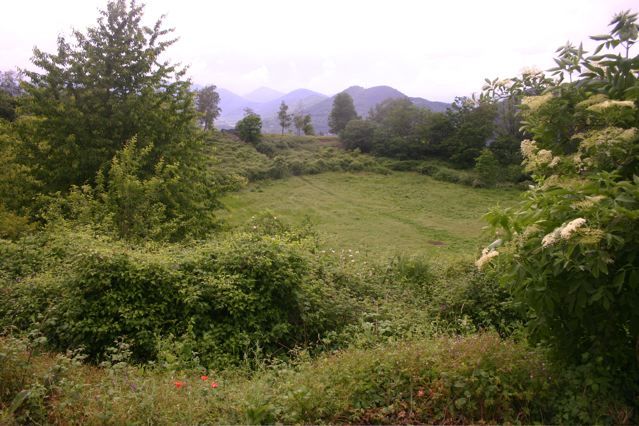
Following a night in Barcelona, we traveled north past Vic and Rupit to a beautiful stone house high on a mountainside. You can see here the view from our room in Mas El Solanot. Notice the tabletop mountains and cliffs, as well as architecture going back to the Middle Ages and even Roman times.

We were staying on the edge of La Garrotxa, which is about 1/4 the size of Champaign County in terms of area and population. It looks very different because of its 40 volcanoes and many cliffs, not to mention the medieval architecture, Mediterranean flora, and red tile roofs.

Volca Montsacopavolca

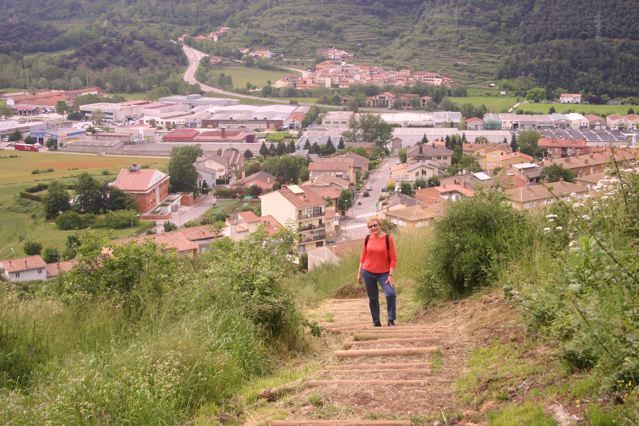
We traveled to many of the volcanoes in Garrotxa. Here we are climbing up to look at the crater of Volca Montsacopa, in the center of Olot.

colades The photo on the left is from the Route of Les Tres Colades, with its spectacular basalt cliffs. It shows the results of the cooling of the lava as it flowed towards the site of what is now Sant Joan les Fonts.

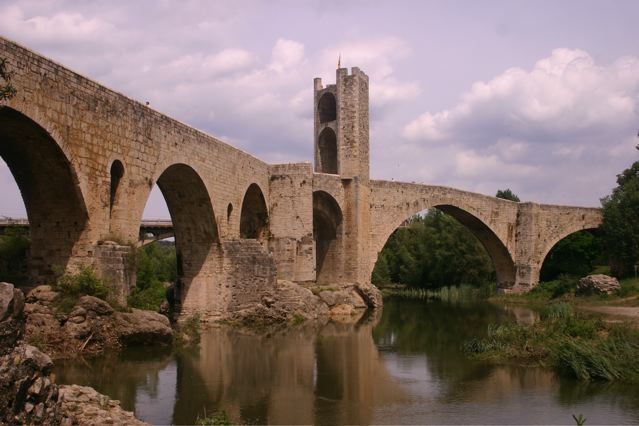
besaluOn the right is a 12th-century Romanesque bridge in Besalú with a portcullis in center. It was partially destroyed during the Spanish Civil War, then rebuilt in the 60’s.

rupit A view of Rupit and the nearby Salto de Sallent, a 100-meter waterfall. The photo below shows a cascade upstream from the main fall. There was an iron cross embedded in the rock, presumably marking the spot where someone had come too close to the edge. I decided not to go up closer to investigate. But it was impressive to see that the unpaved road crosses the stream above the main fall, going through six inches of water just a few feet from the 100-meter drop.

salto-sallentsalto-sallent1

girona girona2

Scenes from Girona, where the conference was held. The cathedral perches on a hill in the center of the beautiful old town (Barri Vell), which lies just across the Onyar River

Africa Day, Dublin

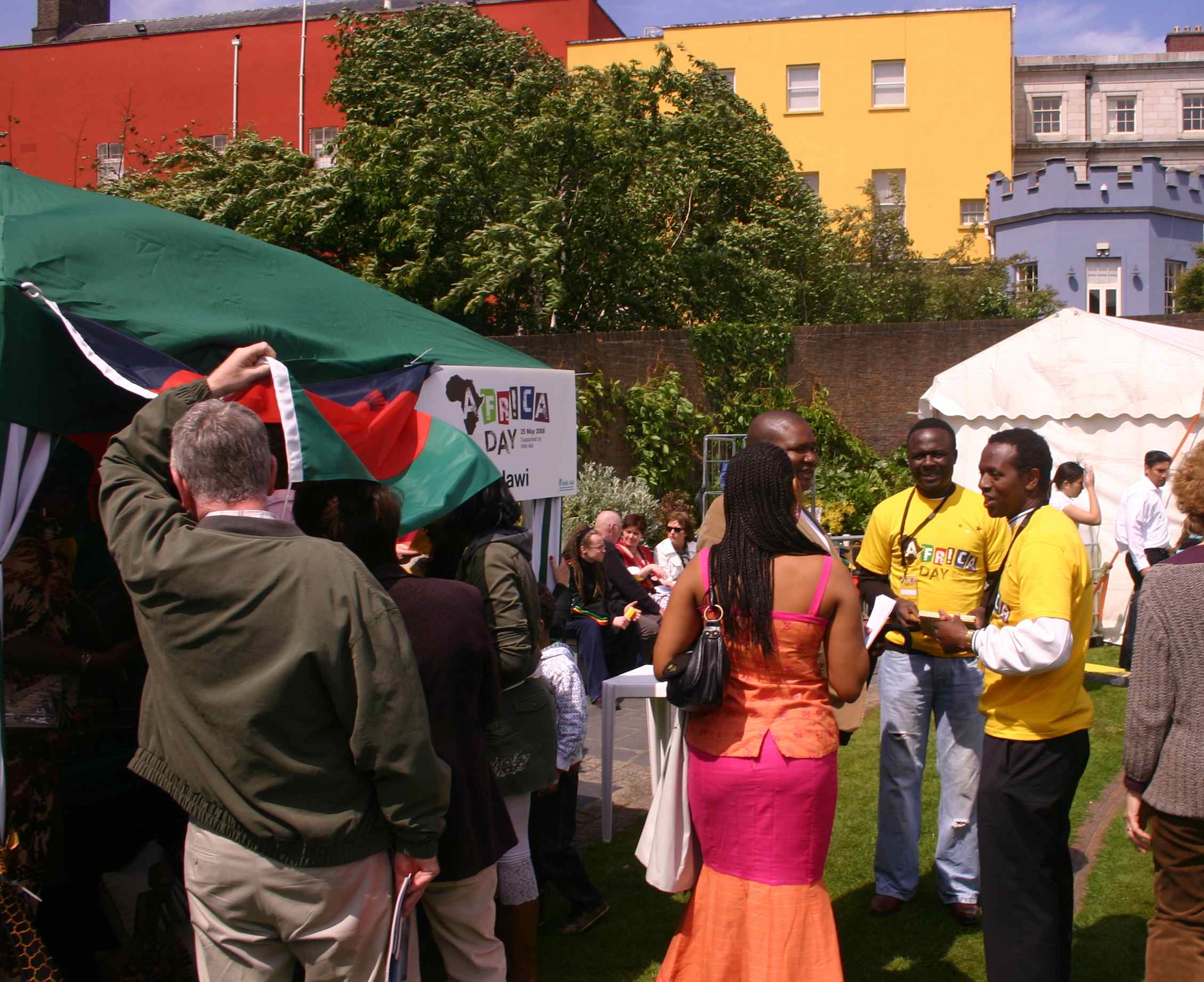
May 25 was Africa Day, the commemoration of the founding in 1963 of the Organisation of African Unity, which later became the African Union. In honor of that, the Irish Aid organized a wonderful set of Africa Day events, held at the Irish Film Institute, the National Botanical Gardens, and other venues. We went to those at Dublin Castle and the Chester Beatty Library.

There were musical performances and dance, lectures, storytelling sessions, photography exhibits, arts and crafts, and food from many regions and cultures of Africa.

A notice prior to the event advised bringing suncreen and umbrellas for the rain, which was a good indication of the variability in the weather this time of year in Dublin. But the weather turned out to be friendly and helped make it a worthwhile day all around. By mid-afternoon there was a line to get in to the Dublin Castle grounds. I hope this becomes an annual event.

JAAL Technology Department

During 1997-2002, I edited the Technology Department in the International Reading Association’s Journal of Adolescent and Adult Literacy (JAAL). The columns were intended to promote dialogue about new communication and information technologies and to explore what these media mean for literacy and literacy educators. Each had several distinct sections, including an “email” message from me, an “issue of the month,” often written by a guest author, descriptions of selected websites, and a glossary. In addition to the print version, each column appeared in the Electronic Classroom section of Reading Online.

The columns have now been collected into a book, Literacy in the Information Age: Inquiries into Meaning Making with New Technologies (2003, Newark, DE: International Reading Association).