
There are two epochs in computer history: Before ENIAC and After ENIAC. The first practical, all-electronic computer was unveiled on Feb. 14, 1946, at the U. of Pennsylvania’s Moore School of Electronics. ––Alexander Randall 5th
ENIAC (Electronic Numerical Integrator and Computer) was a programmable, electronic, general-purpose digital computer. It was the first to have all of these features in a generally useable machine.
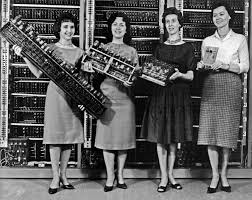
The photo shows four mathematicians/programmers for ENIAC, from L to R, Patsy Simmers (ENIAC), Gail Taylor (EDVAC), Milly Beck (ORDVAC), and Norma Stec (BRLESC-I). The original “computers,” also women, were soon to be replaced by an electronic computer.
The women in the photo above are holding circuit boards from the first four Army electronic computers, illustrating the rapid evolution and miniaturization of computing technology. Photo: Wikimedia Commons.
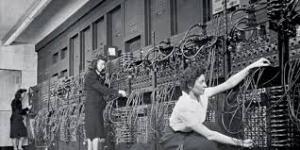
ENIAC’s 80th birthday is significant to me because it comes during a year when most of my classmates are also turning 80. We’ve shaped and been shaped by the digital world that ENIAC helped to spawn.
It’s appalling to see how that digital world is being used to oppress ordinary people. Regimes from Teheran to Washington, DC are using the technologies of ENIAC’s spawn to spy upon, categorize, track down, deport, and otherwise persecute people who are simply asserting their rights, or often just quietly trying to live their lives.
References
“ENIAC,” Wikipedia, February 6, 2026.
Scott McCartney, ENIAC: The Triumphs and Tragedies of the World’s First Computer, Berkley, 2001).
Alexander Randall 5th, “Q&A: A Lost Interview with ENIAC Co-Inventor J. Presper Eckert,” Computer World, February 14, 2006.
 Chip's journey