In a discussion group focused on John Dewey, we’ve been reading Eddie S. Glaude, Jr’s 2007 book, In a shade of blue: Pragmatism and the politics of Black America. It’s an excellent application of Deweyan pragmatism to the current challenges facing African Americans today.
Last week, we discussed Glaude’s chapters 3 and 4, including a section on Ira Berlin (pp. 99-105). What Glaude has to say about Berlin was fine on its own, but it seems abstract and narrowly focused on only one, albeit important, issue: forced conversion to Christianity.
Freedmen and Southern Society Project
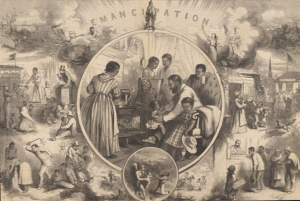
Glaude missed a great opportunity to talk about the Freedmen and Southern Society Project (FSSP). Leslie Rowland and Ira Berlin started the FSSP in 1976.
A central aim of the project was edit a documentary history of the transition from slavery to freedom in the US South. The documents include letters, affidavits, testimony, reports, petitions, legal proceedings, and other material by slaves and former slaves, slaveholders and former slaveholders, military officers and soldiers, agents of the Freedmen’s Bureau, and other participants in the drama of emancipation. The project built a social history of emancipation during the time when four million people gained their freedom (paraphrasing text from FSSP).
Pragmatism as a tool for inquiry
In contrast to the section in Glaude’s book, the FSSP offers an amazingly comprehensive look at slavery in the US, Emancipation, Reconstruction, and the after-effects. It documents the experience through the words of slaves and ex-slaves themselves, as well as others, making a compelling case for Glaude’s theory of African-American agency in a time of unconscionable institutional oppression.
Along the way, though probably without intending to do so, FSSP demonstrates Glaude’s goal of showing the value of Deweyan pragmatism—considering the whole situation and grounding conclusions in ordinary experience.
Additional reading
Note that four volumes for general readers and classroom use have also been published by the Project: