I had shoulder surgery on August 18, so my days of paddling through rapids or hoisting a canoe on my shoulders need to be postponed. As a substitute, I’ve been reading A thousand miles in the Rob Roy canoe on rivers and lakes of Europe (1866), by John Macgregor (1825-1892).
 MacGregor himself led a life that sounds like an overdone adventure yarn. At the age of three months, he was rescued from a burning ship whil een route to India with his parents. At the age of 12, he helped launch a rescue boat for a ship in distress off Belfast, then slipped aboard secretly a the last moment to help out. He grew up sailing, boat-building, riding, reading, and experimenting with home-made steam engines, batteries, and chemicals that led to several major explosions. He attended seven schools before graduating from Trinity College, Dublin in mathematics. He traveled throughout the world, fighting Greek pirates and crocodiles, climbing Mont Blanc, Etna, and Vesuvius. He won awards for sharpshooting, drew for Punch and illustrated books, and wrote his own books on marine propulsion, patent law, travel, and transcriptions of Syrian and Egyptian melodies he had heard in his travels.
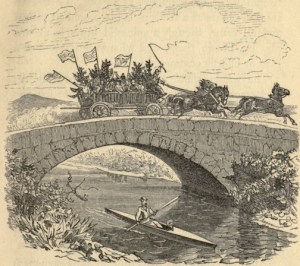
MacGregor built a hybrid canoe / kayak with a sail and a double-bladed, kayak paddle which he named the “Rob Roy”. He then paddled through the rivers, lakes and canals of Germany, France and Switzerland, portaging between waterways on a cart or on trains. His account of the journey became a best seller and was the beginning of the recreational canoeing movement. His trip inspired many, including Robert Louis Stevenson, who made his own voyage in a Rob Roy, and then wrote about it in his first published book, An inland voyage.
 MacGregor’s account portrays a Europe with only distant resonance to today. Instead of shopping centers and freeways, there were people cutting hay with hand tools. Instead of the Web, there were newspapers, 3241 in Germany alone.
A thousand miles displays a buoyant optimism and refreshing sense of discovery. MacGregor talks of “a strange feeling of freedom and novelty which lasted to the end of the tour,” (p. 15), and throughout, of a reverence for the canoe, which I share:
Something like it is felt when you first march off with a knapsack ready to walk anywhere, or when you start alone in a sailing-boat for a long cruise.
But then in walking you are bounded by every sea and river, and in a common sailing-boat you are bounded by every shallow and shore; whereas, I was in a canoe, which could be paddled or sailed, hauled, or carried over land or water to Rome, if I liked, or to Hong-Kong. (p. 15)
 I also like his descriptions of wildlife, for example of herons “wading about with that look of injured innocence they put on when you dare to disturb them.” (p. 35) Later, he refers to a gathering including the
long-necked, long-winged, long-legged heron, that seems to have forgotten to get a body, flocks by scores with ducks of the various wild breeds, while pretty painted butterflies and fierce- looking dragon-flies float, as it were, on the summer sunbeams, and simmer in the air. (p. 71)
At the village of Geisingen it was discovered that the boiler of my engine needed some fuel, or, in plain terms, I must breakfast. (p. 59)
 MacGregor’s challenges along the way become not discouragements, but the very stuff of the journey. He reminds me that a broken shoulder is just a toss on the billows, one that can be an opportunity to learn:
It is, as in the voyage of life, that our cares and hardships are our very Mentors of living. Our minds would only vegetate if all life were like a straight canal, and we in a boat being towed along it. The afflictions that agitate the soul are as its shallows, rocks, and whirlpools, and the bark that has not been tossed on billows knows not half the sweetness of the harbour of rest. (p. 37)