Muzzling science

I know the world of universities and research is pretty small in the greater scheme of things, and therefore not discussed much on the TV news or in newspapers. As a result, it may not be obvious how much Federal policies since 9/11 have impacted research and higher education.

For example, consider this comment from a discussion list regarding a venue for the Association of Internet Researchers (AoIR) conference:

Canada as a north American venue has a lot of appeal for many of our members for various reasons, one of the more important ones being visa issues (most say it’s easier to get visas for Canada than the US, and also some are uncomfortable with the fingerprinting procedure in the US and don’t want to do that).

The AoIR will probably not meet in the US next time. This is happening for other conferences, especially in the newer fields, such as Internet Research.

Put that together with new restrictions on access to scientific and technical information, new barriers for students and researchers from other countries coming to the US, cutbacks in support for research at both the National Institutes of Health and the National Science Foundation, gag orders on scientists (as we saw last month at NASA), distortions of scientific findings (as in the global warming case), and politicizing of scientific review committees. The result is a negative climate for research and higher education. The impact is already evident to researchers and those in higher education, and the impact on the larger economy is beginning.

For the European Union, this is a terrific opportunity to surpass the US. They’ve already initiated a major new research program openly promoted as a way to take advantage of the US policies and to lure the most promising young researchers away from the US. It’s also opened doors for India, China, and other countries.

There are of course national security arguments made for each of these new policies. But there is even stronger evidence that they actually weaken national security. For example, the clampdown on access to scientific and technical information is making it harder to develop responses to biological warfare. It’s also very hard to understand how losing our leadership position in science and technology will make us stronger.

What’s perhaps most worrisome is that muzzling people and information in this way means that it is increasingly more difficult to have open debate about the worth of the policies. As with the Patriot Act or the Detainee Treatment Act, the new laws come with criticism-proof provisions.

Someday, we should ask whether the effort to protect what we value is actually destroying it.

Planetariums: education or entertainment?

As you know, two of the major functions of museums are education and entertainment. David Leake, who is director of the Staerkel Planetarium (and a former student), asked an interesting question about planetariums, which are akin to museums, or include museums, depending on how you look at it:

Why do some planetariums focus on education while others focus on entertainment?

Before reading what he found, you have to know that astronomers study circles. The objects–stars, planets, galaxies, etc–are roughly circular and so are the ways they move in orbits. Diameter then becomes a very important thing to know. So, for example the sun is 100 times the diameter of the earth and as a result 1 million times as massive.

It turns out that planetariums are also circular. As their diameter doubles, their volume and hence cost go up 8-fold. Dave found that planetariums smaller than 75 feet in diameter are low-budget operations, which focus on education. They open up as needed, host school groups, and have programs designed to teach. Above 75 feet they shift to a focus on entertainment. There are high-interest shows (Harry Potter recently) with stiff admission charges.

Dave’s study (a masters thesis) is so beautiful, not only because it provides a plausible and empirically-supported account of a major divide in the field, but also because the account itself (in terms of diameter) is so well-suited to the object of study.

The closest analogy I can come up with for other types of museums is that museums for young people focus on both education and entertainment. They’re all about exploring what’s new, especially through all the senses. As the audience ages the museums gradually shift the emphasis to preserving artifacts. There’s less attention to employing all the senses, and more on conveying the needed information. Is that because the older folks become more conscious of preservation? Or have their senses dulled, so they just want to get the answer in the least amount of time?

Yale Russian Chorus

Last Saturday, Stephen appeared on WTNH TV (New Haven, Connecticut) representing the Yale Russian Chorus. You can see the story and video online . This was to promote a benefit concert called “Songs of Hope”, on January 29, for the Connecticut Bridge of Hope Summer Program for Russian Orphans.

The program brings older Russian Orphans to Connecticut in the summer in hopes of finding their “forever families”. The children spend about one month with a host family learning about family life, attending local day camps, and participating in a typical American summer experience.

Lycksele learning centers

On October 21, while I was in Sweden, I spent a day in Lycksele. There, I learned about an innovative organization called Akademi Norr from Regis Cabral, their EU coordinator. The organization emerged as the result of cooperation among 13 municipalities in four counties in northern Sweden. It initiates, coordinates, and implements higher education programs and courses for people in the north, in order to meet needs for both education and development.

Each of the 13 municipalities has its own learning center, typically housed with the community library. Akademi Norr works with the center, a local industry, community members, and a university to devise a specialized higher education program. The center offers meeting spaces, ICTs, local tutoring, and other services. Their program shares many similarities with the GSLIS Chicago program in LIS education.

For example, I visited one of these learning centers, Lycksele lärcentrum. Most of their website is in Swedish, but you can see a little bit more in English on education in Lycksele. They’ve set up several programs. One currently underway leads to a BS in Engineering, with a focus on GIS; another is for a BS in Nursing, with an emphasis on ICTs.

Students who have completed these programs have easily found jobs in their region, because the program is designed from the start to make that possible. This is especially important in a region with strong ties to the land and community. The program is also designed to meet the needs of local industries, which might otherwise have dfficulty finding qualified workers in such a sparsely-populated area (3.8 people/sq-mi in Lapland versus 223.4 people/sq-mi in Illinois)

The staff in the Lycksele lärcentrum as well as at Akademi Norr are very open to having people visit or study what they are doing. There are possibilities for funding through iorganizations such as the American-Scandinavian Foundation . We could learn a great deal about community work, meaningful learning, ICTs in education, and more, through a better understanding of the learning centers programs.

Fulbright trip to Umeå and Göteborg, Sweden

I’ve been selected for a Fulbright Senior Specialists award to Sweden, during the second half of October. My first week will be at the Department of Informatics at Umeå University. I’ll visit with Ulf Hedestig, who works in computer support for collaborative learning, and Victor Kaptelinin, who works in human computer interaction and activity theory. Victor is from Russia and had worked with A. N. Leont’ev at Vygotsky’s institute in Moscow, but he also has strong interests in John Dewey’s work. I’ll be giving a major talk on learning there, as well as leading a discussion on the Schools of Information movement in the US.

During the second week, I’ll go to the IT-University at Göteborg, where they’ve been using my situated evaluation approach. I’ll see Marisa Ponti, who works on in the area ICT and Learning, as well as others. There’s a half-day seminar, “Supporting Distributed Collaboration in Science: Reflections from Experiences”, which I’ll present along with Diane Sonnenwald, from the University College of Borås. Later that week, I’ll teach a two-day short course on Pragmatic Design of Information and Communication Technologies, and then on Friday give a lecture on inquiry-based learning.

On Tuesday of that week, I’ll go to the Swedish School of Library & Information Science in Borås to give talks on our distributed knowledge project and the information school movement. In addition to Diane Sonnenwald, I hope to meet with there with Olof Sundin, who has done recent work on pragmatism and sociocultural theory, and also with Louise Limberg, who work in information literacy. She and I are both involved with an information literacy project directed by Eero Sormunen in the Department of Information Studies at the University of Tampere, Finland.

Somewhere in there, I plan to teach my classes in Champaign using Flashmeeting (web-based, video conferencing). We may have links from the various Swedish universities in addition to the class in LIS 109 and me.

Prolearn Summer School: Usability Panel

The first PROLEARN Summer School was held September 5-9, 2005 at Isik University in Sile, Turkey. The objective was “to contribute to the creation of an institutional culture, integrating distributed researchers across Europe into one community. It provides a framework for structuring a number of on going research, training, and scientific leadership activities.”

This slideshow could not be started. Try refreshing the page or viewing it in another browser.

LEEP

  • online professional development program
  • library & information science
  • 10 units, leading to a masters degree
  • ~100 Ss/year

challenges

  • low expertise, high resistance among Ss and Ts
  • low-end equipment
  • courses incompatible with online

outcomes

  • 100% retention
  • faculty choose
  • now larger than on-campus
  • students around world
  • model for others
  • WISE consortium (13 unis)

approach

  • low-end tech
  • tech support
  • faculty buy-in
  • cohort model
  • coordination with library, advising, etc
  • blended learning
  • mix sync & async

inquiry model

  • appropriate tech for each course
  • participatory design
  • diversity as a resource
  • Learning, culture and community in online education: Research and practice
  • LEEP Virtual Reunion

Internationalists Anonymous

It’s true. I’ve been in denial for too long. I kept deluding myself by saying that I was just “looking at the evidence” or “thinking.” Now I know that it is time to face reality and admit that I have become an internationalst.

I’d like to blame my year abroad, but that’s just shirking the repsonsibility. In fact, it wasn’t just talking to non-Americans (shall I say “un-Americans”?) that caused the problem. It was also the reading, the examination of data, and, dare I say it, looking at history.

The warning signs were there. I began to ask why the US, the richest nation on earth, lagged far behind others in helping to alleviate world poverty. Figures like .7% (the world goal for development aid) and .015% (the US record) began to gnaw at me. I read about the Arctic ice cap melting faster than anyone had predicted, and then wondered why the US failed to agree to the Kyot o treaty. And of course, the wars in Afghanistan and Iraq, the illegal detentions, the torture, the lies, and the inability to do anything about the root causes of terrorism all made me lose faith in the absolute rightness of the US versus the rest of the world.

Back in the US now, I see signs of hope. The local newspaper and television news show me the path back to health, when “world news” means “events that involve Americans, especially music or movie stars.” A good dose of shopping malls and lots of time spent driving should help, too, but I realize now that I have to seek real change within myself.

I want to find a chapter of Internationalists Anonymous. I want to tell my sad story and then work with a support group to return to the fold. What future can there be for me with all these impure thoughts, this questioning of the self-evident rightness of everything the US does? Perhaps, with some concerted effort and ample time, I can rid myself of this dreaded internationalism.

Quill, revisited

Quill iLab As an experiment to test iLabs version 3, and also to satisfy a long-standing impulse of mine to resurrect Quill, I created a Quill iLab (click on the image to see more).

This iLab combines information that used to be on basic html pages regarding the book, Electronic Quills: A Situated Evaluation of Using Computers to Teach Writing, and new interactive features, which emulate what Quill did on Apple II computers many years ago. The example texts are taken directly from the book, and represent examples actually written by students during the Quill project.

I was pleased to see that iLabs could do much of what Quill did, and in a much easier way than writing in Pascal on the Apple, with its 64KB memory. I was also reminded that we had some good ideas for promoting writing and collaboration, even with that primitive equipment.

Check it out and let me know what you think. If you’d like to be authorized as a member so you can see how entering texts work, just let me know.

Georges-Louis Leclerc, Comte de Buffon

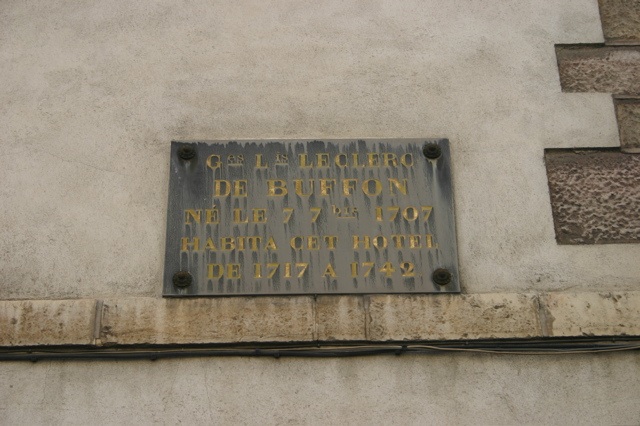
Buffon’s plaqueAfter being inspired by George Reese’s work with Buffon’s needle, then seeing the movie, Le Pacte des loups (Brotherhood of the Wolf), then Buffon’s statue in the Jardin des Plantes, I’ve kept an eye out for Georges-Louis Leclerc, Comte de Buffon. He did amazing work in natural history, mathematics, biology, cosmology, translation, and essays. He also examned alleged specimens for the beast of Gévaudan, which provided the basis for the movie.

On Sunday we saw his house in Dijon (where he lived from 1717 to 1742), on naturally, rue Buffon.

From his Wikipedia entry you can follow links to Buffon’s needle.