Writing for a Change

As you all may know, the campus has an effort, led by Libbie Morley, to establish a National Writing Project site here. There will be an opening reception at Levis Faculty Center on April 3.

Among the materials we’re reviewing prior to submitting a proposal for the site is a new book, Writing for a Change: Boosting Literacy and Learning Through Social Action, edited by Kristina Berdan et al. (Jossey-Bass, 2006). It reflects a collaboration between the National Writing Project and the Centre for Social Action at De Montfort University in Leicester, England. I was struck in reading it how close the goals of an NWP site could be to what we’re doing with Community Informatics.

Below is an abstract, although it doesn’t do justice to the social action dimension as shown in the book:

Writing for a Change shows teachers how to engage students in “real world” problem-solving activities that can help them to acquire voice, authority, and passion for both reading and writing practice. Written in collaboration with the Center for Social Action in England, the book describes the innovative Social Action process for encouraging students to collaborate on problems of their own choosing—to analyze options, develop action plans, discover solutions, and finally to reflect on their work. Featuring stories by teachers who have successfully used the method, the book shows that first graders as well as high-school students can enjoy this exciting and educational process. Practical guidance for applying the process to any curricular area is provided along with an extensive list of classroom activities.

We Make the Road by Walking

I’ve been reading We Make the Road by Walking: Conversations on Education and Social Change, by Myles Horton & Paulo Freire (Temple University Press, 1990). I was reminded of it by Patrick Berry. If you haven’t read it, I recommend it highly. Meeting at a conference in 1987, Freire had invited Horton to join with him in “speaking a book.” The result is essentially a transcript of their lively and provocative conversations.

One section especially caught my interest. It’s called “Is it possible just to teach biology?” As Freire asks, “Is it possible to discuss, to study the phenomenon of life without discussing exploitation, domination, freedom, democracy, and so on?” As I expected, neither one answers “yes”; they reject the idea of neutrality in teaching anything. Many people might read that as advocating the imposition of one’s own ideas on others. But both Horton and Freire talk about sharing their ideas in a way that shows how they actually create more space for students to disagree, or to find their own path to greater understanding. They create a space in which everyone comes to a richer understanding of the subject at hand.

Tour of Paseo Boricua during AERA

speaker

John Dewey Society Sponsored Off-Site Program

Date: Wednesday, April 11

Time: 4:30 p.m. – 9:30 pm

Location: Puerto Rican Cultural Center, 2739-41 W. Division Street

Cost: $30 (includes bus transportation, program, and dinner)

Transportation: A bus will collect participants from the front of the Fairmont Chicago hotel at 4:30 p.m. and return there at 9:30 p.m.

Paseo Boricua, with its motto of ‘live and help others to live’ is renowned for its multigenerational and holistic community activism around human rights and social change and, in particular its model of learning in which ‘the community is the curriculum.’ With its many academic partnerships, Paseo Boricua also provides an outstanding example of university-community collaboration in research, teaching and public engagement.

The one-hour tour will visit the Puerto Rican Cultural Center and key organizations in the neighborhood, including the community library and media center, the Family Learning Center, Café Teatro Batey Urbano, and the Dr. Pedro Albizu Campos Puerto Rican High School. The tour is followed by dinner and a program presented by the National Boricua Human Rights Network: “Political Repression and Human Rights in the Puerto Rican Context.” Special speakers at the program include Dr. Luis Nieves Falcon, noted sociologist and educator who has played a leading role in the campaign to free Paseo Boricua’s political prisoners.

Organizers: Bertram (Chip) Bruce, University of Illinois at Urbana-Champaign, chip@uiuc.edu; Laura Ruth Johnson, Northern Illinois University (lrjohnson@niu.edu); Alejandro Luis Molina, National Boricua Human Rights Network and Dr. Pedro Albizu Campos Puerto Rican High School (alejandro@prcc-chgo.org); and José E. López, Executive Director, Puerto Rican Cultural Center.

Please RSVP to Chip Bruce: chip@uiuc.edu; 217.244.3576

Pragmatism in Romania

On September 26-29, 2007, the second international pragmatism conference will be held in Babes-Bolyai University, in Cluj-Napoca, Romania: The Philosophy of Pragmatism: Salient Inquiries. I’ve proposed speaking on the following:

From Hull House to Paseo Boricua: The Theory and Practice of Community Inquiry

The social settlement called Hull House provided services including kindergarten facilities, an employment bureau, an art gallery, libraries, a cooperative residence for working women, the first Little Theater in America, a Labor Museum, and a meeting place for trade unions. Hull House exemplified John Dewey’s version of pragmatism, requiring a faith in “the potentialities of human nature.” In our work on “community inquiry,” we have attempted to continue that spirit through social action projects in which a key question is “What happens when community members are not merely recipients of services, but as Dewey argues, become part of the process of authority?” The talk focuses on the theory of community inquiry and our work with Paseo Boricua (Chicago), a modern-day version of Hull House.

Map

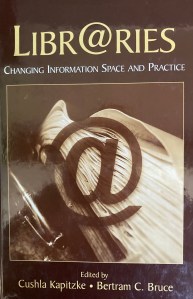
Libr@ries: Changing information space and practice

Libr@ries examines the social, cultural, and political implications of the shift from traditional forms of print-based libraries to the delivery of online information in educational contexts. Despite the central role of libraries in literacy and learning, research of them has, in the main, remained isolated within the disciplinary boundaries of information and library science.


Continue reading

Muzzling science

I know the world of universities and research is pretty small in the greater scheme of things, and therefore not discussed much on the TV news or in newspapers. As a result, it may not be obvious how much Federal policies since 9/11 have impacted research and higher education.

For example, consider this comment from a discussion list regarding a venue for the Association of Internet Researchers (AoIR) conference:

Canada as a north American venue has a lot of appeal for many of our members for various reasons, one of the more important ones being visa issues (most say it’s easier to get visas for Canada than the US, and also some are uncomfortable with the fingerprinting procedure in the US and don’t want to do that).

The AoIR will probably not meet in the US next time. This is happening for other conferences, especially in the newer fields, such as Internet Research.

Put that together with new restrictions on access to scientific and technical information, new barriers for students and researchers from other countries coming to the US, cutbacks in support for research at both the National Institutes of Health and the National Science Foundation, gag orders on scientists (as we saw last month at NASA), distortions of scientific findings (as in the global warming case), and politicizing of scientific review committees. The result is a negative climate for research and higher education. The impact is already evident to researchers and those in higher education, and the impact on the larger economy is beginning.

For the European Union, this is a terrific opportunity to surpass the US. They’ve already initiated a major new research program openly promoted as a way to take advantage of the US policies and to lure the most promising young researchers away from the US. It’s also opened doors for India, China, and other countries.

There are of course national security arguments made for each of these new policies. But there is even stronger evidence that they actually weaken national security. For example, the clampdown on access to scientific and technical information is making it harder to develop responses to biological warfare. It’s also very hard to understand how losing our leadership position in science and technology will make us stronger.

What’s perhaps most worrisome is that muzzling people and information in this way means that it is increasingly more difficult to have open debate about the worth of the policies. As with the Patriot Act or the Detainee Treatment Act, the new laws come with criticism-proof provisions.

Someday, we should ask whether the effort to protect what we value is actually destroying it.

Planetariums: education or entertainment?

As you know, two of the major functions of museums are education and entertainment. David Leake, who is director of the Staerkel Planetarium (and a former student), asked an interesting question about planetariums, which are akin to museums, or include museums, depending on how you look at it:

Why do some planetariums focus on education while others focus on entertainment?

Before reading what he found, you have to know that astronomers study circles. The objects–stars, planets, galaxies, etc–are roughly circular and so are the ways they move in orbits. Diameter then becomes a very important thing to know. So, for example the sun is 100 times the diameter of the earth and as a result 1 million times as massive.

It turns out that planetariums are also circular. As their diameter doubles, their volume and hence cost go up 8-fold. Dave found that planetariums smaller than 75 feet in diameter are low-budget operations, which focus on education. They open up as needed, host school groups, and have programs designed to teach. Above 75 feet they shift to a focus on entertainment. There are high-interest shows (Harry Potter recently) with stiff admission charges.

Dave’s study (a masters thesis) is so beautiful, not only because it provides a plausible and empirically-supported account of a major divide in the field, but also because the account itself (in terms of diameter) is so well-suited to the object of study.

The closest analogy I can come up with for other types of museums is that museums for young people focus on both education and entertainment. They’re all about exploring what’s new, especially through all the senses. As the audience ages the museums gradually shift the emphasis to preserving artifacts. There’s less attention to employing all the senses, and more on conveying the needed information. Is that because the older folks become more conscious of preservation? Or have their senses dulled, so they just want to get the answer in the least amount of time?

Yale Russian Chorus

Last Saturday, Stephen appeared on WTNH TV (New Haven, Connecticut) representing the Yale Russian Chorus. You can see the story and video online . This was to promote a benefit concert called “Songs of Hope”, on January 29, for the Connecticut Bridge of Hope Summer Program for Russian Orphans.

The program brings older Russian Orphans to Connecticut in the summer in hopes of finding their “forever families”. The children spend about one month with a host family learning about family life, attending local day camps, and participating in a typical American summer experience.

Lycksele learning centers

On October 21, while I was in Sweden, I spent a day in Lycksele. There, I learned about an innovative organization called Akademi Norr from Regis Cabral, their EU coordinator. The organization emerged as the result of cooperation among 13 municipalities in four counties in northern Sweden. It initiates, coordinates, and implements higher education programs and courses for people in the north, in order to meet needs for both education and development.

Each of the 13 municipalities has its own learning center, typically housed with the community library. Akademi Norr works with the center, a local industry, community members, and a university to devise a specialized higher education program. The center offers meeting spaces, ICTs, local tutoring, and other services. Their program shares many similarities with the GSLIS Chicago program in LIS education.

For example, I visited one of these learning centers, Lycksele lärcentrum. Most of their website is in Swedish, but you can see a little bit more in English on education in Lycksele. They’ve set up several programs. One currently underway leads to a BS in Engineering, with a focus on GIS; another is for a BS in Nursing, with an emphasis on ICTs.

Students who have completed these programs have easily found jobs in their region, because the program is designed from the start to make that possible. This is especially important in a region with strong ties to the land and community. The program is also designed to meet the needs of local industries, which might otherwise have dfficulty finding qualified workers in such a sparsely-populated area (3.8 people/sq-mi in Lapland versus 223.4 people/sq-mi in Illinois)

The staff in the Lycksele lärcentrum as well as at Akademi Norr are very open to having people visit or study what they are doing. There are possibilities for funding through iorganizations such as the American-Scandinavian Foundation . We could learn a great deal about community work, meaningful learning, ICTs in education, and more, through a better understanding of the learning centers programs.