While living in Dublin, I often walk past the Suas Foundation’s Bridge to College (B2C) space on Fenian Road. But I find it hard not to pause to see what’s happening inside. There’s always activity there.
 I first became aware of B2C when Brendan Tangney of Trinity College took me there to see the construction last fall. Even then, I could see it was special. It might be characterized as a computer access centre, but most of those that I’ve seen have computers in utilitarian rows, plain tables, and some bland color on bare walls. In contrast, I saw here the beginning of pods for small groups to work together on projects. There were low curved walls defining the pods, which promised just the right balance of privacy for the groups and the possibility of communication across groups. When Maxine Greene talks about transformation of public spaces to promote democratic engagement, I know she means far more than furniture, but I nevertheless felt that this was a tangible expression of making spaces work for people and for more inclusive learning.
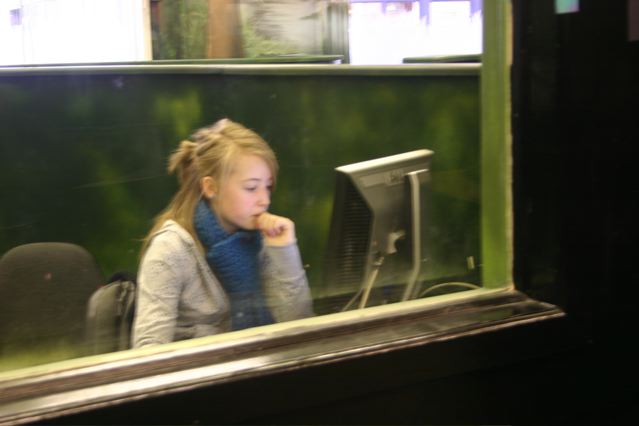
 Soon, I saw a primeval forest emerging. A thick, green carpet suggesting grass, or maybe pond vegetatio, grew on the floor, while a Lord of the Rings forest appeared on the walls, with ancient trees and mist rising from the swamp. That was just the room in the front. Through a doorway and a time-warp window I could see a nightclub or cafe in the second room. It had black walls with a cityscape, and rising above that, surrealistic images. The whole thing made me want to explore and to be a part of whatever was going to happen there. It’s an attractive space with computers organized into pods, projectors, digital cameras, printers, and other tools, as well as a physical space with meeting areas, movable furniture, room to move about, and a small stage.
 On later visits, I met with developers Claire Conneely and John Lawlor. I learned that this wasn’t just a pretty space. I saw Transition Year students engaged in serious, challenging, collaborative, multimedia projects. For example, they would take a video camera in to the neighboring community (between Trinity and the Liffey River). They’d film objects, the neighborhood, and themselves, then edit the video. The next day, they would take on a social action multimedia campaign–visit your elderly relatives over the holidays, stop using drugs, give aid to Africa, and so on. The project involved web-based research, then the creation of a poster, with text, images, and graphics. Later they would produce a radio spot for the same campaign. At the end of the week, they would make a web page integrating all of their work.
 Over three and a half days, students, some of whom might have been on the verge of quitting school, would demonstrate facility with digital video, video and audio editing, web search, graphics, design, web page construction, all in the service of and as an aid to learning about living responsibly in the world. In so doing, they also learned about working together and completing complex tasks. Rather than being monitored or guided every step of the way, they relied on just a mentor, who was just a few years older. The mentor was also a student, but at third level, and was typically learning along with the younger students. There are plans now for a second tier of mentoring, in which the Transition Year students would mentor 11-year-olds.
 I could point about many good things about the space and the programme. There is a good mix of using diverse technologies effectively, collaboration within and across groups, project-based work, inquiry, reflection, and problem-solving. I’ve seen the value of those aspects in some other projects. But three other things stand out for me with B2C:
 First, although the technologies are used in intensive and complex ways, their use is not the end. All of the activities fit together into a unified whole, which extends beyond the technological fluency. In the cases I’ve seen there, students are addressing questions that go beyond B2C or their normal schooling to seek positive transformation of their social lives. Of course, I’d love to hear that the radio spots are actually aired and the poster distributed and read, or that the campaigns extend beyond the week. But even so, there’s a clear realization here of John Dewey’s idea of connecting school and society.
 Second, as I said above, there is a remarkable approach to seeing space and physical facilities as something to be constructed to serve human ends, rather than as a given that constrains what we can do. Many community technology centres or computer labs in schools do a good of managing the digital technologies effectively, but they rarely have the resources, or perhaps the vision, to see that the physical space can be something that is inviting, reinforcing, and conducive to productive social interaction. Here, the physical space is treated as seriously as the choice of software or projectors.
 Third, B2C is a useful facility, but far more than that, it is an artistic creation, and here, I speak of the totality–the painted walls, the furniture, the window to see from city to forest or forest to city. It reminds us of Jane Addams’s call that the first furniture for Hull House should be art on the walls, or the view prevalent in Chinese schools that the aesthetic side of learning is as important as the cognitive.







 Twelve young people from the Docklands area not only star in the film, but devised it based on their own experiences there. Philip McMahon wrote the actual script following interviews with the young people; it was directed by Colin Thornton. I thought it was an excellent portrayal of the challenges facing many young people today.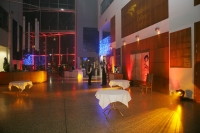



 Chip's journey