Community as Intellectual Space: Aesthetics as Resistance

CIS flyer The 4th Annual Community as Intellectual Space symposium is being held this week at Paseo Boricua in Chicago, June 13-15. Events will start at the Puerto Rican Cultural Center (PRCC), 2739/41 W. Division (near corner of Division and California).

This year, the focus is on Aesthetics as Resistance: The Act of Community Building. There will be artist-led tours of the beautiful murals found throughout the neighborhood, the annual People’s Parade, a delicious Puerto Rican dinner, workshops on community-education activities as diverse as urban agriculture and computer programming for children using Squeak, meetings with local Humboldt Park/Paseo Boricua community and government leaders, including Rep. Luis Gutierrez and Rep. Cynthia Soto, and panels on liberatory education. [Click to enlarge the poster or follow the link above for more details.]

Aesthetics as Resistance promises an active dialogue on art, identity, and cross-cultural community building with community leaders, artists, educators, librarians, activists, students, and residents. It expresses the PRCC’s vision to build community grounded in cultural practice, including murals, poetry, music, and the People’s Parade. These practices are both creative and political acts to develop community out of local funds of knowledge.

Paseo Boricua has a motto: ‘Live and help others to live.’ It is known for its multigenerational and holistic community activism around human rights and social change. Education is structured around the belief that ‘the community is the curriculum,’ reflecting the ideas of Paulo Freire and providing a contemporary version of Hull House.

With its many academic partnerships, Paseo Boricua also provides an outstanding example of university-community collaboration in research, teaching and public engagement. For example, last year the community hosted a tour and visit for the John Dewey Society. This furthered dialogue around how the community answers Dewey’s call for critical, socially-engaged citizens, for an active public, and for education as lived experience.

[This announcement is also posted on the John Dewey Society Social Issues blog.]

Garrotxa and Collsacabra

Before going to the conference in Girona on the future of the university, we spent a few days in the Pyrenees (Pireneus in Catalan), mostly in Garrotxa county (camarca) and in Vall de Sau Collsacabra. Collsacabra is a high plateau in the north-east part of Osona county; it’s also called Cabrerès.

Here are some photos; click on any photo to enlarge it.

from-mas-el-solanotgarrotxa1

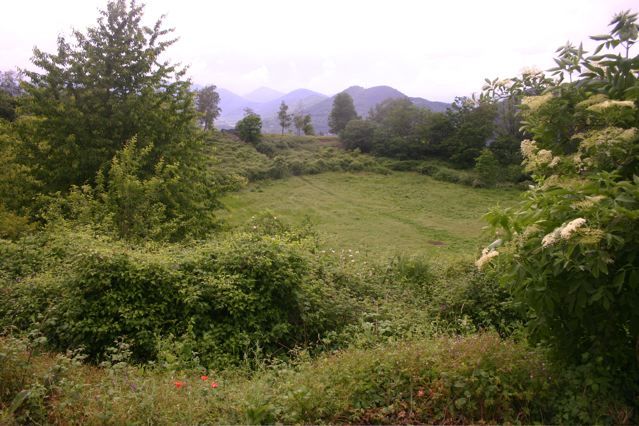
Following a night in Barcelona, we traveled north past Vic and Rupit to a beautiful stone house high on a mountainside. You can see here the view from our room in Mas El Solanot. Notice the tabletop mountains and cliffs, as well as architecture going back to the Middle Ages and even Roman times.

We were staying on the edge of La Garrotxa, which is about 1/4 the size of Champaign County in terms of area and population. It looks very different because of its 40 volcanoes and many cliffs, not to mention the medieval architecture, Mediterranean flora, and red tile roofs.

Volca Montsacopavolca

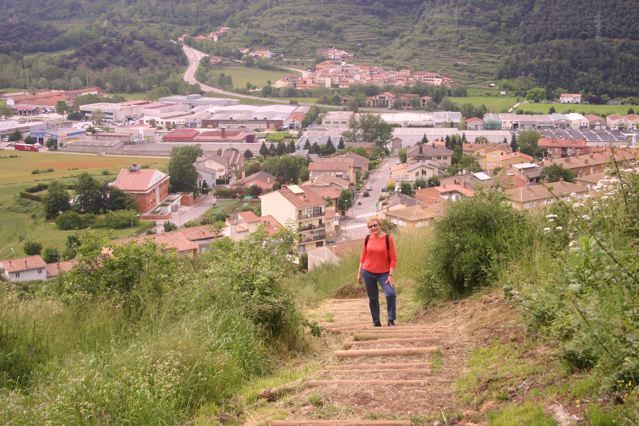
We traveled to many of the volcanoes in Garrotxa. Here we are climbing up to look at the crater of Volca Montsacopa, in the center of Olot.

colades The photo on the left is from the Route of Les Tres Colades, with its spectacular basalt cliffs. It shows the results of the cooling of the lava as it flowed towards the site of what is now Sant Joan les Fonts.

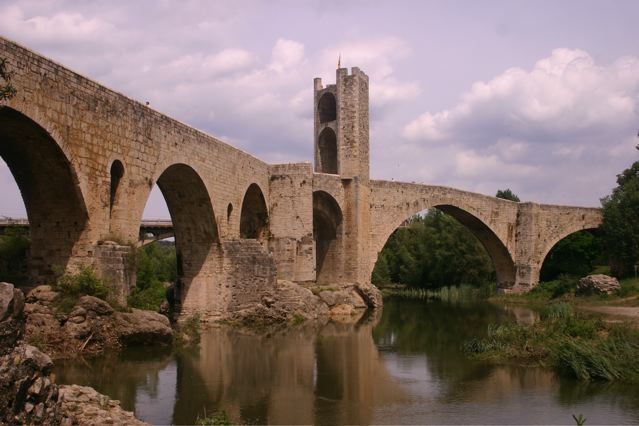
besaluOn the right is a 12th-century Romanesque bridge in Besalú with a portcullis in center. It was partially destroyed during the Spanish Civil War, then rebuilt in the 60’s.

rupit A view of Rupit and the nearby Salto de Sallent, a 100-meter waterfall. The photo below shows a cascade upstream from the main fall. There was an iron cross embedded in the rock, presumably marking the spot where someone had come too close to the edge. I decided not to go up closer to investigate. But it was impressive to see that the unpaved road crosses the stream above the main fall, going through six inches of water just a few feet from the 100-meter drop.

salto-sallentsalto-sallent1

girona girona2

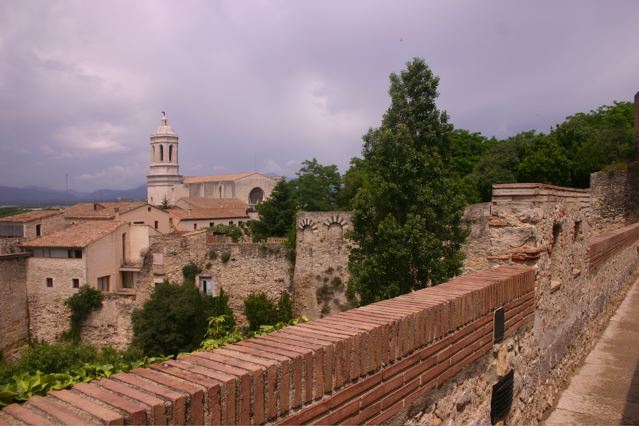
Scenes from Girona, where the conference was held. The cathedral perches on a hill in the center of the beautiful old town (Barri Vell), which lies just across the Onyar River

The student as the axis of change in the university

Univest 08 I just returned from the Univest 08 conference: The student as the axis of change in the university, which was held on June 2-3 in Girona, Spain. There were excellent presentations and discussions, for me aided considerably by simultaneous translation from Spanish or Catalan into English.

I thought that it worked very well to have students respond to the major presentations. It’s also hard to think of a more pleasant place to hold a conference than Girona, with outstanding restaurants, a beautiful old city, large parks, rivers, and great museums.

Girona wall, cathedralOne motivation for the conference was the European Convergence Process, a scheme to make Europe competitive with the United States in tertiary education. Beginning in 2010, more than 40 European countries will participate in the European Space for Higher Education, in which students, professors, and researchers will be able to move about without borders.

img_73581The aim of the process, which began in 1999 in Bologna is to produce a higher-quality, more homogeneous system, which is also more competitive in its teaching methods. A hope is that it will help build a society based on European knowledge, manifesting in culture and education the convergence that is already underway in the political and economic arenas.

The conference brought together teachers, students, administrators, and people from government and industry around topics, such as:

  • Student-centered instructional planning
  • Learner self-regulation
  • Student supervision and tuition
  • Student participation in university life
  • Experiences outside the classroom

My own talk was on student-centered learning, particularly on helping students by getting them to focus not on themselves, but instead on their communities.

Africa Day, Dublin

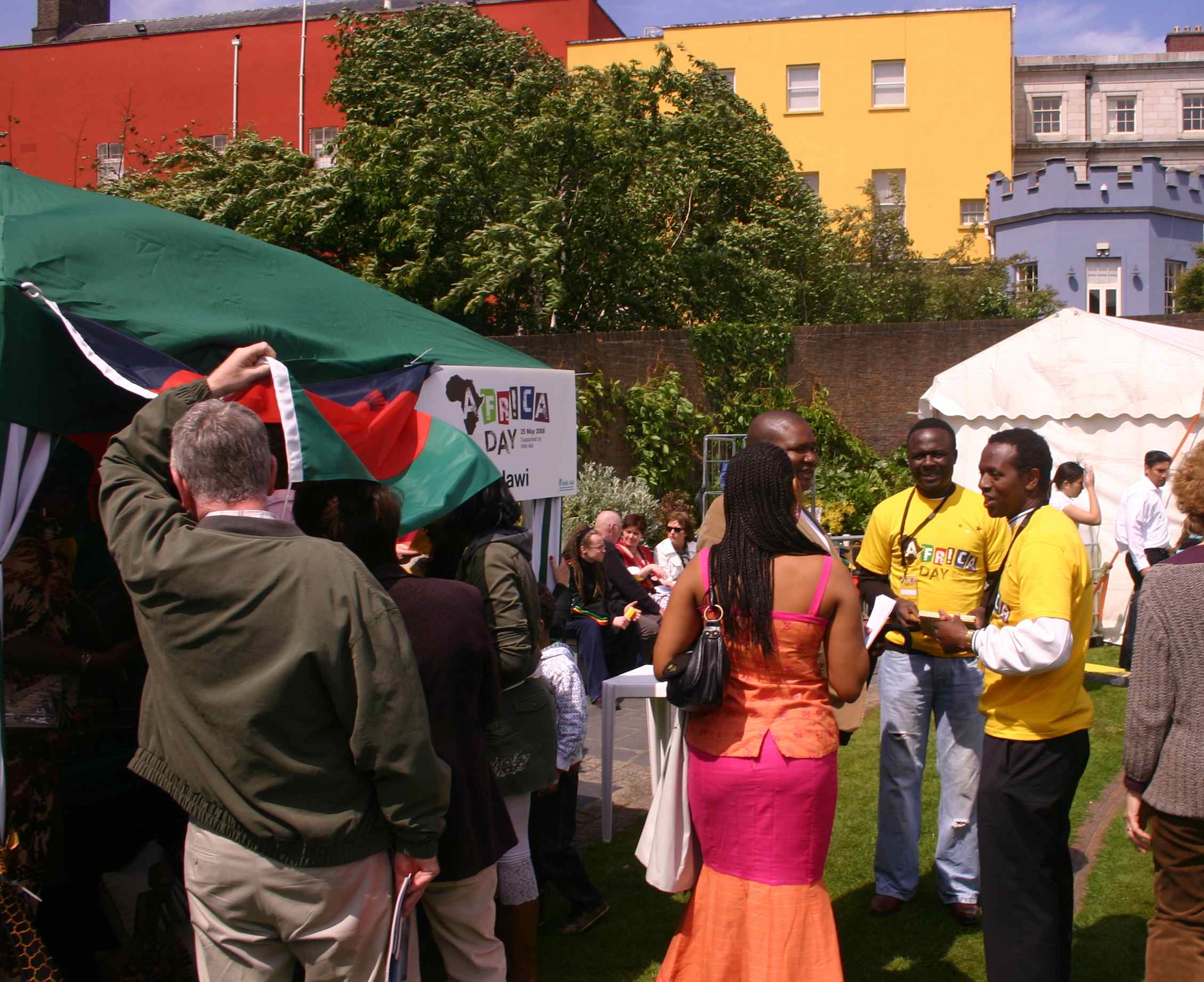
May 25 was Africa Day, the commemoration of the founding in 1963 of the Organisation of African Unity, which later became the African Union. In honor of that, the Irish Aid organized a wonderful set of Africa Day events, held at the Irish Film Institute, the National Botanical Gardens, and other venues. We went to those at Dublin Castle and the Chester Beatty Library.

There were musical performances and dance, lectures, storytelling sessions, photography exhibits, arts and crafts, and food from many regions and cultures of Africa.

A notice prior to the event advised bringing suncreen and umbrellas for the rain, which was a good indication of the variability in the weather this time of year in Dublin. But the weather turned out to be friendly and helped make it a worthwhile day all around. By mid-afternoon there was a line to get in to the Dublin Castle grounds. I hope this becomes an annual event.

Reading versus first-hand experience

Three thoughts regarding reading and first-hand experience:

MUCH have I travell’d in the realms of gold,
And many goodly states and kingdoms seen;
Round many western islands have I been
Which bards in fealty to Apollo hold.
Oft of one wide expanse had I been told
That deep-brow’d Homer ruled as his demesne:
Yet did I never breathe its pure serene
Till I heard Chapman speak out loud and bold:
Then felt I like some watcher of the skies
When a new planet swims into his ken;
Or like stout Cortez, when with eagle eyes
He stared at the Pacific—and all his men
Look’d at each other with a wild surmise—
Silent, upon a peak in Darien.
—John Keats, “On first looking into Chapman’s Homer”

No book or map is a substitute for personal experience; they cannot take the place of the actual journey. The mathematical formula for a falling body does not take the place of throwing stones or shaking apples from a tree.
—John Dewey, Schools of tomorrow

There are some who say that sitting at home reading is the equivalent of travel, because the experiences described in the book are more or less the same as the experiences one might have on a voyage, and there are those who say that there is no substitue for venturing out in the world. My own opinion is that it is best to travel extensively but to read the entire time, hardly glancing up to look out of the window of the airplane, train, or hired camel.
—Lemony Snicket, Horseradish: Bitter truths you can’t avoid

Technology in Docklands Education

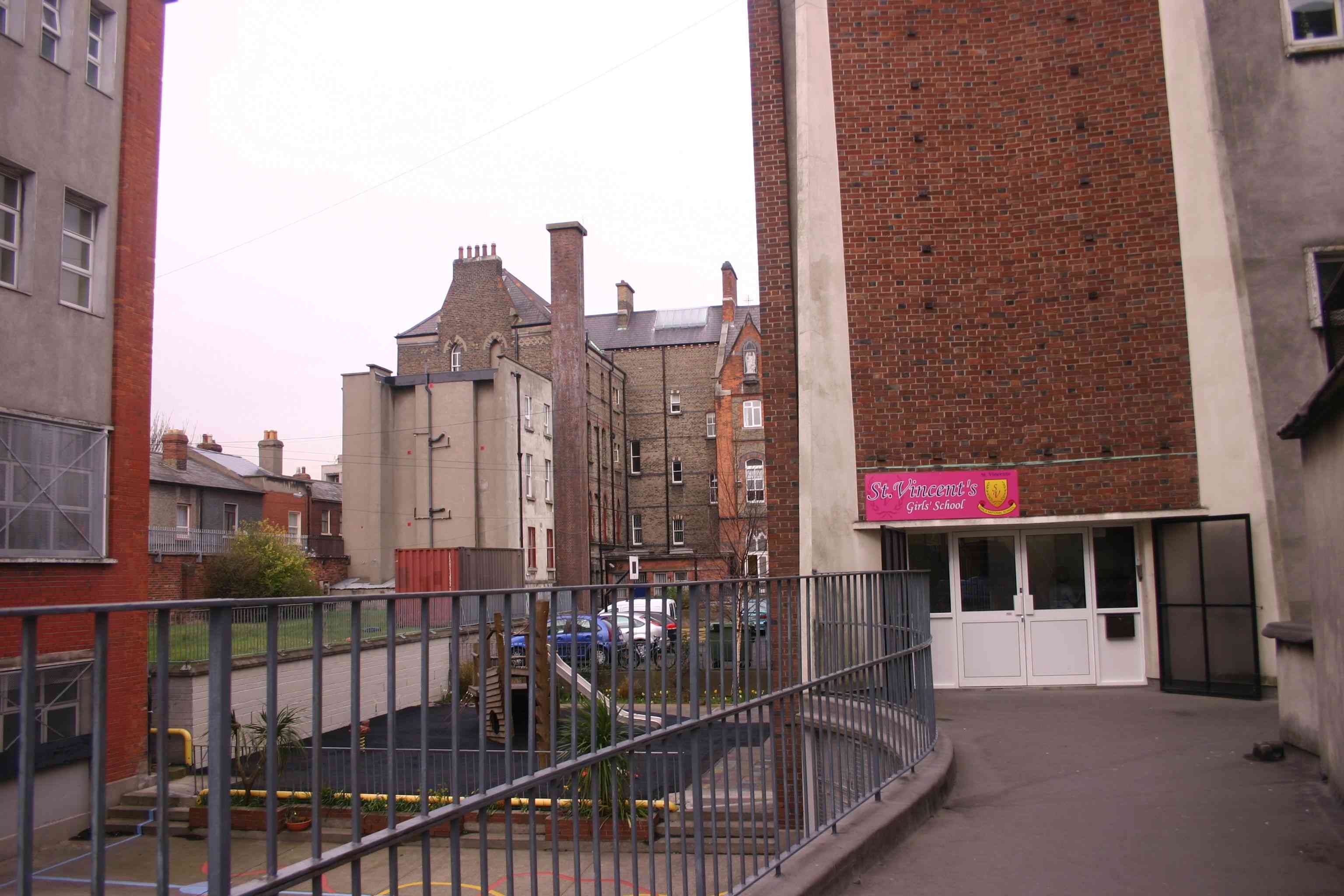
One of the most interesting experiences for me this year in Dublin was to work with Abi Reynolds and Leo Casey on the Technology in Docklands Education (TIDE) project. The aim was to meet with 24 Docklands-area schools and other partners to investigate the current use of technologies in teaching and learning, to document their experiences, and to report on current and future needs. Most of the schools are in one of the DEIS categories (officially disadvantaged). You can see the entrance to one of the TIDE schools, the St. Vincent’s Girls School on North William St., in the first photo.

St Vincent\'s, North William StThe research design involved face-to-face interviews with principals and teachers, followed by an online survey. We learned about the school library, computer resources, interactive whiteboards, digital cameras, and other resources. We also observed some ICT-based activities in the classrooms or neighborhood.

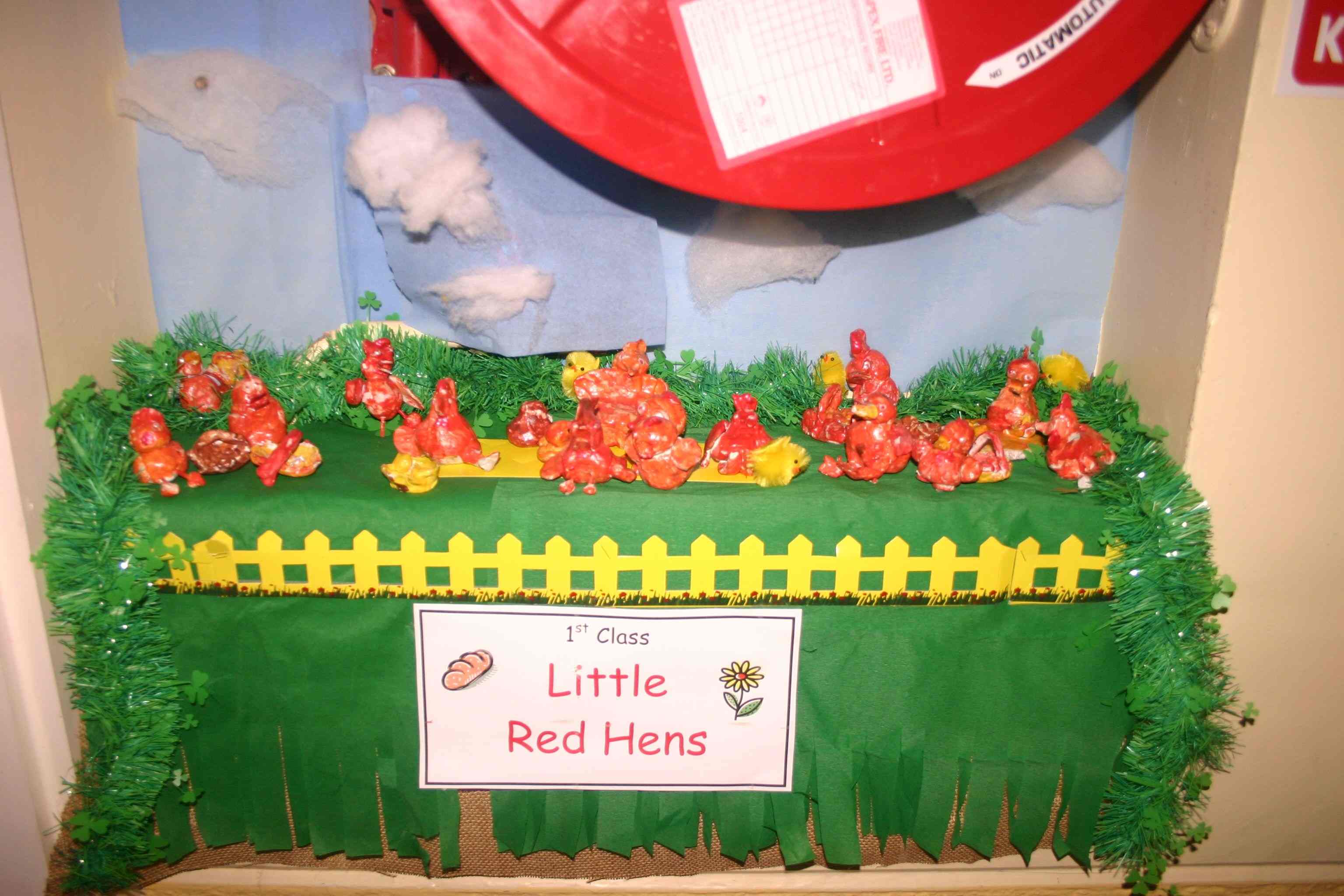
For the analysis, we used scenario-based design (Carroll & Farooq, 2005) to describe the current situation and to identify needs. This led to producing scenarios of use—stories about exemplary projects, such as a stop-action animation involving Little Red Hens (see second photo). We also identified scenarios of support—stories of ways that the schools could be helped to enhance learning.

Visiting the schools gave me a good sense of education in inner-city Dublin, but also of the local communities. I became familiar with landmarks such as Five Lamps, Sheriff Street, and Ringsend, and learned about how Fairview Park near the River Tolka originated through landfill.

Many of the joys and challenges in the schools seemed similar to what I’ve seen in schools in China, Australia, Russia, the US, etc. But I also found myself expecting to be surprised as each school revealed its own special identity. One Principal told us that they had a large population of Filipino children, in part related to the demand for health care workers in the nearby hospitals. He said it had transformed his school, with all of the children becoming more interested in language, culture, and geography.

References

Bruce, Bertram C., & Reynolds, A. (2010, February, in press). Technology in Docklands education: Using scenarios as guides for teaching and research. Educational Studies, 36(1).

Carroll, J. M., & Farooq, U. (2005). Community-based learning: Design patterns and frameworks. In H. Glllersen, K. Schmidt, M. Beaudouin-Lafon, & W. Mackay (Eds.), Proceedings of the 9th European Conference on Computer-Supported Cooperative Work (Paris, France, September 18-22, 2005), pp. 307-324. Dordrecht, The Netherlands: Springer.

Our presentation to the Principals and teachers:

Mother Jones

This May, I feel connections to Mary Harris Jones, who was born in 1830, possibly on Mayday, in Cork, Ireland. She was a prominent labor and community organizer in the US, best known as Mother Jones. Her birthplace is in one of my favorite counties in Ireland and her burial place is not too far from my home in Illinois in the Mount Olive Union Miners Cemetery. That cemetery is also the home for coal miners killed in rioting associated with strikes which she had led.

Mother Jones’s legendary work during her 100 years of life is an inspiration. Her concern for working people caused her to be at odds with union leadership at times, as well as with companies or government. This combativeness led to her being called many things, including the “Miners’ Angel.”

Another labor organizer described her as “the greatest woman agitator of our times.” A DA called her “the most dangerous woman in America,” because she could inspire supposedly contented workers to demand their rights. When a Senator denounced her as the “grandmother of all agitators”, she answered, “I hope to live long enough to be the great-grandmother of all agitators.” She herself said “I’m not a humanitarian; I’m a hell-raiser.” I can’t pretend to or even fully imagine anything like the life she led, but I still admire her courage and caring.

Mother Jones magazine

Beyond place and dates, I feel a connection to Mother Jones in that I find the magazine named after her, to be one of the best sources for insights into current events. It probes deeper into issues than mainstream news services such as NY Times, BBC, or Deutsche Welle and has more factual content than most blogs or opinion magazines.

A good example, and what I started to write about today, is an article called Irony Man, by Nick Turse. It’s in part a review of the film Iron Man, but is really more a review of America’s disastrous foreign policy and how its most enduring harm may be to our own psyche and culture.

Dodder birds

Dodder walkFor much of my time here in Dublin, I’ve walked to work alongside waterways. First, it was the Liffey River. Then for a long time it was the Dodder, the second large, remaining, and still aboveground river in Dublin. Sometimes, it has been the Grand Canal. Each of the waterways has its collection of birds, the best being those along the Dodder.

I would often see a grey heron just downstream from the bridge near our apartment. There is also a pair of mute swans, who swim almost always close together, but every few weeks they have a day when they separate by a half mile. There are two main types of gulls, one I think being a Galway gull. swan in DodderThey’re fond of standing on the walkway’s stone railing, until I’d get with 44.5 inches, or was it 46.3?

Near where the Dodder joins the Liffey, I occasionally see cormorants. Further upstream mallards are very common and also moorhens, but they’re a little harder to see because they hang out below the brush near the bank. Magpies will also come down to the water at times.

mallardNote: The distant, red cranes in the photo of the walkway aren’t the feathered kind.

The Fís Book Club

Fis Book Club

The Fís Book Club has received an enthusiastic response from schools here in Ireland, and now in the UK. Fís means “vision” in Irish, and also stands for Film in Schools. It’s been developed at the Institute of Art, Design, and Technology in Dun Laoghaire.

The Fís Book Club is essentially a web-place where children post video book reviews based on their independent reading. The methods for making and posting the reviews are simpler and more straightforward than on other sites I’ve seen, thus allowing the focus to be on the reading and response.

The collected video book reports form a child-friendly online video Book Review Catalogue, which is accessible only to the participating schools. Teachers and children within the project can watch the videos of other children’s book reviews, find books they might like to read, or compare responses. There are no advertisements in the site.

Death and taxes

An excellent report from Christian Aid Ireland has just been published. It paints a graphic and disturbing picture of the global economic system and the devastating impact of policies sustained by transnational corporations (TNC) and the governments that serve them. Have any of the US Presidential candidates even mentioned issues such as this?

The report, Death and taxes: the true toll of tax dodging, shows how the global taxation system allows the world’s richest to avoid social responsibilities while continuing to under-develop much of the world. This system costs poor nations far more than they receive in all the governmental and private aid. It’s essentially a relentless mechanism for taking money from the poor to give to the rich.

As the report says,

This is in part to do with super-rich individuals. It is also to do with governments, including the UK government, who have let this situation develop and persist. But it is mostly about the world’s transnational corporations wielding their enormous power to avoid the attentions of the tax man – with devastating results.

The situation is stark and urgent. We predict that illegal, trade-related tax evasion alone will be responsible for some 5.6 million deaths of young children in the developing world between 2000 and 2015. That is almost 1,000 a day. Half are already dead.

Corporations “avoid…the tax man” in various ways, including setting up legal schemes for tax-avoidance and demanding tax concessions and low royalty rates on output. They also use false accounting, such as fake invoices, mispriced transfer of goods, services, and finances, and illicit transfers of cash.

Research by Raymond Baker, a senior fellow at the US Center for International Policy, says that 7 per cent of global trade involves the illicit movement of capital between countries by TNCs and other business entities. Transfers of goods and services within a TNC are mispriced to take advantage of differing tax rates and to minimise profits where they are high. Accomplices in unrelated companies issue false invoices to disguise the profits made in a transaction and reduce the tax liability. Baker says:

For the first time in the 200-year run of the free-market system, we have built and expanded an entire integrated global financial structure the basic purpose of which is to shift money from poor to rich. [It is] the ugliest chapter in global economic affairs since slavery.

The Death and Taxes report provides much more detail on the real, immediate, and personal impact of what may seem to be an obscure or esoteric issue. It also offers recommendations for what can be done about it. The data and analysis support the efforts of the Organisation for Economic Co-Operation and Development to regulate tax havens and end the secrecy. They also show the urgent need for an international accounting standard that requires companies to reveal country-by-country accounting.

Aid from organizations such as Christian Aid Ireland is vital in today’s world. But the bottom line on the accounting here is that if wealthy nations abandoned all their aid programs they would be more decent partners in the world than they are now, if they simply acted honestly and fairly with others.