Creative democracy: Yes we can!

Yesterday’s election of Barack Obama as President of the United States was not only promising for our future, but was also a moving reaffirmation of all that America can be.

His Presidency may not fulfill all the dreams that the candidacy inspired; some things may not change at all. But it reminds me of what Thurgood Marshall said after the Brown v. Board of Education decision in 1954, which outlawed segregated schools. When asked what the Supreme Court ruling really meant, Marshall, said that in fact nothing had changed, except that henceforth, repeating the civil rights mantra, “the law is on our side”. In a similar way, Obama’s Presidency offers no guarantees, but does offer exciting possibilities in terms of uniting Americans and restoring America’s role in the community of nations.

The election of Obama is also a reminder that democracy is not a static system, but a process in need of continual renewal by all. Dewey (1976/1939, p. 230) expresses this in his essay, “Creative democracy: The task before us”:

Democracy as compared with other ways of life is the sole way of living which believes wholeheartedly in the process of experience as end and as means; as that which is capable of generating the science which is the sole dependable authority for the direction of further experience and which releases emotions, needs and desires so as to call into being the things that have not existed in the past. For every way of life that fails in its democracy limits the contacts, the exchanges, the communications, the interactions by which experience is steadied while it is also enlarged and enriched. The task of this release and enrichment is one that has to be carried on day by day. Since it is one that can have no end till experience itself comes to an end, the task of democracy is forever that of creation of a freer and more humane experience in which all share and to which all contribute.

Let’s have the audacity to hope that we are capable of creating of “a freer and more humane experience in which all share and to which all contribute.” I might add that John McCain’s concession speech was a gracious and thoughtful step in that direction.

References

Dewey, John (1976). Creative democracy: The task before us. In J. Boydston (Ed.), John Dewey: The later works, 1925-1953, volume 14 (pp. 224-230). Carbondale: Southern Illinois University Press. (Original work published 1939)

Kluger, Richard (1977, 1975). Simple justice. The history of Brown v. Board of Education and Black America’s struggle for equality. New York: Vintage Books.

the informal education site

Here’s a vote for infed.org on a big election day in the US: When needing to investigate the topic of multiculturalism recently, I was reminded again of the site, a great starting point for “exploring the theory and practice of informal education, lifelong learning and social action.” The articles are well-written and have good source lists. For example, see ‘race’ and difference – developing practice in lifelong learning, a recently updated piece by Mark K. Smith.

infed (the informal education homepage) was established in 1995 as an open, independent and not-for-profit site.

Put together by a small group of educators, it is now accessed around 6 million times a year.

a space to explore

Our aim is to provide a space for people to explore the theory and practice of informal education, social action and lifelong learning. We want to encourage educators and animateurs to develop ways of working and being that foster association, conversation and relationship.

via about us @ the informal education homepage

LIS 590 IBL, Inquiry-Based Learning, Spring 2009

We’ve changed the format for my spring course, Inquiry-Based Learning. It was originally scheduled as a LEEP (online) offering, LIS 590 IBO, but will now instead be offered on campus as LIS 590 IBL. Please share this description with anyone who may be interested.

  • Course: LIS 590 IBL, Inquiry-Based Learning (CRN: 36880)
  • Instructor: Bertram (Chip) Bruce
  • Semester: Spring, 2009
  • Prerequisites: Graduate student status
  • Schedule: Mondays, 9:00-11:50 am, 109 LISB
  • Website: http://illinois.edu/goto/ibl

Inquiry-based learning is a powerful way of thinking about learning as it occurs in libraries, museums, community centers, homes, workplaces, or online, as well as in formal settings, such as schools and universities. It implies the creation of environments in which learners are actively engaged in making meaning through personal and collaborative inquiry. It does not ignore the usual focus on content/skills: “What should be taught?,” or method: “How should we teach?” but begins with even more basic questions about the nature of learning and life.

Because of this, considerations of inquiry-based learning lead directly to issues of lifelong learning, the nature of knowledge, purpose, social justice, and democracy. This broad sweep makes it impossible to encapsulate inquiry-based learning in a simple framework or method. But it is also an indication of its importance in defining ways of thinking about the meaning of community, the roles of teachers and students, the relations between school and society, and how learning and life go together.

In the course we will examine the nature of inquiry and of inquiry-based learning, drawing on philosophical, historical, and critical sources such as Jane Addams, John Dewey, Paolo Freire, and Myles Horton. We’ll read about, observe, and engage in inquiry-based learning. In the course of this, we’ll also consider challenges to inquiry-based learning, including those related to management, assessment, basic skills, cultural differences, and pedagogical goals.

Income inequality is rising in most OECD countries

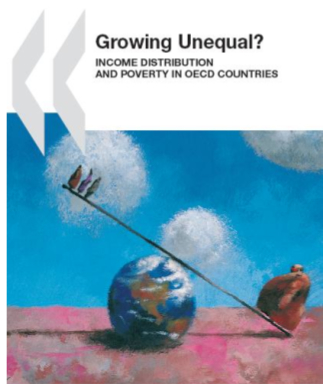
According to a new Organisation for Economic Co-operation and Development report, Growing Unequal? Income Distribution and Poverty in OECD Countries, a combination of globalization, economic growth, and other societal changes has not only led to a larger gap between rich and poor nations; it’s also led to a growing gap between rich and poor in more than three-quarters of OECD countries over the past two decades.

Of the OECD countries, except for Mexico and Turkey, the United States has highest inequality level and poverty rate. Since 2000, income inequality has increased rapidly, accentuating a long-term trend that began in the 1970s.

OECD’s Growing Unequal? finds that the economic growth of recent decades has benefitted the rich more than the poor. In some countries, such as Canada, Finland, Germany, Italy, Norway and the United States, the gap also increased between the rich and the middle-class.

Countries with a wide distribution of income tend to have more widespread income poverty. Also, social mobility is lower in countries with high inequality, such as Italy, the United Kingdom and the United States, and higher in the Nordic countries where income is distributed more evenly.

Launching the report in Paris, OECD Secretary-General Angel Gurría warned of the dangers posed by inequality and the need for governments to tackle it. “Growing inequality is divisive. It polarises societies, it divides regions within countries, and it carves up the world between rich and poor. Greater income inequality stifles upward mobility between generations, making it harder for talented and hard-working people to get the rewards they deserve. Ignoring increasing inequality is not an option.”

via Income inequality and poverty rising in most OECD countries

Idealizing torture

It’s good that people are talking about the issues of renditions, prisons, and torture; too many others treat them as outside of their lives, even though our public policies have very real consequences for people every day. My last post, Once-secret memos endorse CIA torture tactics generated an email comment from someone who said that she “could justify torture if it meant avoiding as many deaths as occurred in 9/11.”

Of course, we’re fortunate in one sense that torture is not a familiar part of most of our lives. But the result is that we idealize it. For many people it’s the glorified version they see on television, as on 24, in which heroes suffer but survive, and bad guys get what they deserve. In that idealized world, moral choices appear more clear-cut: Is it OK to torture one evil person so that thousands of lives can be saved?

But in the real world, there is no evidence that torture actually works:

There is almost no scientific evidence to back up the U.S. intelligence community’s use of controversial interrogation techniques in the fight against terrorism, and experts believe some painful and coercive approaches could hinder the ability to get good information, according to a new report from an intelligence advisory group.

Those TV situations don’t happen, for a variety of reasons. We end up torturing innocent people (who have never even been tried). People who defend torture should be asking, not “is there any conceivable situation in which torture could be justified?”, but “what is the cost of abusing our Constitution, our laws and our moral values? are we absolutely sure that it’s worth it? when we start down that path, how do we decide where to stop?”

I’ve signed the petition at the National Religious Campaign Against Torture (NRCAT); to say that I don’t believe we should be on the path at all.

References

Aftergood, Steven (2007, January 15). Intelligence Science Board Views Interrogation. Federation of American Scientists.

Intelligence Science Board (2006, December). Educing Information: Interrogation: Science and Art: Foundations for the Future, Phase 1 Report (374 pages, 2.5 MB).

Once-secret memos endorse CIA torture tactics

When I was younger I read about torture in other countries and times, with a sense of fear and revulsion. Later I learned about the School of Americas in Fort Benning, Georgia (since renamed as the Western Hemisphere Institute for Security Cooperation). There, the US Army trains Latin American security personnel using training manuals that advocate torture, extortion, and execution. Graduates of the School, including notorious dictators, are responsible for some of the worst human rights abuses in Latin America. But I sought a scintilla of relief in the idea that the torture didn’t actually happen here.

In recent years, I learned about the CIA rendition program, set up during the Clinton administration, and expanded under Bush, in which people are kidnapped and transferred to countries that practice torture, thus violating the long-standing international legal principle of nonrefoulement. Again, one might grasp for a moral distinction between enacting and simply aiding torture. When we learned about Abu Ghraib torture and prisoner abuse, we saw that, too, as far away. We were told that it wasn’t actually authorized, even though official rhetoric and policies might have set the stage for it.

In all of these cases, we kept grasping for distinctions–someone else carried out the torture, even though we taught them how to do it; some other country’s laws were barbaric, though we kidnapped people, denied them trial, and took them there, knowing full well, even desiring, what would happen; some low-level soldier abused, even killed detainees, but we had trained them, defined their mission, demonized the people they were sent to aid, and then conveniently looked the other way.

Throughout, we kept asserting that while we associate with others who do unspeakable things, we don’t do it ourselves. After all, if we were to begin to engage in torture, where would it end? How would we be any different from those dictatorships and totalitarian regimes?

We’re even uneasy talking about it:

As recently as last month, the administration had never publicly acknowledged that its policymakers knew about the specific techniques, such as waterboarding, that the agency used against high-ranking terrorism suspects. In her unprecedented account to lawmakers last month, [Condoleezza] Rice, now secretary of state, portrayed the White House as initially uneasy about a controversial CIA plan for interrogating top al-Qaeda suspects.

Last week we learned that, well, we don’t just train others to torture; we don’t just write training manuals for torture; we don’t just ship people off to countries that torture; we don’t just have a few aberrant soldiers who stray from the official line:

The Bush administration issued a pair of secret memos to the CIA in 2003 and 2004 that explicitly endorsed the agency’s use of interrogation techniques such as waterboarding against al-Qaeda suspects — documents prompted by worries among intelligence officials about a possible backlash if details of the program became public.

In this case, the CIA itself knew it was crossing the line, that there could be a public backlash directed at them. It insisted on written authorization before continuing.

The Bush administration quickly complied. Why? Because, like the many Latin American dictators who had been trained by the School of Americas, they thought the torture would serve their purposes and they knew they could get away with it. Americans who had learned to accept the School of Americas, the CIA rendition program, and Abu Ghraib prisoner abuse, had become all too ready to accept that it does actually happen here. And it’s not just someone else who does it. It’s not against policy. It is the policy, and it’s our leaders who make it happen.

References

Mayer, Jane (2005, November 14). A deadly interrogation: Can the C.I.A. legally kill a prisoner?. The New Yorker.

Warrick, Joby (2008, October 15). CIA tactics endorsed in secret memos: Waterboarding got White House nod. Washington Post.

Powell asks, “What if he is?”

Colin Powell’s endorsement of Barack Obama for President was a powerful statement from a much-respected figure. It will certainly help Obama’s campaign. But at least as significant was his challenge of Islamophobia:

I’m also troubled by, not what Senator McCain says, but what members of the party say, and it is permitted to be said. Such things as ‘Well you know that Mr. Obama is a Muslim.’ Well the correct answer is ‘He is not a Muslim, he’s a Christian, he’s always been a Christian.’ But the really right answer is ‘What if he is? Is there something wrong with being a Muslim in this country?’ The answer is ‘No. That’s not America.’ Is there something wrong with some 7-year old Muslim-American kid believing that he or she can be president? Yet I have heard senior members of my own party drop the suggestion he’s a Muslim and he might be associated with terrorists. This is not the way we should be doing it in America.

gugart@msn.com">Photo courtesy of Tom Gugiluzza-Smith, August 2008</a>I feel strongly about this particular point because of a picture I saw in a magazine. It was a photo-essay about troops who were serving in Iraq and Afghanistan. And one picture at the tail end of this photo essay was of a mother in Arlington Cemetery and she had her head on the headstone of her son’s grave. And as the picture focused in you can see the writing on the headstone. And it gave his awards, Purple Heart, Bronze Star, showed that he died in Iraq, gave his date of birth, date of death. He was 20 years old. And then at the very top of the headstone, it didn’t have a Christian cross, it didn’t have a Star of David. It had a crescent and a star of the Islamic faith. And his name was Karim Rashad Sultan Khan. And he was an American, he was born in New Jersey, he was 14 years old at the time of 9/11 and he waited until he can go serve his country and he gave his life. [Photo courtesy of Tom Gugiluzza-Smith, August 2008]

Powell is not the first to make this point, but it’s difficult to name another such prominent political leader who has done so. Others, including Obama himself, have focused on the fact that some statements about his ethnic or religious background have been false, not on the bigotry revealed by the very question itself. Ignoring the presupposition of those questions shows a lack of understanding and respect for the US Constitution, which should bring shame on Republican and Democratic leaders alike.

See Abed Z. Bhuyan, On Faith: Guest Voices: Powell Rejects Islamophobia

John Dewey in Turkey: Lessons for today

The Republic of Turkey was proclaimed on October 29, 1923. As its first President, Mustafa Kemal Atatürk (photo below) sought to establish the modern Turkey as a “vital, free, independent, and lay republic in full membership of the circle of civilized states.” He recognized the need for “public culture,” which would enable citizens to participate fully in public life, and saw the unification and modernization of education as the key. Accordingly, one of his first acts was to invite John Dewey, who arrived in Turkey just nine months after the proclamation.

In this endeavor, the ideas of Atatürk and Dewey were consonant. Dewey’s words above (“vital, free, …”) could have been written by Atatürk, just as Dewey might have talked about “public culture.” Both recognized the need to institute compulsory primary education for both girls and boys, to promote literacy, to establish libraries and translate foreign literature into Turkish, and to connect formal schooling, the workplace, and government.

Today is John Dewey’s 149th birthday. Back in 1924, he was nearing the age of 65, when many people think of retiring. But his three-month-long study in Turkey was an ambitious project. He addressed issues of the overall educational program, the organization of the Ministry of Public Instruction, the training and treatment of teachers, the school system itself, health and hygiene, and school discipline. Within those broad topics, he studied and wrote about orphanages, libraries, museums, playgrounds, finances and land grants for education, and what we might call service learning or public engagement today.

He laid out specific ideas, such as how students in a malarial region might locate the breeding grounds of mosquitoes and drain pools of water of cover them with oil. In addition to learning science they would improve community health and teach community members about disease and health. Workplaces should offer day care centers and job training for youth. Libraries were to be more than places to collect books, but active agents in the community promoting literacy and distributing books. In these ways, every institution in society would foster learning and be connected to actual community life. As Dewey (1983, p. 293) argued,

The great weakness of almost all schools, a weakness not confined in any sense to Turkey, is the separation of school studies from the actual life of children and the conditions and opportunities of the environment. The school comes to be isolated and what is done there does not seem to the pupils to have anything to do with the real life around them, but to form a separate and artificial world.

Atatürk saw the need to unify Turkey into a nation state, despite its great diversity. Dewey supported that but emphasized that unity cannot come through top-down enforcement of sameness (p. 281):

While Turkey needs unity in its educational system, it must be remembered that there is a great difference between unity and uniformity, and that a mechanical system of uniformity may be harmful to real unity. The central Ministry should stand for unity, but against uniformity and in favor of diversity. Only by diversification of materials can schools be adapted to local conditions and needs and the interest of different localities be enlisted. Unity is primarily an intellectual matter, rather than an administrative and clerical one. It is to be attained by so equipping and staffing the central Ministry of Public Instruction that it will be the inspiration and leader, rather than dictator, of education in Turkey.

This was realized in many ways. For example, the central ministry should require nature study, so that all children have the opportunity to learn about and from their natural environment, but it should insist upon diversity in the topics, materials, and methods. Those would be adapted to local conditions, so that those in a coastal village might study fish and fishing while those in an urban center or a cotton-raising area would study their own particular conditions.

Many of Dewey’s ideas were implemented and can be seen in Turkey today, as we come upon its 85th birthday next week. What’s even more striking to me is how relevant they are to the US today. Many of our problems can be traced to the “separation of school studies from the actual life of children and the conditions and opportunities of the environment,” but also to the separation of work from learning, of health from community, of libraries from literacy development, or of universities from the public. Dewey would be the first to argue that we need to re-create solutions in new contexts, but his report from long ago and far away still provides insights for a way forward today.

References

Ata, Bahri (2000). The influence of an American educator (John Dewey) on the Turkish educational system. Turkish Yearbook of International Relations (Milletlerarası Münasebetler Türk Yıllığı), 31. Ankara: Ankara Üniversitesi.

Bilgi, Sabiha, & Özsoy, Seckin (2005). John Dewey’s travelings into the project of Turkish modernity. In Thomas S. Popkewitz (ed.), Inventing the modern self and John Dewey: Modernities and the traveling of pragmatism in education (pp. 153-177). New York: Palgrave Macmillan.

Dewey, John (1983). Report and recommendations upon Turkish education. In Jo Ann Boydston (ed.), The Middle Works: Essays on Politics and Society, 1923-1924. Vol. 15 of Collected Works. Carbondale: Southern Illinois Press.

Wolf-Gazo, Ernest (1996). John Dewey in Turkey: An educational mission. Journal of American Studies of Turkey, 3, 15-42.

Which side of the road do they drive on?


Map of the world showing the driving directions for all countries and any changes that have occurred, beginning with Finland’s change in 1858
     drives on right      drove on left, now drives on right      drives on left      drove on right, now drives on left      had different rules of the road within borders, now drives on right

[Map from Right- and left-hand traffic]

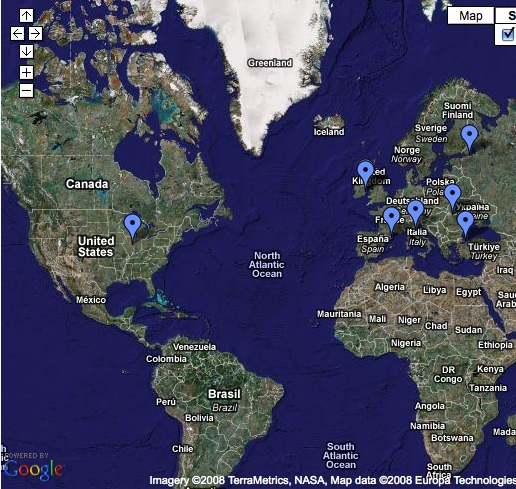
While working at the National College of Ireland, I got into a lunchtime discussion about driving, in particular, about why some countries, such as Ireland, drive on the left and others, such as the US, drive on the right. None of us could even say with much certainty how many people in the world did it one way or the other. Seemingly simple questions led to many jokes, confident pronouncements, and further questions about changeovers, what boats and planes do, and so on.

As I began to look into it more, I realized this was yet another example of how simple questions can lead to interesting inquiries without end. One of the most interesting sources I came across was a website, Which side of the road do they drive on?, edited by Brian Lucas, and based in large part on The Rule of the Road: An International Guide to History and Practice by Peter Kincaid. Here’s an excerpt from the site:

The side of the road one drives on seems to be one of those mundane details of everyday life which people take for granted and never bother to write down. In his book, Kincaid comes up with a blank: “I have been unable to discover any firm evidence as to what the rule of the road was in any part of the ancient civilizations in Greece, Rome, or Assyria. It seems inconceivable that there was not one.” We have found, however, evidence that the ancient Romans drove on the left.

In late 1998, the remains of a Roman quarry was discovered at Blunsdon Ridge, near Swindon, England. It is one of the largest and best-preserved Roman quarries known. Ruts in the road leading to this quarry are much deeper on one side of the road than on the other. If it can be assumed that the side of the road with deeper ruts was the side used by loaded carts leaving the quarry, while the side with shallow ruts indicates empty carts arriving, then we can conclude that at this particular location, at least, the Romans drove on the left. (Sources: a web page in the SwindonWeb Local News Archives for October 1998 which has since disappeared, and an article by Gwynne Dyer, Is driving on the right right or wrong?, from 1999.)

Another piece of evidence comes from a Roman coin. Robert Pease writes that he has seen a picture of a denarius from between 50 BC and 50 AD showing two horsemen riding past each other, right shoulder to right shoulder (i.e. each keeping to the left side of the road).

It was amazing to me to learn how this simple practice connects with our physical characteristics, modes of transportation, revolution and empire, warfare, commerce, and many other aspects of daily life.

Nobel Peace Prize winner wants jobs for the young

UN LITERACY DECADEIt’s not a new idea, that providing opportunities for people to earn a living and to contribute to society is at the heart of peacebuiding, but it was good to hear Martti Ahtisaari highlighting that in his recent speech:

Nobel Peace Prize winner Martti Ahtisaari said Saturday that finding jobs for more than 1 billion young people in the Middle East and Asia will be a major challenge to peacebuilding in the next decade.

“During the next 10 years about 1.2 billion young 15-to-30-year-olds will be entering the job market and with the means now at our disposal about 300 million will get a job,” Ahtisaari said in an interview with Finnish YLE TV.

“What will we offer these young, about a billion of them, or will we leave them to be recruited by criminal leagues and terrorists?” he asked.

Nobel Peace Prize winner wants jobs for the young – International Herald Tribune

I would just add that the need for meaningful, self-sustaining work is not limited to the Middle East and Asia, and that oppressed peoples only rarely turn to violence, but Ahtisaari’s challenge stands as one we must not ignore. Our global economic system increasingly robs people of the opportunity for self-sustaining work and for economic self-determination.

The economic injustice is closely related to lack of education, a problem addressed by the United Nations Literacy Decade 2003-2012 project, whose motto is “Literacy for all: voice for all, learning for all.” The Literacy Decade emphasizes adult literacy as well as one prerequisite for a more just society.

It’s tragic to see how great the gap is between our response to terrorism and global unrest and our appreciation of its underlying causes.