Why I came to library and information science

My academic career includes degrees in biology and computer science, teaching computer science in two universities, research in a high-tech, R&D firm, teaching in a college of education, and teaching now in a school of library and information science. My dissertation adviser was in philosophy, and the dissertation itself was in mathematical logic and artificial intelligence. I’ve published in a variety of journals, including those in other fields. People have often asked: Is there any rationale for this? Were you just booted from one place to another?

I could give a practical account of why I moved to a library and information science school nine years ago, but that wouldn’t explain how I think of the field and what led me to that decision. To do that, I need to start a bit earlier…
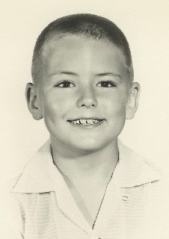
chip54

Chip in Fort Worth, 1954

When I was three years old, I enrolled along with four other children in the Frisky and Blossom Club held at the Fort Worth Children’s Museum (now the Fort Worth Museum of Science and History). Frisky and Blossom were de-scented skunks who lived in the old house that was the Museum then. The club evolved into the Museum School, the largest in the US, with over 200,000 alums. I stayed with the school, learning about plants and animals, astronomy, history, and many other topics. Most importantly, I learned how energizing learning could be when it’s connected to what we care about and how it can grow out of things in the world around us.

That interest in informal learning bolstered by museums and libraries, continued. When I was eight years old, I never missed the bookmobile when it came by our neighborhood. I was a collector of insects, sea shells, postage stamps, books, and all sorts of other things. But reading and writing were the most important means for expanding my world. It’s sad to say, but little of this occurred for me in school, which often felt like some unjustified punishment. I learned arithmetic from card and board games outside of school, but also by counting the minutes until the end of the class, the school day, or the school year. Science was as much through a chemistry set and nature study as through classes. And so on.

These experiences led me to value inquiry-based learning. They also made it harder for me to understand knowledge as confined within static categories. When I applied to college, I considered majoring in history, geology, biology, and English, but later thought philosophy or behavioral sciences might be better. For graduate school, I chose computer sciences, not because I was so enamored of the machine, but because the field appeared the be the closest to offering a general tool for interdisciplinary inquiry. My work in artificial intelligence emphasized computer natural language understanding and reasoning. That led in a more direct way than might appear at first into education. Fortunately, working on projects such as a statistics curriculum and software for high school students, or Quill, a program for reading and writing, allowed me to create learning environments that were more integrated and connected to the life of students, something I had missed to a large extent in my own schooling.

Later, I brought those experiences to a college of education. I found many opportunities to expand on those experiences. But I also found that the means of formal schooling were sometimes disconnected from the ends I valued. The emphases on measurable learning objectives and teacher credentialing often crowded out discourse on the changing nature of literacy or the connection of learning and life. Because my work involves collaborations with those in other disciplines, I saw space for those ideas in other realms, such as writing studies, communication, occasionally in the sciences, and especially, in library and information science.

me

Chip in Dublin, 2007

As I worked with people in library and information science, I found a serious engagement with issues such as the moral and political aspects of texts and information systems, changes to literacy practices related to new technologies and globalization, distributed knowledge making, information for community needs, and new ways of organizing and providing access to information. Although not all of my colleagues would characterize it this way, I see issues of learning threaded through everything we do. Learning is the creative act of meaning making that occurs in praxis, the integration of theory and practice. More than any other discipline, library and information science provides the space to engage with that phenomenon. It brings together the informed and critical understanding of texts and information systems with serious attention to the impact on human life.

There are many other reasons I might add for my joining GSLIS per se–the high level of collegiality, the moral commitment, the respect for both the old and the new, and the sincere interest in and openness to continuing to learn. These things make coming to library and information science seem wise, in spite of myself and my meandering path.

Teaching as bringing to life

During the time of the semester when grades are due, it’s difficult to ignore the aspects of the teaching job that involve judging, ranking, sorting, and critiquing in the sense of finding and documenting fault. But these aspects have little to do with teaching, and usually stand in the way. When one is learning, it can be helpful to know where one has gone wrong, but more often the wrong is painfully obvious and what we need even more is to know what of our fragile attempts can be brought to life. For that, we need critique in another sense, one that’s a friend to the new, brings ideas to life, and makes quality vivid.

Anton Ego, Michel Foucault, and Elliot Eisner speak to this issue:

We critics risk very little, yet enjoy a position over those who offer up their work and themselves to our judgment. We thrive on negative criticism for it’s fun to write and to read. But the bitter truth we critics must face is that in the grand scheme of things, the average piece of junk is probably more meaningful than our criticism designating it so. But there are times when a critic truly risks something, and that is in the discovery and defense of the new. The world is often unkind to new talent, new creations. The new needs friends. –the critic, Anton Ego, Disney/Pixar movie Ratatouille


I can’t help but dream about a kind of criticism that would not try to judge, but bring an oeuvre, a book, a sentence, an idea to life; it would light fires, watch the grass grow, listen to the wind, and catch the sea-foam in the breeze and scatter it. It would multiply, not judgments, but signs of existence; it would summon them, drag them from their sleep. Perhaps it would invent them sometimes – all the better. All the better. Criticism that hands down sentences sends me to sleep; I’d like a criticism of scintillating leaps of imagination. It would not be sovereign or dressed in red. It would bear the lightning of possible storms.–Michel Foucault

If connoisseurship is the art of appreciation, criticism is the art of disclosure. Criticism, as Dewey pointed out in Art as Experience, has at is end the re-education of perception… The task of the critic is to help us to see. Thus…connoisseurship provides criticism with its subject matter. Connoisseurship is private, but criticism is public. Connoisseurs simply need to appreciate what they encounter. Critics, however, must render these qualities vivid by the artful use of critical disclosure. –Elliot Eisner, 1985, pp. 92-93

References

Eisner, Elliot W. (1985). The art of educational evaluation: a personal view. London: Falmer.

Foucault, Michel (1980, April). The masked philosopher. Le Monde, interview by Christian Delacampagne.

Smith, Mark K. (2005). Elliot W. Eisner, connoisseurship, criticism and the art of education. The encyclopaedia of informal education.

Stake, Robert E., & Schwandt, Thomas (2006). On discerning quality in evaluation. In Ian Shaw, Jennifer C. Greene, & Melvin M. Mark (eds.), Handbook of evaluation: Policies, programs and practices. Sage.

Appropriating technologies: Nets for fish or for mosquitoes?

Appropriating TechnologiesThe notion of “appropriate technologies” is familiar; it’s similar to saying we should use the right tool for the job. In developing countries, this usually implies that we should find tools that fit with the local culture, knowledge base, environment, and existing technologies, for example, donkeys might work better than automobiles when the roads are in poor condition or non-existent.

There’s a related idea, in which the user is not just a passive recipient of some technology, but an active (re-)creator of it. People can actively appropriate technologies, interpret, use, and even re-design them to fit their needs. An excellent example of this is the alternate uses people have found for insecticide-treated nets:

Insecticide-treated nets (ITNs) are a simple, cost-effective way to fight malaria and are distributed to pregnant women and children in Kenya, often for free. But when Noboru Minakawa of the Institute of Tropical Medicine in Nagasaki, Japan, and colleagues surveyed villages along Lake Victoria, they found people were using the nets for fishing or drying fish, because the fish dry faster in the nets than on papyrus sheets, and the nets are cheaper (Malaria Journal, DOI: 10.1186/1475-2875-7-165).

In Zambia too, ITNs are being used for fishing, straining fruit and even for wedding dresses, says Todd Jennings of non-profit health group PATH in the capital Lusaka. “An ITN in the water is one not hanging in the fisherman’s home protecting his children,” he says.

It would be tragic if these uses of the nets mean that children are unprotected. Can we imagine a day come when people are not forced to choose between providing food and preventing disease?

References

Bruce, B. C., & Rubin, A. D. (1993). Electronic Quills: A situated evaluation of using computers for writing in classrooms. Hillsdale, NJ: Lawrence Erlbaum. See especially Chapter 9.

Eglash, Ron, Croissant, Jennifer L., Di Chiro, Giovanna, & Fouché, Rayvon (Eds.) (2004). Appropriating technology: Vernacular science and social power. Minneapolis: University of Minnesota Press.

New Scientist (2008, December 23). Malaria bed nets’ usefulness is their downfall..

The hidden race war after Katrina

when_the_levees_brokeRebecca Solnit describes her discovery of the Katrina shootings in a recent Mother Jones article and audio interview. She points out that the hidden race war was never really hidden, but it was conveniently ignored, even today, despite Spike Lee’s award-winning documentary and excellent investigative reports, such as as A. C. Thompson’s in The Nation. I suspect the story would still surprise many people and challenge their image of the Katrina aftermath. It should also cause all of us to become more critical of media reports and our own reactions to those:
While the national and international media were working themselves and much of the public into a frenzy about imaginary hordes of murderers, rapists, snipers, marauders, and general rampagers among the stranded crowds of mostly poor, mostly black people in New Orleans during Hurricane Katrina, a group of white men went on a shooting spree across the river.

Their criminal acts were no secret but they never became part of the official story. The media demonized the city’s black population for crimes that turned out not to have happened, and the retractions were, as always, too little too late. At one point FEMA sent a refrigerated 18-wheeler to pick up what a colonel in the National Guard expected to be 200 bodies in New Orleans’s Superdome, only to find six, including four who died naturally and a suicide. Meanwhile, the media never paid attention to the real rampage that took place openly across the river, even though there were corpses lying in unflooded streets and testimony everywhere you looked—or I looked, anyway.

The widely reported violent crimes in the Superdome turned out to be little more than hysterical rumor, but they painted African-Americans as out-of-control savages at a critical moment. The result was to shift institutional responses from disaster relief to law enforcement, a decision that resulted in further deaths among the thirsty, hot, stranded multitude. Governor Kathleen Blanco announced, “I have one message for these hoodlums: These troops know how to shoot and kill, and they are more than willing to do so if necessary, and I expect they will.” So would the white vigilantes, and though their exact body count remains unknown, at least 11 black men were apparently shot, some fatally.

In his excellent report, A. C. Thompson presents a frightening and dismaying picture of the response in Algiers Point:

Facing an influx of refugees, the residents of Algiers Point could have pulled together food, water and medical supplies for the flood victims. Instead, a group of white residents, convinced that crime would arrive with the human exodus, sought to seal off the area, blocking the roads in and out of the neighborhood by dragging lumber and downed trees into the streets. They stockpiled handguns, assault rifles, shotguns and at least one Uzi and began patrolling the streets in pickup trucks and SUVs. The newly formed militia, a loose band of about fifteen to thirty residents, most of them men, all of them white, was looking for thieves, outlaws or, as one member put it, anyone who simply “didn’t belong.”

References

Lee, Spike (2006). When the levees broke: A requiem in four acts. [TV mini-series].

Solnit, Rebecca (2008, December 22). The grinning skull: The homicides you didn’t hear about in Hurricane Katrina. Mother Jones. Audio interview

Solnit, Rebecca (in press). A paradise built in Hell.

Thompson, A. C. (2008, December 17). Katrina’s hidden race war. The Nation.

Thinking with toes and fingers

Four generations

four generations

What pleasure could be greater than spending time with four generations of family (see photo at left), as we did last weekend in Fort Worth? The twins, Caitlyn and Chloe provided all the entertainment one could want, far surpassing anything that might have been offered on TV or on some stage. They were in turn the most attentive audience, soaking in everything around them, including as you can see, Caitlyn exploring her own toes.

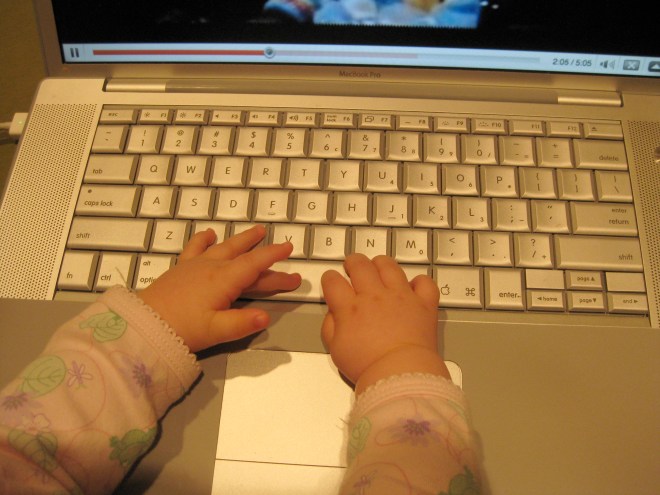
Chloe's fingers on the Mac keyboard

Chloe’s fingers on the Mac keyboard

We did venture on to YouTube to listen to some Raffi songs. This led to some “digital” explorations by the generation poised to supplant in not so many years the so-called digital natives of today. It’s not evident in this photo, but digital here includes toes as well as fingers.

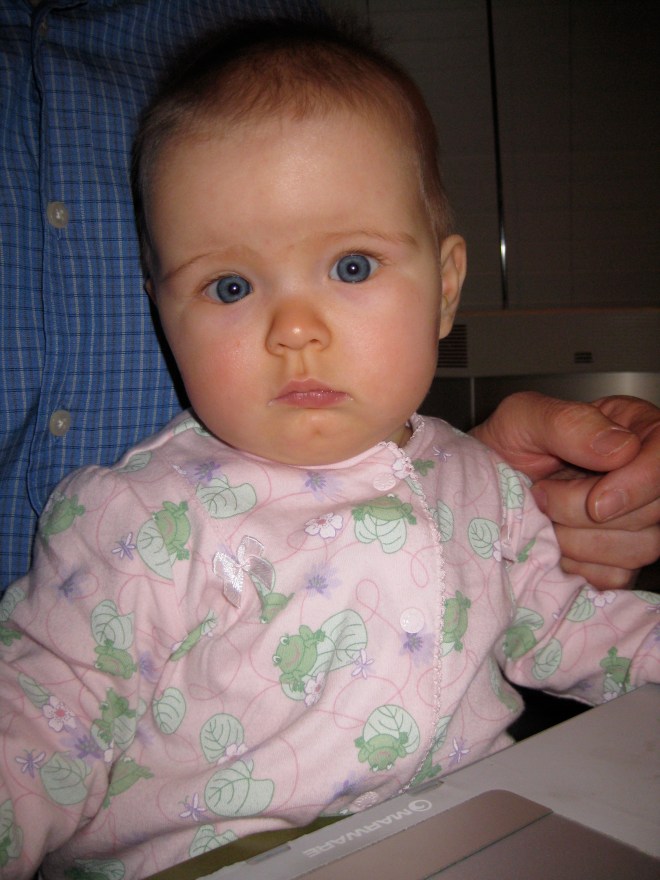
The final photo shows Chloe studying the camera studying her.

Chloe, 7 mos.

Chloe, 7 mos.

For Chloe and Caitlyn, learning involves all the senses and all the body. They explore faces using their eyes, but also their noses and fingers. Things are as they look, but also as they smell and taste and feel.

Some people would claim that the girls don’t talk yet, but that’s only in the incredibly narrow sense of saying that they don’t speak standard English. Their world is actually suffused with communication; it’s a rich laboratory of experiments with sounds linked to ideas and feelings. They gently remind us that the adults among us who constrain their talk to formulaic utterances and language without feeling are the ones who don’t know how to talk.

It will not surprise some of you to hear that this reminds me of John Dewey, who says:

Upon this view, thinking, or knowledge-getting, is far from being the armchair thing it is often supposed to be. The reason it is not an armchair thing is that it is not an event going on exclusively within the cortex or the cortex and vocal organs. It involves the explorations by which relevant data are procured and the physical analyses by which they are refined and made precise; it comprises the readings by which information is got hold of, the words which are experimented with, and the calculations by which the significance of entertained conceptions or hypotheses is elaborated. Hands and feet, apparatus and appliances of all kinds are as much a part of it as changes in the brain. –pp. 13-14, John Dewey, Essays in experimental logic

References

Dewey, John (1916). Introduction to Essays in experimental logic (pp. 1-74). Chicago: University of Chicago.

Are Iraq and Afghanistan the US’s only wars?

I often see the phrase “manage two wars” in popular media. But are there just two wars now, and is it even helpful to think of US wars in the Mideast in this way?

The phrase refers the fact that President Bush, and soon, President Obama, need to manage wars in Iraq and Afghanistan while also addressing needs in the economy, health care, environment, education, and other areas. One implication is that two wars is too many, and perhaps, if we could just wrap up the one that hasn’t gone so well (Iraq), we could then focus our energies on the one we should have addressed earlier (Afghanistan).

There are several problems with this way of thinking. The first is that it’s not true. The US battles in the Mideast aren’t restricted to two countries. In the last three months, US-operated pilotless drones have launched more than 20 missile attacks in Pakistani tribal areas, killing hundreds of people, some who are violent themselves, but many who are civilians as well. Americans don’t think of Pakistan as the site of a war, because US ground troops are not based there, but the fact is that our drones kill people and US forces regularly violate Pakistani sovereignty. Hundreds of NATO and US military vehicles destined for neighboring Afghanistan have been attacked and destroyed (in multiple attacks) by militants there. We risk a larger-scale war in, against, or through a bitterly divided country.

So, perhaps we should be saying “manage three wars”? or more if we look at the swath of interconnected conflicts running from Israel and Jordan, often including parts of Syria, Iraq of course, possibly Iran, Afghanistan, all the way to Pakistan?

Wars, or at least the kind of war the US has been engaged in, aren’t waged directly against nations or national armies, which means that they cannot be won in the conventional way either. The issue isn’t to track down and subdue a foe, but to engage with people and ideas. That larger enterprise is the one we’re losing, despite enormous cost in lives and dollars, as evidenced by al-Zaidi’s shoe throwing and the widespread support it received.

The idea of wars as neatly defined by national boundaries implies that we just need to pick our wars more carefully, and then prosecute them cleanly and efficiently. We have a management problem with two; wouldn’t one be better? But the reality is that it’s not better management in the narrow sense that’s needed, but a different way of thinking about how we can act productively in the world, starting with a reassessment of why we’re there in the first place.

Remaining Awake Through a Great Revolution

irvington_statue_of_rip_van_winkleOn November 4, voters in the US made a momentous choice, not only by taking another step towards racial equality, but also by demanding new ways of relating to other countries, to injustice, to the environment, and to truth itself. As of today, that is only one step; nothing has changed except the direction we are pointed.

Where the path leads next depends even more on the rest of us than it does on President-Elect Obama. The great challenges of globalization, racism, poverty, and violence are unaffected by a single election. Yet, there is a risk that we can fall asleep, lose sight of those challenges, and begin to think only of narrow issues, such as many that surfaced in the campaign.

We have the opportunity now to respond to the challenges posed 43 years ago in Martin Luther King, Jr.’s excellent speech, Remaining Awake Through a Great Revolution. In his talk, he relates the story of “Rip Van Winkle,” who slept 20 years. But he reminds us that when Rip went up to the mountain, the sign on the local inn had a picture of King George III of England. Twenty years later, the sign had a picture of George Washington. Rip had not only slept 20 years; he had slept through a revolution. As King says, “Rip Van Winkle knew nothing about it; he was asleep.”

King saw that we are experiencing a scientific and technological revolution, one that challenges us to remain awake, and to develop a world perspective. It’s more imperative than ever to eradicate racial injustice and rid the world of poverty, and to find an alternative to war and bloodshed. Long before talk of flat worlds, King saw that our destinies were intertwined:250px-martin_luther_king_jr_nywts

All I’m saying is simply this: that all mankind is tied together; all life is interrelated, and we are all caught in an inescapable network of mutuality, tied in a single garment of destiny. Whatever affects one directly, affects all indirectly. For some strange reason I can never be what I ought to be until you are what you ought to be. And you can never be what you ought to be until I am what I ought to be – this is the interrelated structure of reality…And by believing this, by living out this fact, we will be able to remain awake through a great revolution.

Remaining awake means looking beyond government as usual and recognizing that children in Haiti are in our “garment of destiny,” as much a part of our world as the person next door. It means knowing that justice is an ongoing project that needs to be defended wherever we hear of abuses of human rights, not seeking ways to justify them. It means finding an end to wars, not simply moving from one venue to another.

Can we do any better now at addressing King’s great challenges?

References

King, Jr, Martin Luther (1965, June). Remaining awake through a great revolution. Commencement address for Oberlin College, Oberlin Ohio.

Learning from graveyards

oldsectionhillside-017Starting with the town in which they lived, North Andover, Massachusetts, Caroline Donnan’s third-grade students physically entered history. They each adopted the family name of a European settler from the 1640’s period and thereafter assumed an historical role. A story centered on one of the historical characters would then form the basis of a study. That led to holding meetings, making maps, studying architecture, and discussing issues of the time as their assigned characters might do. (Photo by Ron Taylor, 2005).

Unraveling the town’s history, then, became the common vehicle for covering many skill and subject areas. It was also a wonderful excuse to put students in the position of discoverers, gatherers, and inquirers.

Their trips to a graveyard sparked scientific inquiry.

“People say settlers didn’t live as long as we do these days. What can you find here to prove whether or not that is true?” The class spread out to inspect gravestones. Scribbled columns of notes later turned into graphs and charts, subtraction and regrouping, smallpox and diptheria, questions and conclusions…Putting [the findings] together with a tally of how many people died at what ages, we came full circle to questions, connections, information. In point of fact, if settlers survived the first five years of life, their chances for survival were the same as they are today.

johnsoncottageI’m guessing that there are no surviving homes from the 1640’s era in North Andover. But there is the Johnson Cottage, built in 1789. According to the North Andover Historical Society is the “last surviving artisan’s cottage in North Andover’s Old Center.” The students made an expedition there and discovered low ceilings and short beds. This led to further inquiries into what it was like to live in the even earlier period.

The photo of the Cottage, shown here, is used by permission of the Historical Society. Their archives contain the largest amount of information on the Cottage and on the burial grounds in North Andover. They also host educational programs based on the first burial ground.

The students’ inquiries developed as multiple forms of literacy woven through the daily life of the classroom:

When we couldn’t get to real locations, we worked on constructing our own original one-room “town founder’s house” (located at one end of the classroom) or practiced scenes that eventually became “Starting from Scratch,” a full length musical relating the town’s earliest history. We also spent a substantial amount of time writing settler diaries, field notes, notices for the meetinghouse, town records, sermons, poems, trip lists, hymns, project progress reports, hypotheses, and conclusions. And we drew maps and charts, costumes and scenery, fences and rooftops.

It seems odd that a world tied to the past, even to graveyards, could be so alive for the students and Donnan herself. It’s even odder that this fantasy world became closer to the lived experience of the children than did their usual curriculum. But it’s less odd when we realize that it was based on their actual physical and social surroundings, and related to their own experiences of living spaces, health, family, and neighborhood.

Any learning activity raises questions. I’m curious to know how the class related their experiences in the 1789 Cottage to their simulation of life in 1640. I also wonder how much “Starting from Scratch” recognized the culture and lives of the Wampanoag people who lived in the area before 1640. What I can guess is that Donnan’s students were better able to engage in productive dialogue about these and other issues following their year in her classroom.

Donnan’s article is out of print. That’s a pity, because it’s an impressive example of how learning can be connected to life, offering a model for any age of students. Donnan even addresses the standard curriculum problem:

We had but one problem. In all the pages of the neatly typed, carefully bound, district-required social studies curriculum, never once was there mention of any of this.

She concludes by saying that we don’t have to wait:

With all there is to learn and do in the outside world, we really shouldn’t wait until June to get started.

References

Donnan, Caroline (1988). Following our forebears’ footsteps: From expedition to understanding. In V. Rogers, A. D. Roberts & T. P. Weinland (Eds.), Teaching social studies: Portraits from the classroom (Bulletin No. 82) Washington, DC: National Council for the Social Studies.
Gorvine, Harold (1970, May). Teaching history through role playing. The History Teacher, 3(4), 7-20.
Levstik, Linda S., & Barton, Keith C. (2001). Doing history: Investigating with children in elementary and middle schools (2nd ed.). Mahwah, NJ: Lawrence Erlbaum Associates.

The Women Who Went West

Under the leadership of its first Dean, Katharine Sharp, Illinois’ Graduate School of Library and Information Science sent the first librarians west.

As pioneers immigrated to the western towns of Wyoming, New Mexico and Oregon, graduates of Illinois set up libraries to educate the growing population. Often the only women for miles, these librarians created literacy programs with very little resources. –Here & Now: Videos

The video, The Women Who Went West, features Betsy Hearne, re-telling some of the stories of these early librarians. These early librarians showed courage and resourcefulness in spreading books and literacy. As Betsy says, “democracy depends on an informed population,” and they clearly did more than most to make that happen.

Reference

Des Garennes, Christine (2008, November 23). Video shows UI librarians’ quest to settle the West in 1908. The News-Gazette.

National Day of Listening

The day after Thanksgiving (November 28, 2008), has been declared by StoryCorps as the first annual National Day of Listening.

This holiday season, ask the people around you about their lives — it could be your grandmother, a teacher, or someone from the neighborhood. By listening to their stories, you will be telling them that they matter and they won’t ever be forgotten. It may be the most meaningful time you spend this year.

You can preserve the interview using recording equipment readily available in most homes, such as tape recorders, computers, video cameras or a pen and paper. Our free Do-It-Yourself Guide is easy to use and will prepare you and your interview partner to record a memorable conversation, no matter which method of recording you prefer.

The National Day of Listening site has a four-step scheme to help with the process, including the DIY guide and a video. This looks like a great way to build up a family or community oral history.

The process that StoryCorps describes could of course be done any time, but most of us are inclined to procrastinate. We tend to vacillate between thinking that it’s nothing more than listening again to an old story and thinking that it requires fancy equipment, special expertise, and many days of hard work. Maybe setting aside a National Day, calling for one hour of serious listening, and offering a four-step process will make it easier for any of us to do.