Overconsumption is the problem, not population

When we watch farmlands or forests being paved over for new housing, or see images of starving children, it’s hard not to think that there may be just too many people, that we have “exponential” population growth. This leads soon to the idea that we need to “do something” about population.

That view has a long history, including Paul Ehrlich’s The Population Bomb (1968) and Thomas Robert Malthus’s An Essay on the Principle of Population. There may well be negative effects and ultimate limits, but most of the blame assigned to population today would be better assigned to overconsumption.

How we understand the causes of present problems such as climate change, depletion of natural resources, hunger, and war is important, because different causes call for different remedies. An article by Fred Pearce in New Scientist, via Population: Overconsumption is the real problem – opinion – 27 September 2009, summarizes well the major issues here.

The population “bomb” is fast being defused. Women across the poor world are having dramatically fewer babies than their mothers did – mostly out of choice, not compulsion. Half a century ago, the worldwide average for the number of children a woman had was between five and six. Now she has 2.6. In the face of such a fall it is hard to see what more “doing something” about global population might achieve.

Half the world now has a fertility rate below the replacement level, which, allowing for girls who don’t make it to adulthood, is around 2.3. This includes most of Europe, east Asia, North America and the Caribbean. There are holdouts in a few Muslim countries – but not Iran, where fertility is 1.7 – and many parts of Africa

Thus, even if we have too many people, the rate of growth is decreasing, and all the indicators point to further reductions accompanying development. So, if the problem is not exponential population growth, what is it? Pearce goes on to point out that

the world’s richest half billion people – that’s about 7 per cent of the global population – are responsible for 50 per cent of the world’s emissions. Meanwhile, the poorest 50 per cent are responsible for just 7 per cent of emissions. One American or European is more often than not responsible for more emissions than an entire village of Africans.

Every time those of us in the rich world talk about too many babies in Africa or India, we are denying our own culpability. It is the world’s consumption patterns we need to fix, not its reproductive habits.

Pearce talks mostly about climate change, but his argument holds for other aspects of environmental stress, including the basic issue of hunger. Overconsumption in the rich countries occurs through waste, a diet heavily based on meat, and simply too much eating. A study directed by Timothy Jones at the University of Arizona Bureau of Applied Research in Anthropology, indicates that up to fifty per cent of all food ready for harvest in the US never gets eaten. That amount alone is enough to address worldwide hunger needs.

There’s no doubt that we’d do better to balance our population with the available resources, but before we criticize the mote in the eye of starving villagers in Africa, we might well consider the beam in our own.

References

Reality and the third rail

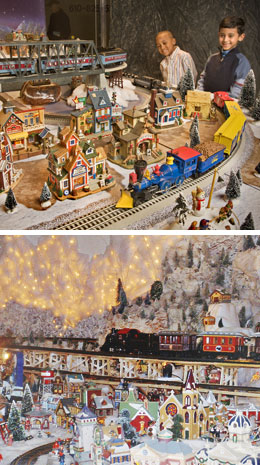
The Reading Terminal Holiday Railroad Photos by G. Widman for GPTMC

When I was last in Philadelphia I walked through the Reading Terminal Holiday Railroad and Train Display.

This is a giant model railroad layout (1/3 mile of tracks) at the Reading Terminal Market. There’s a detailed, interactive display featuring historic scenes of Philadelphia and rural Pennsylvania. Trolleys and Reading Railroad trains pass through City Hall and travel over the Schuylkill River.

I couldn’t help noticing that these were Lionel trains, the sign being the characteristic third rail. I remember as a boy having mixed feelings about that third rail.

On the one hand, it was a reminder that my model train layout wasn’t reality. Of course, a cynic might have pointed out that my mountain was a clearer giveaway, since it scaled to 25 feet high, not to mention that the entire world fit within a 4′ x 8′ rectangle with abrupt declivities on each edge. Yet I could somehow overlook those signs and still be bothered by the third rail.

On the other hand, the third rail was a reminder that I didn’t have the less realistic American Flyer train that my friend Jeff had. My locomotive and cars, as well as my accessories, were all more real, and the third rail spoke to that. In a practical sense, the third rail also permitted more “realistic” wiring of the tracks and switches.

One might say that the third rail marked a gateway between reality and fantasy. It was an icon, drawing me into the model railroad world. I spent hours and hours in that world, which felt more real than many other parts of my life. At other times, though I would look at it and be reminded that that world wasn’t as real as I hoped.

Now, as an adult, rushing to catch the “real” train to the airport, I had the opposite reaction. The beautiful train layout caught my eye, and I immediately wished there was more time to study it. But there was easily enough time to notice a key feature, that characteristic third rail.

This time I knew. That third rail told me that this was a real Lionel train, not some second-rate substitute. This train layout was a real world, with City Halls and rivers, trolleys and people. It was a place I’d once again be happy to lose myself within, as opposed to the false world outside, with all its fake products, commercialism, planned obsolescence, and unkept promises, not to mention the wars, institutional violence, and injustice that belie its values.

Schopenhauer’s porcupines

Several years ago, I read Schopenhauer’s porcupines: Dilemmas of intimacy and the talking cure: Five stories of psychotherapy, by Deborah Anna Luepnitz.

It’s a fascinating book, and you don’t need to be a Schopenhauer scholar, a zoologist, or a psychotherapy patient to get a lot out of it. The entry card instead is being someone who relates to others or would like to do so.

It was there that I encountered Schopenhauer’s parable of the porcupines, the last of many from his Studies in pessimism:

A number of porcupines huddled together for warmth on a cold day in winter; but, as they began to prick one another with their quills, they were obliged to disperse. However the cold drove them together again, when just the same thing happened. At last, after many turns of huddling and dispersing, they discovered that they would be best off by remaining at a little distance from one another. In the same way the need of society drives the human porcupines together, only to be mutually repelled by the many prickly and disagreeable qualities of their nature. The moderate distance which they at last discover to be the only tolerable condition of intercourse, is the code of politeness and fine manners; and those who transgress it are roughly told—in the English phrase—to keep their distance. By this arrangement the mutual need of warmth is only very moderately satisfied; but then people do not get pricked. A man who has some heat in himself prefers to remain outside, where he will neither prick other people nor get pricked himself.

Schopenhauer presents his parables as telling us just how life is, but Luepnitz takes this one in a constructive way. She shows through five case studies how we all have simultaneous needs and fears for intimacy, thus creating a dilemma for full living. As she puts it (p. 19):

Psychotherapy cannot make us whole, but it does allow us to transform suffering into speech and, ultimately, to learn to live with desire.

I was impressed with the book. Coincidentally, shortly after reading it, I had dinner in Philadelphia with a couple, one of whom was her patient.

References

  • Luepnitz, Deborah Anna (2002). Schopenhauer’s porcupines: Dilemmas of intimacy and the talking cure: Five stories of psychotherapy. New York: Basic Books.
  • Schopenhauer, Arthur (1891). The essays of Arthur Schopenhauer; Studies in pessimism (tr. Thomas Bailey Saunders). London: Swan Sonnenschein.

Turtles in China and Australia

During our sabbatical in Beijing and Brisbane, we had a surprising common theme: turtles.

I’ve always liked turtles, so perhaps it was natural that I saw them everywhere we turned. It started when we asked Caroline, a ten-year-old friend from Canada, about her classes at the Bei Da elementary school. She described a strange typing class, which involved typing expressions such as “FD 100 RT 120 FD 100 RT 120”. Although she didn’t realize it at first, this was not typing class, but computer programming using the Logo language. The commands were eventually to be used to command a robotic turtle, or one on a computer screen. In this example, the turtle would be commanded to draw an equilateral triangle, 100 pixels on a side.

We decided that turtle talk was a nice, limited domain in which to practice our feeble Chinese. Wang Dongyi, a Chinese friend, was helping us with that, and we were helping him with his English. Before long we had a bustling turtle circus going in our apartment at Shao Yuan on the Bei Da campus. Caroline, Emily, and Stephen played the turtles, with occasional help from certain childlike adults. We’d issue Logo commands in Chinese or English, and learn from the consequences of the turtles’ behaviors. In this way, we were all practicing both language and programming skills. We of course had to learn the Chinese word for sea turtle, Hai Gui (海归), so that we could say Turtle Emily, forward 30, or its equivalent in Chinese.

These navigational commands happened to be useful for us visitors, as we were continually seeking of giving directions. We began to refer to taxis as Hai Gui, since they needed to execute programs such as forward ten blocks, left, then forward three more.

Hai Gui, from Woodblock Dreams

We saw images and sculptures of turtles. We even ate Hai Gui, probably more than we realized, since we couldn’t always identify or obtain a name for what we were eating. We then learned that the “Hai Gui” or “sea turtles” of China are the returning professionals who contribute to the growth of the Chinese economy. These are the students who were sent abroad, like baby sea turtles, to get advanced degrees and Western experiences, then return to lay their eggs in their homeland.

When we reached Australia, we spent a lot of time outdoors, taking advantage of the beautiful countryside in Queensland. We saw many turtles in lakes and in the ocean, and even swam with adult loggerheads. One highlight, near Bundaberg, was Mon Repos Beach, one of the two largest Loggerhead turtle rookeries in the South Pacific Ocean. Successful breeding there aids survival of this endangered species. The research program conducts animal surveys of nesting turtles, studies of reproduction, migration, behavior, incubation, and genetics.

Visitors can watch the turtles, and if they’re lucky, see the adults lay eggs (from mid November to February) or even better, see the hatchlings emerge and crawl to the sea (from January until the end of March). We couldn’t miss that. The night we went was magical. We saw baby turtles hatch and then crawl to the sea. Emily and Stephen took on the role of turtle guides, standing with legs spread and using a flashlight to guide the way. The turtles would follow the light until they neared the ocean edge and then could follow the moonlight.

Susan and I would not have done well as turtle guides since watching Emily and Stephen do this was too wonderful on its own. As Susan wrote in an email at the time, “The theme of any future message will be turtles; we did see the hatchlings and Stephen and I swam with a huge loggerhead on the [Great Barrier] Reef, a few seconds that were worth the total airfare.”

In that year, we were Hai Gui ourselves, emerging from our safe nest with little understanding of the world we were about to encounter.


Copenhagen climate summit in disarray after ‘Danish text’ leak

The Guardian reports that the leak of the “Danish text” has put the Copenhagen climate change summit in “disarray” (see Copenhagen climate summit in disarray after ‘Danish text’ leak). Developing countries “reacted furiously to leaked documents that show world leaders will next week be asked to sign an agreement that hands more power to rich countries and sidelines the UN’s role in all future climate change negotiations.” The document apparently sets unequal limits on per capita carbon emissions, allowing people in rich countries to emit nearly twice as much.

Meanwhile, James Hansen, “the scientist who convinced the world to take notice of the looming danger of global warming says it would be better for the planet and for future generations” if the talks collapse.

If our children and grandchildren can’t stop us from destroying their world, who will?

Rethinking schools

Rethinking Schools began in 1986 in Milwaukee, Wisconsin, as an effort to address problems such as “basal readers, standardized testing, and textbook-dominated curriculum.”

It’s since become an international publisher of educational materials, with a magazine and books on classroom practice and educational theory, social justice, anti-racism, vouchers and marketplace-oriented reforms, funding equity, and school-to-work. The publications are written by and for teachers, but speaks to students, parents, administrators, researchers, and community members as well.

I like their vision of the common school:

Schools are about more than producing efficient workers or future winners of the Nobel Prize for science. They are the place in this society where children from a variety of backgrounds come together and, at least in theory, learn to talk, play, and work together.

Schools are integral not only to preparing all children to be full participants in society, but also to be full participants in this country’s ever-tenuous experiment in democracy. That this vision has yet to be fully realized does not mean it should be abandoned.

I highly recommend their publications, including the classic, Rethinking Columbus: The Next 500 Years, which was my introduction. I’ve used several of the books or magazine issues in my own teaching and can say that I’ve learned important things from every one of them.

UI 4th for hosting foreign students

The University of Illinois’s Urbana campus continues to host more international students than all but three other universities in the nation, according to the Institute of International Education.

The UI is No. 1 among public universities.

via The News-Gazette.com: UI 4th overall in 2008-09 for hosting of foreign students.


A highlight of my job is to work with a diverse group of students, who bring different experiences and perspectives. This diversity includes nationality.

Considering just the doctoral level, I’ve now served on the committee for 80 students who’ve completed their Ph.D. and another 25 who are still working towards it. Here’s the list of countries represented, among just those for whom I have an official role: USA (58), Taiwan (11), Korea (7), China (5), India (5), Australia (3), Romania (2), Singapore (2), Austria (1), Azerbaijan (1), Belize (1), Germany (1), Haiti (1), Hungary (1), Ireland (1), Japan (1), Nepal (1), Puerto Rico (1), Spain (1), Turkey (1), Vietnam (1). I’ve also been able to work closely with students from Brazil, Canada, Côte d’Ivoire, Cuba, Cypress, Egypt, Iran, Malaysia, Mexico, Pakistan, Poland, South Africa, and many other places.

This list is by nationality, not necessarily by ethnicity or residence. For example, one student was originally from Mexico and now lives and works in Japan, but I counted him as USA, because he’s a US citizen. The number from Asia (32) isn’t far below that from the US, but there are none from Africa, and only two from South America and just seven from Europe (or eight, counting Turkey).

Knowing well the challenges of travel and life in other countries, I’m impressed with the imagination and the perseverance of students from abroad. I’m also very grateful for what they’ve added to the university and to the life of myself and my family.

Inquiry Based Learning interview

Michael Hallissy recently interviewed me from Dublin, Ireland for a podcast on Inquiry Based Learning. I can’t bear to listen to my recorded self, so I’m not sure why you would, but in case you’re a masochist, the link above should be just what you need. Extra credit if you can spot the two factual mistakes we made, one by Michael and one by me.

The Fun Theory

My sister, Susan, just sent a link to the Piano Staircase, which combines health, music, and fun, three of my favorite things:

Take the stairs instead of the escalator or elevator and feel better” is something we often hear or read in the Sunday papers. Few people actually follow that advice. Can we get more people to take the stairs over the escalator by making it fun to do? See the results here.

The Piano Staircase is from the Fun Theory, which

is dedicated to the thought that something as simple as fun is the easiest way to change people’s behaviour for the better. Be it for yourself, for the environment, or for something entirely different, the only thing that matters is that it’s change for the better.

The site has all sorts of clever ideas, many of which have been realized, and some with videos.