“Very rigorous maritime engineering standards”

BP Chairman Carl-Henric Svanberg says that he does “care about the small people.” CEO Tony Hayward says, “I’d like my life back” (he barely had time to watch his 52-foot yacht “Bob” compete in a race off England’s coast). And to the House Oversight and Investigations sub-committee on the Deepwater Horizon oil spill: “I wasn’t involved in any of the decision-making…we drill hundreds of wells around the world.”

I’ve recently learned where they’re getting their material. As John Clarke and Bryan Dawe say, the industry adheres to “very rigorous maritime engineering standards.”

Navigating the corridor of inquiry

It’s not often that I have an Aha! moment reading an academic article. Many have significant flaws and many of the best repeat what’s been said many times before. But I had a very different reaction to Patricia M. Shields’sPragmatism as a Philosophy of Science: A Tool for Public Administration.”

The paper shows how pragmatism as a philosophy of science is used in a research methods class. The course includes guides to writing an empirical capstone project, such as steps to follow, the notebook method, and the classification of conceptual frameworks.  But what makes it special is the explication of these in terms of their roots in the ideas of Peirce, Dewey, and James.

She quotes from William James (1904), who writes about the relation of pragmatism to theories:

Theories thus become instruments, not answers to enigmas, in which we can rest. We don’t lie back upon them, we move forward, and, on occasion, make nature over again by their aid. Pragmatism unstiffens all our theories, limbers them up and sets each one at work…

All these [theories], you see, are anti-intellectualist tendencies… [pragmatism] stands for no particular results. It has no dogmas, and no doctrines save its method. As the young Italian pragmatist Papini has well said, it lies in the midst of our theories, like a corridor in a hotel. Innumerable chambers open out of it. In one you may find a man writing an atheistic volume; in the next some one on his knees praying for faith and strength; in a third a chemist investigating a body’s properties. In a fourth a system of idealistic metaphysics is being excogitated; in a fifth the impossibility of metaphysics is being shown. But they all own the corridor, and all must pass through it if they want a practicable way of getting into or out of their respective rooms.

The paper accomplishes four major feats. First, it serves as an excellent introduction to pragmatism, articulating it in terms of actual experience and concrete action in the world, as pragmatists would have it. Second, it offers a way of thinking about research, which can help anyone who struggles with the relation between theory and practice, or gets stuck in dichotomies such as quantitative/qualitative. It show how theories can come alive, be unstiffened, so that they can help us make sense of experience without overconstraining. Third, the paper describes a creative use of an institutional repository, which helps students enter into a community of inquiry. See, for example, the excellent paper by Robert Brom (2000), Workplace diversity training: A pragmatic look at an administrative practice. Finally, it does a fine job of doing what it sets out to do, to describe the process of designing an excellent approach to a research methods or capstone course.

References

Brom, Robert A. (2000). Workplace diversity training: A pragmatic look at an administrative practice. Applied Research Projects. Paper 91.

James, William (1904, December). What is Pragmatism. From series of eight lectures dedicated to the memory of John Stuart Mill, A new name for some old ways of thinking, from William James, Writings 1902-1920. The Library of America

Shields, Patricia M. (1998). Pragmatism as a philosophy of science: A tool for public administration. Faculty Publications-Political Science. Paper 33.

The texture of peace

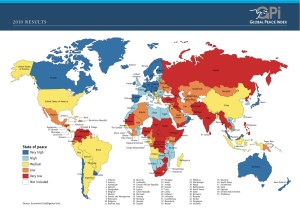
The Vision of Humanity project has just released its latest report on the “texture of peace.”

Using 24 indicators, such as a nation’s level of military expenditure, its relations with neighbors, and the respect for human rights, the report quantifies the different aspects of peacefulness. It measures peacefulness within, as well as between, nations.

Understanding the texture of peace is more useful than saying simply “at war” or “peace is good.” It helps us see that no country is totally peaceful and that degrees of peacefulness can be quantified for comparison among countries or over time. We can also see how the lack of peace has costs beyond acts of violence per se.

The report identifies some of the drivers of peace, such as levels of democracy and transparency, education, and national well being. Their data show that

[t]he most peaceful societies have higher per capita income, high levels of well-being, more freedom, perform better at sustainability, and appear to have a more equitable distribution of social spending (Institute for Economics & Peace, 2010, p. 4).

The study also examines the economic consequences of peace. One remarkable finding for 2010 is that

…had the world been at peace, world economic output might have reached US$62.4 trillion, an increase of 8.5% and easily exceeding the output losses due to the economic crisis of 2008/9… Even a reduction in levels of violence of just 15% would equal the output loss due to the economic crisis (Ibid, p. 51)

I doubt that many people who turn to violence as a solution for conflicts, or any military contractors who benefit from the lack of peace, will read this report and suddenly decide that they’re misguided. But for the rest of us, this study provides some tools to question the direction we’re going, a way to measure progress, and a way to demonstrate the consequences of violence to the economy and the quality of life.

By the way, last year I celebrated ironically the ascension of the US to #83 on the list. It’s not good for anyone that the most powerful nation on earth is ranked among countries with severe poverty, Balkan states, which are still recovering from major conflict, and former Soviet republics. This year the US has dropped to #85.

References

Institute for Economics & Peace (2010). Peace, wealth and human potential. 2010 discussion paper.

Tracking the Oil Spill

The New York Times has some interesting interactive graphics and multimedia on the oil spill in the Gulf, e.g., Map and Estimates of Oil Spilled in the Gulf of Mexico. Be sure to use the “Play” button to see how the spill has developed between April 22 and today.

The story of how this has happened and the ongoing saga have much more impact than figures about “millions of gallons,” especially when estimates vary widely and change frequently. But it’s clearly working its way up the list of the world’s largest oil spills.

As the world continues to demand more oil, producers enter even more treacherous situations. Even if we had good oversight, instead of the cozy relationships we now see between regulators and industry, we’re likely to see more such disasters.

Libraries for netroots activists?

Netroots is a term that describes political activism organized through blogs, wikis, social network services, and other online media. Jerome Armstrong used it first in Netroots for Howard Dean (2002) on MyDD.

The netroots can be a powerful alternative to traditional media and organizations. Often though, the change that activists promote never happens, can’t be sustained, or can’t scale. Netroots talk doesn’t always lead to action.

It may seem to strange to turn to libraries as a solution. Aren’t libraries all about books and old stuff, not the new participatory culture of the net? Aren’t they determinably neutral, both unwilling and unable to engage with the kinds of change activists seek?

In fact, libraries already play a crucial role to support activism of various kinds. And they’re already deeply entangled both with how we go online and with how we find what’s not available there. They’re not only a supplement to the netroots, but a necessary resource to bring netroots activism to life.

If you go to any public library in the US at opening time, you’ll see a group of people waiting to enter. They’re of all ages, ethnicities, and genders, dressed in formal business attire, sports clothes, or old rags. Some may be waiting to check out a book or video, but most are waiting to go online to read their mail, connect with friends, check the news, hunt for a job or apartment, shop, book travel, or do any of the many other functions that reveal how much the net has infiltrated our lives. For them, the library is the face of the net, and the only, or at least the best, way of connecting with it.

Moreover, libraries can provide substantive data, e.g., on the climate, business trends, local history, political processes, art, and more, which is not always available online; text resources, including books, journals, magazines; videos and software; and repositories or archives of local activities. They also offer meeting spaces, and sustainable local points of contact. These resources can expand enormously the knowledge base for netroots activism, something that can turn strongly held views into evidence-based arguments and uncover duplicity in corporate or government bodies.

Libraries also offer reference services, which is important since the deep web holds several orders of magnitude more information than the surface web, and non-web information is much more than that. Libraries also offer instruction on accessing all of these resources, data, and services.

Beyond finding information, libraries increasingly offer opportunities to create and house community-designed or collected resources. For example, a collaboration between Dr. Pedro Albizu Campos High School (PACHS) in Chicago’s Humboldt Park neighborhood and the Newberry Library in Chicago led to a student-curated Puerto Rican history exhibit at the Newberry: Puerto Rican History through the Eyes of Others.

As a means of finding information and tools, a venue for creating resources, a place to learn, and access in the first place, libraries can help turn netroots talk about activism into real action in the world. Of course, most libraries are devoted to principles of open access for all. As a result, what they offer is available to groups large and small, but also to groups on opposing sides of an issue. This means that despite all the power and innovation of the net, much of the action is still, if not increasingly, found in the library.

Impossible motion: magnet slopes

A gravity-defying illusion has won the 2010 Best Illusion of the Year Contest, held yesterday in Naples, Florida.

Koukichi Sugihara, from the Meiji Institute for Advanced Study of Mathematical Sciences, Japan, developed the illusion, which you can see in the video below. Wooden balls appear to roll up the channels, as if they are pulled by a magnet. We’re fooled by assuming that each supporting column is vertical, and that the longest column in the center is the tallest.

This is is similar to the Adelbert Ames’s illusions, such as the Ames room or Ames window, all of which demonstrate that perception is an interaction of the perceiver with the environment.

The Best Visual illusion of the Year Contest is a celebration of the ingenuity and creativity of the world’s premier visual illusion research community. Contestants from all around the world submitted novel visual illusions (unpublished, or published no earlier than 2009), and an international panel of judges rated them and narrowed them to the TOP TEN. At the Contest Gala in the Naples Philharmonic Center for the Arts, the top ten illusionists presented their creations and the attendees of the event voted to pick the TOP THREE WINNERS! via Results of the 2010 Contest now announced!

The other finalists are all worth watching, too.

Inquiry-based learning concepts

We talked in my class Monday about the terms that help us describe inquiry-based learning, or that derive from thinking about it. Students made their individual lists, then shared those with a partner, then in the group as a whole. There was to me a surprising diversity of responses, but with a sense that the different clusters of words were mutually reinforcing.

Below is a tag cloud we made of the terms. We could have added “fallibilism,” “adventure,” “moral,” “trust,” “dialogue,” “reciprocity,” and others. We also agreed that it’s the connections among the terms that really matter. Nevertheless, it was interesting to turn this mirror on our class dialogue over the semester.

Technologies to improve the quality of life

Gary McDarby was one of many very impressive people I met during my stay in Ireland during 2007-08. If you watch this short video, I think you’ll understand why.

It’s amazing how he manages to introduce several important projects in a short time, including Camara, SMART, and the Computer Clubhouse.

Prepare yourself for some tears.

Gary writes:

as many of you know, on the 7th of August 2009 Stuart Mangan and Robert Stringer passed away. I had been working with Stuart on technologies to help improve his quality of life (he had suffered a severe spinal injury in 2008) and Robert Stringer had been taking a holiday after volunteering with Camara in Tanzania when he was killed. In a strange twist of fate they died on the same day.

I have been giving a series of talks on these events with the sole of intention of trying to create something positive out of what was a very sad and challenging time. First and foremost I want to pay tribute to these two wonderful young men.

Recently I gave an IGNITE talk in the Science Gallery on what happened. It’s a short, 5 minute format which is quite a challenge to do, especially if the subject matter is non trivial.

I wanted to try and create something meaningful in this short format so it could be passed around in the viral ways we are all so used to. Its by no means perfect but please feel free to pass it on. The talk is here: