Libraries for netroots activists?

Netroots is a term that describes political activism organized through blogs, wikis, social network services, and other online media. Jerome Armstrong used it first in Netroots for Howard Dean (2002) on MyDD.

The netroots can be a powerful alternative to traditional media and organizations. Often though, the change that activists promote never happens, can’t be sustained, or can’t scale. Netroots talk doesn’t always lead to action.

It may seem to strange to turn to libraries as a solution. Aren’t libraries all about books and old stuff, not the new participatory culture of the net? Aren’t they determinably neutral, both unwilling and unable to engage with the kinds of change activists seek?

In fact, libraries already play a crucial role to support activism of various kinds. And they’re already deeply entangled both with how we go online and with how we find what’s not available there. They’re not only a supplement to the netroots, but a necessary resource to bring netroots activism to life.

If you go to any public library in the US at opening time, you’ll see a group of people waiting to enter. They’re of all ages, ethnicities, and genders, dressed in formal business attire, sports clothes, or old rags. Some may be waiting to check out a book or video, but most are waiting to go online to read their mail, connect with friends, check the news, hunt for a job or apartment, shop, book travel, or do any of the many other functions that reveal how much the net has infiltrated our lives. For them, the library is the face of the net, and the only, or at least the best, way of connecting with it.

Moreover, libraries can provide substantive data, e.g., on the climate, business trends, local history, political processes, art, and more, which is not always available online; text resources, including books, journals, magazines; videos and software; and repositories or archives of local activities. They also offer meeting spaces, and sustainable local points of contact. These resources can expand enormously the knowledge base for netroots activism, something that can turn strongly held views into evidence-based arguments and uncover duplicity in corporate or government bodies.

Libraries also offer reference services, which is important since the deep web holds several orders of magnitude more information than the surface web, and non-web information is much more than that. Libraries also offer instruction on accessing all of these resources, data, and services.

Beyond finding information, libraries increasingly offer opportunities to create and house community-designed or collected resources. For example, a collaboration between Dr. Pedro Albizu Campos High School (PACHS) in Chicago’s Humboldt Park neighborhood and the Newberry Library in Chicago led to a student-curated Puerto Rican history exhibit at the Newberry: Puerto Rican History through the Eyes of Others.

As a means of finding information and tools, a venue for creating resources, a place to learn, and access in the first place, libraries can help turn netroots talk about activism into real action in the world. Of course, most libraries are devoted to principles of open access for all. As a result, what they offer is available to groups large and small, but also to groups on opposing sides of an issue. This means that despite all the power and innovation of the net, much of the action is still, if not increasingly, found in the library.


Impossible motion: magnet slopes

A gravity-defying illusion has won the 2010 Best Illusion of the Year Contest, held yesterday in Naples, Florida.

Koukichi Sugihara, from the Meiji Institute for Advanced Study of Mathematical Sciences, Japan, developed the illusion, which you can see in the video below. Wooden balls appear to roll up the channels, as if they are pulled by a magnet. We’re fooled by assuming that each supporting column is vertical, and that the longest column in the center is the tallest.

This is is similar to the Adelbert Ames’s illusions, such as the Ames room or Ames window, all of which demonstrate that perception is an interaction of the perceiver with the environment.

The Best Visual illusion of the Year Contest is a celebration of the ingenuity and creativity of the world’s premier visual illusion research community. Contestants from all around the world submitted novel visual illusions (unpublished, or published no earlier than 2009), and an international panel of judges rated them and narrowed them to the TOP TEN. At the Contest Gala in the Naples Philharmonic Center for the Arts, the top ten illusionists presented their creations and the attendees of the event voted to pick the TOP THREE WINNERS! via Results of the 2010 Contest now announced!

The other finalists are all worth watching, too.

Inquiry-based learning concepts

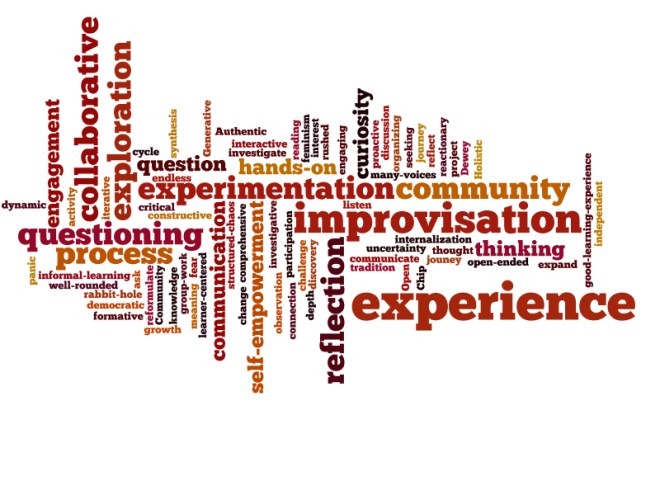
We talked in my class Monday about the terms that help us describe inquiry-based learning, or that derive from thinking about it. Students made their individual lists, then shared those with a partner, then in the group as a whole. There was to me a surprising diversity of responses, but with a sense that the different clusters of words were mutually reinforcing.

Below is a tag cloud we made of the terms. We could have added “fallibilism,” “adventure,” “moral,” “trust,” “dialogue,” “reciprocity,” and others. We also agreed that it’s the connections among the terms that really matter. Nevertheless, it was interesting to turn this mirror on our class dialogue over the semester.

Technologies to improve the quality of life

Gary McDarby was one of many very impressive people I met during my stay in Ireland during 2007-08. If you watch this short video, I think you’ll understand why.

It’s amazing how he manages to introduce several important projects in a short time, including Camara, SMART, and the Computer Clubhouse.

Prepare yourself for some tears.

Gary writes:

as many of you know, on the 7th of August 2009 Stuart Mangan and Robert Stringer passed away. I had been working with Stuart on technologies to help improve his quality of life (he had suffered a severe spinal injury in 2008) and Robert Stringer had been taking a holiday after volunteering with Camara in Tanzania when he was killed. In a strange twist of fate they died on the same day.

I have been giving a series of talks on these events with the sole of intention of trying to create something positive out of what was a very sad and challenging time. First and foremost I want to pay tribute to these two wonderful young men.

Recently I gave an IGNITE talk in the Science Gallery on what happened. It’s a short, 5 minute format which is quite a challenge to do, especially if the subject matter is non trivial.

I wanted to try and create something meaningful in this short format so it could be passed around in the viral ways we are all so used to. Its by no means perfect but please feel free to pass it on. The talk is here:

Dorothy Height, Unsung Heroine of Civil Rights

Dorothy Height, a leader of the African-American and women’s rights movements died on Tuesday at age 98. Her obituary in the New York TImes is a tribute to a courageous and powerful figure in American history, who did enough to fill several ordinary lifetimes:

Dorothy Height, Unsung Heroine of Civil Rights Era, Is Dead at 98 – Obituary (Obit) – NYTimes.com.

Inquiring and acting

John Dewey makes an interesting distinction between understanding and information:

An individual may know all about the structure of an automobile, may be able to name all the parts of the machine and tell what they are there for. But he does not understand the machine unless he knows how it works and how to work it; and, if it doesn’t work right, what to do in order to make it work right…Understanding has to be in terms of how things work and how to do things. Understanding, by its very nature, is related to action; just as information, by its very nature, is isolated from action or connected with it only here and there by accident. (Dewey, 1937, p. 184)

If we line up “how things work” with inquiry and “how to do things” with action, we have a good summary of the Youth Community Informatics activity guide, Community as Curriculum. It’s set up with units on Youth as Inquirer and Youth as Activist.

An example might be to study the problem of alcoholism in your community (Inquirer), then make a book about it, such as This is the Real Me (Activist). Several thoughts occur to me:

  • The inquire/act distinction is not absolute; it’s hard to come up with a good example in which the two roles are not blended and mutually supportive. But it can still be useful for reflecting on our work, and thinking about future directions for community informatics.
  • The Inquirer part goes well beyond what usually happens in school in terms of relevance, connectedness, community base, and so on. But the Activist part rarely happens at all.
  • Much of the research in social informatics, and even community informatics, which studies community use of ICTs, digital divide, or demographic patterns, tends to “name all the parts of the machine and tell what they are there for.” That can be useful, just as it would be for an automobile.
  • But, if we seek understanding in Dewey’s sense, we need more of a community inquiry approach.

References

Dewey, John (1937). The challenge of democracy to education. In The collected works of John Dewey, 1882-1953. Electronic edition. The Later Works of John Dewey, 1925-1953. Volume 11: 1935-1937, Essays, Liberalism and Social Action. [First published (February 1937) in Progressive Education 14, 79-85, from a transcript of an address on November 13, 1936 at the Eastern States Regional Cnference of the Progressive Education Association in New York City.]

Inquiry-based community engagement

Melissa Pognon just alerted me to an interesting article by David Low, on university-community engagement. It presents a dialogical, or inquiry-based, view of engagement, drawing from communication theory and Perice’s theory of inquiry. Low emphasizes that

we do not ‘transfer’ or ‘transmit’ knowledge between social systems, but, rather, we engage a method that enables the recognition of a shared object of enquiry – its entelechy (Nicholls 2000) (p. 108).

This shared enquiry must not only tolerate dissent or difference, it actually depends on dissent to function at all. Such a view is radically different from the dominant university discourse around topics such as “knowledge transfer,” “public outreach,” or “service learning.”

Low writes,

without a method to nurture and reveal dissent, universities would be unable to even recognise different ways of being in the world, and enquiry would be rendered impossible (Hawes 1999, p. 235) (p. 111).

I find myself drawn initially to 2×2 tables such as the one Low presents in his grid-group, then later becoming frustrated with all that they obscure as well as reveal. But the article as a whole has many useful insights.

References

Hawes, L. (1999). The dialogics of conversation: Power, control, vulnerability. Communication Theory, 9(3), 229–264.

Low, David (2008). University-community engagement: A grid-group analysis. Gateways: International Journal of Community Research and Engagement, 1, 107-127.

Nicholls, A. (2000, September). The secularization of revelation from Plato to Freud. Contretemps, 1, 62–70.

Peirce, Charles S. (1877, November). The fixation of belief. Popular Science Monthly, 12, 1-15.

Outside lies magic, Part 2

I wrote most of my last post while flying from San Francisco to Chicago. Flipping through the airline magazine, the essay by Gerard J. Arpey, “The world is a book” caught my eye. It’s from St. Augustine: “The World is a book, and those who do not travel read only a page.” That seemed to be the message of Stilgoe’s Outside lies magic.

But on reading the essay, I encountered another quote that seemed hugely at odds with my own experience at the time. It’s from Antoine de Saint-Exupery’s Wind, sand, and stars, writing about airplanes:

The central struggle of men has ever been to understand one another, to join together for the common weal. And it is this very thing that the machine helps them to do! It begins by annihilating time and space.

Yes, the machine, the airplane, was annihilating time and space, but it was doing so by destroying my connection to the world around me. Instead of seeing more deeply as Stilgoe recommends, I found myself seeking ways to ignore the drone of the engines and the constant pressure on my knees from the seat in front of me. Saint-Exupery’s means for promoting our common humanity has become a factory ship processing fish.

See Outside lies magic, Part 1.