Karkhana, a factory for learning

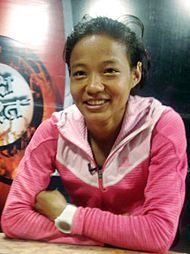
20161105_110713Karkhana, which means “factory” in Nepali, is a place where people make things and learn through doing.

The teachers are engineers, designers, artists, and scientists, but in contrast to some traditional models of learning, the environment is a teacher as well. The Karkhana site is filled with marvels: home-built antennas, a laser cutter, colorful child-designed posters, musical instruments, and more, which make the visitor ask questions and want to touch and make things.

So, it’s an education company and makerspace, one that turns the classroom into a lab for discovery. There’s an excellent slide show with many photos explaining their approach and an overview brochure describing the variety of classes they run.

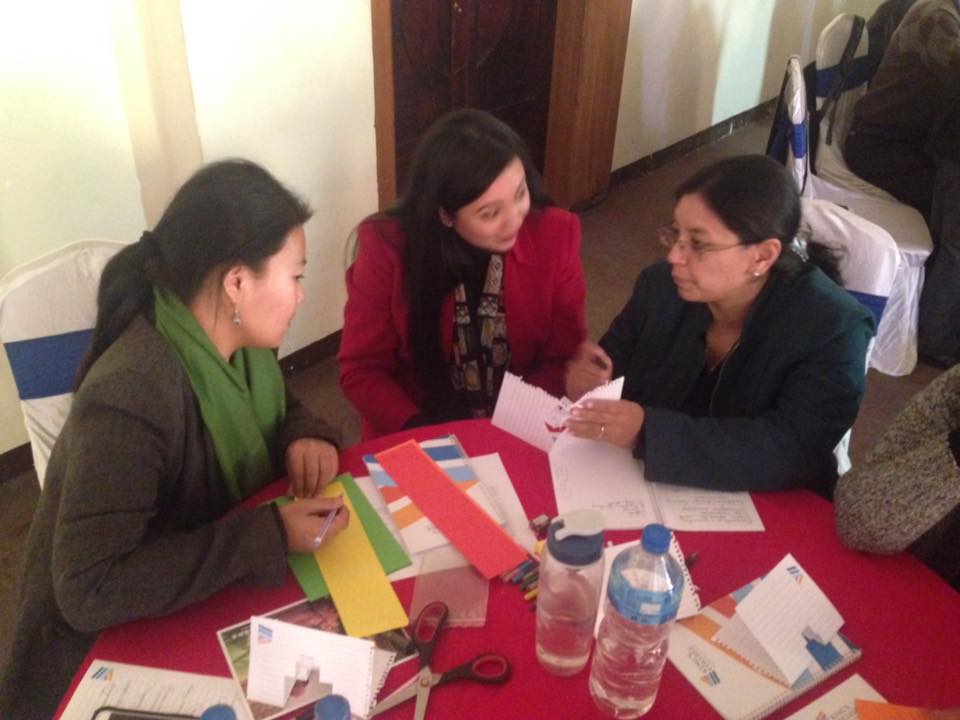
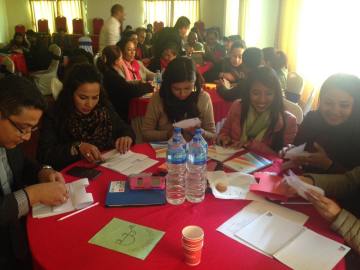
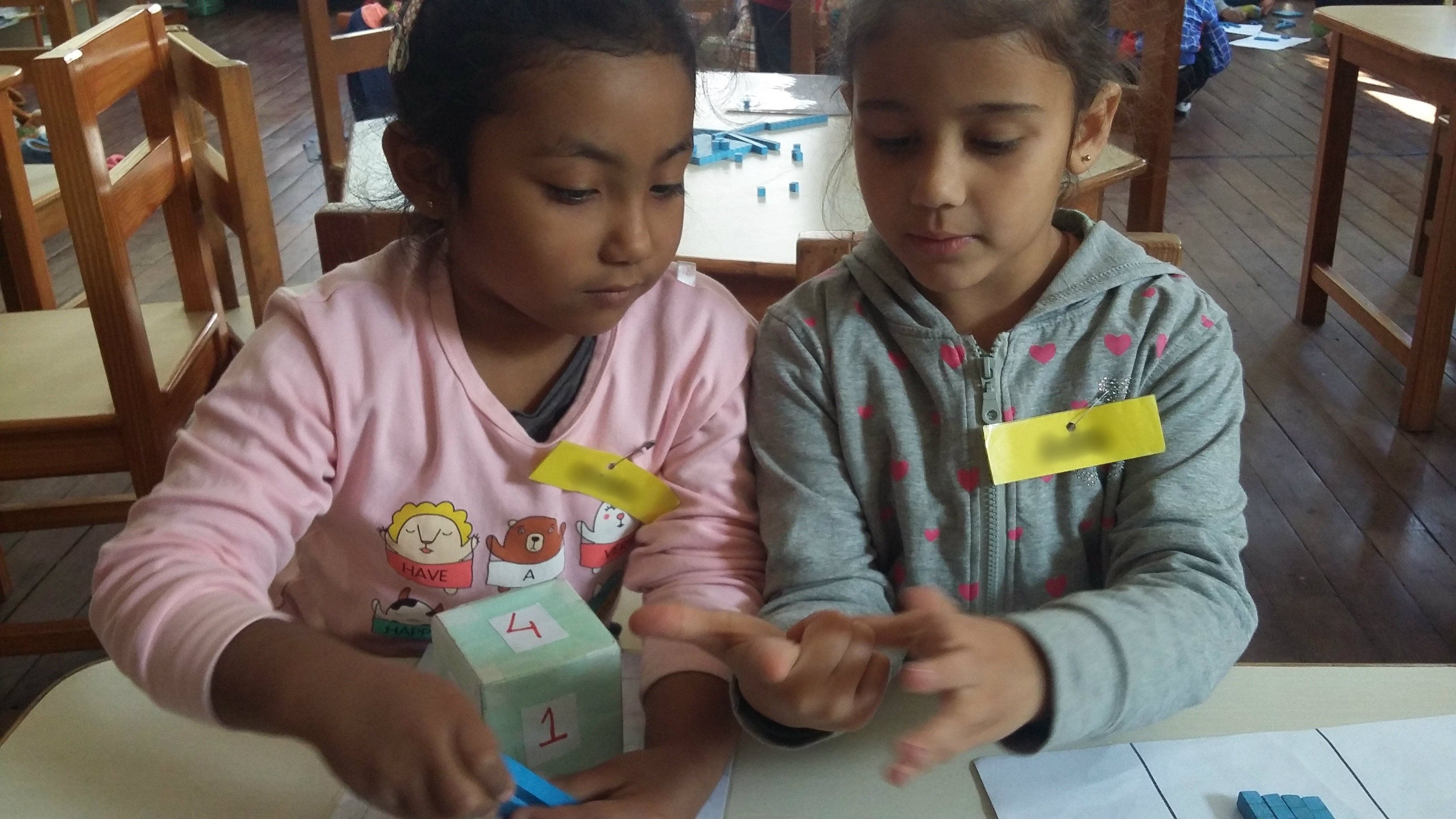
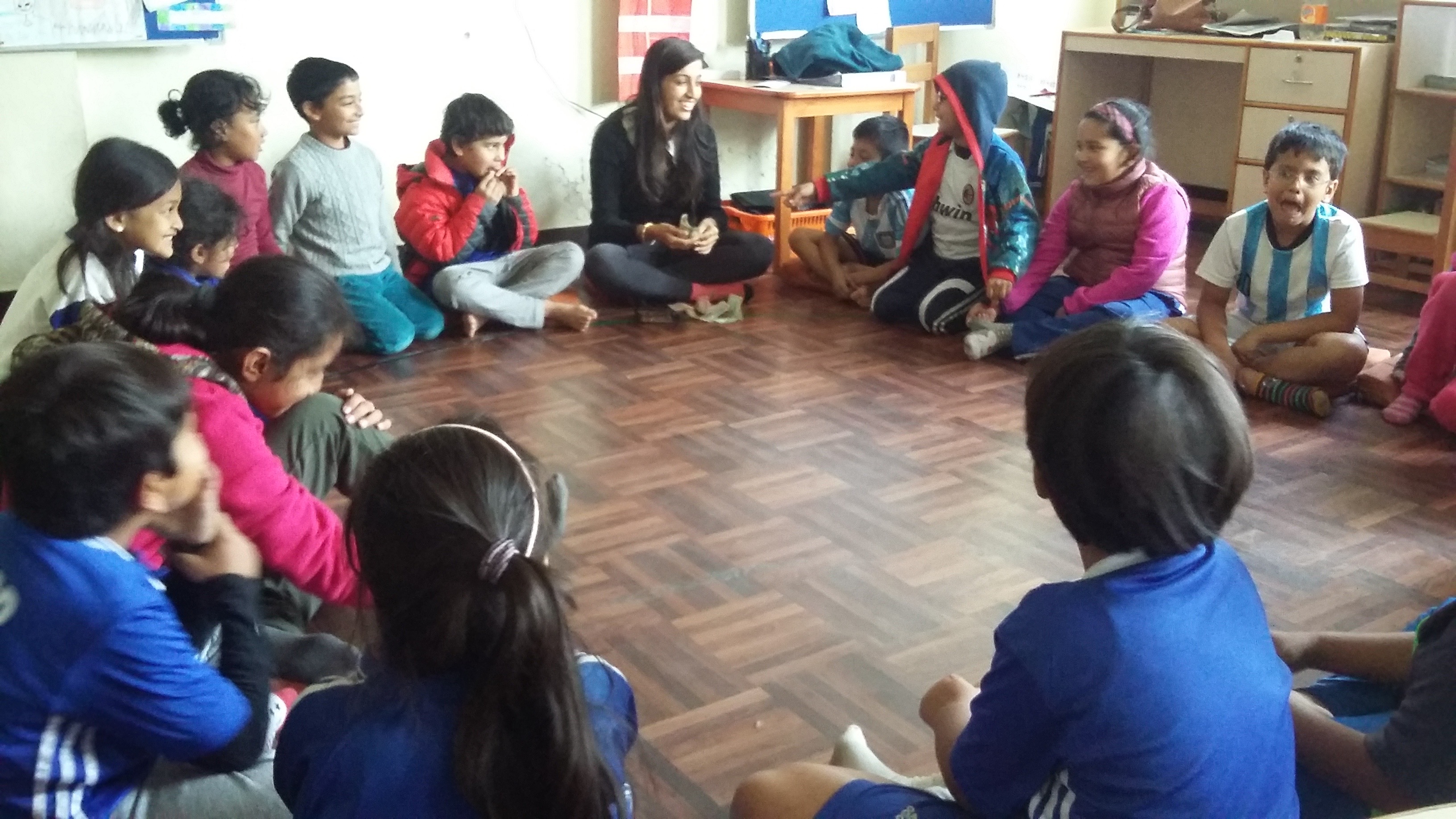
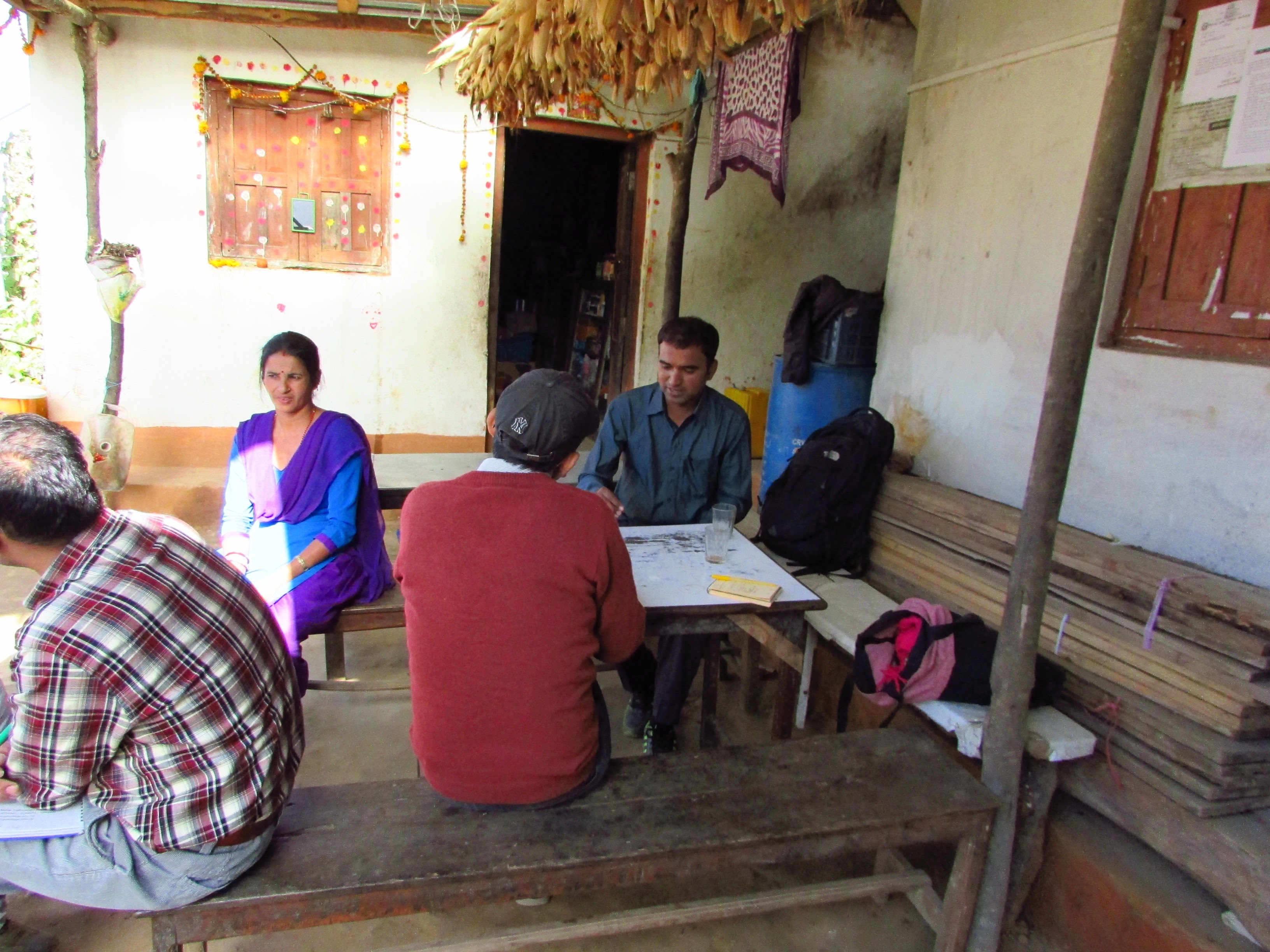
20161109_164243Karkhana works directly with learners ages 8-14 through an after-school program. They also do teacher professional development. I’ve been fortunate to participate in both of these.

There were several good things I noticed beyond the general idea of learning through hands-on inquiry. One was an interesting mix of design though felt pen and whiteboard (or more precisely, whitetable), through physical construction, and with the aid of computers. The point was not to let the medium control the activity, but to let each medium offer affordances that could further the goal–planning a school fair, designing instruments for use on a space station, or building a musical instrument.

20161105_104138Another was the concern for making the Karkhana approach accessible to the ordinary school and ordinary teacher. In addition to workshops for teachers, Karkhana develops a special technology: ziplock bags filled with simple, low-cost materials that can be used in a low-tech, minimal skill situation.

Karkhana already makes new kind of learning available to many children and adults. But it also stands as an example of what could be done someday in Nepali schools, or for that matter, schools anywhere.


Shivapuri Nagarjun National Park

p1090435
I had a wonderful walk in Shivapuri Nagarjun National Park today, seeing both more and less than I’d planned.

My first mistake was going by taxi without clear directions for a non-English speaking driver. Rather than arriving at the Parimuhan entrance, we somehow ended up somewhat west at Tokha. There were a couple of good effects of this. One was that I got a good view of the army camp sprawled over that area. The other was that by starting there I had the trail to myself, since most people sensibly enter through the main gate,

p1090448The day and the trail were beautiful, I took a side trip up to the Banduspati River. There were over 200 constructed steps and a lot of unconsturcted uphill. But it was well worth it to see the cascades and sylvan setting.

One part of the trail greeted me with mica sparkling in the midday sun. I was once again reminded about how much more one can see by going slowly.

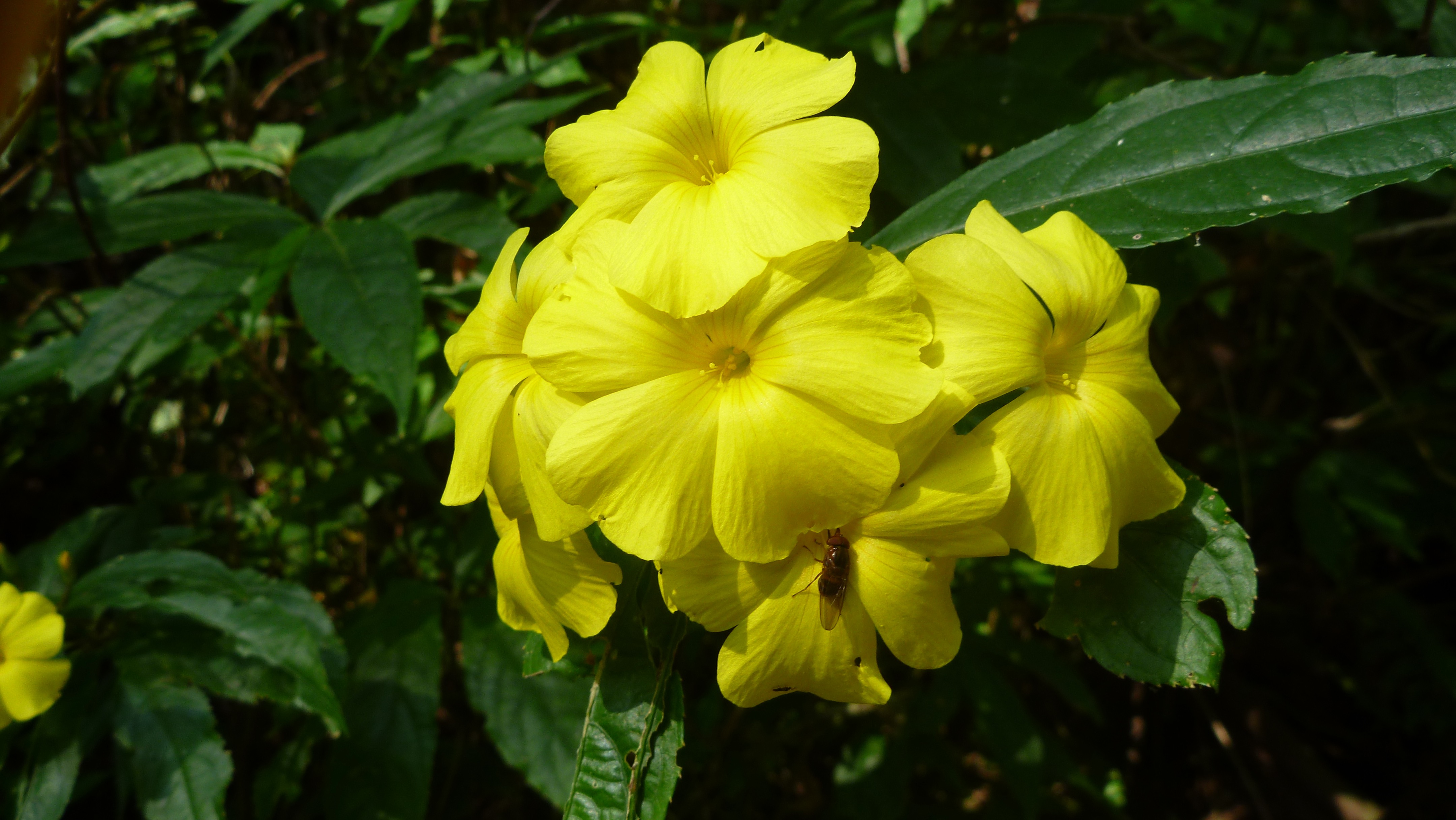
p1090458I saw a profusion of wildflowers, butterflies, dragonflies, birds, and more. Since I was alone and had neither guide nor guidebook, I had the luxury of naming each thing myself. For example, I saw many versions of small-brown-butterfly-that-never-alights-long-enough-for-me-to-take-a-photo. That’s now its technical name.

p1090429I did see a few people-some mountain bikers, some women cutting fodder, a couple of guys working on the trail.

At the base of the trail to Shivapuri Peak, I met a group of students and faculty from St. Lawrence College. They invited me join them on the walk up.

The climb totally destroyed my conceit about being able to keep up with young ones on a climb. Several times I had to pause, and eventually I decided to let them go on because I was holding them back. Could it be that Nepali youth are healthier than those in the US?

In the end, I walked back down to Budhanilakantha and got a ride back to the area of my apartment. Yes, a bit tired, but it was a beautiful day, and wonderful resource so close to the capital city.

This slideshow requires JavaScript.

Community inquiry in Dalchoki

2016-11-13-22-08-15

Himalayas to the north, past the Kathmandu Valley

It’s highly unlikely that you would just happen upon Dalchoki, given that it’s two hours from Kathmandu by jeep up narrow mountain roads, which are dirt surface with ruts and random rock from landslides. If you did, you might wonder what was there. You wouldn’t see an industrial center or a tourist destination.

Despite that, I had one of the warmest and most satisfying few days in Dalchoki that I’ve ever experienced. As part of our progressive education workshop we engaged in community inquiry with the residents.

planning

Planning our visit in the Dalchoki Rising Homestay

From Dalchoki, some views are “blocked” by beautiful green hills, but to the south you can see the Terai plains leading to Ganges basin and India; to the northwest there’s a good view of Manaslu (26,781 ft) at the eastern end of the Annapurna Massif; to the north is the Kathmandu Valley; beyond that, the Langtang Himal, with 13 peaks above 18,000 ft; and to east, Sagarmāthā (Everest).

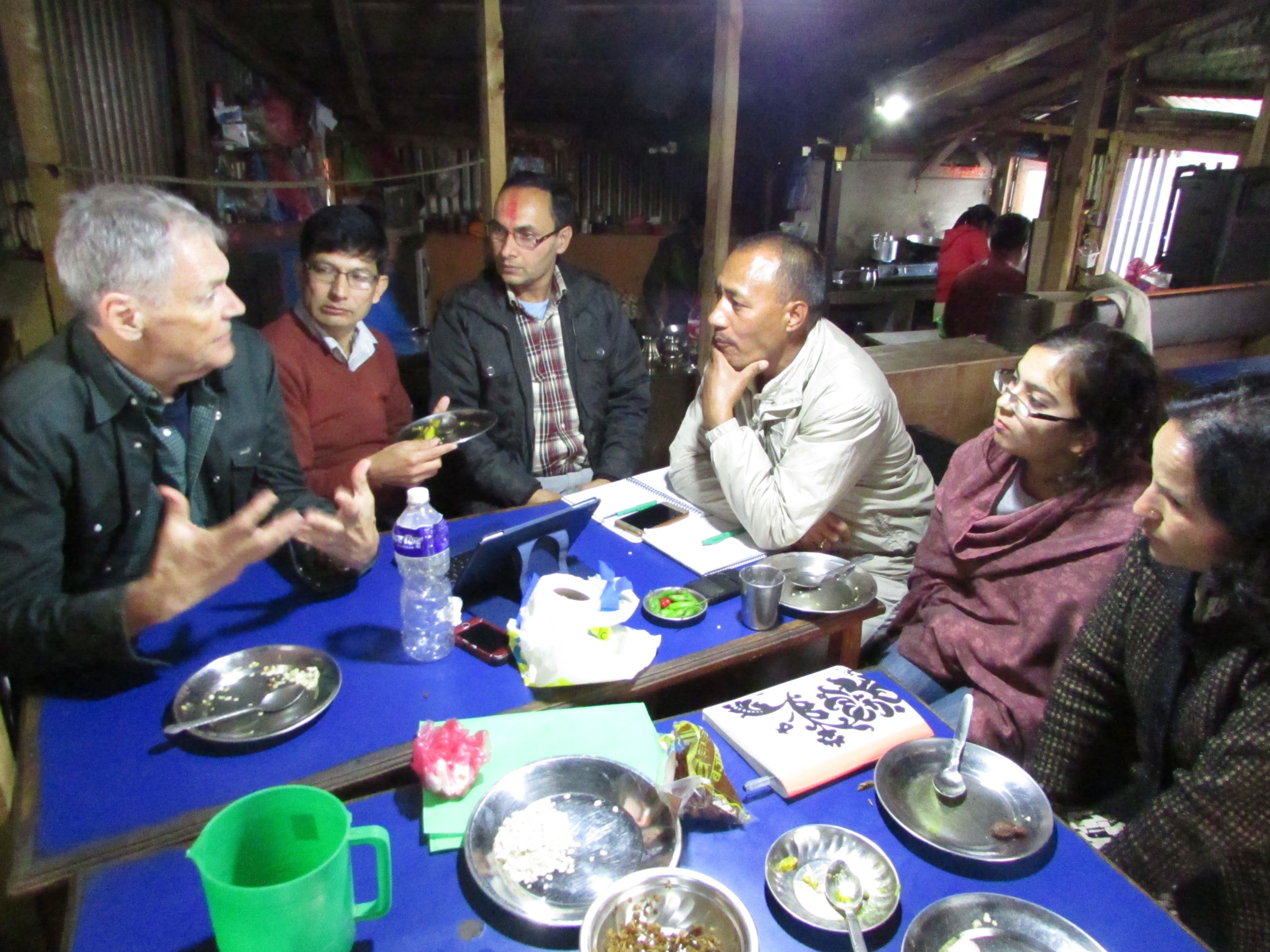
There’s far more than can be included in one blog post. But just to give a sense of what we did, I could talk about the milk collection center. We wanted to meet with people in the village, and knew that they would bring their milk to the center for weighing and testing.

talk

Talking with people in the village

At our time there, we saw the head of the village development committee, and many ordinary farmers. We also talked with the staff in the center. They told us about weighing the milk, adding sulfuric acid which reacts with the non-gay portions of the milk, centrifuging, and then assessing fat content.

One aspect of the discussion was whether this process could become part of the school curriculum, in place of some of the Western content that seems so strikingly inappropriate here. Another was whether there were ways to add value to milk or other agricultural produce to improve the economic condition of the village. That challenge itself could become part of the curriculum. We continued this discussion with teachers at the school the next day,

On a personal level, I had a kind of peak experience, enjoying the incredible views, the warmth of our team of eight, our hosts for the stay, and people in the village. Whether eating delicious, traditional mountain village food, 100% organic, telling stories and laughing by the fire, playing cards, or debating views of education there was an intense feeling of family and community.

This slideshow requires JavaScript.

Views of #45 from Kathmandu

The Himalayan Times: Plan to repair valley roads within a month

The Himalayan Times: Plan to repair valley roads within a month

At the risk of sinking the world in more words about Trump, I have to share a perspective I couldn’t have imagined a few months ago.

Back then, I was convinced that Trump couldn’t win and I didn’t know that I’d be in Kathmandu. But life is full of surprises, some bad and some good.

I’ve been here in the several weeks running up to the election, and seen it through the eyes of Nepali friends.

Around town

The campaign was of course the best show going, here as in the US and elsewhere. Everyone knew about it and had an opinion. I talked with some grade 3 children who were fascinated by the contest between Donald Trump and “that girl.” One said “I don’t like Donald Trump. Nobody does.” They said that Clinton was the President’s wife. I tried to point out that she’d actually had a distinguished career as Senator and Secretary of State, but that seemed to be of little interest.

Solidarity

Solidarity

Most Nepalis I’ve talked to were distressed to hear about the election. They worry both about the future of the US and about its impact on Nepal, particularly around trade. Some also display amusement. They would never say it outright, but it’s something along the lines of Americans being incompetent and clueless.

A few are Trump supporters, usually following the theory of creative disruption: The system is corrupt, leading to US arrogance, endless war, manipulation by banks, and so on. Something needs to be done to shake it up.

At a conference

As the election results were coming in, I was attending a conference here in Kathmandu. There were attendees from Nepal, India, Malaysia, the US, and some other places. Every speaker made some reference to the election. Late in the morning, which was the wee hours in the Eastern US, it started to become clear that Trump was winning.

One speaker said, “I know you’re not listening to me. Instead, you’re following the election on your phones. See, that proves my point about new technologies changing everything.”

Everest Trail Race

Everest Trail Race


That afternoon, everyone asked how I felt. It was hard to answer because I felt so many things: surprise, shock, depression, fear, anger, shame, and more. They wanted me to say what would happen next, which is ironic, since I was so wrong before.

So, what happens in the US has an impact everywhere. Yet many in the US may not appreciate how important global perception of our leadership can be.

In the media

Despite this, the US is not the center of attention all the time. I looked today at the online The Himalayan Times. There are nearly 100 articles. Several at the top of the page address the Indian government’s decision to ban 500 and 1,000 INR banknotes ($7.50 and $15). This is supposed to combat counterfeiting, but has dire consequences for many in Nepal, especially those in border areas.

There are articles about roads, traffic, health, sports, and many other areas, but nothing about Trump until you get to the special World section. There, you can read about Trump meeting with President Obama, and about reactions to the election from Russia, Germany, and UK.

Essentially, the US election is rapidly fading into “other news” or none at all here. With chronic infrastructure problems and a GDP per capita of less than $2 a day, most Nepalis have many other things to worry about. Of course, if Trump follows through on some of his outrageous statements, that will change. If international aid programs are cut, the effect here can be substantial and immediate.

I just keep going by reminding myself that I’m fortunate to be visiting an amazing and wonderful country. I experience surprising things every day, knowing that they’ll be only memories in a few weeks. They’re real of course, but not part of the real life I know back in the US. So, maybe when I return there I’ll discover that all this election stuff was just a strange experience that didn’t actually happen.


The kindness of strangers

Children in my neighborhood

Children in my neighborhood

Susan and I met a Belgian couple in Patan. They were on their honeymoon on the way to Bhutan, because it was the happy country. When I told this story to Raj, a Nepali friend, he said that people here were not always happy, but that they were kind.

Panipuri maker

Panipuri maker

Setting aside the fact that no single label can apply to everyone in a nation, I’d have to agree that I see endless examples of Nepali kindness.

I was waiting for a small van to pick me up to go to King’s College this morning. The driver was a bit late and called to say that he would arrive in 15 or 30 minutes.

The eventual explanation was that when he picked up another passenger before me, they saw a blind woman in the neighborhood. They offered her a ride, which delayed things a little. Small acts like that happen all the time without question.

Progressive Education workshop at King's College

Progressive Education workshop at King’s College

By the way, I got to meet the woman and to watch her set out along the streets. Never again can I complain about the difficult urban walking here.

There are many such examples:

  • Children in my neighborhood invite me to join their games, despite the fact that I seem to be consistently inept.
  • 20161031_141109I stopped in a bakery to buy bread and to ask whether they had a small coffee press. They didn’t. As I was walking away the clerk in the bakery came running after me. She suggested that the tea store across Lazimpat Road might have one (which turned out to be correct). I must have groaned at the continual but chaotic stream of traffic. So, she offered to walk me across the street. A bit shamed by that, I managed to brave the traffic, and made it across and back without incident.
  • Tihar preparations

    Tihar preparations

    Police and soldiers, even those assigned to maintain order for the Indian President’s visit, always seem ready to offer directions when I get lost, and even to lead me part way.

  • When I stopped to watch the making of panipuri, a man spoke to me and patiently explained what was in it, how much it cost, and how to eat it.
  • Climb to the temple in Bandipur

    Climb to the temple in Bandipur

    Participants in the Progressive Education workshop automatically take on helper roles with me and each other. In other situations, I’ve had to spend time with awkward requests like “does anyone know where we could get some paper and scissors for this activity?” or “could you help out this other group or individual who is having difficulty?” Here, I see the help before I’ve even fully recognized the need.

  • When early on I went for a walk to get groceries, I heard some music and stopped to look. I was invited in to join a Rotaract Club of Pashupati-KTM Tihar celebration. This included dancing with them, which I attempted in my clumsy way. I wonder whether it will be on their FB page.
  • I also see Nepalis helping one another. At one time, this is to negotiate impossibly narrow streets. At another, it’s a 10 year old boy carrying his 3 year old sister.

Experiences like these are difficult to capture in words or images. They lead to a feeling, one of trust that the fellow humans around are eager to help when they can in spite of difficult material circumstances.

John Dewey in Nepal

Singing in multiple languages

Singing in multiple languages

If John Dewey were to return to visit US schools of today, he would surely be impressed with the buildings, AC, and new technologies. But he’d likely be disappointed to see that these modern affordances aren’t always used to enrich education as he envisaged. In fact, they often serve to reinforce the separation of schools from the life of the community and divorce children’s learning from the concrete reality of their own experiences.

20161104_135517

Diorama with sand filter for rainwater tank

However, he might have a better experience at his eponymous school in Baluwater, Kathmandu. The principal and the teachers at the John Dewey School would be quick to tell you they have much to learn, but that desire to learn is part of what makes them an inspiring example.

Music and art are infused throughout the curriculum. For example, grade 5 students are learning Spanish. Encouraged to take charge of their own learning, they use computers to select and play Spanish songs, then choreograph dances for those.

Students work with an organic garden and a compost bin. They learn to recycle, which is not so common in Nepal, and extend that to their homes in the community.

I was able to see a grade 4 math class and to play magic squares with the students. Grade 1 students taught me a Nepali song and I shared Skitter-a-dink. Everywhere I saw examples of student work–drawings, writing, and more. They were learning with their hands as well as their heads.

Principal as instructional leader

Principal as instructional leader

Some students had made a diorama of a neighborhood area, complete with a huge rain barrel and the sand filters that are used with them. Other students had gone on learning walks a la Célestin Freinet and then had mapped the community. This suggests a possible collaboration with Kathmandu Living Labs.

20161104_133907

Active learners

It would be easy to quibble: The school is private and available to only a few; its model is far from common; its activities are often quite conventional. But what i saw in the first of several planned visits is a school that I would have been glad to attend or to send my children to, and one that sees growth as the goal, not conformity, both for the children and for the school itself.

Some activities:

Facilties:

Schools for today


Learning Spanish through dance

Learning Spanish through dance

Some people in the US judge the success of their local school by its performance on standardized tests, innovation by the incorporation of sophisticated electronic devices, and curriculum by the latest clever acronym.

Schools seek to meet high standards, which actually consign a large percentage of schools, teachers, and students to the category of  “failing.” Even “successful” schools look more like efficient factories to produce high scores on the way to preparation for college and career. The school is separated from community life, and often from music, art, and play. Compliance and conformity often win out over creativity and critical thinking.

The vision of early 20th century progressives of the school as the social center of the community, students as critical, socially-engaged thinkers who are capable of shaping a just and equitable society, and learning as a means to nurture good and purpose-filled lives, is often lost.

Education in Nepal faces even more problems. For some the issue is whether they have a school at all or a teacher. Books, computers, and electricity are often lacking. Even private schools are under-resourced by US standards. Yet in my short time here I’ve seen numerous examples of creative approaches to teaching and learning that build on that progressive vision, and resist the factory model.

In my next few posts I’ll share some of these Nepali examples. None are perfect (as if that were a sensible goal), and none fully challenge today’s dominant education paradigm. However, they do show how vision, dialogue, and experimentalism can make progress, even when operating within enormous constraints.

[cross-posted on Progressive Educators Network Nepal]

Views of Lazimpat

Views of Lazimpat, Kathmandu from the rooftop terrace of the apartments I’m staying in. Note the mountains, which are unusually clear, probably due to the slowdown of traffic following Tihar and the visit of Indian President Pranab Mukherjee with his Nepali counterpart, President Bidya Devi Bhandari, at the Sheetal Niwas (~White House).

You can see a little of the mix of urban and rural. However to fully appreciate that you need to walk the streets and back alleys.

Kathmandu city itself has about a million inhabitants, but the district and the valley hold several times that many. It’s an interesting mix of megacity (traffic, pollution, crowds) with country (dirt roads, poultry, open air living). I was awakened by roosters and a cat fight outside my window this morning. One can see cows lying in the middle of the densely traveled Ring Road.

In and around the Lazimpat Apartments.

Tihar preparations.

Some of the many thangkas on display.

Neighborhood shots.

My stay in Lazimpat, Kathmandu

20161102_083216-1

Welcoming elephant

Those of us in the US could learn from Nepalis (and others, as well) about hospitality. Despite having far less in material resources, my host country for a seven week stay has been uniformly friendly, helpful, and generous.

I’ve seen this at the institutional level (King’s College has supplied me with an overly large and nice apartment in a convenient and pleasant area), among friends and colleagues, in shops or touristy places, and among people I meet on the street. Even the towel in my apartment is welcoming.

Lazimpat Apartment

Lazimpat Apartment, lit for the third day of Tihar

When I went for my first walk from the apartment, I heard some music and stopped to look. I was invited in to join the Rotaract Club of Pashupati-KTM, in their Tihar celebration. They asked me to dance with them, which I did in my clumsy way. Will that appear on their FB page?

This was an experience that can’t be captured in words or video, but confirmed my sense of being welcomed. There were many smiles and a lot of interest in who I was, but no pressure to explain myself or to interact in any way that didn’t feel comfortable.

Rangoli for Tihar

Rangoli for Tihar


I’ve regularly been invited to join family gatherings, garland making sessions, or just to chat. One Tihar party even came to me, just outside my window. You can hear a snipper of that one here: Tihar party in the garden

There is a new manager of Lazimpat Apartment, who started the day I arrived. He wants to make the otherwise international style apartment look more Nepali. He’s placing Thangkas in every sitting room. These are Tibetan Buddhist paintings, in this case, on cotton. They usually depict a deity, scene, or mandala. You can see below, some not-so-good photos of those in my apartment.