A new video for the Drummer Cove conservation area has just been released. Thanks go especially to Mary Doucette, advised by Mike Fisher.
The Drummer Cove area is remarkably varied for its 11+ acres. It is also unusual for offering a 1+ mile trail with easy access.
Length & Extent of Trail: 1.1 miles; 11.3 acres plus easements
Area description: The Drummer Cove Conservation Area includes salt marsh, tidal flats, coastal bank and oak pine forest on its upland. The entire area is within the recharge area to Drummer Cove and as such falls into the Wellfleet Harbor Area of Critical Environmental Concern. The land is in State designated Priority Habitat for rare species. The four benches provide great views of the Cove.
Location: The trail head is at 170 Pond Ave in South Wellfleet. 41.91415, -70.00165
Directions: Exit Route 6 heading west for approximately 0.5 miles on Paine Hollow Road to the first stop sign. Turn left on Pleasant Point Road for approximately 0.25 miles. Turn left on to Pond Ave for 0.3 miles, the last part being a dirt road to a parking area at the trail head.
There’s a land I know where the bluebonnets grow that is paradise to me,
From Amarillo skies down to Mexico, from the Pecos to the sea
Kenneth Threadgill, “Coming back to Texas”
Fifty years ago, I heard Kenneth Threadgill and the Hootenanny Hoots perform “Coming back to Texas” at the Split Rail in South Austin. This was in the “land that gave me birth.”
I went with good friends to share pitchers of beer, enjoy fried onion rings, and listen to great music performed by Threadgill, George McLean, and other notables. I should retract that. The music wasn’t always “great,” especially when folks like me chose to sing along.
“Fraulein” was a favorite and we weren’t awake enough to see that the term might be sexist. We were transported by lines like
Far across deep blue waters, lives an old German’s daughter
By the banks of the old river Rhine.
It was easy to ignore the fact that the actual subject of the song was a German-American living in Houston. If the singer had really meant
By the same stars above you, I swear that I love you
You are my pretty fraulein
he might have put more effort into just making the relationship work, not dreaming about the old river Rhine.
The Lone Star and Pearl longneck beers were cheap, there was no cover charge, no dress code, and no paving in the parking area. Hippies, cowboys, and graduate students mingled with little concern for status or political beliefs.
This was the Old Austin, near its end. Today, the streets around the Capitol and the University are just a tiny eye of calm in the middle of the hurricane of highways, suburban developments, and booming tech industry that characterize the New Austin.
But the real purpose of our stop in Austin was not to reminisce, but to see family, just a few of whom are shown here in a photo from dining out. The family time has been far more precious than even the memories of the Split Rail.
Indian blanket (Gaillardia pulchella)At Matt’s El RanchoChecking out the lower vanagain bed for comfort and sizeAt sister Karen’s; Henry recovering from broken arm playing basketball
Days 8-11: Lake Bisteneau, Louisiana, 2233 miles, 12 states
Even more so because it the Choctaw way of thinking, west is the direction of death. That’s the direction that people travel after they have died and left this world, so having to move towards the west in particular made it even more traumatic for Choctaws because it was moving toward the land of the dead.
Ian Thompson, “The Choctaw Spirit”, speaking of the forced removal of Choctaw people through the Trail of Tears
The Natchez Trace is a National treasure. I hesitate to say much about it for fear that hordes of people will come and overwhelm its natural beauty.
Rather than embarking on a lengthy book project, which the Trace deserves, let me just list some things it does not have and some things it does.
The Natchez Trace does not have:
Large trucks
Buses
Heavy traffic of any kind
Billboards
Trash
Only a few of the many things the Natchez Trace does have:
At least three crossings of branches of the Trail of Tears, including the water trail on the Tennessee River
Two thousand year old burial mounds from the Hopewell culture
Jackson Falls, a stunning waterfall descending in several cascades over limestone shelves covered with moss and lichen
Rock Spring, a short walk along Colbert Creek with beaver dams, secluded pools, wildflowers, birds, amphibians, and carved stone steps across the Creek
The award-winning Double Arch Bridge over Birdsong Hollow
Trails of all kinds–wheelchair accessible, challenging climbs, horse trails
444 miles of a winding, two-lane highway lined with trees and occasional meadows, marshes, and ponds
Stopping points every two or three miles with nature walks, historical sites, and attractive picnic spots
Free camping in wooded sites
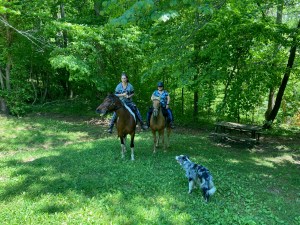
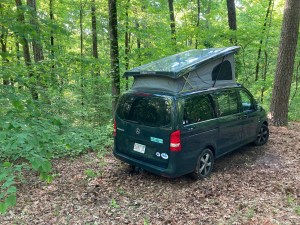
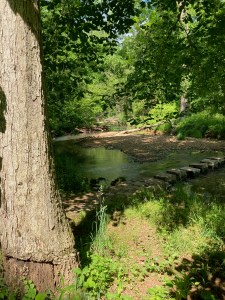
On the horse, and dog, trailVanagain in Natchez Trace campsiteFire ants, after I disturbed their mound with my fingerRock SpringsColbert CreekOld growthLake Bistineau in floodJackson Falls
The videos emphasize impact and broadening participation, especially in the midst of COVID. Visitors can view the videos and participate in the online discussions. They can also vote for favorites (voting and discussion ends on May 18 at 8pm EDT).
My heart aches when I think of the COVID-19 pandemic in Nepal. The situation is dire, worse than in neighboring India.
The latest data I’ve seen (e.g., from Our World in Data) shows a positivity rate in Nepal standing at 47%, meaning that many cases are missed and every other person is infected. The full vaccination rate is 1%. There is little chance to get shots unless the US steps up.
Several of my colleagues have had or currently have COVID-19, including one former student, various colleagues, and several attendees at workshops I led there.
On a recent video call, two people failed to show up because they were sick, one didn’t come because his mother was ill, one just didn’t show up. One showed up but was sick and didn’t say much. Only one was healthy.
The airport is now shut down, so it’s difficult to get oxygen. The health system is overrun. A colleague I trust, Shisir Khanal, has started a GoFundMe: Help People Breathe: Oxygen For Tulsipur to buy oxygen or concentrators. Efforts like that are important, but much more is needed.
The country’s only zoo in Jawalakhel was shut for 10 months due to the pandemic. After reopening, a cap of about a quarter of the usual number of visitors has been imposed. Not surprisingly, the zoo has struggled to stay afloat since it depends heavily on visitor fees. Now, it appears that they may not be able to pay staff or feed the animals.
The only hope may be a new Adopt-an-animal program. Would you like to save an Asian elephant, a one-horned rhino, or a royal Bengal tiger?
The US should treat COVID-19 as a global problem, not simply one of public health in within the US. It is a moral imperative to help Nepal (and other countries), but it also makes sense from the most selfish perspective.
People in the US are celebrating that COVID-19 seems to be at bay. But as the tale in India and other countries shows, early confidence is often undercut by the realities of the virus. The pandemic continues to rage in Nepal, India, other parts of Asia, South America, and Africa.
Widespread infection ignores national boundaries. New variants are not just possible, but inevitable, putting every person on the planet at risk. If we don’t stop the spread, the pandemic can easily return worse than ever in the US. At best it will haunt us for a very long time.
Day 7: Cave Mountain Lake, VIrginia, 1057 miles, 8 states
It all comes of liking honey so much.
A.A. Milne, Winnie the Pooh
After several wrong turns (blame this navigator), one night that was strikingly cold, persistent rain, and some other minor irritations, we arrived at the almost perfect campsite.
The weather was ideal, cool enough to justify a campfire, but not enough to shiver us. Our site was at the end of a loop, with no one else nearby. We mercifully had no wifi or cell service. The comfort facilities were clean and not too far away. We had several pleasant walks and could have spent months doing more in the area.
There was only one problem.
A forbidding sign told us not to leave any food outside or in a tent (no surprise at that), but also no bug spray, no hand sanitizer, charcoal and lighter fluid, toothpaste, or virtually any other item I’d ever imagined on a camping trip.
The problem of course was bears. They can easily become a nuisance or a major danger, and they’re apparently attracted to everything, at least anything that a human has touched.
During dinner, there were three times that we heard major rustling in the woods just above our site. There was no human trail there, and the rustling was much too loud to be from a raccoon or turkey. That night, too, we heard four-footed steps outside our van, enough to make us stretch out the time between needed nighttime comfort breaks.
We might have beeome bear food, but through intelligence, perseverance, and bravery we managed to make it though the night.
Days 5-6: Prince William Forest, VIrginia, 824 miles, 8 states
This is the forest primeval. The murmuring pines and the hemlocks, Bearded with moss, and in garments green, indistinct in the twilight,
Henry Wadsworth Longfellow, “Evangeline: A Tale of Acadie”
With the Williams. Guess which baseball team they support!
We stayed last night in Prince William Forest Park, Virginia. There had been a continuous rain for several hours leading up to our arrival in the area, so the grounds were soggy, the air was misty, and the trees were dripping.
Our stay almost didn’t happen, because we’d made a mistake on our reservation. A ranger happened to pass by as we were considering speaking to the usurpers of our campsite. We learned that they were totally in the right and that our reservation was for a previous day. Fortunately, there was an unoccupied site we were able to use.
The Park sits next to the Quantico Marine Base, and as a reminder of the toll of war, the Quantico National Cemetery. The area of the Forest was once home to several villages, including one for former slaves.
It’s now a lush green landscape, much further along than our cape Cod vegetation and denser in any case. There’s a beautiful Scenic Drive, trails, well-spaced campsites, and limited, but well-functioning facilities.
We visited nephew Mark, his wife Laura, and their two boys in Springfield. It’s a sign of the enforced isolation of covid on top of our laziness that they’ve been in a new home for five years and we hadn’t seen it before.
Mark and Laura may have started a trend. We’ll be seeing at least seven family individuals or groups in domiciles new to us on this trip, and as a bonus, one family in Texas and another in California who’ve sold their homes and moved out, but don’t have a new one yet. In addition to covid, there are growing families and new jobs, maybe a little restlessness appropriate to our times.
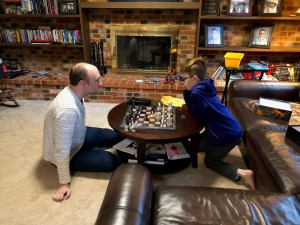
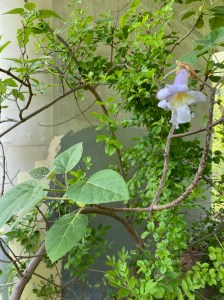
Chess masters. Why is there no large screen TV?Blue heron at Burke LakeIntrepid explorersPaulownia bush taking advantage of a disturbed area under a bridgeCicadas preparing to emerge
An analysis of the use of our WCT website shows that many visitors to the site are interested in exploring the conservation areas and trails. That’s especially the case in July and August.
Responding to that need, Mary Doucette, our Americorps worker, has produced a terrific video for the Fox Island and Pilgrim Spring area.
It’s now posted in our video showcase, which will eventually contain additional WCT videos (currently just this one).
The ecosystems perspective on learning offers a new way of thinking about how learning through life — work, play, home, family, and community — relates to formal education and its many informal counterparts in libraries, clubs, churches, online, etc. It conceives education broadly as the central process of democratic life. For the educator in formal or informal settings, it provides a theoretical framework for what the best educators are already doing. For the researcher or evaluator, it offers tools for analysis. For anyone it suggests ways to reflect on our own learning through life.
Sandy Hook is a beautiful, peaceful respite. There are interesting walks and cycle routes all over. The big activities are in other-than-human nature, since the principal human activity was the now dilapidated Fort Hancock.
Beach plums bloom wildly in the spring, promising unlimited jams and jellies. Menhadens litter the beach. Perhaps a school was attacked by bluefish, or seabirds? Ospreys circle overhead, in flocks of four or more, a pattern that I’d never seen before. The tides move inexorably, but the whitecaps come and go as the wind keeps changing. The Raritan bay side and the Atlantic ocean side each have their distinctive character.
Beach plum bush with blossoms
The isolation and calm aren’t for everyone. Sarah Patterson was appointed Assistant Keeper of the Lighthouse in 1867. She assisted her brother, Charles Patterson, who was Head Keeper and tended the lighthouse from 1861 to 1885. She complained about what seemed monotonous to her:
…I get homesick…I can only look at sand and water [here]. We can’t hardly tell whether its spring or not… [because] it is always one thing here; the sand and cedars never change.
Sarah Patterson Johnson in a letter to her father at the family farm in Howell Township, NJ
Sarah never knew that the beach season would disrupt the calm of Sandy Hook starting each June. I imagine that it’s quite different then. Huge parking lots, A through M, imply hundreds of cars, beach parties, loud music, frisbees, dogs, and raucous times.
The summer could offer a fun adventure, but I’ll settle for quiet interrupted only occasionally by the warning horn of the ferry approaching the nearby dock, gorgeous sunsets and sunrises over the water, and sand and cedars that actually change all the time.