Against Cartesianism

In his Meditations on First Philosophy, René Descartes writes

we should conclude from all this, that those things which we conceive clearly and distinctly as being diverse substances, as we regard mind and body to be, are really substances essentially distinct one from the other; and this is the conclusion of the Sixth Meditation… we cannot conceive of body excepting in so far as it is divisible, while the mind cannot be conceived of excepting as indivisible. For we are not able to conceive of the half of a mind as we can do of the smallest of all bodies; so that we see that not only are their natures different but even in some respects contrary to one another.

He goes on to argue for the distinct separation of body and mind, part of what has become known as Cartesian dualism. While the whole argument may appear to some as abstract philosophical theorizing, it has had an enormous influence on Western thought, not only in philosophy, but also in social sciences, arts, religion, education, medicine, political theory, gender studies, colonialism studies, and other areas. For background, see Russell Shorto’s Descartes’ Bones: A Skeletal History of the Conflict Between Faith and Reason.

I’d like to recommend three classic, short essays that discuss the problem of Cartesian dualism and its consequence for life today.

(1) One is “Some Consequence of Four Incapacities,” by C.S. Peirce, written in 1868 for the Journal of Speculative Philosophy. Peirce directly critiques four major assumptions of Cartesianism.

(2) A second is John Dewey’s essay, “Body and Mind.” He writes,

the question of the integration of mind-body in action is the most practical of all questions we can ask of our civilization. It is not just a speculative question; it is a demand: a demand that the labor of multitudes now too predominantly physical in character be inspirited by purpose and emotion and informed by knowledge and understanding. It is a demand that what now pass for highly intellectual and spiritual functions shall be integrated with the ultimate conditions and means of all achievement, namely the physical, and thereby accomplish something beyond themselves.

(3) A third classic is by Arthur Bentley, “The Human Skin: Philosophy’s Last Line of Defense.

All three of these make the same general point––a rejection of dualist thinking, which derives from Descartes’s attempt to reconcile science and religion, but which pervades our thinking in practically every other area, and a call for integrated approaches to complex problems.

References

Charles S. Peirce. “Some Consequences of Four Incapacities.” Journal of Speculative Philosophy 2 (1868): 140–57.

John Dewey. “Body and Mind.” In The Collected Works of John Dewey, 1882-1953, edited by Jo Ann Boydston, LW 3:25-40. Carbondale & Edwardsville, IL: Southern Illinois University Press, 1967.

Arthur F. Bentley. “The Human Skin: Philosophy’s Last Line of Defense.Philosophy of Science 8 (1941): 1–19.

Why is there such tax phobia?

I’ve never met anyone who wishes their taxes were higher. Some taxes are a nuisance, like the few cents extra on a cup of coffee, and some are burdensome, like the Social Security tax on low wage earners. But most of us recognize that national defense, health care, good schools, roads, and parks, and so on, are accomplished best when we pull together.

Taxes are a means to enable our Nation to work for a common good, for widely shared goals. So, why is there is a phobia today about any tax increase? Part of the explanation may lie in a major misunderstanding about wealth in the country.

Most people believe that Warren Buffet should pay more in taxes than his receptionist does. Even he thinks that he should pay more (in fact, he pays less). People support that position even if it effectively redistributes wealth. In fact, most of us believe that we’d all be slightly better off if poor people and middle-class people had more money, even if that meant that the very rich had a little less.

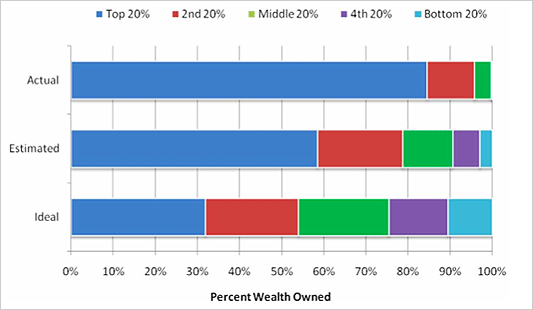
Michael Norton and Dan Ariely have done some research on these issues. They found that Americans drastically underestimate the level of wealth inequality in the US. Americans know that there’s a range of wealth, but they don’t realize just how rich the rich really are, and how poor the poor really are. So, they think that the wealth distribution is more even, or equitable, than it really is. Not only that, their ideal would be even more equitable than the current situation, imagined or real.

Norton and Ariely’s data indicate that the richest quintile of Americans own 84% of all wealth, while people in their survey estimated that the top quintile owns just 59%. Conversely, they think that the low income groups have more wealth, when in fact the wealth of the bottom two quintiles doesn’t even register on the chart.

Distribution of wealth in the US

Distribution of wealth in the US

Putting this another way, no group (Democrats, Republicans, rich, poor, men, women) wants a country as unjust as the one they think we have. But the one they think we have is at least more just than the one that we do have. Some think we should have total equity; some want a wealth distribution more like Sweden’s. Only 10% want what we actually have. And yet, we’re willing to risk a default and economic catastrophe in order to make the US even more unjust.

Modest changes in income and estate tax rates and closing of tax loopholes would go a long way toward addressing the National budget deficit and reducing the debt. We’d still have a wealth distribution more unequal than that of other first world nations and more unequal than we really want. But it would be a step towards making everyone pay their fair share.

Not doing that doesn’t mean that we all walk away to tax-free heaven. Instead, it means that the lower quintiles bear an even larger burden through reduction in social services and regressive taxes, such as local sales taxes and social security taxes on wages (which are designed to tax low wage earners the most).

It’s clear why there’s a phobia about tax increases. It’s not about any tax, but about the type of tax and who should pay. The people pulling the strings are the ones who like the fact that they control most of the wealth and are quite happy to keep the burden on those least able to pay. They’re afraid that they might have to pay their share.

The real question is why everyone else seems content to go along.

References

Norton, Michael I., & Ariely, Dan (forthcoming). Building a better America – one wealth quintile at a timePerspectives on Psychological Science.