The Women Who Went West

Under the leadership of its first Dean, Katharine Sharp, Illinois’ Graduate School of Library and Information Science sent the first librarians west.

As pioneers immigrated to the western towns of Wyoming, New Mexico and Oregon, graduates of Illinois set up libraries to educate the growing population. Often the only women for miles, these librarians created literacy programs with very little resources. –Here & Now: Videos

The video, The Women Who Went West, features Betsy Hearne, re-telling some of the stories of these early librarians. These early librarians showed courage and resourcefulness in spreading books and literacy. As Betsy says, “democracy depends on an informed population,” and they clearly did more than most to make that happen.

Reference

Des Garennes, Christine (2008, November 23). Video shows UI librarians’ quest to settle the West in 1908. The News-Gazette.

What, when, and where of web pages

tree-of-practices-screenHow do we find an entry on a website? Usually, we do it either from a general search or by a link from another entry. But both of those are enabled by the fact that the entries are connected in some pattern.

What

One such pattern depends on what the entry is about. When we focus on the what, we call the entry a page. The main page on a topic (the parent) then links to sub-topics (the children). An example of this is my page on Teaching, which has several children pages. There can be many generations of pages, resulting in complex family tree of pages. Of course, with hyperlinking, it’s not strictly a tree structure, but the fundamental idea isn’t that different from the kinds of outlines we were taught to do in school.

ribbon

When

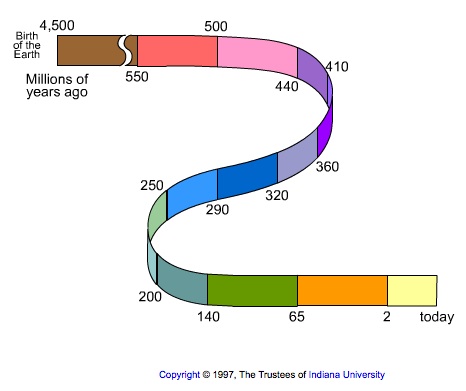
A second way to organize pages has become so common that many people use its name to refer to any website. That’s to focus on the when of an entry. In that case, the website becomes a blog and the entries, now called posts, are organized by their time of creation into a chronology, usually with the most recent first.

Image at left, showing geologic time, courtesy of the Indiana Geological Survey.

world_mapWhere

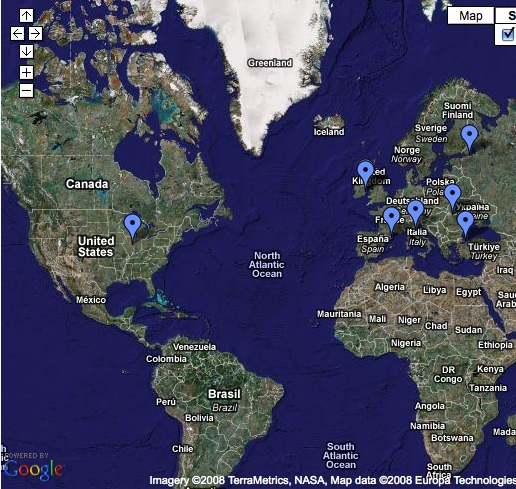
So we have a conceptual organization and a temporal one, what else is there? Well, another that is emerging now is a spatial organization. In this case, the entries, now called place-descriptions(?), are organized by their geotag, or where they occurred. For example, my entry on Aughavannagh and Glenmalure is more about the place than about the particular time our visit occurred. Just as pages can be grouped into a tree structure or posts into a chronology, place-descriptions can be grouped into a spatial map using their geotags. So, this site now has a world map, with place markers indicating the place-descriptions.

Things get messy in practice. We also use the less-structured tags and categories as other ways to find entries. A given entry might serve as a page, a post, or a place-description. And none of this works if the entries aren’t marked appropriately.

52°54′55″N 6°25′28″W

John Dewey in Turkey: Lessons for today

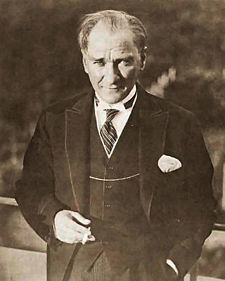
The Republic of Turkey was proclaimed on October 29, 1923. As its first President, Mustafa Kemal Atatürk (photo below) sought to establish the modern Turkey as a “vital, free, independent, and lay republic in full membership of the circle of civilized states.” He recognized the need for “public culture,” which would enable citizens to participate fully in public life, and saw the unification and modernization of education as the key. Accordingly, one of his first acts was to invite John Dewey, who arrived in Turkey just nine months after the proclamation.
In this endeavor, the ideas of Atatürk and Dewey were consonant. Dewey’s words above (“vital, free, …”) could have been written by Atatürk, just as Dewey might have talked about “public culture.” Both recognized the need to institute compulsory primary education for both girls and boys, to promote literacy, to establish libraries and translate foreign literature into Turkish, and to connect formal schooling, the workplace, and government.

Today is John Dewey’s 149th birthday. Back in 1924, he was nearing the age of 65, when many people think of retiring. But his three-month-long study in Turkey was an ambitious project. He addressed issues of the overall educational program, the organization of the Ministry of Public Instruction, the training and treatment of teachers, the school system itself, health and hygiene, and school discipline. Within those broad topics, he studied and wrote about orphanages, libraries, museums, playgrounds, finances and land grants for education, and what we might call service learning or public engagement today.

He laid out specific ideas, such as how students in a malarial region might locate the breeding grounds of mosquitoes and drain pools of water of cover them with oil. In addition to learning science they would improve community health and teach community members about disease and health. Workplaces should offer day care centers and job training for youth. Libraries were to be more than places to collect books, but active agents in the community promoting literacy and distributing books. In these ways, every institution in society would foster learning and be connected to actual community life. As Dewey (1983, p. 293) argued,

The great weakness of almost all schools, a weakness not confined in any sense to Turkey, is the separation of school studies from the actual life of children and the conditions and opportunities of the environment. The school comes to be isolated and what is done there does not seem to the pupils to have anything to do with the real life around them, but to form a separate and artificial world.
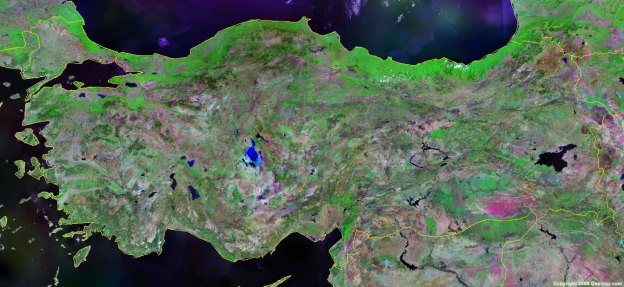
Atatürk saw the need to unify Turkey into a nation state, despite its great diversity. Dewey supported that but emphasized that unity cannot come through top-down enforcement of sameness (p. 281):

While Turkey needs unity in its educational system, it must be remembered that there is a great difference between unity and uniformity, and that a mechanical system of uniformity may be harmful to real unity. The central Ministry should stand for unity, but against uniformity and in favor of diversity. Only by diversification of materials can schools be adapted to local conditions and needs and the interest of different localities be enlisted. Unity is primarily an intellectual matter, rather than an administrative and clerical one. It is to be attained by so equipping and staffing the central Ministry of Public Instruction that it will be the inspiration and leader, rather than dictator, of education in Turkey.

This was realized in many ways. For example, the central ministry should require nature study, so that all children have the opportunity to learn about and from their natural environment, but it should insist upon diversity in the topics, materials, and methods. Those would be adapted to local conditions, so that those in a coastal village might study fish and fishing while those in an urban center or a cotton-raising area would study their own particular conditions.

Many of Dewey’s ideas were implemented and can be seen in Turkey today, as we come upon its 85th birthday next week. What’s even more striking to me is how relevant they are to the US today. Many of our problems can be traced to the “separation of school studies from the actual life of children and the conditions and opportunities of the environment,” but also to the separation of work from learning, of health from community, of libraries from literacy development, or of universities from the public. Dewey would be the first to argue that we need to re-create solutions in new contexts, but his report from long ago and far away still provides insights for a way forward today.

References

Ata, Bahri (2000). The influence of an American educator (John Dewey) on the Turkish educational system. Turkish Yearbook of International Relations (Milletlerarası Münasebetler Türk Yıllığı), 31. Ankara: Ankara Üniversitesi.

Bilgi, Sabiha, & Özsoy, Seckin (2005). John Dewey’s travelings into the project of Turkish modernity. In Thomas S. Popkewitz (ed.), Inventing the modern self and John Dewey: Modernities and the traveling of pragmatism in education (pp. 153-177). New York: Palgrave Macmillan.

Dewey, John (1983). Report and recommendations upon Turkish education. In Jo Ann Boydston (ed.), The Middle Works: Essays on Politics and Society, 1923-1924. Vol. 15 of Collected Works. Carbondale: Southern Illinois Press.

Wolf-Gazo, Ernest (1996). John Dewey in Turkey: An educational mission. Journal of American Studies of Turkey, 3, 15-42.

first Youth Community Informatics Forum

In the Youth Community Informatics Forum held June 27-28, 2008, about 40 young people and youth leaders came to Champaign from a variety of economically disadvantaged, mostly minority communities throughout the state.

There was a youth media festival on Friday. Then on Saturday, participants spent the morning working in one of four small groups to investigate “information spaces” in the community. These included the Center for Children’s Books, Champaign Public Library, the Independent Media Center, Espresso Royale, Native House, Cafe Paradiso, Transit Plaza, Illini Union, and bronze plaques around campus. The group leader introduced a staff member from the center to the students for a small tour and helped them use a Flip video camera and a GPS receiver to record their observations.

At each site, the youth asked questions such as:

  1. What do we see in this information center? How do we like it?
  2. What is this center about?
  3. What do we want people to know about the center?
  4. How can we give others a clear idea about the center through watching/hearing our report?

In the afternoon, they created a Google map with their videos, text, and GPS coordinates. They also added music (an innovation we hadn’t planned on, but perfectly appropriate). They then shared their findings in a public presentation.

The activity was conceived in terms of an Inquiry Cycle:

Inquiry cycle

Inquiry cycle

  • Ask: What are the information spaces in the community?
  • Investigate: Visit, listen, explore, video, determine geo-coordinates.
  • Create: Make a GIS site with video, music, text.
  • Discuss: Share the product and the findings with others.
  • Reflect: Think about issues of journalism, democracy, careers, technologies, etc.

We found that the students learned technology skills, problem solving, cooperative work, writing, public presentation, specific information spaces, community journalism, university life, and much more.

Although the June activity made use of diverse new technologies, it is important to note that the focus was on learning about the community, asking questions, and sharing findings with others, not on the technologies per se. The most effective use of these technologies in libraries and similar settings would likely involve embedding that use in a larger, purposeful context. That context in turn could be a way to help connect youth with other resources, such as books and structured activities.

We’re now planning a similar activity in October with the Mortenson Center Associates, a group of visiting, international librarians. This will be the first day of a two- or three-day event. The longer time will allow for discussion about how the information spaces might differ in different countries, what technologies are available in different contexts, how valuable the activity would be for youth in their libraries, and so on. Students from the Community Informatics (LEEP) course would lead the investigation of the local-area information centers.

Both youth leaders and young people said they enjoyed the Forum, learned a lot, and hope for more. One youth leader said that next year he’d like to bring a much larger group. Another wrote,

I believe, in the not too distant future, that this conference will be seen as a landmark in developing a new perspective as part of the partnership between those marginalized sectors of civil society and the university in bridging the digital divide.

As Myles Horton might say, that’s a long haul, but at least there was good spirit of cooperation in learning, which I hope will carry over to continuing work in these communities.

[Cross-posted on social issues]

Reading versus first-hand experience

Three thoughts regarding reading and first-hand experience:

MUCH have I travell’d in the realms of gold,
And many goodly states and kingdoms seen;
Round many western islands have I been
Which bards in fealty to Apollo hold.
Oft of one wide expanse had I been told
That deep-brow’d Homer ruled as his demesne:
Yet did I never breathe its pure serene
Till I heard Chapman speak out loud and bold:
Then felt I like some watcher of the skies
When a new planet swims into his ken;
Or like stout Cortez, when with eagle eyes
He stared at the Pacific—and all his men
Look’d at each other with a wild surmise—
Silent, upon a peak in Darien.
—John Keats, “On first looking into Chapman’s Homer”

No book or map is a substitute for personal experience; they cannot take the place of the actual journey. The mathematical formula for a falling body does not take the place of throwing stones or shaking apples from a tree.
—John Dewey, Schools of tomorrow

There are some who say that sitting at home reading is the equivalent of travel, because the experiences described in the book are more or less the same as the experiences one might have on a voyage, and there are those who say that there is no substitue for venturing out in the world. My own opinion is that it is best to travel extensively but to read the entire time, hardly glancing up to look out of the window of the airplane, train, or hired camel.
—Lemony Snicket, Horseradish: Bitter truths you can’t avoid

The Fís Book Club

Fis Book Club

The Fís Book Club has received an enthusiastic response from schools here in Ireland, and now in the UK. Fís means “vision” in Irish, and also stands for Film in Schools. It’s been developed at the Institute of Art, Design, and Technology in Dun Laoghaire.

The Fís Book Club is essentially a web-place where children post video book reviews based on their independent reading. The methods for making and posting the reviews are simpler and more straightforward than on other sites I’ve seen, thus allowing the focus to be on the reading and response.

The collected video book reports form a child-friendly online video Book Review Catalogue, which is accessible only to the participating schools. Teachers and children within the project can watch the videos of other children’s book reviews, find books they might like to read, or compare responses. There are no advertisements in the site.

Rothesay, Isle of Bute, Scotland

rothesayLeo Casey and I just traveled to Rothesay, Isle of Bute, Scotland, where we went for a day of writing on digital literacy with Allan Martin. As you can see in the photo, it’s a beautiful island, harbor, and town.

We stayed in the Victoria Hotel on the seafront just below the church to the left and worked in a house also on the seafront, behind the white ferry in the center of the harbor. There was time for a walk in the hill above the harbor, and a Chinese meal in the town center,

The night before was in Glasgow where managed to visit the famous Horseshoe Bar. I have a big presentation tomorrow, a keynote at the inaugural International Professional Development Association meeting, which will be held at St Patrick’s College in Drumcondra, Dublin.

Best stories for digital story (re-)telling

Digital storytelling can be for any kind of story, but one application I see a lot in schools is essentially responding to a story by retelling it in a digital form, often with interesting rewriting done by the students. This is carried out using software such as Comic Life or PhotoStory, or sometimes with full video. There’s often the use of clay or puppet animation.

I’ve seen all sorts of stories and media used, such as claymation in a 1st-grade class around The Little Red Hen or in a third grade around The Three Little Pigs. You can see in my blog a post about The Hundred-Mile-An-Hour Dog in a fourth grade.

A teacher asked me whether there were any best stories for this, especially in the context of introducing the technology to other teachers. Other than thinking that stories with distinctive characters and action plots lend themselves well to digital storytelling, I hesitated to recommend any particular stories. But he wanted to have some suggestions of what has worked well, or is likely to work well, in terms of engaging students and making good use of the media.

Do you have any experience with this, or suggestions about his question?

Ching-Chiu Lin, who works in this area, says:

I thought about an article in Art Education that discusses ways that illustrators tell stories in picture books, such as pace of turning the pages and arrangement of images (see below). Instead of seeking exemplary books for teachers to use, another suggestion is to think about the possibilities of transforming/applying these artistic storytelling styles into digital form.

For example, David Wiesner’s Tuesday and Flotsam (style of combination and arrangement of images) may encourage students to write their own unique stories (scripts) based on the same images they view. The use of diagonals and geometric patterns in Gerald McDermott’s Anansi The Spider may be easy for younger students to making their videos by using the collage style animation. Or students can use a story from one book and represent it by borrowing another book’s style.

This line of thinking may help teachers not only thinking about the story itself, but also ways of presentation, learning objectives, and learners’ prior knowledge.

Eubanks, P. (1999). Learning to be a connoisseur of books: Understanding picture books as an art medium. Art Education, 52(6), 38-44.

Dáil na nÓg Fairsay campaign

The Youth, Media and Democracy conference concluded yesterday at Dublin Institute of Technology. There was an excellent program, with presentations from youth groups using a variety of media–film (documentaries, personal stories, what-ifs), comics, hip hop, remix (VJ-ing, web video mashups), object animation, radio, and more. There were also interesting talks about the Fresh Film Festival, media policy, the 5th World Summit on Media for Children held in Johannesburg, the Story of Movies, Digital Hub FM, and much more.

I was also impressed with the Dáil na nÓg campaign to encourage mainstream media to provide more balanced coverage of youth, especially to show the diversity of youth activities and not just negative images. A small group of Dáil na nÓg representatives has conducted this campaign, called Fairsay. They’ve had multiple meetings with media and policy makers, assisted by Anne O’Donnell from the Office of the Minister for Children.

Dáil na nÓg means “youth parliament”. Young people come as representatives of their local area to tell decision makers in Government what they think of issues that affect their daily lives.

The young Dáil na nÓg representatives gave excellent presentations and participated fully in panel discussions, demonstrating by their presence how young people can learn social responsibility, communication skills, and connected understanding through active civic participation.

So, it’s ironic that the Fairsay work is only partly sanctioned by the schools. For example, when they were waiting for a media callback they had to have their mobile phones on vibrate during class. When a call came it had to be taken down the hall in the study room. The classroom might be a place to teach about government or media, but not to actively engage with it.

Any teacher knows the many distractions available today for young people, mobile phones being near the top of the list. Still, it’s unfortunate that we can’t find better ways (this applies to US schools even more) to make actually participating in democracy take precedence over just talking about it. The young people at the conference showed how they could use media in diverse ways to move beyond the spectator role to become active participants.

The Hundred-Mile-An-Hour Dog

The Hundred-MIle-An-Hour Dog

I recently re-visited a classroom, which is one of those that give me hope when I’m down about the challenges facing education today. It’s not that everything is perfect; that would seem so unreal as to dis- rather than en-courage. No, it was that the principal, the teacher, and the students were all engaged in learning in productive, connected ways.

The students were ten-year-old boys in a fourth class. They had read The Hundred-Mile-An-Hour Dog by Jeremy Strong. They then used storyboards, clay animation, a digital camera, and online music to create a digital story. There were six groups and each one responded to a different chapter in the book,

The novel was the overall winner of the 1997 Red House Children’s Book Award. You can get an idea of the story from Strong’s description:

Streaker is a dog that can run as fast as a whirlwind. Unfortunately she is badly trained. She doesn’t know her name and doesn’t know what ‘Stop!’ means either. She is driving everyone mad. Then Trevor takes on a bet with nasty Charlie Smugg. Trevor will train Streaker in two weeks, or he will have to bath in a tub full of muck and frogspawn. Can Trevor’s friend Tina help – or is Tina after something else quite different?

When A. and I talked with the boys we had exchanges such as:

A/C: Do you like this?
B: Yes!
A/C: Can you tell us why?
B: Because it’s fun, not work.
A/C: But aren’t you working hard?
B: Well, yes, it’s work, but it’s different.

We also heard, “it’s easier to think in groups,” “[when you have a question] you go back to the story,” and “[when we disagree] we talk it out.” The activity combined art—sketches, coloring, clay figures, collage backdrops; group work—planning, sharing work, dispute resolution; technology—audio files and editing, digital photography, photostory; as well as reading and writing.

The principal says that activities like this—it’s really a whole program—have totally changed teaching and learning in the school. It’s boosted self-esteem and helped the school re-connect with the community. She “can’t imagine the school without it.” The work develops multiple intelligences, fosters project work, leads to integrated learning, and addresses the standard curriculum goals in the process. Teachers learn from each other, and maybe from the children, too,