
Community informatics has very definitions, such as that it
…brings together people concerned with electronically enabling local (and virtual) communities; and structuring collaborations between researchers, practitioners (including industry) and policy makers to support community ICT implementation and effective use.
Community Informatics Research Network
Definitions such as the one above appropriately name various constituencies, thus serving organizational needs. But for me they are oddly both too narrow, excluding legitimate elements and activities, and too broad, lacking a principled organization or rationale.
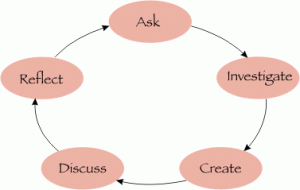
The Inquiry Cycle
I’d like to suggest an alternative, drawing from the experience of the Community informatics Initiative (CII) at the University of Illinois, as well as helpful discussion with CII staff and students. The organizational principle that I’d like to suggest is that community informatics is a form of disciplined inquiry, with central questions, methods of investigation, actions, collaborations, and theories. I’d like to present that here using the the Inquiry Cycle as a framework and CII activities as concrete examples.
The Inquiry Cycle (Bruce, 2009) characterizes inquiry as involving five major aspects: a guiding question (Ask), methods of investigation (Investigate), active participation (Create), collaboration and dialogue (DIscuss), and reflection (Reflect). These aspects don’t necessarily proceed in a prescribed order; inquiry may involve any of the aspects in varying degrees and orders. For example, Reflect is often the beginning point of inquiry, leading to the formulation of the Ask. The idea of cycle (or better, spiral) suggests that inquiry does not complete, but generates further inquiries.
Community Informatics as a Type of Inquiry
The definition below is rather lengthy. Think of the Ask as the core question that defines community inquiry. The other elements then elaborate on that, emphasizing the variety of approaches needed to address the core question.
Ask: How can we work with communities to learn about democratic participation in the digital age, and to promote engagement with information and communication technologies for both individual and community growth?
Investigate: CII investigates the ways that people in communities create and share knowledge, how social networks operate and evolve, how access to technologies is differentially distributed, especially along lines of race and class, and the development of policy regarding information and communication technologies. These communities may be large or small, geographically-based or online. The goal of these investigations is to learn more about the dynamics of communities, their capacities and challenges, and how they make use, or not, of various tools. Basic research such as this is necessary for informed and meaningful action with communities.
Create: CII builds tools, such as Prairienet, Community Inquiry Labs, geographic information systems, media archives, and computer technology centers. It works with organizations such as Books to Prisoners, S.O.A.R. [after-school program]@ B.T. Washington Elementary, Paseo Boricua, and others to expand opportunities for learning and to support social justice. Building as well as using tools in a critical manner not only addresses immediate needs; it’s a key aspect of learning about community informatics.
Discuss: CII provides forums for interaction and collaboration, such as the Journal of Community Informatics, CI Reflections blog, and the CI Research Series. A diversity of theories and methods are not only welcomed, but seen as necessary for understanding diverse and changing social and technological realities.
Reflect: CII helps make sense of experiences of communities as they use information and communication to address their needs. It also critically analyzes its own inquiries, its tools, and its modes of interaction and collaboration. These reflections help build stronger accounts of community informatics, including extensions of critical race theory, political economy, critical literacy, as well as the development of new frameworks, such as the theory of community inquiry, and generate new questions for further inquiry.
References
Bruce, Bertram C. (2009, April). “Building an airplane in the air”: The life of the inquiry group. In Joni Falk & Brian Drayton (eds.), Creating and sustaining online professional learning communities. New York: Teachers College Press. [ISBN: 0-807749-40-0]
Cross-posted on CI Reflections


 Chip's journey