Jack Easley was an professor at the University of Illinois from 1962 until his retirement in 1989. His research on cognitive development in the learning of science and mathematics across various cultures influenced educators around the world. He co-founded the Dialogues in Methods of Education group, which continues to this day. He was also a much loved friend, who died December 10, 1994.
I recently came across some insightful email messages from Jack. Here’s one that I’m certain he would like to have shared more widely, even though they were simply rough notes related to a project:
There is a lot of attention given over to kits and manipulative materials for inquiry. Since these are not always available, it is worthwhile looking at what can be done without the kits, the manipulative blocks, etc.
Math
The Japanese schools use cardboard replicas of plastic tiles, and several teachers in the US have found that these can be cut out of file folders with a paper cutter. It is not necessary to have one set for each child, but the following sizes would be appropriate for each team:
- 5 square units (half-inch squares are usually fine, but 1in or 1 cm can be used.)
- 2 oblongs, 5 units long (e.g., .5 in by 2.5 in)
- 5 oblongs, 10 units long (e.g., .5 in by 5 in)
- 2 fifties (e.g., 2.5 in by 5 in)
- 10 hundreds (e.g., 5 by 5 in)
With rulers, children can mark one side of the oblongs, fifties and hundreds into ways that show how they all fit together. Other sizes ( 20s, 40s, 25s, etc.) are often convenient, depending on the story problems (going to the bank, etc.) children are solving with these cardboard tiles.
Using bulletin board paper, scrolls of 500 or 1,000 units can also be cut and rolled up (e.g., 5 in by 25 in, or 5 in by 50 in). To make representations of even larger numbers is not much of a problem with the smaller sized units, but if you use 1 sq in as a unit, it begins to get out of hand.
The size of unit can be chosen not only with the fine motor coordination of children in mind, but with the fact that place value and round numbers upwards of 99 are much easier to talk about than those between 9 and 100. Smaller unit sizes (.5 in or 1 cm) should permit more meaningful work with scrolls for numbers like 5,000 or 10,000.
In my opinion, and that of a minority of mathematics educators, the word “ten” is one of the least often suspected but most often confused among number names. The problem may be that “ten” is not a word that easily takes adjectival modification as in “Two tens, three tens, etc.” Ten is most often used as an adjective itself as in “ten fingers, ten hundred, etc.” Research suggests that it takes children until about fourth grade to realize that ten can be a unit instead of just a counting number or the cardinal number of a collection (Cobb & Wheatley, 1988; Steffe, 1983; Steffe & Cobb, 1988.) Informal observations suggest that 100, 1,000, and 1,000,000 are treated as abstract units quite naturally by most 6-year-olds. The debate is whether or not young children can plausibly attach concrete representations to those units.
There are other troubles with the names of numbers greater than 9 and less than 100, e.g., 18 and 81 sound too much alike, both beginning with the word, “eight,” and there are few people who would think that “twenty” was originally pronounced, and possibly spelled, “twain tens.” (Some have tried introducing new number names, onety, twoty, threety, fourty, fivety, and doing that seems to help in regrouping, but teachers and parents complain that children don’t know how to translate them into standard English.) Saying how many tens there are in 11, 22, 35, etc. is no longer a part of English speech today. Instead, everyone learns to rattle off the counting numbers 1 to 100 without pausing to think that there are ten cycles in that series. It may work like telling time or money. (With digital timepieces, we count minutes from 01 to 59 and then hours. We count cents from 01 to 99 and then dollars.) Starting over, which is the essence of place value, is something we don’t seem to think about naturally with those funny two-digit number names. (In the orient, and many native American languages, number names are much more sensible than in European languages.) However, all is well when we get to a hundred and we have three digits. A great deal of regrouping in arithmetic, which is the real advantage of understanding place value, can be learned by working with cardboard tiles and scrolls, without adding and subtracting those peculiarly named numbers from 10 through 99. Adding and subtracting hundreds and thousands, multiplying and dividing by hundreds and by thousands teach place value well and provide ample practice for first and second graders on basic, one-digit addition and subtraction facts.
Cutting templates for drawing the cm size tiles and scrolls in coffee can lids permits children in first and second grade to represent numbers by drawings on paper instead of actually manipulating the tiles themselves. The Japanese have found that drawings of tiles to represent an operation is a valuable intermediate step between manipulation of tiles with number sentences and writing numerical algorithms without manipulations, for it helps children invent and test their own algorithms.
Geometrical forms can be cut out of folders or paper. Also, it is instructive to draw circles, squares, triangles, and other regular figures six or seven inches across and measure their circumferences in various ways. One way to measure a circumference is to set the compass for an inch or a cm of separation and count how many steps it takes to walk around the figure and back to the starting point.
Place a pencil across your hand near the tips of your fingers. Put the heel of your other hand on top of it. Predict, Observe, Explain (POE) where the pencil will be when you have moved the heel of your top hand back until it is over the heel of the bottom hand. Do this motion several times without the pencil, then POE where the pencil will be.
Architecture
Tiling patterns that repeat endlessly can be made on a flat surface. One interesting challenge is to design and cut-out a piece of paper that folds up to make a box, a prism, a pyramid, or some other shaped three-dimensional object.
Columns can be made from rolled or folded construction paper and tested for load bearing by piling textbooks on top. The number of science books, or math books, that a column can hold is something to predict, observe, and explain (POE). One can even measure (POEM) the length, diameter, and circumference of such columns and figure out some kind of graph that represents how those quantities relate to the load a column will carry. Applications (POEMA) of what has been learned can be found, in studying the structure of buildings, bridge supports, street light and traffic light posts, and in making models of buildings. (This is also a good use for science and mathematics books which children and teachers find boring.)
Making designs for stained glass windows with a compass is an intriguing activity. A six-pointed rose window is one goal, but many other designs are possible. Of course coloring one’s design in the most attractive way possible is an added challenge, which assumes everyone has some crayons, or whatever to color them with.
Optics
Punching a pencil through the middle of a dark piece of construction paper 8-11 inches wide and laying it down on a white piece of paper on a flat desk in a well-lighted classroom raises the following question: Looking at the white spot (after making the edges neat by tearing off or folding back the torn pieces the pencil left), try to predict (P) what shape and size that white spot will become when the dark paper is raised an inch or two. (Of the hundreds of people I have asked that question, only one 3rd grade girl, who must have tried it before and one physics Ph.D. could come close.) Observe and Explain (POE) what has been observed. Measure (POEM) how high the dark paper is raised above the white paper and measure what you can of the pattern of light you can see when looking underneath the dark paper (POEM). Is there a relation between the two measurements? What is the best way to make such measurements as you gradually raise the dark paper higher and higher? Plot a graph.
Apply (POEMA) this phenomenon to other sources of light besides schoolroom lights. E.g., tape the dark paper to the window, and cover the rest of the window(s) and turn out the lights. If you hold a thin piece of white paper near the pencil hole, can you see any pattern on the white paper? Substitute a magnifying glass or hand lens for the pencil hole? How does that change the way things look? the graph? Go outdoors on a sunny day with a piece of dark paper in which you have carefully cut three or four different shaped holes about the size of a dime or less. Hold the dark paper so it casts a shadow over a white paper. What is the shape of the light spots going through the holes? How do they change as you move the dark paper higher? (POEM)
Put some water in the plastic cup or glass bottle. Put a pencil in the water. How does it look? Why? If you can find a straight soda straw, put it in and compare it’s shape with the pencil. POE what you will see when you look through the soda straw into the water.
Air
- Blow through a piece of tubing or soda straw into a jar or cup of water. What is the smallest bubble you can blow? What is the biggest bubble you can blow? Can you blow a bubble and suck it back in before it leaves the end of the tube or straw? What is inside the bubbles you blow? How is it different from the air in the room? Where does the air in the bubble come from? Where does it go when a bubble pops?
- Put a wad of tissue or paper towel in the bottom of the plastic cup or glass bottle, big enough so it won’t fall out when you turn it upside down. (Use tape if necessary to hold it.) POE what will happen to the paper when you push it carefully up-side down into a coffee can, plastic tub, acquarium, or other large container half full of water. (POEM) Measure how much water goes into the cup or jar. If possible, make measurements at different depths under the water. Plot a graph of how much water goes into the jar for each depth under the water. POEMA What use can you think of for the air trapped in an open container under water? Can you arrange for a cricket or other small animal to breathe that air while under water? Pour out the air trapped in a container while it is under water. Do you think you could catch it in another container under the water, pouring it from one to the other under water? Borrow another container and try.
- Put a soda straw into water and place your finger or thumb over the open end. Raise it out of the water. What is inside? Can you do that with a piece of hose? (POE) What makes the water run back when you let go? (POEA) Homework (with parental consent and assistance): Can you do it with a wide tube like a cardboard tube waterproofed with rubber cement or melted wax?
- If you can get a box that a drink (milk or juice) was in, and put the hose over the straw, can you blow and suck on the tube to make the sides of the box go out and in? What does it take to make a tight fit? What happens when the air can leak around the straw? What happens to the tube when you blow or suck on it?
Social Studies
Graphs
- Sample people in your class to find out how many live with grandparents, aunts and uncles, with one parent, two parents, etc.
- Find out who knows where various foods are produced, what kind of people produce them, etc.
- Find out what children think about where adults get the money they need for food and rent if they work at a bank, a store, a restaurant, a post office, a police station, a school, as a house cleaner, a nurse, a doctor, a care giver, a university, a power company, etc. What do such people have to spend money for to do their work?
Science
For the following science activities, certain other things like wax paper, a mirror, a soda straw, a milk carton, a large bowl, etc. are mentioned as needed. Other things in the generic kit may be used, and POEMA may be used also. They come from: Science Games & Puzzles, by Laurence B. White, Jr. drawings by Marc T. Brown, Addison Wesley, 1975
- Racing drops of water on wax paper.
- Stand sideways against a wall. Push the side of your foot against the wall. Now try to lift your other foot.
- Dip one end of a drinking straw in dishwashing liquid. Take it out. Blow in the other end. Keep blowing. Try cut ting your straw end like a cross.
- Blow bubbles on a very cold day. Your warm breath makes them very light.
- Push a thumbtack into a pencil eraser. Touch the thumbtack on your lip. Rub the tack hard 20 times on your sleeve and touch it to your lips again.
- Try to drop a coin into a glass under water in the middle of a big bowl.
- Collect and taste rain water. Does it taste different from other water?
- Try printing your name while looking at the pencil and paper in the mirror.
- Roll a little piece of foil in a ball and drop it in a funnel. You cannot blow it out unless you stop up the funnel.
- Balance a ruler on your finger. with & without a ball of clay on top.
- Have your friend lay his (her) head on a table or desk while you tap softly on the bottom.
- Hold a pencil in your teeth while scraping on it.
- Is your pet right or left pawed? Put some food in a jar. Which paw is used?
- Can you freeze a penny in the middle of a piece of ice?
- Can you turn yourself upside down with a teaspoon?
- Can you eat an apple without tasting it?
- Which is longer your forearm or your foot?
- Can you tie your arms in a knot? Cross them and hold the two ends of a tube while uncrossing.
- Write ‘A BOX’ on a card and look at it in a mirror several different ways.
- Punch three holes in a paper cup or milk carton. Which hole will squirt best?
- Can water stick to itself? Punch two holes side by side.
- Can you separate pepper and salt that have been mixed?
- Roll down a slope a full can, an empty can, a hollow ball, a base ball, etc. Which one wins?
- Tie a string around a nail, then tie the string around another nail, and another. This is how to make a string nail xylophone, which you can play with another nail.

 I was fortunate to have a visit with youth planners at the Kennedy High School in Richmond, CA on Wednesday this week. These were students studying their own community and developing plans to improve it. They’ll be presenting these plans to the Mayor next month.
 What I saw is part of Y-PLAN (Youth — Plan, Learn, Act, Now), a city planning program run by UC Berkeley’s Center for Cities & Schools. Deborah McKoy is the creator of Y-PLAN and the center’s founder and executive director.
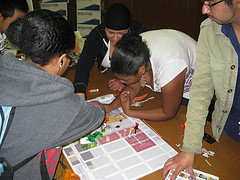 Sarah Van Wart from the UC Berkeley I School was my guide. She and two undergrads, Arturo and Sarir had been leading the high school students in a community planning exercise. They first examined their current situation, using dialogue, photos, and data. They then considered alternatives and how those might apply to a planned urban development project.
  The development will include schools, housing, a park, and community center, but the questions for city planners, include “How should these be designed?” “How can they be connected?” “How can they be made safe, useful, and aesthetically pleasing?”
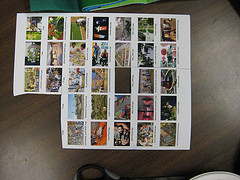
 On the day I visited, the youth had already developed general ideas on what they’d like to see in the development. Now they were to make these ideas more concrete through 3-D modeling. Using clay, toothpicks, construction paper, dried algae, stickers, variously colored small rocks, and other objects, they constructed scale models of the 30 square block development. One resource they had was contact sheets of photos of other urban environments. They could select from those to include as examples to emulate or to avoid.
 I was impressed with the dedication and skill of the leaders of the project, including also the teacher, Mr. G. But the most striking thing was how engaged the young people were. I heard some healthy arguing about design, but I didn’t see the disaffection that is so common some high schools today.
 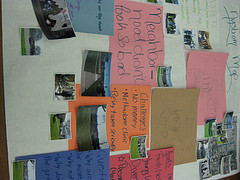 My only regret is that I wasn’t able to follow the process from beginning to end. But from the rich, albeit limited, glimpse I had, the project is an excellent way to engage young people in their own communities, to use multimedia for learning and action in the world, and to learn how to work together on meaningful tasks. It’s a good example of community inquiry.
 I was saddened to learn about the lonely death of Juanita Goggins, a great leader and educator. Her life is a reminder of both the possibilities we have and the great challenges we still face around race in America.
 The always controversial
 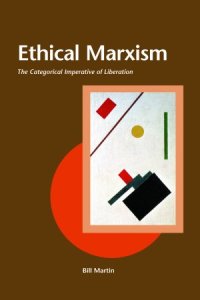 Recently, the Board has considered reviving the reputation of Senator Joseph McCarthy, to portray him as an American hero. They also debate the Biblical underpinnings of the nation’s founding, the superiority of America, and its divine ordination.
 Chip's journey