Blog surfing

broulee-surfingAnyone who writes a blog is curious about who’s reading it and is usually interested to read on similar topics. Both of those motivations lead to an interest in blog aggregators, sites that bring together blog posts from around the world.

Some of these are automatic, based on keywords in the posts. In most cases these turn out to be spam sites, promoting a product or service. I suspect that the large number of hits I received on a post about youth may have come from an automatic aggregator.

There are also more intentional aggregations such as blog rolls or blog carnivals. At blog carnival, for example, you can find carnivals on many topics, and submit your own posts to them. You can also create a new carnival on a topic of your choice. Some of the existing ones are elaborate, representing considerable effort, such as Carnival of Education. But even the best of the carnivals have a little of that quality of random listing that one sees in the spam aggregators.

smokeThere are now in between sites, such as Alpha Inventions or Condron. For these, new posts are harvested automatically, but you can also submit a post and categorize it. Visitors to the aggregator site see a slide show like presentation of other sites, often constrained by topic or language. This leads to an enormous boost in hits on blog posts, especially from Alpha Inventions.

Lesley Dewar has been running some experiments on this at No Tall Poppies. I plan to replicate those here, and share the results.

The big question of course, is not whether some scheme can produce more visits to a web page, but what if anything leads people to engage in what they read, to think critically, and to integrate that with their own experiences. My guess is that somewhere in all the surfing, syndication, aggregation, cross-linking, and such, that there are occasional sparks of real connection, but that there’s also a lot of smoke without fire.

What is community informatics?

Community informatics has very definitions, such as that it

…brings together people concerned with electronically enabling local (and virtual) communities; and structuring collaborations between researchers, practitioners (including industry) and policy makers to support community ICT implementation and effective use.

Community Informatics Research Network

Definitions such as the one above appropriately name various constituencies, thus serving organizational needs. But for me they are oddly both too narrow, excluding legitimate elements and activities, and too broad, lacking a principled organization or rationale.

Inquiry cycle
Inquiry cycle

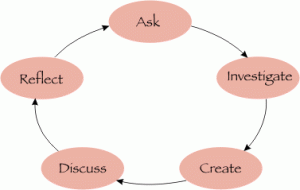
The Inquiry Cycle

I’d like to suggest an alternative, drawing from the experience of the Community informatics Initiative (CII) at the University of Illinois, as well as helpful discussion with CII staff and students. The organizational principle that I’d like to suggest is that community informatics is a form of disciplined inquiry, with central questions, methods of investigation, actions, collaborations, and theories. I’d like to present that here using the the Inquiry Cycle as a framework and CII activities as concrete examples.

The Inquiry Cycle (Bruce, 2009) characterizes inquiry as involving five major aspects: a guiding question (Ask), methods of investigation (Investigate), active participation (Create), collaboration and dialogue (DIscuss), and reflection (Reflect). These aspects don’t necessarily proceed in a prescribed order; inquiry may involve any of the aspects in varying degrees and orders. For example, Reflect is often the beginning point of inquiry, leading to the formulation of the Ask. The idea of cycle (or better, spiral) suggests that inquiry does not complete, but generates further inquiries.

Community Informatics as a Type of Inquiry

The definition below is rather lengthy. Think of the Ask as the core question that defines community inquiry. The other elements then elaborate on that, emphasizing the variety of approaches needed to address the core question.

Ask: How can we work with communities to learn about democratic participation in the digital age, and to promote engagement with information and communication technologies for both individual and community growth?

Investigate: CII investigates the ways that people in communities create and share knowledge, how social networks operate and evolve, how access to technologies is differentially distributed, especially along lines of race and class, and the development of policy regarding information and communication technologies. These communities may be large or small, geographically-based or online. The goal of these investigations is to learn more about the dynamics of communities, their capacities and challenges, and how they make use, or not, of various tools. Basic research such as this is necessary for informed and meaningful action with communities.

Create: CII builds tools, such as Prairienet, Community Inquiry Labs, geographic information systems, media archives, and computer technology centers. It works with organizations such as Books to Prisoners, S.O.A.R. [after-school program]@ B.T. Washington Elementary, Paseo Boricua, and others to expand opportunities for learning and to support social justice. Building as well as using tools in a critical manner not only addresses immediate needs; it’s a key aspect of learning about community informatics.

Discuss: CII provides forums for interaction and collaboration, such as the Journal of Community Informatics, CI Reflections blog, and the CI Research Series. A diversity of theories and methods are not only welcomed, but seen as necessary for understanding diverse and changing social and technological realities.

Reflect: CII helps make sense of experiences of communities as they use information and communication to address their needs. It also critically analyzes its own inquiries, its tools, and its modes of interaction and collaboration. These reflections help build stronger accounts of community informatics, including extensions of critical race theory, political economy, critical literacy, as well as the development of new frameworks, such as the theory of community inquiry, and generate new questions for further inquiry.

References

Bruce, Bertram C. (2009, April). “Building an airplane in the air”: The life of the inquiry group. In Joni Falk & Brian Drayton (eds.), Creating and sustaining online professional learning communities. New York: Teachers College Press. [ISBN: 0-807749-40-0]

Cross-posted on CI Reflections

End the destructive payroll tax

1192440-4-hands-of-worker1Governments around the world see the need to get people back to work and increase consumer confidence. Knowing that they need to act, they’re bailing out banks, insurance companies, and manufacturing industries, as well as helping high income taxpayers by reducing income taxes.

In the midst of the crisis, they’re ignoring the most effective way to increase jobs and consumer spending: End the destructive payroll tax, thereby helping the unemployed get jobs. When low and middle income families pay only their fair share of taxes, they’ll be able to spend more on the things they value, thus boosting the economy to grow in productive directions. That’s not happening because of the regressive payroll tax scheme.

The US reliance on payroll taxes discourages employers from hiring and workers from working:

  • For most workers payroll taxes amount to 17 percent of salaries (high income workers pay less than that); this represents a huge disincentive to hiring people or to seeking a job,
  • 3/4 of households pay more in payroll taxes than they do in personal income taxes,
  • The taxes are now almost 40 percent of federal revenues; meaning that we’re increasingly running the government on the backs of the lowest income workers.

healthcare_worker_flu_shots_help_patients1Payroll taxes reduce the things we do want: jobs, a healthy economy, individual and family health, spending based on real human needs, social justice. Meanwhile we give a free ride to things we don’t want: pollution, dependence on foreign oil, an unhealthy environment, foolish use of limited resources, increasing income divides.

Why not couple a reduction in payroll taxes with increased taxes on the things we don’t want? Hendrik Hertzberg, writing in the New Yorker (“Not insane”), argues that we need a package approach:

A whole good idea would be to make a payroll-tax holiday the first step in an orderly transition to scrapping the payroll tax altogether and replacing the lost revenue with a package of levies on things that, unlike jobs, we want less rather than more of—things like pollution, carbon emissions, oil imports, inefficient use of energy and natural resources, and excessive consumption. The net tax burden on the economy would be unchanged, but the shift in relative price signals would nudge investment from resource-intensive enterprises toward labor-intensive ones. This wouldn’t be just a tax adjustment. It would be an environmental program, an anti-global-warming program, a youth-employment (and anti-crime) program, and an energy program.

construction_worker_handsThe bipartisan coalition Get America Working! emphasizes the fact that payroll taxes exacerbate the true unemployment of discouraged workers, with its consequent toll on both individuals and society:

America has one giant unused resource, its hidden unemployed. There are tens of millions of capable Americans who might seek employment if the job market was better, but who, believing that is impossible, do not look and therefore do not count as “unemployed”. They include many older Americans, women, young people, people with disabilities, minorities, and other chronically underemployed groups. Much of this lost opportunity is the result of ever-rising payroll taxes forcing up the cost of hiring.

The key to change is lowering the price of labor relative to that of the only other basic inputs in the economy—natural resources such as materials, energy and land. Eliminating the payroll tax alone could produce as many as 20 million new jobs. That would (1) profoundly enrich the lives and health of those who get the jobs; (2) power a sharp increase in the production of goods and services; (3) cut today’s enormous public and private costs of supporting so many dependents; and (4) sharply reduce the costs of many social dysfunctions – ranging from crime/violence/drugs to unmotivated students—caused by today’s massive true unemployment.

Today, the me nobody knows

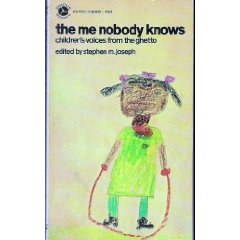
me_nobody1I came across the poem, “Today,” in the me nobody knows: children’s voices from the ghetto, by Stephen M. Joseph (Avon, 1969). There are many beautiful, and some heartbreaking, stories and poems in the book, which is an anthology of writings by children in Bedford-Stuyvesant, Harlem, Jamaica, and the lower west and east sides of Manhattan. The year after the book was published, a musical based it, The Me Nobody Knows, premiered in New York.

Joseph, a teacher, invited the children to write, offering three choices: to write using their names, in which case he was willing to meet at lunch or outside of school to talk with them about it; omit their names, but still hand in the writing; or write, but neither sign the paper nor hand it in. But he never forced them to write at all.

The pieces in the book give one picture of life in the inner city, or for that matter, many children everywhere. They invite the question: Are we doing any better for children today, 40 years later?

This poem struck me for its rhythm and the ways that things seem not totally to fit, but do fit all the same.

Today
Cynthia L, Age 15

Today is my day,
Today should be your day,
If it’s your day and my day
It’s everybody’s day.
In your way is my day
Because you made a day that comes all the way.
And two days of a way equal today.
That will never fade away.
In our own way let’s find ways
To make great exciting things happen.
In your ways, make my days,
You made a day that comes all the way,
And two days that are made up of your ways,
Those kind of days will never fade away.

Yale Russian Chorus tours Quebec

My son, Stephen, writes this about the Yale Russian Chorus tour in Quebec:

In March 2009 the Yale Russian Chorus went on tour to Quebec. We sang at a variety of venues, including Laval University in Quebec City and both Francophone and Anglophone retirement homes in Montreal. The contacts we had made with the Russian Orthodox community in Montreal allowed us to end our tour with an exciting concert at St. Nicholas Russian Orthodox Cathedral. We stayed for most of the tour at the house of Paul and Sandy Gauthier, whom my family had met on our sabbatical to China.

To publicize these events, we had the privilege of appearing on Radio-Canada twice. The first was an interview I did over the phone to advertise our first concert, at St. Elizabeth Catholic church in North Hatley.

Halfway through our stay in Montreal, we drove to the CBC/Radio-Canada building in Montreal to appear on the morning show “C’est bien meilleur le matin”. After discussing the history of the Russian Chorus with the host, Franco Nuovo (and surmising possible connections to the CIA), I rejoined the group to sing our version of the Russian folk song “Po moriam, po volnam” (Across the seas, across the waves)

Why I like to use walking poles

leki_polesOK. I know it looks strange, but here are a few reasons I like to use walking poles:

  1. If I don’t have a baby or a dog with me, it provides something to talk about with strangers.
  2. It add ten years to the usability of my knees (and ankles, hips, back, feet,…).
  3. Even in the short run, my knees don’t hurt so much after a long walk.
  4. I can fend off small animals.
  5. A stick can be handy for opening gates, picking up objects, making an impromptu tent, or hoisting a flag. See more reasons to carry a walking stick.
  6. I get upper body exercise while walking.
  7. I burn more calories, but don’t even feel that I’m exercising.
  8. I walk faster.
  9. I’m less likely to fall when crossing a stream and stepping on slippery, unstable, rounded rocks, or even just stepping on a wet leaf or going down a bumpy sidewalk.
  10. I can use the same sticks for x-country skiing.
  11. They remind me to get more exercise, and to be outside more, providing a partial escape from the computer screen.
  12. They’re reflective, which makes it much safer to walk at night, especially since they move rapidly in the normal walking motion.
  13. They make me feel that I’m in Finland again.
  14. Using them is similar to using a bicycle or roller blades in that walking is suddenly easier.
  15. Cars slow down and avoid me more. I’m not sure why. Do they think I’m disabled? that I might strike them with the poles? that I look larger? that I look strange? Whatever it is, I appreciate their response.
  16. They’re a big help going up a steep hill, because you can use your arms to push up.
  17. They provide a measure of safety going downhill.
  18. They’re handy for retrieving a frisbee stuck in a tree, a hat that fell in a stream, or a ball that rolled under a cabinet.
  19. When you’re tired of walking, you can lean on them to rest.
  20. And they’re especially useful for canoeing!

Sharing your books, for a noble cause …

wordle_mark_quote [tag cloud from the UC Books to Prisoners site, created using wordle]

UC Books to Prisoners is an Urbana, IL based project providing books to Illinois inmates at no cost. Books to Prisoners offers books by mail to all Illinois inmates and operates lending libraries in the two Champaign County jails.

Is your book collection weighing you down? Do you have a home library that is threatening the structural integrity of your abode? Champaign-Urbana has many great places to donate books. One of the neediest is the Books to Prisoners program, profiled earlier in a Smile Politely piece.

We take donations of used books from the community, mail books in response to prisoner requests, and stock and staff the two local jail libraries. Those books that are not suitable for prisoners, for a variety of reasons, are sold to cover the postage to mail books.

Thanks to community support, we have sent 32,162 books in 8,281 packages to 5,096 inmates since we were founded five years ago. Go here for details about dropping off books.

If you’d like to get rid of your books, merely to make space to acquire more, come to our Spring Book Sale April 3–5 at the IMC in the old Urbana Post Office. A huge assortment of high quality books: paperbacks at 50 cents, hardbacks for a buck.

via Sharing your books, for a noble cause … : SPlog : Smile Politely

Arts and the cognitive life of the university

Harvard has issued a Report of the task force on the arts (2008, December), which argues that the arts are an integral part of the cognitive life of the university. Similar reports come out regularly from other institutions; this one is notable mostly because of Harvard’s stamp on the value of the arts, especially for inquiry in all fields. There is (belated) attention to a wide view of arts both in appreciation and in making, as well as the use of new technologies:

The use of new digital and media technologies—in virtually all forms of inquiry—provides an unprecedented opportunity for our students to take art-making seriously “for itself,” while seeing it as an enhancement of their own specific scholarly and professional interests. “Making” in the visual arts, for instance, is no longer restricted to the hand-held technologies of pencil, brush, chisel and camera…The availability of computer software for creative purposes allows for a range of artistic practices that may not “train the hand and eye” in the time-honored traditional sense, but whose imaginative and aesthetic possibilities provide the important cognitive and conceptual training of an “art-making” education. (pp. 8-9)

One side note is the recognition of Harvard’s “unusual, if not unique” relation to arts practice. The report notes for example that

By 1869, Yale had opened the doors to its School of Art . Yale now confers graduate degrees in arts practice from four separate professional schools—the School of Art, School of Drama, School of Music, and School of Architecture—and it provides as well profound opportunities for mentorship and instruction within the talented undergraduate population. (p. 6)

Happy Pluto Day!

plutolithograph1Image courtesy of Windows to the Universe. “This is an artist’s conception of Pluto and Charon. Pluto is in the background and Charon is in the foreground. Pat Rawlings, Science Applications International”

The Illinois State Senate has redeemed poor Pluto from dwarf planet status to its rightful place in the universe, and established March 13 as Pluto Day. This was done in large part to honor Illinois native Clyde Tombaugh. One justification for this was that Tombaugh was the only American to discover a planet. Another was that there were no real problems left to work on.

There are of course a few problems with the Senate’s idea. Early Native Americans undoubtedly discovered most of the planets in our solar system, even if official histories don’t credit them. Other Americans have discovered many planets outside of our solar system. And what Tombaugh discovered isn’t really a planet, under current definitions.

225px-clydetombaughBut Pluto is now part of our culture. Even if it’s not a planet, do we really want children going around saying “My very educated mother just served us nine”? Nine what? Pluto gives us a reason to add “pizzas,” which might be reason enough to keep it.

Tombaugh did do something. Eric Jakobsson, points out that they should have honored him for “discovering the first of the Kuiper objects (as opposed to the last of the planets). Arguably, that was a more important discovery than another planet, because it added a whole new dimension to our understanding of the solar system.”

Eric’s argument highlights two different conceptions of learning. In one, authority gives us the answer, case closed. In another, ideas become tools for further inquiry. Richard Shaull, puts it this way in the foreword to Paulo Freire’s Pedagogy of the Oppressed (1993):

There is no such thing as a neutral educational process. Education either functions as an instrument to facilitate the integration of the younger generation into the logic of the present system, or it becomes the practice of freedom, the means by which men and women participate in the transformation of their world.

We should remember and honor Tombaugh’s dedication, intelligence, and painstaking studies of photographs. His work on Pluto and asteroids contributed to transforming our scientific understanding of the universe. That was not the social world that Freire means when he says the “practice of freedom,” but in its own way represented a challenge to the “present system.” Unfortunately, the Senate’s rearguard action has become an internet joke that fails to express what Tombaugh really accomplished.

RiseOut: “Defining Our Own Education”

I’ve been reading the articles on RiseOut, an online “news center focused on deschooling, youth activism, and other related issues concerning the rights of youth in the U.S.” There are entries on deschooling; unschooling; youth media; racism; the Highlander Folk School in New Market, Tennessee; Dr. “Patch” Adams; a review of the book, The Teenage Liberation Handbook, How to quit school and get a real life and education (by Grace Llewellyn); critiques of school segregation (and recent Supreme Court decisions that support it), credentialism, and military conscription.

Most of the articles on RiseOut are well-researched, thoughtful, and provocative. They remind me of the wonderful book, Letter to a teacher by the schoolboys of Barbiana, in which youth in Italy present a searing critique of their education and the unjust society it supports.

Both the Barbiana book and RiseOut address the question that Earl Kelley asks: What is real in education?. Kelley answers that the bedrock reality is the the actual life of youth.

The Obama administration’s proposed “Cradle to Career” education plan, has many good components, but education reform will never accomplish much if schooling continues to be separated from actual life and fails to come to terms with the issues raised in RiseOut.

From the RiseOut site:

We provide a diversity of alternatives to education that are self-directed and decentralized from standardized schooling. We support a young person’s choice in dropping out of school, free of social stereotypes and biases. We aim to provide a plethora of alternatives from a 12-year prison like sentence of state schooling, while staying vigilant of abuses against young people through diagnosing, segregation, ageism, adultism, sexism, and other assholisms.

A message to those who have decided to quit school:

Instead of dropping out, we applaud you for your courage to “riseout” from a nightmarish disposition of compulsory schooling. We hope RiseOut can be a resource for sharing your stories and providing choices towards regaining control over your own education.