The Irony of Fate

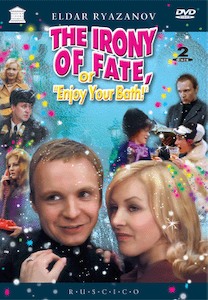
When Stephen lived in St. Petersburg, he learned about the Russian classic movie, Ирония судьбы, или С лёгким паром! (Ironiya sudby, ili S lyogkim parom!; The Irony of Fate, or Enjoy your Bath!) and bought us a dvd of it.

I watched that and also the sequel, Ирония судьбы: Продолжение (Ironiya sudby 2; The Irony of Fate 2). In the sequel, the original actors continue the story, now 30 years later. Can you think of any other movies in which the story line continues that long, with the actors aging naturally?

The movie is a sad love story, but also a farce, with slapstick, rampant misunderstandings, demonstrations of the limits of logic, and still, strikingly honest and insightful comments on the human condition. It shows some of the best and worst of Russia.

It’s easy to understand why watching Ironiya sudby has become a New Year’s Eve tradition in Russia. We followed that tradition here in two parts, the first on New Year’s Day and the second last night. In between, Emily and Stephen prepared a special Russian dinner, including borscht, salade Olivier, and blinis with herring, salmon, onions, and creamed butter.

Zhenya and Nadya were the same as always. He’s 36, a talented surgeon, but nerdy and shy. It’s not clear where his life is going next or what he wants to commit to doing. Nadya is a literature teacher, beautiful, but also somewhat shy and unsure of herself. Together with Galya and Ippolit they stumble through a bizarre, yet oddly-believable, sequence of events in which they learn what matters most.

If you were to hear the plot ahead of time, you’d not only lose some of the fun, but you might wrongly conclude that it’s contrived and silly. Instead, that plot becomes a muted background, which the viewer quickly catches onto. It then serves like the click-clack of a train (here, the faceless architecture of the Brezhnev era), with the real action going on inside the railroad cars.

I especially like the guitar-accompanied songs, which are based on poems by Boris Pasternak, Marina Tsvetayeva, Yevgeny Yevtushenko, Bella Akhmadulina, and others. They fit with the story, and they’re sung in full.

See additional posts of mine on movies.

Minds-on Math, Science, and Social Studies with standard school supplies

Jack Easley was an professor at the University of Illinois from 1962 until his retirement in 1989. His research on cognitive development in the learning of science and mathematics across various cultures influenced educators around the world. He co-founded the Dialogues in Methods of Education group, which continues to this day. He was also a much loved friend, who died December 10, 1994.

I recently came across some insightful email messages from Jack. Here’s one that I’m certain he would like to have shared more widely, even though they were simply rough notes related to a project:


There is a lot of attention given over to kits and manipulative materials for inquiry. Since these are not always available, it is worthwhile looking at what can be done without the kits, the manipulative blocks, etc.

Math

The Japanese schools use cardboard replicas of plastic tiles, and several teachers in the US have found that these can be cut out of file folders with a paper cutter. It is not necessary to have one set for each child, but the following sizes would be appropriate for each team:

  • 5 square units (half-inch squares are usually fine, but 1in or 1 cm can be used.)
  • 2 oblongs, 5 units long (e.g., .5 in by 2.5 in)
  • 5 oblongs, 10 units long (e.g., .5 in by 5 in)
  • 2 fifties (e.g., 2.5 in by 5 in)
  • 10 hundreds (e.g., 5 by 5 in)

With rulers, children can mark one side of the oblongs, fifties and hundreds into ways that show how they all fit together. Other sizes ( 20s, 40s, 25s, etc.) are often convenient, depending on the story problems (going to the bank, etc.) children are solving with these cardboard tiles.

Using bulletin board paper, scrolls of 500 or 1,000 units can also be cut and rolled up (e.g., 5 in by 25 in, or 5 in by 50 in). To make representations of even larger numbers is not much of a problem with the smaller sized units, but if you use 1 sq in as a unit, it begins to get out of hand.

The size of unit can be chosen not only with the fine motor coordination of children in mind, but with the fact that place value and round numbers upwards of 99 are much easier to talk about than those between 9 and 100. Smaller unit sizes (.5 in or 1 cm) should permit more meaningful work with scrolls for numbers like 5,000 or 10,000.

In my opinion, and that of a minority of mathematics educators, the word “ten” is one of the least often suspected but most often confused among number names. The problem may be that “ten” is not a word that easily takes adjectival modification as in “Two tens, three tens, etc.” Ten is most often used as an adjective itself as in “ten fingers, ten hundred, etc.” Research suggests that it takes children until about fourth grade to realize that ten can be a unit instead of just a counting number or the cardinal number of a collection (Cobb & Wheatley, 1988; Steffe, 1983; Steffe & Cobb, 1988.) Informal observations suggest that 100, 1,000, and 1,000,000 are treated as abstract units quite naturally by most 6-year-olds. The debate is whether or not young children can plausibly attach concrete representations to those units.

There are other troubles with the names of numbers greater than 9 and less than 100, e.g., 18 and 81 sound too much alike, both beginning with the word, “eight,” and there are few people who would think that “twenty” was originally pronounced, and possibly spelled, “twain tens.” (Some have tried introducing new number names, onety, twoty, threety, fourty, fivety, and doing that seems to help in regrouping, but teachers and parents complain that children don’t know how to translate them into standard English.) Saying how many tens there are in 11, 22, 35, etc. is no longer a part of English speech today. Instead, everyone learns to rattle off the counting numbers 1 to 100 without pausing to think that there are ten cycles in that series. It may work like telling time or money. (With digital timepieces, we count minutes from 01 to 59 and then hours. We count cents from 01 to 99 and then dollars.) Starting over, which is the essence of place value, is something we don’t seem to think about naturally with those funny two-digit number names. (In the orient, and many native American languages, number names are much more sensible than in European languages.) However, all is well when we get to a hundred and we have three digits. A great deal of regrouping in arithmetic, which is the real advantage of understanding place value, can be learned by working with cardboard tiles and scrolls, without adding and subtracting those peculiarly named numbers from 10 through 99. Adding and subtracting hundreds and thousands, multiplying and dividing by hundreds and by thousands teach place value well and provide ample practice for first and second graders on basic, one-digit addition and subtraction facts.

Cutting templates for drawing the cm size tiles and scrolls in coffee can lids permits children in first and second grade to represent numbers by drawings on paper instead of actually manipulating the tiles themselves. The Japanese have found that drawings of tiles to represent an operation is a valuable intermediate step between manipulation of tiles with number sentences and writing numerical algorithms without manipulations, for it helps children invent and test their own algorithms.

Geometrical forms can be cut out of folders or paper. Also, it is instructive to draw circles, squares, triangles, and other regular figures six or seven inches across and measure their circumferences in various ways. One way to measure a circumference is to set the compass for an inch or a cm of separation and count how many steps it takes to walk around the figure and back to the starting point.

Place a pencil across your hand near the tips of your fingers. Put the heel of your other hand on top of it. Predict, Observe, Explain (POE) where the pencil will be when you have moved the heel of your top hand back until it is over the heel of the bottom hand. Do this motion several times without the pencil, then POE where the pencil will be.

Architecture

Tiling patterns that repeat endlessly can be made on a flat surface. One interesting challenge is to design and cut-out a piece of paper that folds up to make a box, a prism, a pyramid, or some other shaped three-dimensional object.

Columns can be made from rolled or folded construction paper and tested for load bearing by piling textbooks on top. The number of science books, or math books, that a column can hold is something to predict, observe, and explain (POE). One can even measure (POEM) the length, diameter, and circumference of such columns and figure out some kind of graph that represents how those quantities relate to the load a column will carry. Applications (POEMA) of what has been learned can be found, in studying the structure of buildings, bridge supports, street light and traffic light posts, and in making models of buildings. (This is also a good use for science and mathematics books which children and teachers find boring.)

Making designs for stained glass windows with a compass is an intriguing activity. A six-pointed rose window is one goal, but many other designs are possible. Of course coloring one’s design in the most attractive way possible is an added challenge, which assumes everyone has some crayons, or whatever to color them with.

Optics

Punching a pencil through the middle of a dark piece of construction paper 8-11 inches wide and laying it down on a white piece of paper on a flat desk in a well-lighted classroom raises the following question: Looking at the white spot (after making the edges neat by tearing off or folding back the torn pieces the pencil left), try to predict (P) what shape and size that white spot will become when the dark paper is raised an inch or two. (Of the hundreds of people I have asked that question, only one 3rd grade girl, who must have tried it before and one physics Ph.D. could come close.) Observe and Explain (POE) what has been observed. Measure (POEM) how high the dark paper is raised above the white paper and measure what you can of the pattern of light you can see when looking underneath the dark paper (POEM). Is there a relation between the two measurements? What is the best way to make such measurements as you gradually raise the dark paper higher and higher? Plot a graph.

Apply (POEMA) this phenomenon to other sources of light besides schoolroom lights. E.g., tape the dark paper to the window, and cover the rest of the window(s) and turn out the lights. If you hold a thin piece of white paper near the pencil hole, can you see any pattern on the white paper? Substitute a magnifying glass or hand lens for the pencil hole? How does that change the way things look? the graph? Go outdoors on a sunny day with a piece of dark paper in which you have carefully cut three or four different shaped holes about the size of a dime or less. Hold the dark paper so it casts a shadow over a white paper. What is the shape of the light spots going through the holes? How do they change as you move the dark paper higher? (POEM)

Put some water in the plastic cup or glass bottle. Put a pencil in the water. How does it look? Why? If you can find a straight soda straw, put it in and compare it’s shape with the pencil. POE what you will see when you look through the soda straw into the water.

Air

  • Blow through a piece of tubing or soda straw into a jar or cup of water. What is the smallest bubble you can blow? What is the biggest bubble you can blow? Can you blow a bubble and suck it back in before it leaves the end of the tube or straw? What is inside the bubbles you blow? How is it different from the air in the room? Where does the air in the bubble come from? Where does it go when a bubble pops?
  • Put a wad of tissue or paper towel in the bottom of the plastic cup or glass bottle, big enough so it won’t fall out when you turn it upside down. (Use tape if necessary to hold it.) POE what will happen to the paper when you push it carefully up-side down into a coffee can, plastic tub, acquarium, or other large container half full of water. (POEM) Measure how much water goes into the cup or jar. If possible, make measurements at different depths under the water. Plot a graph of how much water goes into the jar for each depth under the water. POEMA What use can you think of for the air trapped in an open container under water? Can you arrange for a cricket or other small animal to breathe that air while under water? Pour out the air trapped in a container while it is under water. Do you think you could catch it in another container under the water, pouring it from one to the other under water? Borrow another container and try.
  • Put a soda straw into water and place your finger or thumb over the open end. Raise it out of the water. What is inside? Can you do that with a piece of hose? (POE) What makes the water run back when you let go? (POEA) Homework (with parental consent and assistance): Can you do it with a wide tube like a cardboard tube waterproofed with rubber cement or melted wax?
  • If you can get a box that a drink (milk or juice) was in, and put the hose over the straw, can you blow and suck on the tube to make the sides of the box go out and in? What does it take to make a tight fit? What happens when the air can leak around the straw? What happens to the tube when you blow or suck on it?

Social Studies
Graphs

  • Sample people in your class to find out how many live with grandparents, aunts and uncles, with one parent, two parents, etc.
  • Find out who knows where various foods are produced, what kind of people produce them, etc.
  • Find out what children think about where adults get the money they need for food and rent if they work at a bank, a store, a restaurant, a post office, a police station, a school, as a house cleaner, a nurse, a doctor, a care giver, a university, a power company, etc. What do such people have to spend money for to do their work?

Science

For the following science activities, certain other things like wax paper, a mirror, a soda straw, a milk carton, a large bowl, etc. are mentioned as needed. Other things in the generic kit may be used, and POEMA may be used also. They come from: Science Games & Puzzles, by Laurence B. White, Jr. drawings by Marc T. Brown, Addison Wesley, 1975

  • Racing drops of water on wax paper.
  • Stand sideways against a wall. Push the side of your foot against the wall. Now try to lift your other foot.
  • Dip one end of a drinking straw in dishwashing liquid. Take it out. Blow in the other end. Keep blowing. Try cut ting your straw end like a cross.
  • Blow bubbles on a very cold day. Your warm breath makes them very light.
  • Push a thumbtack into a pencil eraser. Touch the thumbtack on your lip. Rub the tack hard 20 times on your sleeve and touch it to your lips again.
  • Try to drop a coin into a glass under water in the middle of a big bowl.
  • Collect and taste rain water. Does it taste different from other water?
  • Try printing your name while looking at the pencil and paper in the mirror.
  • Roll a little piece of foil in a ball and drop it in a funnel. You cannot blow it out unless you stop up the funnel.
  • Balance a ruler on your finger. with & without a ball of clay on top.
  • Have your friend lay his (her) head on a table or desk while you tap softly on the bottom.
  • Hold a pencil in your teeth while scraping on it.
  • Is your pet right or left pawed? Put some food in a jar. Which paw is used?
  • Can you freeze a penny in the middle of a piece of ice?
  • Can you turn yourself upside down with a teaspoon?
  • Can you eat an apple without tasting it?
  • Which is longer your forearm or your foot?
  • Can you tie your arms in a knot? Cross them and hold the two ends of a tube while uncrossing.
  • Write ‘A BOX’ on a card and look at it in a mirror several different ways.
  • Punch three holes in a paper cup or milk carton. Which hole will squirt best?
  • Can water stick to itself? Punch two holes side by side.
  • Can you separate pepper and salt that have been mixed?
  • Roll down a slope a full can, an empty can, a hollow ball, a base ball, etc. Which one wins?
  • Tie a string around a nail, then tie the string around another nail, and another. This is how to make a string nail xylophone, which you can play with another nail.

Civil rights for the LGBT community, and for all

In his ‘Letter from the Birmingham jail‘, Martin Luther King placed the struggle against injustice in Birmingham in a larger context:

Moreover, I am cognizant of the interrelatedness of all communities and states. I cannot sit idly by in Atlanta and not be concerned about what happens in Birmingham. Injustice anywhere is a threat to justice everywhere.

While those lines are often quoted, they’re more often ignored. For many people, injustice means what happens to them directly, not what happens to others.

Countering that passivity, and calling on progressives allies to stand up, is a video made by one of my students, Phil Reese. It’s an excellent message about civil rights for all, including the LGBT community. In addition to conveying an important message, it’s done in a creative way, reminding us of the many silenced voices around us.

Progressives can’t sit by while Civil Rights are taken away from Americans–help us and become a true ally in the fight for Equality! -HEY #p2 We’re talking to you! AFTER THE VID VISIT http://bit.ly/HEYP2ALLY for more!

US advances to 83rd on the Global Peace Index

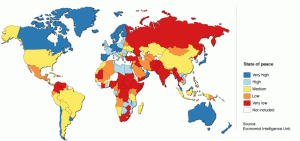
This year, the US advanced from 97th to 83rd on the Global Peace Index ( GPI). On this day of peace, it’s not just parochial competition that makes me wish that it ranked much higher. When the nation with the most powerful military and the largest weapons industry ranks low, the whole world suffers.

The GPI is a project of the Institute for Economics and Peace, which identifies some of the drivers of peace and then ranks the nations of the world by their peacefulness (or ‘absence of violence’).

144 countries are ranked on 24 measures within, as well as between, nations. These measures include levels of democracy and transparency, education and material well being, military expenditure, relations with neighboring countries, and respect for human rights. The data used come from the International Institute of Strategic Studies, the World Bank, various UN offices and Peace Institutes, and the Economist Intelligence Unit.

On the map, red indicates violence and blue the absence of violence. Yellow is in between.

References

Engelhardt, Tom (2009, December 22). In nightmares begin responsibilities: Why war will take no holiday in 2010. TomDispatch.com. “Excuse the gloom in the holiday season, but I feel like we’re all locked inside a malign version of the movie Groundhog Day…”

Moving the world: A celebration of writing and community

Parc de la Tête d'Or, Lyon, Sergio Canobbio

Last Wednesday, I was fortunate to attend a significant literary event, called Moving the World: A Celebration of Writing and Community.

Over a three-hour period, I heard essays, letters, poems, and collaborative writing, but also saw drawings and paintings. I got to meet with the artists and to ask them questions about their work. The intellectual and artistic quality as well as the variety of the works were outstanding. The program was beautifully organized by Patrick Berry and Cory Holding.

An event such as this one is not uncommon; what made this one special was that it was held in the chapel of the Danville Correctional Center, and the artists were all inmates. They showed off the work they’ve done through courses offered by the Education Justice Project (EJP), led by Rebecca Ginsburg. EJP is a response to the abundant evidence showing that

College-in-prison programs reduce arrest, conviction, and reincarceration rates among released prisoners. Evidence has also linked the presence of college-in-prison programs to fewer disciplinary incidents within prison, finding that such programs produce safer environments for prisoners and staff alike. College-prison programs also have benefits for inmates’ families and, hence, their communities.

Captured Potential, Larry Brent

The EJP is an outstanding effort to help young men who want to become better family and community members. If you had experienced Moving the World, you’d at least have seen inmate-students focusing their energies on reading and writing, on reflecting about their lives, families, and communities, and perhaps most significantly, engaged in how they can make positive contributions to the world both inside and outside the prison.

As I said, the quality of the writing and the oral performances was superb. I was impressed with nearly all of the works. One, entitled “Progressive tears: A prisoner’s retrospective cry for Dewey’s help,” asked the philosopher John Dewey whether his progressive vision was still relevant today. Do we as a people still believe in equality and justice? Do we still see education as a means for building a better society? One may wonder, since the use of Pell Grants for prisoners was eliminated in 1994, and most prison college programs have closed.

Another essay asserts “We all want the same things.” It shows that both prisoners and ordinary people on the outside want prisoners to turn from crime to productive citizenship. Other works included letters to family members, poems, reflections on life. The painting, “Captured potential,” and its accompanying text, express well both the tragedy of prison and the possibilities. I doubt whether anyone made it through the event with dry eyes.

You can see some of the writing itself in the National Gallery of Writing.

An event like Moving the World makes the drudgery and nonsense of many other parts of life much more bearable. I not only enjoyed it in the sense of savoring, rather than counting, the moments, I was also impressed by the obvious thoughtfulness, organization, and high standards that went into it. I now understand why one instructor said that her participation has raised the standards back at the university.

References

Howard Zinn’s “Three Holy Wars”

Howard Zinn spoke at the Progressive magazine’s 100 Anniversary Conference. He makes a persuasive case for questioning even the good wars, such as the “three holy wars” of US history.

It’s worth thinking about Zinn’s argument in light of Obama’s Nobel Prize lecture, in which he says “Still, we are at war, and I am responsible for the deployment of thousands of young Americans to battle in a distant land. Some will kill. Some will be killed.” Is the war in Afghanistan a more holy war than the ones that Zinn questions?

Overconsumption is the problem, not population

When we watch farmlands or forests being paved over for new housing, or see images of starving children, it’s hard not to think that there may be just too many people, that we have “exponential” population growth. This leads soon to the idea that we need to “do something” about population.

That view has a long history, including Paul Ehrlich’s The Population Bomb (1968) and Thomas Robert Malthus’s An Essay on the Principle of Population. There may well be negative effects and ultimate limits, but most of the blame assigned to population today would be better assigned to overconsumption.

How we understand the causes of present problems such as climate change, depletion of natural resources, hunger, and war is important, because different causes call for different remedies. An article by Fred Pearce in New Scientist, via Population: Overconsumption is the real problem – opinion – 27 September 2009, summarizes well the major issues here.

The population “bomb” is fast being defused. Women across the poor world are having dramatically fewer babies than their mothers did – mostly out of choice, not compulsion. Half a century ago, the worldwide average for the number of children a woman had was between five and six. Now she has 2.6. In the face of such a fall it is hard to see what more “doing something” about global population might achieve.

Half the world now has a fertility rate below the replacement level, which, allowing for girls who don’t make it to adulthood, is around 2.3. This includes most of Europe, east Asia, North America and the Caribbean. There are holdouts in a few Muslim countries – but not Iran, where fertility is 1.7 – and many parts of Africa

Thus, even if we have too many people, the rate of growth is decreasing, and all the indicators point to further reductions accompanying development. So, if the problem is not exponential population growth, what is it? Pearce goes on to point out that

the world’s richest half billion people – that’s about 7 per cent of the global population – are responsible for 50 per cent of the world’s emissions. Meanwhile, the poorest 50 per cent are responsible for just 7 per cent of emissions. One American or European is more often than not responsible for more emissions than an entire village of Africans.

Every time those of us in the rich world talk about too many babies in Africa or India, we are denying our own culpability. It is the world’s consumption patterns we need to fix, not its reproductive habits.

Pearce talks mostly about climate change, but his argument holds for other aspects of environmental stress, including the basic issue of hunger. Overconsumption in the rich countries occurs through waste, a diet heavily based on meat, and simply too much eating. A study directed by Timothy Jones at the University of Arizona Bureau of Applied Research in Anthropology, indicates that up to fifty per cent of all food ready for harvest in the US never gets eaten. That amount alone is enough to address worldwide hunger needs.

There’s no doubt that we’d do better to balance our population with the available resources, but before we criticize the mote in the eye of starving villagers in Africa, we might well consider the beam in our own.

References

Reality and the third rail

The Reading Terminal Holiday Railroad Photos by G. Widman for GPTMC

When I was last in Philadelphia I walked through the Reading Terminal Holiday Railroad and Train Display.

This is a giant model railroad layout (1/3 mile of tracks) at the Reading Terminal Market. There’s a detailed, interactive display featuring historic scenes of Philadelphia and rural Pennsylvania. Trolleys and Reading Railroad trains pass through City Hall and travel over the Schuylkill River.

I couldn’t help noticing that these were Lionel trains, the sign being the characteristic third rail. I remember as a boy having mixed feelings about that third rail.

On the one hand, it was a reminder that my model train layout wasn’t reality. Of course, a cynic might have pointed out that my mountain was a clearer giveaway, since it scaled to 25 feet high, not to mention that the entire world fit within a 4′ x 8′ rectangle with abrupt declivities on each edge. Yet I could somehow overlook those signs and still be bothered by the third rail.

On the other hand, the third rail was a reminder that I didn’t have the less realistic American Flyer train that my friend Jeff had. My locomotive and cars, as well as my accessories, were all more real, and the third rail spoke to that. In a practical sense, the third rail also permitted more “realistic” wiring of the tracks and switches.

One might say that the third rail marked a gateway between reality and fantasy. It was an icon, drawing me into the model railroad world. I spent hours and hours in that world, which felt more real than many other parts of my life. At other times, though I would look at it and be reminded that that world wasn’t as real as I hoped.

Now, as an adult, rushing to catch the “real” train to the airport, I had the opposite reaction. The beautiful train layout caught my eye, and I immediately wished there was more time to study it. But there was easily enough time to notice a key feature, that characteristic third rail.

This time I knew. That third rail told me that this was a real Lionel train, not some second-rate substitute. This train layout was a real world, with City Halls and rivers, trolleys and people. It was a place I’d once again be happy to lose myself within, as opposed to the false world outside, with all its fake products, commercialism, planned obsolescence, and unkept promises, not to mention the wars, institutional violence, and injustice that belie its values.

Schopenhauer’s porcupines

Several years ago, I read Schopenhauer’s porcupines: Dilemmas of intimacy and the talking cure: Five stories of psychotherapy, by Deborah Anna Luepnitz.

It’s a fascinating book, and you don’t need to be a Schopenhauer scholar, a zoologist, or a psychotherapy patient to get a lot out of it. The entry card instead is being someone who relates to others or would like to do so.

It was there that I encountered Schopenhauer’s parable of the porcupines, the last of many from his Studies in pessimism:

A number of porcupines huddled together for warmth on a cold day in winter; but, as they began to prick one another with their quills, they were obliged to disperse. However the cold drove them together again, when just the same thing happened. At last, after many turns of huddling and dispersing, they discovered that they would be best off by remaining at a little distance from one another. In the same way the need of society drives the human porcupines together, only to be mutually repelled by the many prickly and disagreeable qualities of their nature. The moderate distance which they at last discover to be the only tolerable condition of intercourse, is the code of politeness and fine manners; and those who transgress it are roughly told—in the English phrase—to keep their distance. By this arrangement the mutual need of warmth is only very moderately satisfied; but then people do not get pricked. A man who has some heat in himself prefers to remain outside, where he will neither prick other people nor get pricked himself.

Schopenhauer presents his parables as telling us just how life is, but Luepnitz takes this one in a constructive way. She shows through five case studies how we all have simultaneous needs and fears for intimacy, thus creating a dilemma for full living. As she puts it (p. 19):

Psychotherapy cannot make us whole, but it does allow us to transform suffering into speech and, ultimately, to learn to live with desire.

I was impressed with the book. Coincidentally, shortly after reading it, I had dinner in Philadelphia with a couple, one of whom was her patient.

References

  • Luepnitz, Deborah Anna (2002). Schopenhauer’s porcupines: Dilemmas of intimacy and the talking cure: Five stories of psychotherapy. New York: Basic Books.
  • Schopenhauer, Arthur (1891). The essays of Arthur Schopenhauer; Studies in pessimism (tr. Thomas Bailey Saunders). London: Swan Sonnenschein.

Turtles in China and Australia

During our sabbatical in Beijing and Brisbane, we had a surprising common theme: turtles.

I’ve always liked turtles, so perhaps it was natural that I saw them everywhere we turned. It started when we asked Caroline, a ten-year-old friend from Canada, about her classes at the Bei Da elementary school. She described a strange typing class, which involved typing expressions such as “FD 100 RT 120 FD 100 RT 120”. Although she didn’t realize it at first, this was not typing class, but computer programming using the Logo language. The commands were eventually to be used to command a robotic turtle, or one on a computer screen. In this example, the turtle would be commanded to draw an equilateral triangle, 100 pixels on a side.

We decided that turtle talk was a nice, limited domain in which to practice our feeble Chinese. Wang Dongyi, a Chinese friend, was helping us with that, and we were helping him with his English. Before long we had a bustling turtle circus going in our apartment at Shao Yuan on the Bei Da campus. Caroline, Emily, and Stephen played the turtles, with occasional help from certain childlike adults. We’d issue Logo commands in Chinese or English, and learn from the consequences of the turtles’ behaviors. In this way, we were all practicing both language and programming skills. We of course had to learn the Chinese word for sea turtle, Hai Gui (海归), so that we could say Turtle Emily, forward 30, or its equivalent in Chinese.

These navigational commands happened to be useful for us visitors, as we were continually seeking of giving directions. We began to refer to taxis as Hai Gui, since they needed to execute programs such as forward ten blocks, left, then forward three more.

Hai Gui, from Woodblock Dreams

We saw images and sculptures of turtles. We even ate Hai Gui, probably more than we realized, since we couldn’t always identify or obtain a name for what we were eating. We then learned that the “Hai Gui” or “sea turtles” of China are the returning professionals who contribute to the growth of the Chinese economy. These are the students who were sent abroad, like baby sea turtles, to get advanced degrees and Western experiences, then return to lay their eggs in their homeland.

When we reached Australia, we spent a lot of time outdoors, taking advantage of the beautiful countryside in Queensland. We saw many turtles in lakes and in the ocean, and even swam with adult loggerheads. One highlight, near Bundaberg, was Mon Repos Beach, one of the two largest Loggerhead turtle rookeries in the South Pacific Ocean. Successful breeding there aids survival of this endangered species. The research program conducts animal surveys of nesting turtles, studies of reproduction, migration, behavior, incubation, and genetics.

Visitors can watch the turtles, and if they’re lucky, see the adults lay eggs (from mid November to February) or even better, see the hatchlings emerge and crawl to the sea (from January until the end of March). We couldn’t miss that. The night we went was magical. We saw baby turtles hatch and then crawl to the sea. Emily and Stephen took on the role of turtle guides, standing with legs spread and using a flashlight to guide the way. The turtles would follow the light until they neared the ocean edge and then could follow the moonlight.

Susan and I would not have done well as turtle guides since watching Emily and Stephen do this was too wonderful on its own. As Susan wrote in an email at the time, “The theme of any future message will be turtles; we did see the hatchlings and Stephen and I swam with a huge loggerhead on the [Great Barrier] Reef, a few seconds that were worth the total airfare.”

In that year, we were Hai Gui ourselves, emerging from our safe nest with little understanding of the world we were about to encounter.