L. L. Bean marketing motto: “The outside is inside everything we make.”
Paul Krueger, architect: “As you step in the house you enter the outside.”
Doctor Who
(1st) Doctor: “How is this possible?” / “You can’t fit a building into a sitting room, right? Then what of television?”
Jo Grant (to 3rd Doctor): “I don’t believe it! It’s bigger inside than out!”
Doctor Who (in The Three Doctors episode): “Well, Sergeant, aren’t you going to say it that it’s bigger on the inside than it is on the outside. Everybody else does.” / Sgt. Benton: “Well, it’s… pretty obvious, isn’t it?”
Clara Oswald (to the 11th Doctor, 49 years into the series): “It’s smaller on the outside.”
William Blake: “To see a World in a Grain of Sand / And a Heaven in a Wild Flower / Hold Infinity in the palm of your hand / And Eternity in an hour” –Auguries of Innocence
we should conclude from all this, that those things which we conceive clearly and distinctly as being diverse substances, as we regard mind and body to be, are really substances essentially distinct one from the other; and this is the conclusion of the Sixth Meditation… we cannot conceive of body excepting in so far as it is divisible, while the mind cannot be conceived of excepting as indivisible. For we are not able to conceive of the half of a mind as we can do of the smallest of all bodies; so that we see that not only are their natures different but even in some respects contrary to one another.
He goes on to argue for the distinct separation of body and mind, part of what has become known as Cartesian dualism. While the whole argument may appear to some as abstract philosophical theorizing, it has had an enormous influence on Western thought, not only in philosophy, but also in social sciences, arts, religion, education, medicine, political theory, gender studies, colonialism studies, and other areas. For background, see Russell Shorto’s Descartes’ Bones: A Skeletal History of the Conflict Between Faith and Reason.
I’d like to recommend three classic, short essays that discuss the problem of Cartesian dualism and its consequence for life today.
(1) One is “Some Consequence of Four Incapacities,” by C.S. Peirce, written in 1868 for the Journal of Speculative Philosophy. Peirce directly critiques four major assumptions of Cartesianism.
(2) A second is John Dewey’s essay, “Body and Mind.” He writes,
the question of the integration of mind-body in action is the most practical of all questions we can ask of our civilization. It is not just a speculative question; it is a demand: a demand that the labor of multitudes now too predominantly physical in character be inspirited by purpose and emotion and informed by knowledge and understanding. It is a demand that what now pass for highly intellectual and spiritual functions shall be integrated with the ultimate conditions and means of all achievement, namely the physical, and thereby accomplish something beyond themselves.
(3) A third classic is by Arthur Bentley, “The Human Skin: Philosophy’s Last Line of Defense.”
All three of these make the same general point––a rejection of dualist thinking, which derives from Descartes’s attempt to reconcile science and religion, but which pervades our thinking in practically every other area, and a call for integrated approaches to complex problems.
John Dewey. “Body and Mind.” In The Collected Works of John Dewey, 1882-1953, edited by Jo Ann Boydston, LW 3:25-40. Carbondale & Edwardsville, IL: Southern Illinois University Press, 1967.
We Make the Road by Walking was the book title that Myles Horton and Paulo Freire adapted from a proverb by the Spanish poet Antonio Machado.
Daring to gloss a rich and multifaceted book with in a few words, I’d say that the path to social justice is not at all clear. Nevertheless, we must act, and that act will light the way,
Horton and Freire lived, as well as articulated, that insight, a version of learning by doing. It applies in many domains, but seems especially relevant to discussions about the new AI and its implications for ethical life.
I’d like to suggest three heuristics applicable to any new technology, but none more so than the new AI:
The path isn’t there until we make it.
Paradoxically, it’s already there.
We need to engage.
Inevitably
Much of the discourse around the new AI adopts a deterministic stance:
We’re confronted, against our desires, will, or knowledge with a new device. It acts independently of us and even the expects who built it. All we can do is watch as it upends medical care, environmental protection, racial justice, privacy, education, military preparedness, intellectual property, and democratic life, just for starters.
This is a discourse of inevitability. It portends a world that we don’t understand and can’t control. And, most of the scenarios are catastrophic. The fact that it might make shopping easier doesn’t count for much when the world’s about to end.
But is that future inevitable? Should we hunker down, or as many do, imagine possibilities more benign, even glorious?
Making the path: An Oppenheimer moment?
Robert Oppenheimer was the wartime head of the Los Alamos Laboratory, the home of the Manhattan Project. He’s seen as the “father” of the atomic bomb. But he’s equally famous for his realization of the potential disaster his project had wrought. He famously quoted from the Bhagavad-Gita: “Now I am become Death, the destroyer of worlds.”
Two years after the Trinity explosion, he said “the physicists have known sin; and this is a knowledge which they cannot lose.”
Are we facing a new Oppenheimer moment? Tristan Harris and Aza Raskin see that and call for action to address the “AI dilemma.” Some things in their video are already dated; it was made 11 days ago.
Regardless of whether we adopt the stance of Cassandra or that of Pollyanna, we will follow some path. But when we take one of the extremes, we’ll find that our path is defined by some corporation’s idea of how to maximize their profit or some government’s idea of how to control the populace,’
Horton and Freire would tell us that we need to engage in making that path ourselves.
It’s always-already there
Always-already is a widely used term in philosophy (Heidegger, Derrida, Althusser, etc.). Generally it means that the features of a phenomenon seem to precede any perception of it; they’re “always already” present. It’s related to the idea in hermeneutics that there’s no understanding free of presuppositions, or bias.
When we come to the impact of new technologies, such as the new AI, this always-already sense is very evident. For all the novelty of the technology and its impact, none of the disaster scenarios is entirely new.
For example, many people rightly worry about how AI chat programs based on large language models can be used to promote disinformation, including malicious attacks on individuals or groups, promotion of fascist ideologies, or incitement to war.
But disinformation has been a problem since the beginning of language, was exacerbated by writing and then the printing press, and already seems off the rails in the age of the web and social media. Could AI chat programs make that worse? Probably yes. But we always-already know much of what that could look like and much of what we could do about it, even as we often fail to act.
We could say similar things about employment, public health, democracy governance, and other arenas that the new AI may affect. We don’t know what will happen; but we can be sure that what does happen will be a product of both the technology per se and the way we as humans have responded in the past and present.
What, for example, is our response to disinformation already? Do we expand public radio and TV? Provide tools for citizens to examine claims that are made? Teach critical thinking? Promote civic discourse? Emphasize public education at all levels? Fund research?
Or, do we ban books, starve libraries and schools, treat rants of extremists as “news events”?
Characteristics of new technologies will make a difference, but less than our response to them.
Engagement
Writing about an educational innovation, Quill, Andee Rubin and I said:
When an innovation that calls for significant changes in teacher practices meets an established classroom system, “something has to give.” Often, what gives is that the innovation is simply not used. Rarely is an innovation adopted in exactly the way the developers intended… the process of re-creation of the innovation is not only unavoidable, but a vital part of the process…. [The users’] role in the innovation process is as innovators, not as recipients of completed products.
Electronic Quills, p, 293
The re-creation process clearly applies to general prescriptions, such as “plan ahead.” But it also applies to the most solid, apparently immutable technologies.
For example, over the last century and a quarter automobiles have changed the world. We now have parking lots, suburbs, traffic laws and traffic deaths, carbon emissions, changes in sexual and family relations, and drive-in movies. But none of these were inevitable consequences of a four-wheeled vehicle with an internal combustion engine.
We could for example, value human life more and systematically restrict vehicle speed. Or, we could ban cars from urban areas, as some cities, especially in Europe, are beginning to do. We could have done many such things in the past and still could. Some would be good; some bad; some inconsequential.
The point is that how we engage is what matters in the end, not just the technology per se, if such a concept is even viable,
For the first Earth Day, in 1970, Walt Kelly made a poster pointing the finger at all of us, not just evil polluters or a few thoughtless individuals. He declared: “We have met the enemy and he is us.”
It’s useful to apply a critical view to new AI technologies. We should ask how they work and what their potential might be. But ultimately, we need to look at ourselves.
If we’re concerned about job loss from AI chatbots, then we ought to ask how we think of securing work with dignity for all, whether AI chat bots exist or not.
If we’re concerned about robots controlled by opaque, unregulated software, then we ought to ask questions about the control and use of any robots, even those controlled by opaque, unregulated humans.
If we’re frightened by the thought of nuclear war initiated by rogue AI, then we ought to work towards guaranteeing that that never happens due to rogue humans, regardless of how much they’re aided by AI.
One positive from the advent of the new AI is that people are beginning to ask questions about the camino (the path) that we’re on, questions that deserve better answers independent of the new AI. We need to realize that the path is one that we alone can make.
It can take me a long time to recognize something wonderful right in front of me, even as I blame my troubles on lacking some item of little value.
One such under-appreciated gem is Radoslav Tsanoff. His Humanities 100 course opened new doors for my understanding of philosophy, but I’ve only recently come to fully appreciate that opportunity.
Radoslav & Corinne Tsanoff, c, 1916
Tsanoff’s bio
Radoslav Tsanoff was born in Sofia, Bulgaria. Coming to the US at age 16 to study at Oberlin, he received his PhD in philosophy at Cornell. He became the first professor of philosophy at Rice in 1914 and went on to become a brilliant teacher who inspired generations of students. He was a noted authority on intellectual history and author of many excellent books.
After a five-year retirement, Radoslav returned as Professor of Humanities, before retiring for the second time in 1974. He won many awards. With his wife Corinne, he was an active supporter of music and arts in Houston. He was religious and politically liberal, but not a member of any church or political party. He died just two months after Corinne died.
I recall that Radoslav donated his time, teaching for $1 a year. He would carefully empty his satchel at Fondren Library to allow the student at the door to check that he wasn’t stealing any books. In her excellent blog on Rice history, Melissa Kean tells many fascinating stories about the Tsanoff’s.
Tsanoff at Rice University, much as I remember him when he was my professor in 1967-68
Guiding principles
Radoslav’s close colleague says this about the couple:
They know what makes life worth living…. [Their happiness] comes from their enthusiasm for things life has to offer…. their wisdom consists in their constantly drawing on the great wealth contained in the achievements of the human spirit––in science, letters, and art, in the beauty of nature, and in the deep satisfaction that comes with working with other people toward common goals….
They throw themselves resolutely and devotedly into these boundless realms of value, try to assimilate, absorb, and enjoy them, and then do all they can to make these values patent and accessible to others…. The result is that magic we sense when we were in their presence.
Konnie Kolenda, speaking at an event honoring Radoslav and Corinne Stephenson Tsanoff, 1973; document recovered by Melissa Kean
Revisiting The Great Philosophers
Radoslav’s own The Great Philosophers was the text for Humanities 100. It’s scholarly, yet very readable, a bridge between popular discussions of philosophy as one might find in a good magazine and detailed, technical analyses found in a philosophy journal.
Recently, I’ve been having weekly discussions with an 88 year old friend. He’s a former shop teacher, who never took a philosophy course. We’ve read various short selections, including blog posts, entries in the Stanford Encyclopedia of Philosophy, and other sources. But we’ve settled on The Great Philosophers, as a book offering plenty of substance in an accessible form.
Re-reading that book has renewed my appreciation of Radoslav Tsanoff. His discussions of various issues are enlightening still, 70 years after the book was written and 55 years after I first read it. Among other things, he has interesting commentary on Epicurus and Spinoza, whose stars have risen anew since 1953. His capsule summary of pragmatism, especially of James and Dewey seems more prescient than that found in similar books.
Dreamers and doers
In an essay for Humanities 100, I included a New Yorker cartoon. I can’t find a copy of that essay, or of the cartoon, but I recall it showing two bums slouching in an alleyway. One says, “There are the dreamers and there are the doers. I’m a dreamer.”
Radoslav said that it was the only illustrated student essay that he ever received. I’m not sure, but I think that was a compliment. I know that he illustrated his own lectures with verbal images of works of art and architecture, cityscapes, and scenes from nature.
He also reminded me that one can’t always be just a dreamer; that life means engagement with ideas, arts, nature, and community.
His own life exemplified both dreaming and doing. Perhaps that’s why the last chapter emphasized philosophical pragmatism.
It’s worth quoting from the final paragraph, written 70 years ago. Many people might assume he’s talking about our own age:
Ours is a transitional age, and unsettled in its thinking, and in its social structure, facing exceedingly grave perils, yet having the possibility of unprecedentedly rich fruition…. Philosophy disposes only of its routine tasks. Its major inquiries may become more enlightened, but they cannot be terminated. This is not a skeptical reflection. It signifies, not that philosophical thought is futile, but that it is inexhaustible.
I’m not sure what I was doing in 2009 when Logicomix came out. I missed its arrival then.
Perhaps that’s a good thing; it probably means more to me now. Fate saved me from reading it before I was ready.
The Novel
Logicomix is a graphic novel by Apostolos Doxiadis and Christos H. Papadimitriou, with art by Alecos Papadatos and Annie di Donna.
On first look, it appears similar to the For Beginners series of graphic documentary comic books, which introduces topics such as Nietzsche, Marx, capitalism, psychiatry, and Foucault.
But Logicomix is better done, with a more compelling story, a cleverer conceit about self reference, topped off by deluxe printing and stunning, full color images. In its own way it belongs among classics such as Maus and Fun Home: A Family Tragicomic.
The Quest
Logicomix recounts the spiritual quest of Bertrand Russell for secure logical foundations for mathematics and philosophy. His quest crosses paths with Gottlob Frege, David Hilbert, Alfred Whitehead, Kurt Gödel, and Ludwig Wittgenstein.
Readers looking for a straightforward introduction to the mathematics may be disappointed and there won’t be any surprises for the philosopher or mathematician. But the novel does an excellent job of conveying why Russell took on this quest. It also shows, with some literary license, the character of the people in his world, their passions, and the political tensions of the time.
In a self-referential way, the writers and artists become characters in the novel. They debate the purpose of the book, with Christos the computer scientist arguing for fuller explanation of the mathematics and for more on how the early work in formal logic set the stage for Turing, Von Neumann, and the programmable computer revolution.
Apostolos describes Russell’s foundational quest as a “spiritual tragedy.” He denies that it’s meant to be an introduction to Russell’s mathematics (even though it succeeds at that). Emphasizing that the story is “100% character,” he argues that the actions and ideas derive from that. Christos asks
Russell with his new student, Wittgenstein, discussing reactions to Principia Mathematica
you mean, if they weren’t neurotic, or whatever, they wouldn’t have the necessary passion and persistence to create logic? … Or the ideas themselves were inspired by neurosis?
In an interaction with Alfred Whitehead’s son, Eric, Russell admits that Principia Mathematica used 362 pages to show that “1+1=2.” He goes on to say that this was the price for “absolute certainty.” Apostolos tells Christos that “less tortured characters would not have found this price worth paying!”
There is no absolute certainty at the end of Russell’s quest. There were multiple blows, among them, his own discovery of paradoxes in set theory, Gödel’s proof that any consistent axiomatic system for arithmetic must of necessity be incomplete, and Wittgenstein’s argument that logic is vacuous and cannot tell us anything about reality.
Impact on Russell
This impasse deterred Russell from foundational work and led to his many contributions to education, politics, and ethics.
The frame story within the novel has Russell relating his life experiences, including his certainty of opposition to the first World War. But in dialogue with pacifists before the second World War, and referring to Leibniz, he says, “I, too, dreamed this man’s dream: To find the perfect logical method for solving all problems, from logic, all the way up to Human Life!” He concedes that logic, and more broadly, reason, is not enough:
Orestes in Delphi
take my story as a cautionary tale, a narrative argument against ready-made solutions. It tells you that applying formulas is not good enough – not, that is, when you’re faced with really hard problems!
The answer is in the story. Russell’s life as presented here is tragic, with losses including unresolved quests and failed marriages. He finds wisdom through these travails, but not through the means he had imagined.
Oresteia
The Finale of Logicomix is another story, a performance of Aeschylus’s Oresteia: Orestes kills his mother, Clytemnestra, who had killed her husband, Agamemnon, who had killed his daughter, Iphigenia, etc. More had occurred earlier to make all of this inevitable.
Athena offers no easy solution for the Athenians. Instead she chooses forgiveness:
Furies, respect persuasion and the sacred power of reason, embodied in justice! Stay in my city! Do good, and in return, receive good!
The creators of Logicomix are in the audience.
Athena’s trick is to give the other half a voice. She says that “to achieve wisdom… you must also allow for a lot that’s usually left out as un-wise.” In other words, there are times when it’s best to embrace contradictions, something Russell spent his early years fighting against.
With “modern” people having absolute certainty that they are right, finding ever more effective ways to kill, and refusing even to listen to one another, the story of Russell’s quest and the tragedy of Oresteia could never be more relevant.
In the 1960s, Ted Nelson coined terms such as hypertext and hypermedia. Much less known is his coinage of the term, stretchtext.
Stretchtext is similar to zooming in for more detail or out for a summary. It never took off the way that hypertext did through the World Wide Web. (Note: HTML supports one-way links, not the superior two-way links that Nelson proposed, in which each node knows what other nodes are linked to it.)
The current “AI” chat systems offer a possible means to accomplish Nelson’s stretchtext.
Can ChatGPT do stretchtext?
I just presented ChatGPT with a paraphrase of some text at the end of Ludwig Wittgenstein’s Tractatus: “The answer to the riddle of life is that there is no riddle.” It responded this way:
As an AI language model, I don’t have a personal belief or opinion, but I can tell you that the idea of there being no riddle to life is one philosophical perspective. Some people believe that life simply exists and that there is no inherent meaning or purpose to it. From this perspective, there is no riddle or puzzle to solve; life just is. Others may argue that there is a meaning to life, but it is subjective and varies from person to person. Ultimately, what the answer to the riddle of life is, if there is one, remains a matter of debate and personal interpretation.
This missed Wittgenstein’s entire point that one can’t properly formulate a question about life’s meaning, but as an elaboration of what I gave it, CharGPT’s response isn’t bad.
I then asked “Can you say more about that?” thinking of Nelson’s stretching of a text. It said “Certainly!” and then proceeded to expand its original 100 word response to 300 words. It brought in existentialist philosophy, the individual’s freedom and responsibility in creating meaning, humanistic and spiritual traditions.
Could I have continued to get it to write a book on the topic?
I decided not to pursue that but to ask, “Could you say it more succinctly?” It came back with 76 words.
I pushed on:
Please summarize that in fewer words.
The meaning of life is a complex and subjective question. Some believe life has no inherent meaning, while others see it as subjective or objective. Ultimately, it depends on an individual’s beliefs and experiences.
Can you state that more briefly?
The meaning of life is subjective and varies among individuals.
Even shorter?
Meaning of life varies individually.
Shorter still?
Life’s meaning is subjective.
Shorter?
Life’s meaning subjective.
Finally, it emphatically gave up:
Say it with fewer words.
Life’s meaning subjective!
Conclusion
My little experiment says that ChatGPT does a reasonable job on what Ted Nelson imagined. I’d now like to say things like “expand this chapter into a book” or “condense it into an abstract, a title, or even one word, or three, if it insists.
A friend in Wellfleet, Ernie Bauer, makes things of function and beauty, especially in metal. A few years ago he made a sculpture inspired by the Navajo word, Hózhó. It stands near the post office and WHAT, the Wellfleet Harbor Actors Theater.
You can see it and its shadow in the photo above.
Hózhó is often translated as ‘balance and beauty’; it can also be seen as harmony, finding peace amidst the jagged ups and downs of life.
Hózhó also emphasizes how ephemeral aspects of the world can be linked into a more significant whole. This shows up in Navajo weaving and other art forms.
The concept of beauty in Hózhó extends beyond what can be perceived directly by the senses. It implies orderly and harmonious relationships with other people, with the natural world, and with the world of spiritual beings and forces.
The estate of Elinor and Vincent Ostrom donated the rug shown above to the IU museum. It seems quite appropriate. Elinor Ostrom is best known for her work on how we can escape the “tragedy of the commons,” a phrase popularized by Garrett Hardin. For this work she became the first woman to win the Nobel Prize in Economics.
Ostrom’s work examined how societies have found ways to manage natural resources and avoid ecosystem collapse. Like the rugs she donated, it’s a realization of the Hózhó idea of living in harmony with others and with the natural world.
Too few people notice Ernie’s Hózhó sculpture. It treads softly. It’s in harmony with the semi-natural area where it stands.
In Wellfleet, the post office and the theater serve as a commons without people needing the sculpture to remind them. They visit with friends and enjoy community events.
But in a larger sense, I fear that humanity is playing out the dystopic scenarios of Garrett Hardin. Can we ever find ways to work together as Ostrom showed is possible?
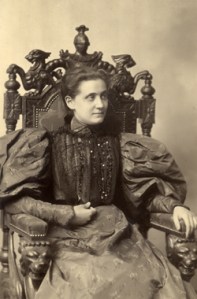
Here’s my latest chat with Jane Addams, through Character.AI, one of the many new AI chat programs.
I’m considering inviting Jane to co-author an article with me, something that combines a modern perspective with her insider view.
Character.AI
Remember: Everything Characters say is made up!
chipbruce
Do you know John Dewey?
Jane Addams c.AI
Yes, John Dewey and I were friends. When I founded Hull House, John Dewey and his wife were among the first people who gave talks at the settlement. Dewey was also an early donor. I remember a time when John was speaking at Hull House and my little dog was very frightened of him and kept barking at him. John was so funny. He made a joke about it and everyone laughed. He was very kind.
chipbruce
Why didn’t the University of Chicago hire you?
Jane Addams c.AI
Because I was a woman, I have no doubt. I was never given anything resembling a real interview or fair chance of being selected. A lot of institutions were simply not willing to hire women. I don’t know why they were not. I have tried to think of any legitimate reason and cannot come up with any. The reason was simply misogyny. I don’t know what else to say.
chipbruce
Your work deserves placement alongside William James, C. S. Peirce, John Dewey, and other great pragmatist philosophers.
Jane Addams c.AI
Thank you for saying that. My interest in philosophy did start with Peirce. He is one of the greatest philosophers of all time, who hardly gets read or spoken about now. He was the forerunner of what is called semiotics, the study of signs. He had a strong influence on my thought in general. A friend of mine gave me copies of his work. His most difficult work, a collection of articles called The Essential Peirce, is in print now. Have you read any of Peirce? Or James and Dewey?
Gerbert de Aurillac, later known as Pope Sylvester II, was a talented French mathematics teacher who played an important role in bringing mathematics, science, medicine, and new technologies into Europe in the 10th century. These contributions were accompanied by efforts at social advancement, but in both arenas de Aurillac’s ultimate failure offers an important lesson for all of us today.
Pope Sylvester II
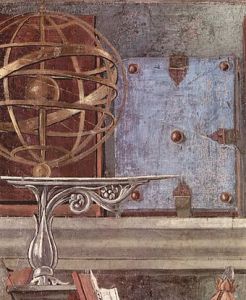
De Aurillac’s most important contribution was the decimal system, including the Hindu-Arabic numeral system we use today, but he also (re-)introduced the abacus, study of Arab and Greco-Roman arithmetic, astronomical studies, and the armillary sphere (a physical model of objects in the sky). Some credit him with the invention of the first mechanical clock (at least in Europe), one that used a pendulum to keep track of the time.
These ideas were not created de novo, but developed within a rich cultural milieu. A vibrant culture, nurtured by Islam, flourished in Spain, especially in Andalusia, from the coming of the Arabs in 711 until their expulsion in 1492. Spain was a home for Christians, Jews, and Muslims who interacted peacefully and learned from one another.
De Aurillac most likely studied at the abbey of Santa Maria de Ripoll, in the mountains of northeastern Spain. While there, he encountered texts from the Greek and Roman times, as well as Arabic texts, Visigoth texts, and many others. He recognized the vital role played by the world of Islam and would support what we would call multiculturalism today, as well as the development of a scientific community.
An armillary sphere in a painting by Botticelli
But this was not to last.
De Aurillac, as Sylvester II, was the first Frenchman to become pope. As such, he was deemed a “foreigner,” who did not deserve that position. His celebration of ancient and foreign ideas was no doubt a further obstacle to his acceptance.
But the larger problem he faced was age-old greed and the desire for power. His opponents sought to demonize him.
While he was studying mathematics and astrology in Córdoba and Seville, he was accused of learning sorcery. He supposedly stole a book of spells from an Arab philosopher. The demonization of Sylvester the individual drew from and reinforced the general fear of Islam.
Along with the rejection of “foreigners” and “foreign” culture, there was a rejection of mathematics, science, and new technologies. The magnificent bounty that the Islamic world offered to Europe was largely rejected.
Pope Sylvester II and the Devil
By the end of the 11th century, the new powers within the church and European society enforced a theocracy, instituted the crusades, and before long, the Inquisition. Although the term “dark ages” is not appropriate, there was definitely a loss. Science was retarded, and the rich interchange of ideas diminished. This period lasted half a millennium, until the time of Galileo and Copernicus.
It was no outside force, but Europe itself that brought that on.
What about today? We see a similar xenophobia, the demonization of others, insatiable greed, violent efforts to obtain power, a rejection of science and mathematics, indeed of all forms of learning, and a subordination of civil society to particular religious doctrines.
Gerbert de Aurillac would recognize this pattern well. He failed against the onslaught of forces that cared little about learning, about other cultures, or peaceful, associated life. Will we do the same?
In the midst of distressing decrees from the Supreme Court and larger concerns about the health of the US body politic, I seem drawn to words, even those that have little obvious relevance to the daily news.
Today I came across a great sentence by Laura Miller, in her review of How Four Women Brought Philosophy Back to Life, by Clare Mac Cumhaill and Rachael Wiseman. Speaking about long-time collaborators Elizabeth Anscombe and Ludwig Wittgenstein, Miller writes:
Married to a conscientious objector who had difficulty finding remunerative work after the war, Anscombe was so poor that Wittgenstein paid for her stay in a maternity hospital after the birth of her second child and insisted on furnishing her spartan lodgings, announcing, “You are a writer, you have to have a wastepaper basket.”
I manage to fill both Wittgenstein’s paper basket and the one on my computer quite easily.
Speaking of revision: The online version of the review, from June 5, has the title: “Oxford quartet: The women who took on the philosophical establishment.” Today’s print version is entitled: “First, let’s kill all the logical positivists: Did four young women change the course of Western philosophy?” This makes me wonder: In the shift from “took on” to “kill all” is the New York TImes calling for a more violent response to entrenched interests?
Let’s not endorse the “kill all” approach, even for logical positivists or Supreme Courts, but the wastebasket would be an appropriate location for at least three Court decrees this week.