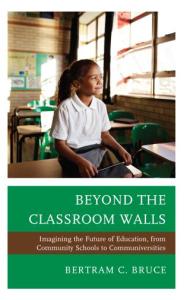
The book asks readers to adopt a critical and comprehensive view of education (pre-K to lifelong learning) as existing both within classroom walls, and in the surrounding world, including communities and workplaces. It presents an integrated view of online learning, community schools, communiversities, and learning through work.
Continue readingeducation
Realities of community-based learning during lockdown
It was great to see the published paper copy of our article: “Realities of Implementing Community-Based Learning during Lockdown: Lessons from a Troubled Journey.” You can see photos of the authors below.

In the Editor’s Introduction to the Schools Studies in Education issue, Andy Kaplan writes,
In “Realities of Implementing Community-Based Learning during Lockdown: Lessons from a Troubled Year,” Raunak Chaudhari, Smriti Karanjit Manandhar, and Bertram C. Bruce examine the fortunes and misfortunes they encountered implementing a program at King’s College in Kathmandu, Nepal. They had conceived the program as a meaningful experiment in education reform, an effort to connect classroom learning to the needs and desires of the world outside the university. Although the onset of the pandemic seriously altered the original design of the course, the course provided many valuable experiences as well as an important example of how the ambitions of integrated learning create conditions of adaptability that are well suited to emergent and emergency circumstances.

Video: Fulbright Specialist in Nepal, 2019
The Frames film program has produced a short video of my work in Nepal, focusing on the Fulbright Specialist trip in 2019. I hope you enjoy it.
The Frames Film Program provides opportunities for multi-barriered youth (ages 16 to 30) to learn the basics of filmmaking — at no cost. It is an off-site program of Frog Hollow Neighbourhood House. As a Vancouver-based film production and life skills program, it provides opportunities for youth to learn the basics of filmmaking in a supportive, safe and fun environment.
The noisy anorak
I have many embarrassing moments in my life. Here is just one.
In 1993, JIm Edgar was Governor of Illinois. Maybe he wasn’t perfect, but two of his predecessors were in prison for misdeeds as Governor and two of his successors went to prison as well. Need I mention that Jim was the only one of the group who failed to get rich in office?
I’ll refer to him as Jim, mostly because it’s easier than saying “the (then) current Governor of the State of Illinois.” Also, he is almost exactly my age.
Jim was invited to speak at the University of Illinois, where I was teaching as a Professor in the College of Education. Coincidentally, his daughter Elizabeth was my lab assistant in the science lab used for preservice and inservice classes in science education.
I was fortunate to get an invitation to a limited capacity event, perhaps 100 attendees. It was to be held from 4 to 5 on a weekday. This presented a problem. I taught class until 4 that day and had a meeting with local school teachers at 5 at a nearby school.
But I figured that I would end class a few minutes early, then rush to the event and stand inconspicuously in the back, being prepared to leave at 4:50. It was a great plan. It would all work out.
The first flaw in my plan came as students had an unusual number of questions that day. So I had to run to the event, still reliant on my plan to stand in the back and skip out early.
When I arrived, I discovered that this was a major media event. There were TV cameras, photographers, news reporters, and all sorts of people in limousines. I say “all sorts” but now, recalling the event, I think the attendees were nearly all men, all in dark suits with ties, all looking very somber until the TV lights came on, when they would flash big smiles. People had come to be seen as much as to hear the speech.
I in contrast was wearing blue jeans and a green, nylon anorak. I loved that jacket. It’s only defect was that it was very noisy when the nylon brushed against something. I stood out, not in a good way. But I still had the plan to stand inconspicuously in the back and sneak out early.
Unfortunately, I was the last to arrive and my plan was immediately rejected by a couple of the many ushers. They pointed to the last remaining seat. It was in row 3 in the exact middle. They insisted that I go to sit there, probably something about not wanting to show an empty seat on TV.
I reluctantly forced my way through the crowd to get to my selected seat. This required rubbing my noisy anorak against other attendees, many of whom were… large. I made a lot of noise and as my arrival pushed us past the nominal start time, all eyes, and TV cameras were on me. Who is this tall guy dressed and acting so inappropriately? Why doesn’t he just sit down and look like all the other dark suits?
I survived that part, although I was hot in my anorak from the run to the event and the embarrassment. I decided to endure that and focus on the speech.
Often a speaker will select an audience member to focus on, rather than trying to meet every pair of eyes at once. Jim did that. I was in the exact middle, and had the most inappropriate garb. I was also genuinely interested. I felt that he was speaking directly to me.
It was actually quite good. Jim related the saga of his failed attempt to provide a floor for funding of schools in Illinois. As in most states, Illinois provided a substantial portion of school funding out of local property taxes. This meant for example, that New Trier High School could spend $15K per pupil per year (not sure of the exact numbers here). They had just installed a new swimming pool. They could hire the best teachers, the fastest computers, and provide the smallest classes. Since area housing was expensive, the local taxpayers got all of this with a lower tax rate and a far lower percentage of their income.
Meanwhile, some rural schools in downstate Illinois could not afford needed repairs. They spent, say $2.7K per pupil per year. Jim’s plan was to seek a balance, $3.5K per pupil per year funded by a progressive income tax.
This was a brilliant initiative. However, it was opposed by politicians from Chicago, who fought for every advantage for their region, by the Democrats who rebelled against anything the Republican Governor would propose, and by his own Republicans who saw it as a giveaway to the poor and could not countenance a progressive income tax.
Note that Jim was taking on one of the most egregious, anti-democratic practices we have in this country. But he did it in a very modest way. There was no idea of truly equalizing funding for the institution that is supposed to offer a level playing field for all citizens, much less the idea that poor students might need extra help.
He worked hard on this for at least a year, but the idea was doomed from the start.
That was the bulk of the speech. Towards the end he turned to a second topic. This was an urging of the university to get more involved with the local community, especially with the schools. I thought “great!” It was exactly what I was doing. In fact at 5:00 I was to meet with local school teachers. I wanted to say that, but couldn’t in this formal lecture format.
But I also realized that if he didn’t wrap it up quickly. I’d be late for that meeting. As much as I didn’t want to further disturb the big gathering, I felt an even stronger obligation to be timely with the teachers and to show respect for their work.
I was obviously fidgeting. I began studying my watch, trying to calculate the precise moment when I would need to leave the meeting regardless of the disturbance. 4:55 was a messy compromise. I knew the big event was scheduled to got to 5:00, but it might easily go on until 5:30. 4:55 would make me a couple of minutes late to the teachers, but if I ran again and didn’t encounter traffic it could all work.
I waited until 4:55:15, then stood up abruptly as Jim was speaking. He paused, other audience members groaned or mumbled invectives, the TV cameras focused in. I thought that nothing could have been more embarrassing until I heard the noisy anorak rubbing against people and seats.
I did manage to escape. The teachers probably wondered why I was so disheveled and probably smelled from all the running.
The next day I saw Elizabeth in the science lab.
Me: I was fortunate get an invitation to your father’s speech yesterday. He did a great job.
Elizabeth: Oh! He’ll be happy to hear that. He worried that he’d gone on too long and said that some audience members were fidgeting.
Democratic Education in the 21st Century
A Call for Papers
Guest Editor: Bertram (Chip) Bruce
Editor of Schools: Studies in Education: Andy Kaplan
In an age of climate disasters, extreme income inequality, conspiracy theories, anti-democratic movements, segregated schooling, pandemic, and more, the need for democratic education has never been greater, but it may also seem less viable than ever. Classics such as John Dewey’s Democracy and Education are still relevant but invite us to re-invent education for today.
The symposium
Schools: Studies in Education, published by the University of Chicago Press, plans to host a symposium on this topic to celebrate Schools’ twentieth anniversary of publication. The mission of Schools is to present inquiry into the subjective experience of school life. Unique among academic journals of education, Schools features articles by and about the daily life of classrooms, descriptions and reflections on the meaning of what happens when learning actually occurs.
To celebrate our twentieth year of publication, we propose a symposium on how to think about democratic education in today’s world, and how we should plan for the future. How should issues such as indigenous people’s rights, racism, women’s rights, authoritarian governments, the concentration of wealth, and more make us analyze, discuss, and work to create democratic education?
We highly encourage submissions from classroom educators at all levels, from educators outside the United States, and from educators associated with alternative schools or informal learning.
Deadlines
- November 15, 2021: One-page prospectus for your proposed article
- July 25, 2022: in preparation for the workshop, send first draft, outline, or notes to Andy Kaplan; the folder containing these drafts will be accessible to contributors by August 1
- August 15: online workshop
- October 15: final ms. to be considered for the Spring 2023 issue
- October 31: editors’ review of the ms.
- November 30: outside review of the ms.
- December 31: final, revised copy
- Spring 2023: publication of the first set of articles
- Similar deadlines will apply for the Fall 2023, or beyond, issues
Manuscript preparation
Interested authors should submit a one-page prospectus describing what their project entails. This is to determine appropriateness and balance for the special issue. We anticipate a mix of empirical and theoretical contributions. Completed manuscripts will undergo the usual Schools: Studies in Education review process before final acceptance.
Articles should be a maximum of 8000 words (25 double-spaced pages). Please follow the Schools style guide.
Articles will appear in the Spring and Fall 2023 issues. There is a possibility of a follow-on book publication based on revised versions of the articles, once the symposium has been published in Schools.
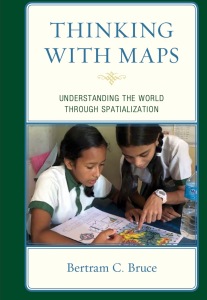
Thinking with Maps: Understanding the World through Spatialization

Spatial reasoning, which promises connection across wide areas, is itself ironically often not connected to other areas of knowledge. Thinking with Maps: Understanding the World through Spatialization addresses this problem, developing its argument through historical analysis and cross-disciplinary examples involving maps.
Continue readingFulbright Specialist in Nepal, 2019
During February-March, 2019, I had a wonderful Fulbright Specialist experience hosted by King’s College in Kathmandu, Nepal. This followed on two previous trips to there to work with educators from K-12 through college levels, in and out of school.
Sensible planning for online learning

Wikimedia Commons, CC BY-SA 4.0.
In the rush to online education, schools and colleges appear to expect instant transference of their on-campus programs to new media such as Zoom and Moodle.
Anyone who has observed the implementation of online education knows that this is a recipe for disaster, one that will lead to little meaningful learning and much angst on the part of students, teachers, parents, and administrators.
In this context, it’s worth taking a look at what has contributed to the success of some online learning.
The LEEP online masters program
In 1996, the Graduate School of Library and Information Science (now the iSchool) at the University of Illinois began offering master’s degrees over the Internet, with only brief periods of on-campus learning.
This program, actually just a scheduling option for the traditional degree, is called LEEP. It has a 24-year record of success from the perspectives of students, faculty, staff, employers, researchers evaluating the program, and formal accreditation bodies.
Upon graduation, one student said that it
has truly been a marvelous, exhilarating experience. I have met and learned from a wonderful group of students and teachers. At times overwhelming, but always challenging, the GSLIS classes have taught me far more than I could have imagined. I have gained insights and confidence, knowledge and skills, and friends for a lifetime. The virtual community of LEEP3 continues to develop and thrive. [Quoted in a 1999 paper by Dean Leigh Estabrook, “New Forms of Distance Education”]
Why has LEEP been so successful, especially in contrast with what many are doing today? This is worthy of a longer discussion, but it’s useful to list a few of the characteristics of LEEP that have helped it to succeed:
- Voluntary participation: Faculty were invited to participate, but were not required to do so. Although some were eager to give the new modality a try, others needed to see how their colleagues fared first.
- Planning and preparation: Through course releases and other mechanisms, faculty were given time to prepare new courses or new versions of existing courses that reflected the affordances and constraints off the new medium.
- Match to available resources: There was detailed consideration of the background knowledge needed by students, and of the necessary technical features such as bandwidth, computer and operating system platforms, or microphones and speakers.
- Technical support: There was substantial technical support for both students and faculty, so that they could concentrate on the course content.
- Reflection: There was an annual retreat to discuss successes, surprises, and challenges.
- Analysis and ongoing revision: The program was regularly and systematically studied through surveys, interviews, and analyses of course interactions. This has led to books, articles, conference presentations, and other publications, which contributed to the program’s continuing development.
- Collaboration: The program was developed in collaboration with other units within the university and with similar programs at other institutions.
What schools are doing instead
International Handbook of Progressive Education
International Handbook of Progressive Education (Peter Lang, 2015) represents a project involving over 60 authors and editors from countries around the world.
Mustafa Yunus Eryaman and I are editors, aided immeasurably by Section editors John Pecore, Brian Drayton, Maureen Hogan, Jeanne Connell, Alistair Ross, and Martina Riedler.
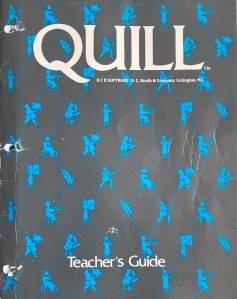
Continue readingQuill teacher’s guide

Quill is a set of microcomputer programs that use the computer’s capabilities to help teachers teach writing. Students from third grade through high school have been successful with Quill, including gifted and talented, special education, and English as a second language students.
The Quill programs are tools for teachers and students. Teachers can use Quill to provide challenging, meaningful writing activities for students. Students can use the programs to practice various types of writing and produce finished products they can share with classmates and teachers. These are motivating, adaptable writing activities that supplement and enrich existing language arts curricula, and can be integrated into all content areas.