Dreaming in Hindi, by Katherine Russell Rich

kathy_sari

Recently, I listened to an interesting Afternoon Magazine (WILL AM 580) radio interview with Katherine Russell Rich, related to her book, Dreaming in Hindi: Coming Awake in Another Language.

It’s her own story of learning language. When Rich lost her job at a New York magazine, she didn’t just file for unemployment compensation, she decided to immerse herself in Hindi and in India, as she says on her website;

I’d recently lost a job, I was watching the business I’d been in and loved, magazines, begin to crumble. My world had been turned upside down. Compounding that was the fact that in the decade before, I’d gotten smacked around twice by breast cancer. I barely recognized my own life anymore. Or the way that I put it in the book was, “I no longer had the language to describe my own life, so I decided to borrow someone else’s.”

There are many examples revealing about Hindi, English, language in general, culture, and Rich herself, e.g.,

…the word for yesterday and tomorrow is the same: kal, from Kali, the goddess of death and destruction. There’s a philosophy embedded in there—it’s only when you’re in today, aaj, that you’re here; if you’re in yesterday or tomorrow, you’re in blackness.

What is community informatics?

Community informatics has very definitions, such as that it

…brings together people concerned with electronically enabling local (and virtual) communities; and structuring collaborations between researchers, practitioners (including industry) and policy makers to support community ICT implementation and effective use.

Community Informatics Research Network

Definitions such as the one above appropriately name various constituencies, thus serving organizational needs. But for me they are oddly both too narrow, excluding legitimate elements and activities, and too broad, lacking a principled organization or rationale.

Inquiry cycle
Inquiry cycle

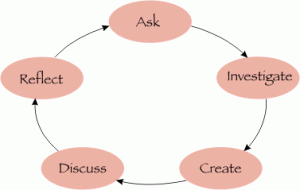
The Inquiry Cycle

I’d like to suggest an alternative, drawing from the experience of the Community informatics Initiative (CII) at the University of Illinois, as well as helpful discussion with CII staff and students. The organizational principle that I’d like to suggest is that community informatics is a form of disciplined inquiry, with central questions, methods of investigation, actions, collaborations, and theories. I’d like to present that here using the the Inquiry Cycle as a framework and CII activities as concrete examples.

The Inquiry Cycle (Bruce, 2009) characterizes inquiry as involving five major aspects: a guiding question (Ask), methods of investigation (Investigate), active participation (Create), collaboration and dialogue (DIscuss), and reflection (Reflect). These aspects don’t necessarily proceed in a prescribed order; inquiry may involve any of the aspects in varying degrees and orders. For example, Reflect is often the beginning point of inquiry, leading to the formulation of the Ask. The idea of cycle (or better, spiral) suggests that inquiry does not complete, but generates further inquiries.

Community Informatics as a Type of Inquiry

The definition below is rather lengthy. Think of the Ask as the core question that defines community inquiry. The other elements then elaborate on that, emphasizing the variety of approaches needed to address the core question.

Ask: How can we work with communities to learn about democratic participation in the digital age, and to promote engagement with information and communication technologies for both individual and community growth?

Investigate: CII investigates the ways that people in communities create and share knowledge, how social networks operate and evolve, how access to technologies is differentially distributed, especially along lines of race and class, and the development of policy regarding information and communication technologies. These communities may be large or small, geographically-based or online. The goal of these investigations is to learn more about the dynamics of communities, their capacities and challenges, and how they make use, or not, of various tools. Basic research such as this is necessary for informed and meaningful action with communities.

Create: CII builds tools, such as Prairienet, Community Inquiry Labs, geographic information systems, media archives, and computer technology centers. It works with organizations such as Books to Prisoners, S.O.A.R. [after-school program]@ B.T. Washington Elementary, Paseo Boricua, and others to expand opportunities for learning and to support social justice. Building as well as using tools in a critical manner not only addresses immediate needs; it’s a key aspect of learning about community informatics.

Discuss: CII provides forums for interaction and collaboration, such as the Journal of Community Informatics, CI Reflections blog, and the CI Research Series. A diversity of theories and methods are not only welcomed, but seen as necessary for understanding diverse and changing social and technological realities.

Reflect: CII helps make sense of experiences of communities as they use information and communication to address their needs. It also critically analyzes its own inquiries, its tools, and its modes of interaction and collaboration. These reflections help build stronger accounts of community informatics, including extensions of critical race theory, political economy, critical literacy, as well as the development of new frameworks, such as the theory of community inquiry, and generate new questions for further inquiry.

References

Bruce, Bertram C. (2009, April). “Building an airplane in the air”: The life of the inquiry group. In Joni Falk & Brian Drayton (eds.), Creating and sustaining online professional learning communities. New York: Teachers College Press. [ISBN: 0-807749-40-0]

Cross-posted on CI Reflections

Fences or webs?

old-new schools

In my last post I talked about the Eight-Year-Study, which documented the success of progressive education at fostering intellectual curiosity, cultural awareness, practical skills, a philosophy of life, a strong moral character, emotional balance, social fitness, sensitivity to social problems, and physical fitness.

I had come across materials related to the study in the Progressive Education Association Records in the University of Illinois Archives. This is a treasure-trove, not only of the Progressive Education Association per se, but also of the various social movements they were involved in. I hope to explore it more.

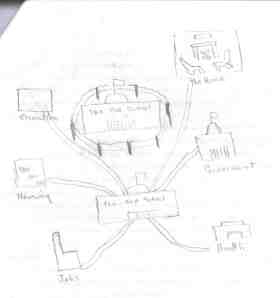
One drawing I found is shown here. It’s included in the folder for the booklet that later appeared as Dare our secondary schools face the atomic age? However, there are no images in that booklet. The drawing shows two visions for schools. In one, the “old school,” there is a fence surrounding the building; activities of the school are separate from those of the world around it, and as a result, schooling is separated from the actual life of the children.

In a second vision, the “new school,” the building is substantially the same, but it is connected to sites for recreation, housing, jobs, health, government, and by implication, all aspects of life. This idea of community-based schools was key to the Progressive Education movement, especially in its later years, as members realized they needed to do more than promote child-centered learning in an individual sense. That was true for “community schools” per se (Clapp, 1939), but actually for all schools, urban or rural, large or small, primary or secondary.

Today, many of these ideas have survived under rubrics such as “civic engagement,” “public engagement,” “community-based learning,” or “service learning.” But often those ideas are seen as one-way or very limited in scope, as in a single course. It’s worth revisiting the earlier visions to understand better how schools and universities could better fulfill the high hopes we place upon them.

References

Benedict, Agnes E. (1947). Dare our secondary schools face the atomic age?. New York: Hinds, Hayden & Eldredge.

Benedict, Agnes E. (1947). Pencil drawing, Progressive Education Association Records, 1924-1961, Record Series 10/6/20, Box 4, folder Dare the Schools Face the Atomic Age?, University of Illinois Archives.

Clapp, Elsie Ripley (1939). Community schools in action. New York: Viking.

Thinking with toes and fingers

Four generations

four generations

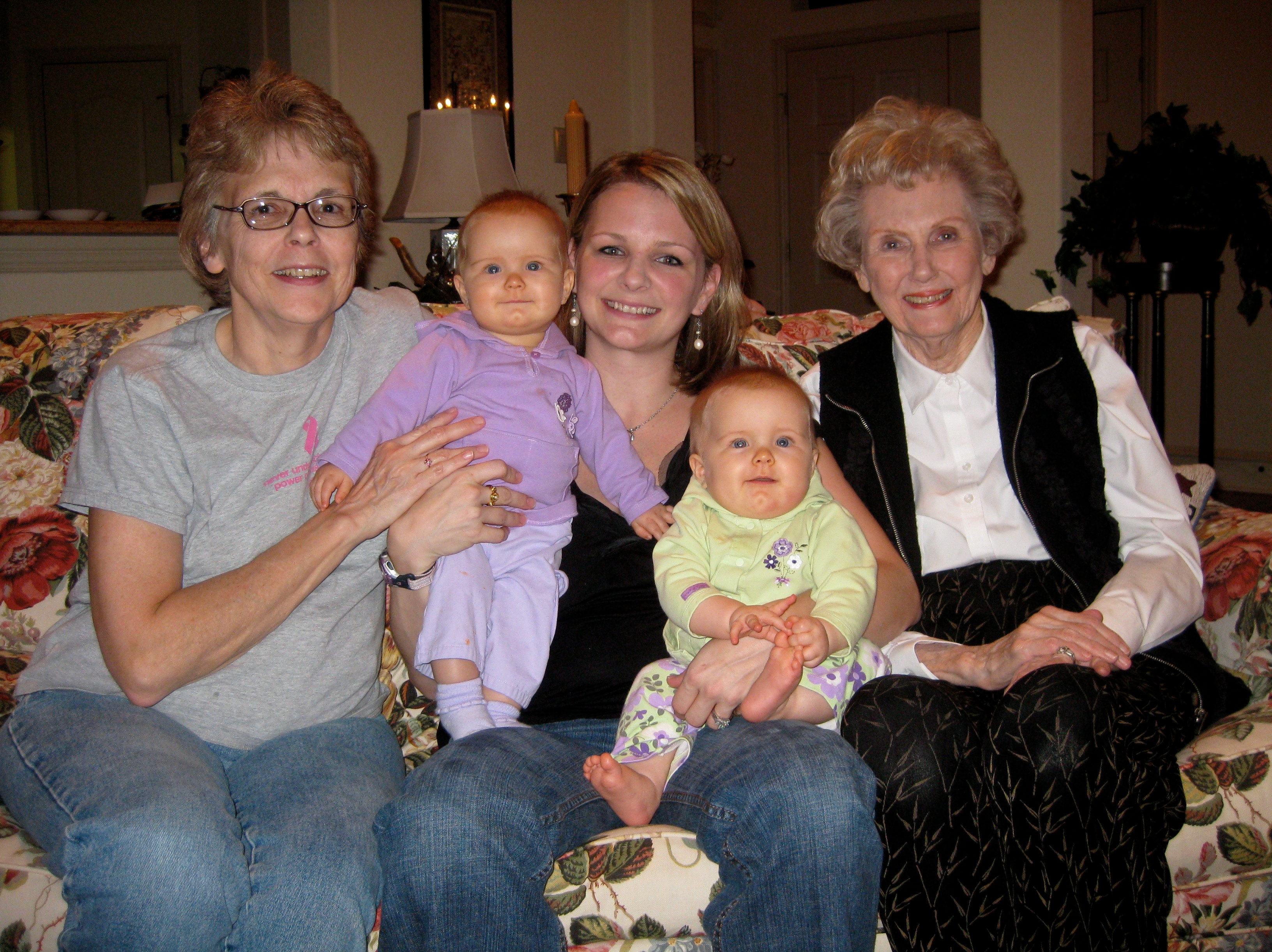
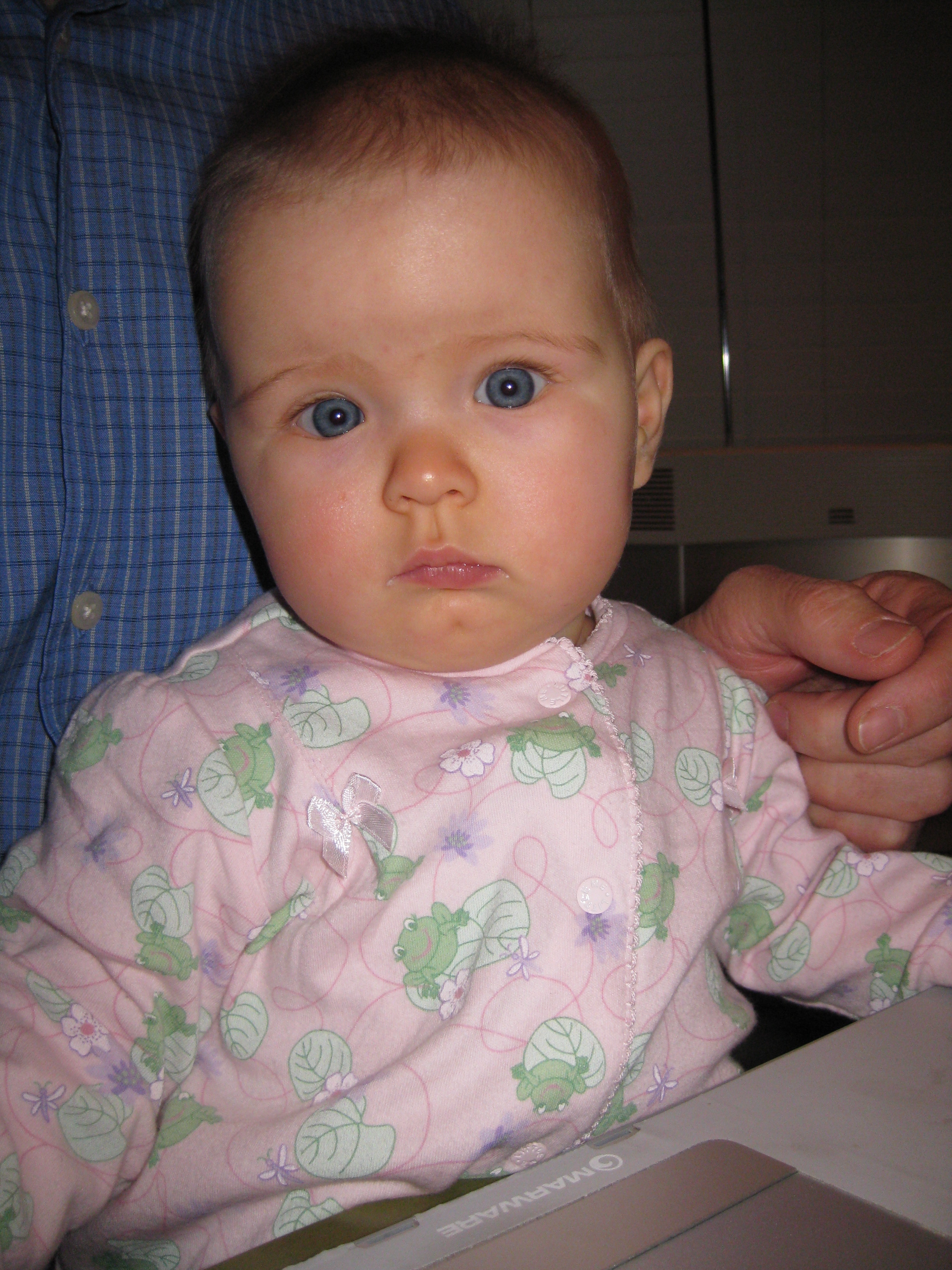
What pleasure could be greater than spending time with four generations of family (see photo at left), as we did last weekend in Fort Worth? The twins, Caitlyn and Chloe provided all the entertainment one could want, far surpassing anything that might have been offered on TV or on some stage. They were in turn the most attentive audience, soaking in everything around them, including as you can see, Caitlyn exploring her own toes.

Chloe's fingers on the Mac keyboard

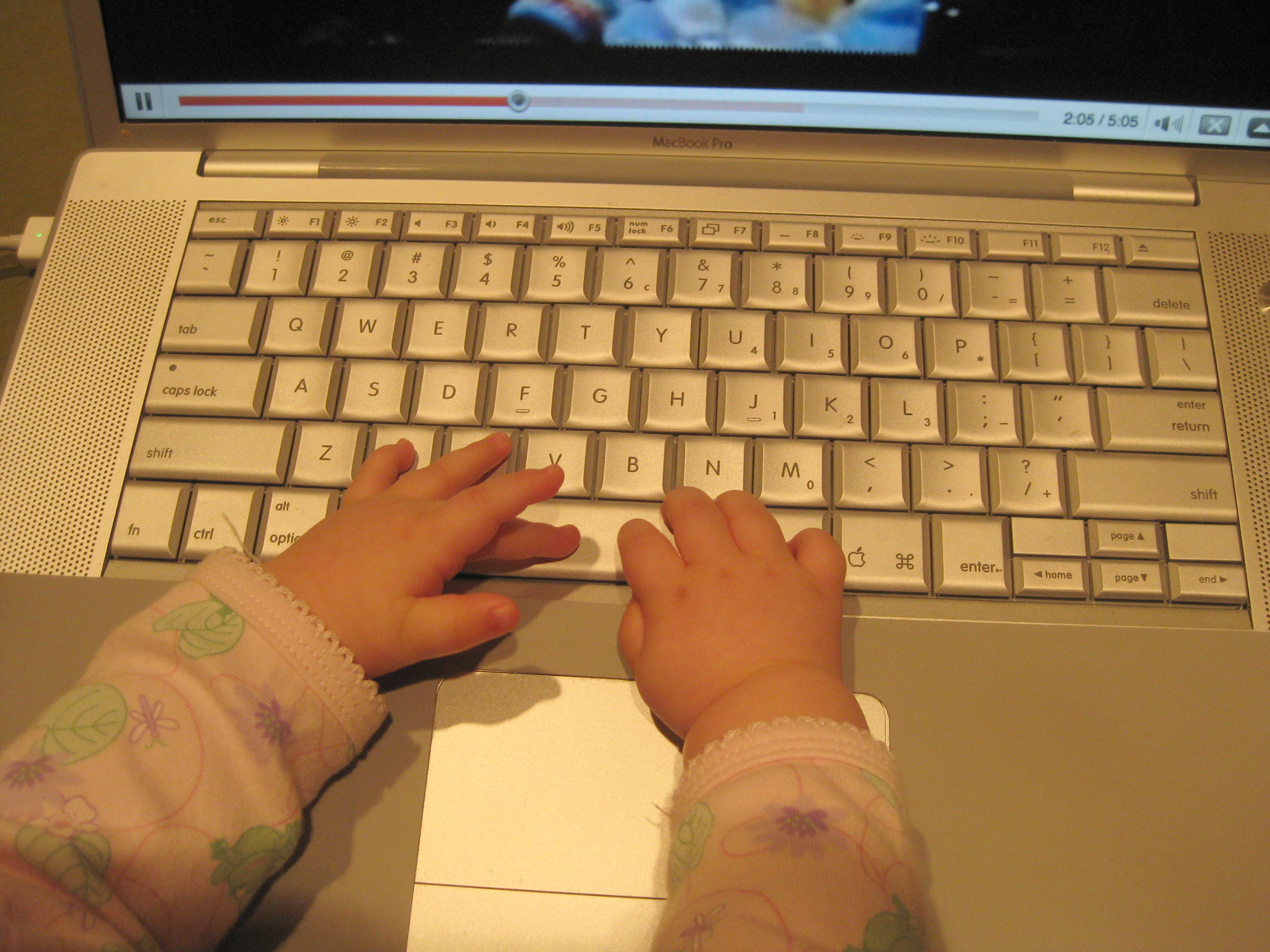
Chloe’s fingers on the Mac keyboard

We did venture on to YouTube to listen to some Raffi songs. This led to some “digital” explorations by the generation poised to supplant in not so many years the so-called digital natives of today. It’s not evident in this photo, but digital here includes toes as well as fingers.

The final photo shows Chloe studying the camera studying her.

Chloe, 7 mos.

Chloe, 7 mos.

For Chloe and Caitlyn, learning involves all the senses and all the body. They explore faces using their eyes, but also their noses and fingers. Things are as they look, but also as they smell and taste and feel.

Some people would claim that the girls don’t talk yet, but that’s only in the incredibly narrow sense of saying that they don’t speak standard English. Their world is actually suffused with communication; it’s a rich laboratory of experiments with sounds linked to ideas and feelings. They gently remind us that the adults among us who constrain their talk to formulaic utterances and language without feeling are the ones who don’t know how to talk.

It will not surprise some of you to hear that this reminds me of John Dewey, who says:

Upon this view, thinking, or knowledge-getting, is far from being the armchair thing it is often supposed to be. The reason it is not an armchair thing is that it is not an event going on exclusively within the cortex or the cortex and vocal organs. It involves the explorations by which relevant data are procured and the physical analyses by which they are refined and made precise; it comprises the readings by which information is got hold of, the words which are experimented with, and the calculations by which the significance of entertained conceptions or hypotheses is elaborated. Hands and feet, apparatus and appliances of all kinds are as much a part of it as changes in the brain. –pp. 13-14, John Dewey, Essays in experimental logic

References

Dewey, John (1916). Introduction to Essays in experimental logic (pp. 1-74). Chicago: University of Chicago.

Learning from graveyards

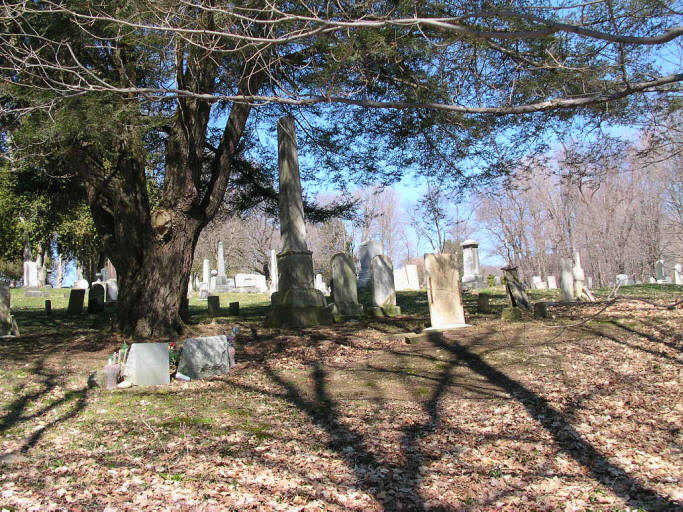
oldsectionhillside-017Starting with the town in which they lived, North Andover, Massachusetts, Caroline Donnan’s third-grade students physically entered history. They each adopted the family name of a European settler from the 1640’s period and thereafter assumed an historical role. A story centered on one of the historical characters would then form the basis of a study. That led to holding meetings, making maps, studying architecture, and discussing issues of the time as their assigned characters might do. (Photo by Ron Taylor, 2005).

Unraveling the town’s history, then, became the common vehicle for covering many skill and subject areas. It was also a wonderful excuse to put students in the position of discoverers, gatherers, and inquirers.

Their trips to a graveyard sparked scientific inquiry.

“People say settlers didn’t live as long as we do these days. What can you find here to prove whether or not that is true?” The class spread out to inspect gravestones. Scribbled columns of notes later turned into graphs and charts, subtraction and regrouping, smallpox and diptheria, questions and conclusions…Putting [the findings] together with a tally of how many people died at what ages, we came full circle to questions, connections, information. In point of fact, if settlers survived the first five years of life, their chances for survival were the same as they are today.

johnsoncottageI’m guessing that there are no surviving homes from the 1640’s era in North Andover. But there is the Johnson Cottage, built in 1789. According to the North Andover Historical Society is the “last surviving artisan’s cottage in North Andover’s Old Center.” The students made an expedition there and discovered low ceilings and short beds. This led to further inquiries into what it was like to live in the even earlier period.

The photo of the Cottage, shown here, is used by permission of the Historical Society. Their archives contain the largest amount of information on the Cottage and on the burial grounds in North Andover. They also host educational programs based on the first burial ground.

The students’ inquiries developed as multiple forms of literacy woven through the daily life of the classroom:

When we couldn’t get to real locations, we worked on constructing our own original one-room “town founder’s house” (located at one end of the classroom) or practiced scenes that eventually became “Starting from Scratch,” a full length musical relating the town’s earliest history. We also spent a substantial amount of time writing settler diaries, field notes, notices for the meetinghouse, town records, sermons, poems, trip lists, hymns, project progress reports, hypotheses, and conclusions. And we drew maps and charts, costumes and scenery, fences and rooftops.

It seems odd that a world tied to the past, even to graveyards, could be so alive for the students and Donnan herself. It’s even odder that this fantasy world became closer to the lived experience of the children than did their usual curriculum. But it’s less odd when we realize that it was based on their actual physical and social surroundings, and related to their own experiences of living spaces, health, family, and neighborhood.

Any learning activity raises questions. I’m curious to know how the class related their experiences in the 1789 Cottage to their simulation of life in 1640. I also wonder how much “Starting from Scratch” recognized the culture and lives of the Wampanoag people who lived in the area before 1640. What I can guess is that Donnan’s students were better able to engage in productive dialogue about these and other issues following their year in her classroom.

Donnan’s article is out of print. That’s a pity, because it’s an impressive example of how learning can be connected to life, offering a model for any age of students. Donnan even addresses the standard curriculum problem:

We had but one problem. In all the pages of the neatly typed, carefully bound, district-required social studies curriculum, never once was there mention of any of this.

She concludes by saying that we don’t have to wait:

With all there is to learn and do in the outside world, we really shouldn’t wait until June to get started.

References

Donnan, Caroline (1988). Following our forebears’ footsteps: From expedition to understanding. In V. Rogers, A. D. Roberts & T. P. Weinland (Eds.), Teaching social studies: Portraits from the classroom (Bulletin No. 82) Washington, DC: National Council for the Social Studies.
Gorvine, Harold (1970, May). Teaching history through role playing. The History Teacher, 3(4), 7-20.
Levstik, Linda S., & Barton, Keith C. (2001). Doing history: Investigating with children in elementary and middle schools (2nd ed.). Mahwah, NJ: Lawrence Erlbaum Associates.

What, when, and where of web pages

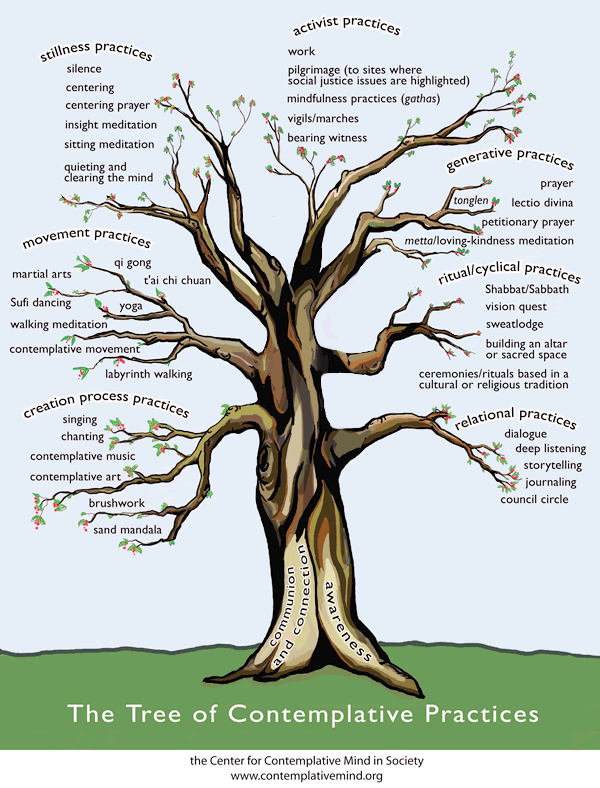
tree-of-practices-screenHow do we find an entry on a website? Usually, we do it either from a general search or by a link from another entry. But both of those are enabled by the fact that the entries are connected in some pattern.

What

One such pattern depends on what the entry is about. When we focus on the what, we call the entry a page. The main page on a topic (the parent) then links to sub-topics (the children). An example of this is my page on Teaching, which has several children pages. There can be many generations of pages, resulting in complex family tree of pages. Of course, with hyperlinking, it’s not strictly a tree structure, but the fundamental idea isn’t that different from the kinds of outlines we were taught to do in school.

ribbon

When

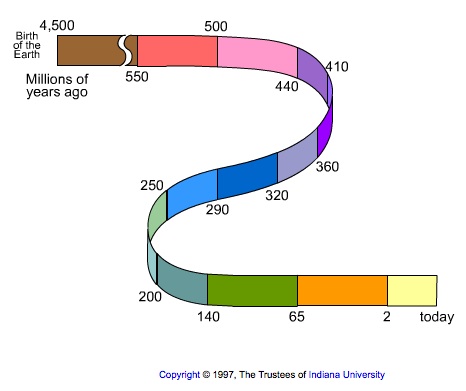
A second way to organize pages has become so common that many people use its name to refer to any website. That’s to focus on the when of an entry. In that case, the website becomes a blog and the entries, now called posts, are organized by their time of creation into a chronology, usually with the most recent first.

Image at left, showing geologic time, courtesy of the Indiana Geological Survey.

world_mapWhere

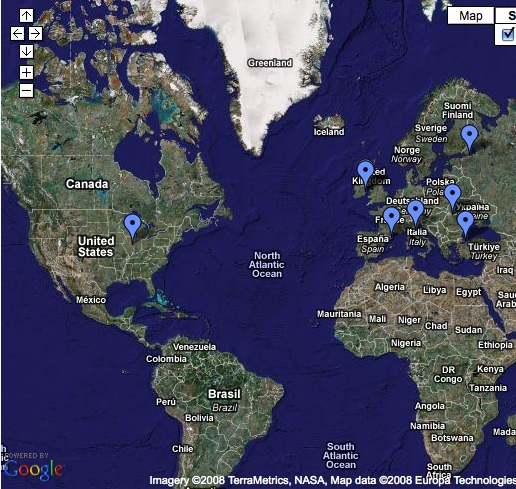
So we have a conceptual organization and a temporal one, what else is there? Well, another that is emerging now is a spatial organization. In this case, the entries, now called place-descriptions(?), are organized by their geotag, or where they occurred. For example, my entry on Aughavannagh and Glenmalure is more about the place than about the particular time our visit occurred. Just as pages can be grouped into a tree structure or posts into a chronology, place-descriptions can be grouped into a spatial map using their geotags. So, this site now has a world map, with place markers indicating the place-descriptions.

Things get messy in practice. We also use the less-structured tags and categories as other ways to find entries. A given entry might serve as a page, a post, or a place-description. And none of this works if the entries aren’t marked appropriately.

52°54′55″N 6°25′28″W

John Dewey in Turkey: Lessons for today

The Republic of Turkey was proclaimed on October 29, 1923. As its first President, Mustafa Kemal Atatürk (photo below) sought to establish the modern Turkey as a “vital, free, independent, and lay republic in full membership of the circle of civilized states.” He recognized the need for “public culture,” which would enable citizens to participate fully in public life, and saw the unification and modernization of education as the key. Accordingly, one of his first acts was to invite John Dewey, who arrived in Turkey just nine months after the proclamation.

In this endeavor, the ideas of Atatürk and Dewey were consonant. Dewey’s words above (“vital, free, …”) could have been written by Atatürk, just as Dewey might have talked about “public culture.” Both recognized the need to institute compulsory primary education for both girls and boys, to promote literacy, to establish libraries and translate foreign literature into Turkish, and to connect formal schooling, the workplace, and government.

Today is John Dewey’s 149th birthday. Back in 1924, he was nearing the age of 65, when many people think of retiring. But his three-month-long study in Turkey was an ambitious project. He addressed issues of the overall educational program, the organization of the Ministry of Public Instruction, the training and treatment of teachers, the school system itself, health and hygiene, and school discipline. Within those broad topics, he studied and wrote about orphanages, libraries, museums, playgrounds, finances and land grants for education, and what we might call service learning or public engagement today.

He laid out specific ideas, such as how students in a malarial region might locate the breeding grounds of mosquitoes and drain pools of water of cover them with oil. In addition to learning science they would improve community health and teach community members about disease and health. Workplaces should offer day care centers and job training for youth. Libraries were to be more than places to collect books, but active agents in the community promoting literacy and distributing books. In these ways, every institution in society would foster learning and be connected to actual community life. As Dewey (1983, p. 293) argued,

The great weakness of almost all schools, a weakness not confined in any sense to Turkey, is the separation of school studies from the actual life of children and the conditions and opportunities of the environment. The school comes to be isolated and what is done there does not seem to the pupils to have anything to do with the real life around them, but to form a separate and artificial world.
Atatürk saw the need to unify Turkey into a nation state, despite its great diversity. Dewey supported that but emphasized that unity cannot come through top-down enforcement of sameness (p. 281):

While Turkey needs unity in its educational system, it must be remembered that there is a great difference between unity and uniformity, and that a mechanical system of uniformity may be harmful to real unity. The central Ministry should stand for unity, but against uniformity and in favor of diversity. Only by diversification of materials can schools be adapted to local conditions and needs and the interest of different localities be enlisted. Unity is primarily an intellectual matter, rather than an administrative and clerical one. It is to be attained by so equipping and staffing the central Ministry of Public Instruction that it will be the inspiration and leader, rather than dictator, of education in Turkey.

This was realized in many ways. For example, the central ministry should require nature study, so that all children have the opportunity to learn about and from their natural environment, but it should insist upon diversity in the topics, materials, and methods. Those would be adapted to local conditions, so that those in a coastal village might study fish and fishing while those in an urban center or a cotton-raising area would study their own particular conditions.

Many of Dewey’s ideas were implemented and can be seen in Turkey today, as we come upon its 85th birthday next week. What’s even more striking to me is how relevant they are to the US today. Many of our problems can be traced to the “separation of school studies from the actual life of children and the conditions and opportunities of the environment,” but also to the separation of work from learning, of health from community, of libraries from literacy development, or of universities from the public. Dewey would be the first to argue that we need to re-create solutions in new contexts, but his report from long ago and far away still provides insights for a way forward today.

References

Ata, Bahri (2000). The influence of an American educator (John Dewey) on the Turkish educational system. Turkish Yearbook of International Relations (Milletlerarası Münasebetler Türk Yıllığı), 31. Ankara: Ankara Üniversitesi.

Bilgi, Sabiha, & Özsoy, Seckin (2005). John Dewey’s travelings into the project of Turkish modernity. In Thomas S. Popkewitz (ed.), Inventing the modern self and John Dewey: Modernities and the traveling of pragmatism in education (pp. 153-177). New York: Palgrave Macmillan.

Dewey, John (1983). Report and recommendations upon Turkish education. In Jo Ann Boydston (ed.), The Middle Works: Essays on Politics and Society, 1923-1924. Vol. 15 of Collected Works. Carbondale: Southern Illinois Press.

Wolf-Gazo, Ernest (1996). John Dewey in Turkey: An educational mission. Journal of American Studies of Turkey, 3, 15-42.

“I Came a Stranger” by Hilda Polacheck

I Came A StrangerI just finished reading I Came a Stranger: The Story of a Hull-House Girl, by Hilda Satt Polacheck, and edited by her daughter, Dena J. Polacheck Epstein (University of Illinois Press, 1991). It’s a fascinating account of Polacheck’s journey from Wloclawek, Poland to Chicago, and the role that Jane Addams of Hull House played in her life.

The book is interesting on many levels: Hilda’s life is filled with many compelling, poignant, and humorous stories; she makes the immigrant experience in late-19th, early 20th century Chicago come alive; and she shows what Hull House meant to a girl like her, who “came a stranger” to Chicago, knowing no English and learning to survive by doing. The labor and feminist politics of the era have immediate meaning for her, and she recounts stories about Emma Goldman, Eugene V. Debs, Clarence Darrow, Alice Hamilton, and other great figures of that time. She describes her struggles, romance, triumphs, and tragedies.

It’s a pity then, that the book wasn’t published in her lifetime, as there was no interest in the life of an “obscure woman.” But I was drawn in by her honesty and commitment to the ideals she saw in Jane Addams. I also gained a deeper understanding of the remarkable role that Hull House played in the effort to, as Addams says, “make the entire social organism democratic.”

Garrotxa and Collsacabra

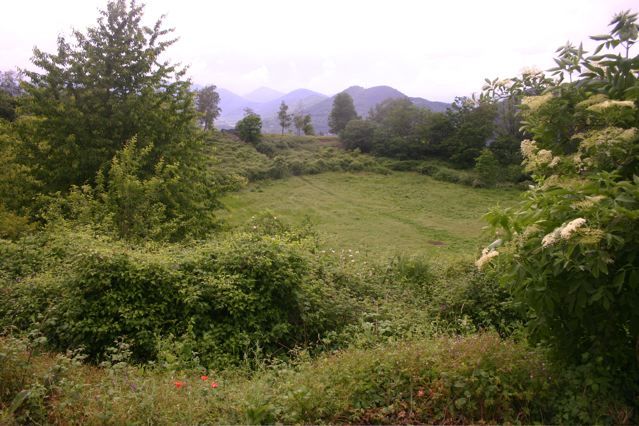
Before going to the conference in Girona on the future of the university, we spent a few days in the Pyrenees (Pireneus in Catalan), mostly in Garrotxa county (camarca) and in Vall de Sau Collsacabra. Collsacabra is a high plateau in the north-east part of Osona county; it’s also called Cabrerès.

Here are some photos; click on any photo to enlarge it.

from-mas-el-solanotgarrotxa1

Following a night in Barcelona, we traveled north past Vic and Rupit to a beautiful stone house high on a mountainside. You can see here the view from our room in Mas El Solanot. Notice the tabletop mountains and cliffs, as well as architecture going back to the Middle Ages and even Roman times.

We were staying on the edge of La Garrotxa, which is about 1/4 the size of Champaign County in terms of area and population. It looks very different because of its 40 volcanoes and many cliffs, not to mention the medieval architecture, Mediterranean flora, and red tile roofs.

Volca Montsacopavolca

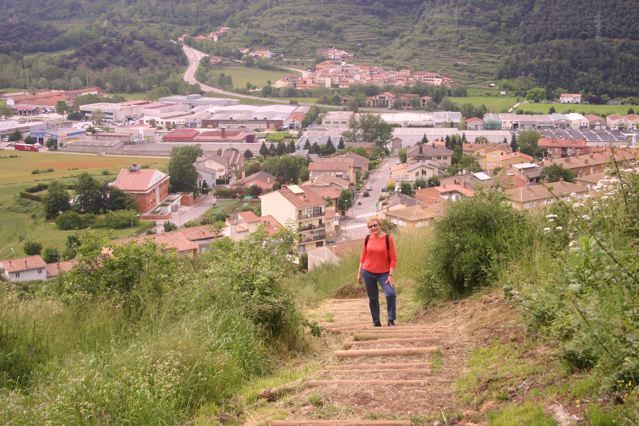
We traveled to many of the volcanoes in Garrotxa. Here we are climbing up to look at the crater of Volca Montsacopa, in the center of Olot.

colades The photo on the left is from the Route of Les Tres Colades, with its spectacular basalt cliffs. It shows the results of the cooling of the lava as it flowed towards the site of what is now Sant Joan les Fonts.

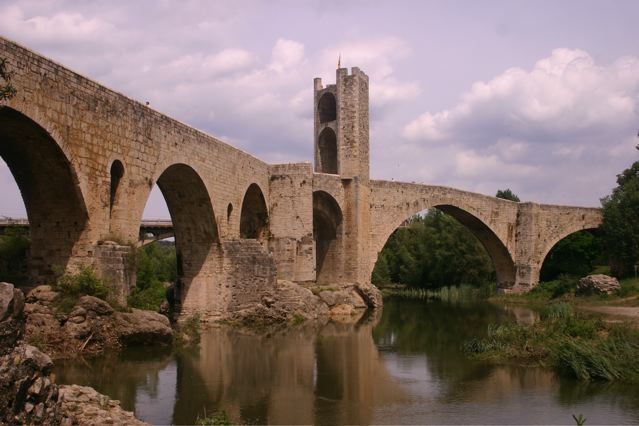
besaluOn the right is a 12th-century Romanesque bridge in Besalú with a portcullis in center. It was partially destroyed during the Spanish Civil War, then rebuilt in the 60’s.

rupit A view of Rupit and the nearby Salto de Sallent, a 100-meter waterfall. The photo below shows a cascade upstream from the main fall. There was an iron cross embedded in the rock, presumably marking the spot where someone had come too close to the edge. I decided not to go up closer to investigate. But it was impressive to see that the unpaved road crosses the stream above the main fall, going through six inches of water just a few feet from the 100-meter drop.

salto-sallentsalto-sallent1

girona girona2

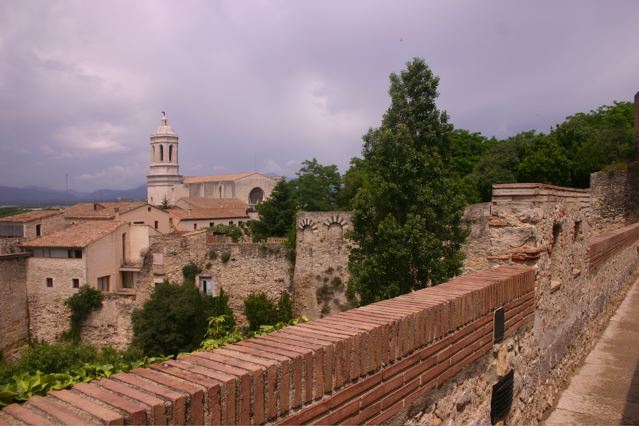
Scenes from Girona, where the conference was held. The cathedral perches on a hill in the center of the beautiful old town (Barri Vell), which lies just across the Onyar River

The student as the axis of change in the university

Univest 08 I just returned from the Univest 08 conference: The student as the axis of change in the university, which was held on June 2-3 in Girona, Spain. There were excellent presentations and discussions, for me aided considerably by simultaneous translation from Spanish or Catalan into English.

I thought that it worked very well to have students respond to the major presentations. It’s also hard to think of a more pleasant place to hold a conference than Girona, with outstanding restaurants, a beautiful old city, large parks, rivers, and great museums.

Girona wall, cathedralOne motivation for the conference was the European Convergence Process, a scheme to make Europe competitive with the United States in tertiary education. Beginning in 2010, more than 40 European countries will participate in the European Space for Higher Education, in which students, professors, and researchers will be able to move about without borders.

img_73581The aim of the process, which began in 1999 in Bologna is to produce a higher-quality, more homogeneous system, which is also more competitive in its teaching methods. A hope is that it will help build a society based on European knowledge, manifesting in culture and education the convergence that is already underway in the political and economic arenas.

The conference brought together teachers, students, administrators, and people from government and industry around topics, such as:

  • Student-centered instructional planning
  • Learner self-regulation
  • Student supervision and tuition
  • Student participation in university life
  • Experiences outside the classroom

My own talk was on student-centered learning, particularly on helping students by getting them to focus not on themselves, but instead on their communities.